Sociology
The Joker and the November Events: A Symposium
A screening and discussion of the film Joker was held under the title 'Joker and the Events of Aban,' featuring talks by thinkers including Bijan Abdolkarimi and Mohammad Hossein Badamchi. The session examined the relationship between the film's themes of humiliation and nihilism and the Aban protests, as well as the boundary between individual and collective action within it.
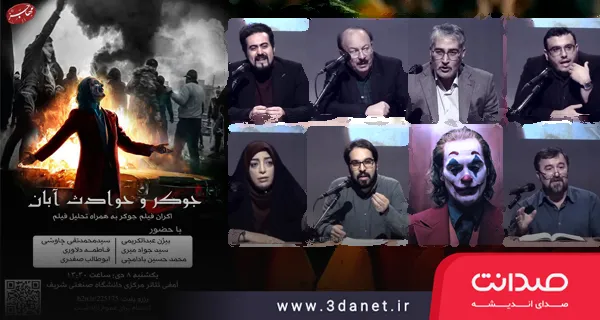
Screening of the film Joker at the symposium “The Joker and the November Events,” with lectures by Bijan Abdolkarimi, Seyed Mohammad Taghi Chavoshi, Seyed Javad Miri, Mohammad Hossein Badamchi, Fatemeh Delavari, Aboutaleb Safdari, and Aydin Ebrahimi, at the central amphitheater of Sharif University of Technology
The film Joker has so pleased cinema lovers that it is discussed in almost every gathering. Of course, the discussion and conversation about it were not limited to cinematic circles, and given the popular protests in various countries, it quickly took on other dimensions, with sociologists and social science faculties also taking it up, and many analyses and behind-the-scenes accounts being told and heard about it.
The screening and analysis program for the film Joker at Sharif was organized by the Mohajer Strategic Think Tank on December 29th at the central amphitheater. In fact, with this program, Mohajer made a glorious return to the university’s student scene and once again heralded its good programs and publications to the Sharif community. Ticket sales for this program were conducted both online and in person, and the orderly ticket sales and adherence to the predetermined schedule were among the strengths of this program. Also, despite the program being paid and its long duration, a considerable crowd was present in the hall, watching Joker and listening to the speakers talk about it.
The Arthurs of Society Can No Longer Tolerate
At the beginning, Mohammad Hossein Badamchi considered Joker a product of humiliation and laughter the best way to confront it. Then, pointing out that our society had become a society of perpetual winners over the past ten years, he stated that excluded human beings, like Arthur in the film Joker, can no longer present themselves as normal and are in need of rebellion. Then, referring to the difficulty of the activists’ situation in the current era, he sees the path to liberation in the present circumstances in the intervention of these very activists.
A Joke Called Life
Dr. Abdolkarimi considered the most prominent dimension of the film to be philosophical and metaphysical, and found Joker to be a symbol of the human being in today’s world, for whom there is no boundary between laughter and tears. In his words, Arthur is intensely lonely and hopeless, and every attempt he makes to escape loneliness leads to failure, and due to the atomization of individuals in society, the political becomes impossible. In Abdolkarimi’s view, the central core of the film is nihilism, and in the film Joker, life is, in fact, a joke that is not at all funny. Of course, Dr. Abdolkarimi distinguished the nihilism of this film from the nihilism of Sadegh Hedayat, because this Joker-esque nihilism also encompasses all strata of society, including the poor. He continued that this film, contrary to the claim of intellectuals who consider the present age to be the age of enlightenment, depicts the future as hell. Pointing to the similarity between political systems calling protesters clowns in the film and calling protesters rioters in the November events was among the notable points of his speech.
The Victim Is Not a Hero
Dr. Ebrahimi critiqued the film from a completely different angle, and by stating the point that in the film, the victim has become a hero, he expressed the aim of his talk as unveiling the false image constructed by this film. In fact, he believed that this film lacks a worldview and active nihilism, meaning that Joker introduces himself as a hero in the film but lacks any kind of collective project, which in fact creates a rupture between the human being and the real world.
A Film Full of Symbols
Dr. Miri, referring to Western and theological symbols, introduced this film as having strong symbols: violence, the deplorable social situation, completely pervasive institutions, anti-capitalist class sentiments, and the mask for realizing one’s own agency. From Miri’s perspective, Arthur is born of corruption in the powerful layers of society who are capable of doing anything, and in the film, there are clear contradictions between different classes of people, for example, a group in the cinema watching a film and a group outside the cinema protesting. Then Dr. Miri, referring to the film’s sequences, examined the process of Arthur’s transformation into Joker. He also considered thought and logic to be two essential elements for analyzing the country’s current events.
Humiliation That Creates Jokers
Dr. Chavoshi, with humility and a relatively lengthy preamble, expressed his view on the film's subject. Stating that to examine anything one must distance oneself from it, Chavoshi explored the concept of truth. He then presented a historical-philosophical perspective on humiliation, and finally noted that the Joker attained his joker status through humiliation. Regarding the recent events, he also expressed hope that the government would set aside humiliation, as the only path to peace is to abandon resentments.
The Joker Is Not Anti-Capitalist
Fatemeh Delavari, noting that the Joker hallucinates all his desires, examined his illness from a Freudian/Lacanian perspective. Then, emphasizing that first, the Joker's rebellion leads to the superhero of the capitalist world, namely Batman; second, every action by the Joker meets with failure; third, the consequences of a Joker-like rebellion are insecurity; and fourth, the Joker's actions were not political, she rejected the anti-capitalist nature of this film. She then examined the Joker's illness from the Deleuzian perspective, which stands in opposition to the Freudian/Lacanian view, and introduced him from this angle. Also, referring to governmental and non-governmental perspectives on the November protests, as well as their protest nature, political character, and non-individualistic quality, she stated that there is little resemblance between the Joker and the protests; in fact, the Joker is eliminated individually, whereas the people of November are eliminated systematically.
The Meaningless Life of the Jokers
After Fatemeh Delavari, Aboutaleb Safdari took the stage as the final speaker. He presented his critique from a philosophical and psychological perspective. Safdari introduced the Joker as a symbol of the people of this era, in that both are trapped in a paradoxical situation, in their own loneliness and meaninglessness; indeed, the Joker's loneliness is so profound that he shares his sorrow with a cold, dark, and unfeeling refrigerator. It was then stated that committing murder and trying to become a comedian are the Joker's attempts to construct meaning for his existence. He continued that after the failure of these methods for a meaningful existence, the Joker finds meaning in taking risks. In fact, the Joker is not seeking advancement through bread; he is seeking to make his existence meaningful.
.
.
Lecture by Mohammad Hossein Badamchi
Watch on Aparat | Watch on YouTube
.
Lecture by Bijan Abdolkarimi
Watch on Aparat | Watch on YouTube
.
Lecture by Aydin Ebrahimi
Watch on Aparat | Watch on YouTube
.
Lecture by Seyed Javad Miri
Watch on Aparat | Watch on YouTube
.
Lecture by Seyed Mohammad Taghi Chavoshi
Watch on Aparat | Watch on YouTube
.
Lecture by Fatemeh Delavari
Watch on Aparat | Watch on YouTube
.
Lecture by Aboutaleb Safdari
Watch on Aparat | Watch on YouTube
.
.
The Joker and the November Events
Screening of the film Joker 2019 with film analysis
Text source: Sharif University of Technology Newspaper
Organized by Mohajer Strategic Think Tank | Sunday, December 29, 2019 | Film screening from 13:30 to 15:30; film analysis from 15:45 to 19:00 | Central Amphitheater, Sharif University of Technology
.
.




Discussion2 comments
تحلیل همه اساتید محترم در مورد فیلم (جوکر) خیلی خوب بود. به نظرم شخصیت (جوکر) به نوعی نماینده گروهی از افراد در سطح جهان است که دچار تعارضات درونی و بیرونی در وجودِ خودشان هستند. هر انسانی در وجودِ خودش به دنبال (حقيقت) و (معنای حقیقت) می گردد. شخصیت جوکر هم مانند همه انسانها به دنبال( حقیقت) است. اینکه واقعاً (حقیقت) چیست؟ کجا باید دنبال حقیقت و معنای حقیقت بگردیم؟ آیا حقیقت مطابق با واقعیت در امر بیرون از ماست؟ اگر اینگونه است,چرا شخصیت (جوکر) دچار مشکلات عدیده می شود؟ جوکر با افرادی روبه رو می شود که به جای کمک کردن به او, او را به نوعی فریب می دهند.این تعارضات در وجودِ جوکر منجر به خنده های هیستریک می شود. در زمانی نه چندان دور حقیقتِ مطلق ( خداوند) بود.انسانِ امروزی علیرغم همه ادعاهایش در همه عرصه ها, دچار تعارضات درونی فراوان است. چراکه( حقیقت) را در بیرون از وجودش دنبال می کند...
سلام اندیشمندان و هنرمندان آمریکا هم قهرمان پروری می کنند و هم قهرمان سازی. ما چه می کنیم؟؟ یک قهرمانِ میهن جان خود را جهت حفظ مرزهای غربی این کشور از دست داده و سایت شما هیچ مطلبی راجع به او منتشر نکرده است. انتقاد مرا بپذیرید و آن را نشر دهید. باتشکر