Sociology
The Marketised University and the Academicised Market
Turning universities into economic enterprises and diploma factories makes the market for buying and selling theses seem natural. As long as the university is a marketplace, this market will persist, and only knowledge suffers.
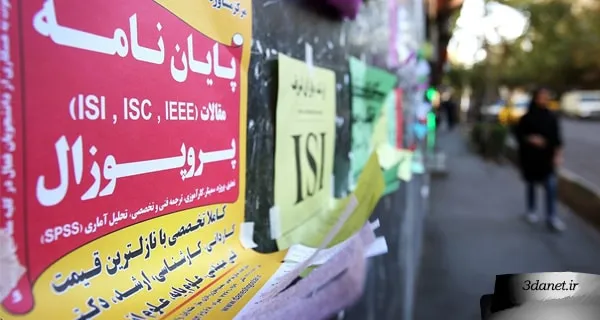
In the second half of Shahrivar, the spectre of the thesis descends upon students like a nightmare. Even on the hot days of summer, the market for dissertations and theses is thoroughly heated. That day, Enghelab Street was in an uproar. Cards, notices, signs, advertisements, and whatnot were abundant and widespread. Along the route, people stood in rows, shouting at passersby and reeling in customers. Despite trying to flee from them, more than ten people stopped me and said, “Don’t you have a thesis? We’ll do it for you in a week!” I would get rid of them by saying I wasn’t a student at all. A week?! God forbid a week! But it seems this rogue’s market will only prosper more day by day.
Of course, last year one of the country’s officials stated that their precise and extensive investigations had led to the discovery of the fact that the hidden hands of certain foreign countries and the behind-the-scenes agents of some external enemies are the cause of this deplorable and dangerous situation. Their aim is also to obstruct the country’s scientific growth and progress, to prevent us from reaching the peaks of science and truth. Although I am not informed about the state of all sciences and academic disciplines, thank God that the country’s universities have made no growth or progress whatsoever in the humanities, especially philosophy, and have thereby been able to thoroughly sever the contaminated hands of these microbes and monsters from the realm of the nation’s science. Other sciences and technologies should also take the humanities as their model in this regard, so they can thwart the agents of the arrogant powers from plundering the science and truth of the universities. The humanities have many lessons for everyone and are truly pioneers. Let us return to Enghelab Street. Reality is in the street.
It needs no explanation that this complex phenomenon has various dimensions. Here, I will look at it from an economic perspective. My claim is that this market is entirely natural and its growth cannot be stopped in any way. I have a reason for this claim. This reason consists of two premises.
First, I do not think anyone who has set foot in a university would disagree with me on this issue that universities have turned into markets. Academic units at all levels have taken on a completely commercial function and have practically become economic enterprises. Some universities can be considered chain factories. Conventional factories produce chips, puffs, biscuits, ice cream, potatoes, sweet pastilles, and spicy, fiery crunchies, and these university factories produce various degrees with titles such as: Associate’s of Wisdom, Philosophy Technician, Bachelor’s of Epistemology, Engineering of Religion, Doctorate of Islamic Numbers, and many real and virtual degrees of such and such a kind. The university apparatus, with all its complex system and various factors, seeks to generate income and profit. Presidents, officials, professors, faculty members, and so on, seek to obtain more money through this means.
The second premise is that an economic institution leads to the formation of other economic institutions. An economic institution is not, and cannot be, a closed, self-contained matter; it cannot merely be itself and have no connection with anything. An economic institution has economic requisites and consequences. Every market creates peripheral markets. For example, if a large market for providing household needs emerges in an area and draws families there for their shopping, naturally, taxi agencies, kebab shops, sandwich shops, and so on will also appear around it. A little further away, a repair shop for the taxis will open, and so on. Now, even if we do not believe in the invisible hand of the market, like some classical and modern economists, at least it is certain that the rules and norms of the market are not conventional and cannot be turned upside down at will. Rather, it is the market that turns us and our lives upside down. Douglass North (1920-2015), Nobel laureate in economics and the father of institutionalism, says: “Institutions are all the rules that direct the behavior of actors. Institutions are the rules of the game among economic, political, and social agents and the constraints that shape the exchanges and interactions of these agents.” In a word, it is the rules that are decisive, not names and formalities.
The situation with universities is no different. In fact, what has taken shape is not a scientific institution but a vast economic marketplace where some sell degrees and many are buyers. It is natural that these economic behemoths create markets around themselves. But these gentlemen either lack a proper understanding of economic mechanisms or they want this booming business to be exclusive to them and these astronomical profits to be theirs alone, and they become upset if anyone takes a morsel from this wide-spread feast.
Unfortunately, this matter is not specific to a particular group. Some professors are also complicit in the issue of theses and dissertations. For example, the fee for a doctoral dissertation for the supervisor is a considerable sum. This is while the supervisors do not even bother to exercise their jaw muscles and move their mandibles so that the wretched student might know what on earth to do. The practice has become that the professor commands: write the complete dissertation and bring it! The situation of the advisory professors and examiners goes without saying. In the end, the defense session is held without it having been read. Neither does the student understand what they have written, nor do the professors know what has transpired. But the result satisfies everyone. The student obtains the degree, and the university and professors get their promotion, money, and other things. The relevant ministries and massive institutions are also pleased; because the end of all this setup is the presentation of figures and statistics regarding the impressive research achievements of academic centers, which leap and increase by tens of percent year after year. And in the end, all those achievements (theses and dissertations) are buried as ones and zeros in electronic systems. In this process, only science and knowledge are harmed. But what are science and knowledge anymore?! The reality is the degree; degrees that are issued without scientific backing. Whereas a degree that lacks a corresponding scientific backing is like a banknote without gold backing. It is nothing more than a piece of paper with great social harms.
As long as universities are marketplaces, academic markets will also remain established and thriving. Just as if universities were truly transformed into genuinely scientific institutions, their requisites and consequences would also be entirely scientific. If these institutes were academic in the true sense of the word, we would witness the emergence of journals, publications, authored works, translations, and many other completely academic things. But for now, these words are a joke, and universities and academics are not joking. Only money is serious. Adam Smith (1723-1790) once said: "Governments compete with one another in no art as much as the art of extracting money from the people." If only he were alive today, he would have added our universities as well.
.
.
The Marketised University and the Academicised Market
Author: Dr. Ali Ghazalifar
.
.




Discussion3 comments
سلام و درود به دوستان گرامی صدا نت. آدرس درست لینک تلگرامی، که در کانال صدانت باید اصلاح شود این است: https://t.me/ThatGoodBook
سلام و درود اصلاح شد
وحشتناک است. تصویری سوررءال! اما همزمان کاملا خیابانی! دست مریزاد! با این تصویر آشنا بوده ایم (بوده ام)، اما بیان تحلیل ورزانه ی دوباره و صدباره ی آن، همیشه تلخیِ راهگشایی دارد. از نویسنده ی جستجوگر این مقاله ی هشدارآمیز بسیار تشکر می کنم. در ضمن، مقاله ی ارزنده ی «تاملی بر کتاب انرژی و عدالت» ایوان ایلیچ به قلم جناب آقای غزالی فر را خواندم. این ایوان ایلیچ است که به موازاتِ بحثِ لزوم کاهش کل مصرف انرژی در جهان (چه فسیلی یا ضد فسیلی آن) می گوید: «درِ دانشگاه ها و بیمارستان ها را ببندید تا نسلی با فرهنگ و سالم تحویل بگیریم.» او حتی منتقد دانشگاه های بظاهر جدیِ هاروارد و آکسفورد و امثالِهم است، چه رسد به کاریکاتورهای کاملا بازاری شده ی دانشگاه در سرزمین های گل و بلبل! بهتر است ایلیچ هم بخوانیم تا به ریشه های عمیق تر هم نگاهی بیندازیم. ایلیچ به نهاد زدایی از آموزش، به «مدرسه زدایی از جامعه» و به شبکه های غیر نهادی و آزاد آموزشی فکر می کند. =========== لینک کانال جناب آقای غزالی فر کار نمی کند. لطفا اصلاح بفرمایید. متشکرم.