Political Science
The Perils of the Third Way: Jurisprudence, Intellectualism, and the Problem of Contemporary Iran in the View of Davoud Feirahi
Davoud Feirahi, a professor of political science, outlines the achievements of religious intellectualism—such as bridging religion and modernity—while examining the movement's perils from a jurisprudential perspective. He identifies the errors of overgeneralization and artificial separation in engaging with fiqh as fundamental oversights of this current.
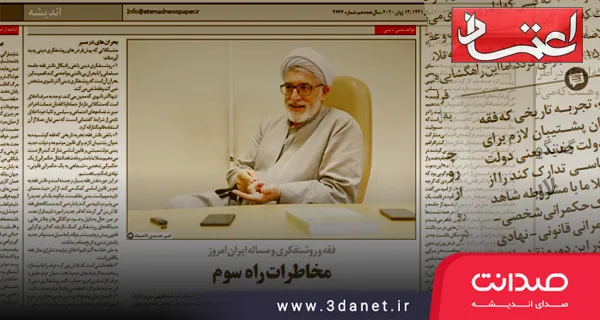
Mohsen Azmoudeh | Religious intellectualism, or religious new-thinking, or modernist religious thought—whatever distinctions one may draw among these three titles—is one of the most important and influential intellectual currents in contemporary Iran. Rightly or wrongly, for better or worse, this intellectual current has been highly influential, especially in the post-revolutionary years, and has sparked various debates and diverse reactions in intellectual circles. Davoud Feirahi, the renowned professor of political science at the University of Tehran and a researcher in the field of political thought, in the following discussion, while pointing to the background and achievements of religious intellectualism, addresses the perils and oversights of this current from the perspective of jurisprudential thought. The newspaper Etemad, and accordingly its Thought page, in accordance with the noble verse, “Who listen to speech and follow the best of it. Those are the ones Allah has guided, and those are people of understanding” (Surah Az-Zumar, Verse 18, Fooladvand translation), deals with the reflection of different views and thoughts with fairness, and while defending freedom of expression, provides this opportunity for all critics to present their reasoned viewpoints and opinions with their own logic and reasoning.
The general formulation of the discussion is as follows; that is, first I will address the definition, necessity, and achievements of religious intellectualism, and then I will discuss the presuppositions and perils of the issues that religious intellectualism has raised, and at the end, I will conclude the discussion by pointing to today's crisis and religious intellectualism.
The Background of Religious Intellectualism
Four intellectual currents constitute the square of our contemporary intellectual history, which are:
1- The current within the state, 2- The intellectual current in the specific sense, 3- The religious current and religious forces, and 4- Religious intellectualism. In the present discussion, I will address the fourth current, namely religious intellectualism. Religious intellectualism as an intellectual current gradually took shape from within the interactions of the Islamic world over the past two centuries and in Iran, especially since the Naseri era, has become one of the most decisive driving forces for the reform of religion, politics, and society. The roots of this current can be traced back to before Seyyed Jamal al-Din and within the state to figures such as Mirza Farrokh Khan, Qa'im Maqam Farahani, Amir Kabir, Mostashar al-Dowleh, and others. Today, this current is known as the third way, which has produced specific concepts and a particular geometry. In summary, this current is one of the most influential intellectual currents of the last 150 years. The most important and principal concepts that religious intellectualism has produced can be summarized in the following cases:
1- The separation between tradition and religion: In the literature of European intellectual history, there was always an attempt to equate religion with tradition. In the literature of our religious intellectualism, we witness this very important separation between tradition and religion.
2- The separation between modernity and the West, or between modernism and Westernism, or between modernism and Westernization, which religious intellectualism was both the initiator and developer of.
3- The very important effort to link religion and modernity.
In the present discussion, given my own specialization and interest, namely political thought, I will try to discuss this third aspect more in the realm of new governance. These three aspects or efforts have created important achievements.
The Achievements of Religious Intellectualism
1- Critique of the existing state of religiosity: Religious intellectualism tried to mobilize a religiosity that had largely turned inward and suffered from isolation and “ghettoization.” That is, the critique of the institution of religion and especially the institution of the clergy is one of the good achievements of religious intellectualism.
2- Critique of the presuppositions of religious sciences and seminary sciences: Religious intellectualism criticized religious rulings and propositions and applied precise benchmarks.
3- Proposing the duality of the concomitance of religious despotism and political despotism: That is, religious intellectualism for the first time confronted the idea that if we witness political despotism in society, it has a connection with something within the religious seminaries. Consequently, religious intellectualism directed society's attention to the necessity of religious reform as a prelude to political reform.
4- A two-sided critique of religious fundamentalism and radical secularism.
5- The endeavor to find a criterion of efficacy and to evaluate religious rulings and propositions: Based on this criterion of efficacy, religious intellectualism for the first time critiqued the duality of legitimacy and social acceptability or efficacy, and put forward a very important idea, showing that, after all, a tree must be known by its fruit, and consequently brought religious theories into competition in the domain of efficacy.
6- Desacralization of religious literature and religious institutions, and proposing a kind of accountability from religious institutions: Intellectualism showed that religious institutions must respond to social ills and political expectations and be responsible.
7- Critique of religion from the perspective of law and ethics: This point, in my view, is the Achilles' heel of religious intellectualism.
The Perils and Oversights of Religious Intellectualism
Religious intellectualism was successful in critiquing the presuppositions of religious propositions, but it has paid less attention to and subjected its own presuppositions to critique. This has caused us to face certain crises today, the solution to which may lie in present reminders and critiques. Therefore, in the second part of this discussion, I will try to address the thought-provoking presuppositions and perils of religious intellectualism. In jurisprudential literature, it is said that one who benefits from something must also accept its loss. The reception, proximity, and grandeur that religious intellectualism has enjoyed, and still does, goes back to its efforts and path-breaking contributions. But these path-breaking contributions have sometimes also created blockages, which I will address below.
Several Fundamental Oversights of Religious Intellectualism
From the Angle of Jurisprudential Discussions
Religious intellectualism rightly stands in the middle of the two worlds of tradition and modernity, or religion and secularism, meaning it can be a double-edged sword, or the reverse. Intellectualism became so immersed in the struggle with secularists and materialists on one side, and seminary and traditional forces on the other, that it neglected the reconstruction of its own discursive system.
1- The error of generalization: Looking at the history of Muslim life, we find that we are the inheritors of the Greek classification of sciences. The Greeks divided sciences into theoretical and practical, or phronesis and techne, and said that philosophy or practical wisdom governs the practical life of people. Muslims had replaced the practical sciences of the Greeks with jurisprudence (fiqh). As a result, the discipline of jurisprudence traditionally flourished from the very emergence of Islam and assumed the responsibility of administering society and governance in all domains, especially in the political domain. It is natural that the discipline of jurisprudence had many errors and mistakes. One of them was the challenges it encountered in the face of modern governance, from within which a series of radical propositions against law and modernity emerged. Given these errors and the marginalia of the jurisprudential apparatus, religious intellectualism was drawn from the rulings of jurists to the negation of the very foundation of jurisprudence. This is while from within philosophy, too, many errors and mistakes have emerged, such as the closed society, fascism, Nazism, communism, and capitalism, yet no one has blamed the errors of philosophers on philosophy itself. Our religious intellectualism, however, made this generalization.
2. The Error of Separation: Religious intellectualism, for the first time, made a particular judgment about jurisprudence, declaring that jurisprudence is confined to obligations and setting it in opposition to law. In other words, it claimed that jurisprudence consumes or has consumed law. Yet, considering the structure of jurisprudential knowledge and its historical experience, we find this not to be the case. In the internal classification of jurisprudence, we divide it into acts of worship and transactions in the broad sense, or into acts of worship, transactions, and politics. The reality, however, is that all the rulings in the transactions section of jurisprudence are legal propositions and rulings. That is, a large part of the jurisprudential apparatus pertaining to transactions is of the nature of law and contract. Our historical experience also shows that during the Constitutional Revolution, jurists attempted to extend the private-law discussions of jurisprudence into the public sphere and offer a legal and contractual interpretation of the constitutional state, thereby presenting a contract- or transaction-based understanding of the constitutional state. In the writings of the late Akhund Khurasani, the late Naini, and the late Mahallati, we see them striving to extend the legal concepts latent in the domain of private jurisprudence into the domain of public law and to discuss constitutionalism from the perspective of trusteeship, proprietary trusteeship, contract, and the implications of contract. For instance, the Constitution, the treatise Tanbih al-Umma, the treatises of the late Mahallati, the telegrams of the late Akhund, the constitutional law books of Foroughi, father and son, the constitutional law of the late Mostafa Khan Adl, and the collection of the First Parliament’s deliberations all speak of the relationship between jurisprudence and law. Meanwhile, religious intellectualism, by labeling jurisprudence as anti-law and separating law from it, and by asserting that the modern world is a world of law, decreed the rejection of jurisprudential knowledge.
3. Jurisprudence and Ethics: Some of our religious intellectuals have set a condition, saying that even if we accept jurisprudence, it must be measured against the touchstone of ethics. The essence of this argument is sound, but it has two very fundamental technical flaws. Friedrich Nietzsche, the German philosopher, in his book Beyond Good and Evil, says that the knowledges of a civilization or a historical epoch are so fundamentally interconnected that they cannot be separated from one another and are akin to blood in the body. Thus, whichever organ of the human body we draw blood from, the characteristics of that blood are the same. The ethics and law of Islamic civilization are also of a single substance and cannot be separated from one another, nor can an absolute status be granted to ethics. Our religious intellectualism has a presupposition, claiming that ethics is universal, global, and based on equality and freedom, and that everyone can comprehend and understand it. But a study of the history of ethics shows how much these very Greeks, the founders of ethics and civic ethics, spoke of natural slavery. Consequently, it is not the case that ethics possesses an absolute criterion. Jurisprudential propositions are inseparable from ethical propositions in the Islamic world. Separating ethics from the totality of the Muslim system of knowledge, or episteme, or discourse is scarcely possible, and in Islamic civilization, ethics and law cannot be separated.
4. The Radical Foundationalism of Religious Intellectualism: Religious intellectualism has greatly neglected practical sciences such as political thought. Recently, however, Dr. Soroush has returned to the discussion of religion and power, which contains some good points, although his lectures have a cursory, overview-like quality and are addressed to a general audience.
But on the whole, this subject itself is auspicious. However, radical foundationalism—that is, focusing on fundamental issues such as revelation, monotheism, and matters related to the afterlife while neglecting practical sciences like jurisprudence, the relationship between jurisprudence and law, the relationship between jurisprudence and politics, and so on—has led to the emergence of problems. I will point out some of these problems below.
Crises Along the Path
Problems that the presuppositions of religious intellectualism have created:
1. By radically negating jurisprudential knowledge, religious intellectualism confronts Muslim society with a crisis of ignorance. The significance of this crisis lies in the fact that religious intellectualism does not specify an alternative; it merely negates.
The only alternative it designates is a sole focus on ethics, which has its own problems, including, firstly, the lack of enforcement guarantees in cases of social and political conflict, and secondly, ethics itself is a function of discursive conditions and cannot practically be used in a legislative manner.
2- By negating the knowledge of jurisprudence (fiqh), we lose the historical experience that jurisprudence has tried to provide as a necessary support for statutory law and the new state, that is, the state based on constitutional law. For instance, with the Constitutional Revolution, we witness the transition of governance from a personal-oral governance to a legal-institutional (written) governance.
In this period, the role of jurisprudence is very prominent, and the knowledge of jurisprudence helps in drafting the constitution. From this perspective, the puzzle of endorsement is important. That is, how the system of tradition accepts and endorses a new matter, or rejects it. The apparatuses of jurisprudence made great efforts to endorse the new matter. At the same time, due to the existence of dualities and challenges, the intellectual apparatuses did not help this jurisprudential modernism to advance and to be more of a link between tradition and the new matter, or between religious texts and our contemporary history.
In summary, the alternative of ethics needs a charge like jurisprudence or law.
3- Jurisprudence is a knowledge that tried to establish custom (ʿurf) and especially to support new customs under the title of precise custom and today's expert custom. Religious intellectualism neglected this aspect, that jurisprudence can support custom.
4- The discourses of religious intellectualism created a kind of crisis in the realm of doctrinal principles and gradually injects a kind of social nihilism into society and the youth, and on the other hand, sharpens the sword of takfir (excommunication) wielded by traditional forces. That is, by creating a sharp contradiction with the foundations of religiosity and by attacking the institution of the clergy, the institution of religion, and historical religiosity at the root of religion, religious intellectualism causes the weapon of defense to be taken from many individuals and institutions, driving them to silence. With the elimination of moderate forces, the contradiction between traditionalists or religious fundamentalists and religious intellectualism increases, and the tactic of takfir is strengthened.
5- Crisis of influence: With the deep foundationalism it acquires, religious intellectualism not only loses its scope of influence but also suffers a crisis of influence within religious institutions; that is, it weakens those forces of jurisprudential modernists who could, by relying on religious intellectualism and its achievements, advance new thinking in this field. These are problems that particularly trace back to a very specific understanding of the opposition between jurisprudence and law, and the opposition between jurisprudence and ethics. We have many treatises from the Constitutional period onwards that, without distancing themselves so much from jurisprudential frameworks, discussed under the title "Treatise on Right and Ruling" (risāla fī al-ḥaqq wa al-ḥukm), meaning treatises on right and ruling. By ruling (ḥukm), one can understand obligation (taklīf). These treatises tried to show how jurisprudence pays attention to rights and, from this angle, defends constitutionalism and the new states. Religious intellectualism ignored these points.
Necessities Considering the Problem of Iran
We are path-dependent; in his famous book, Engineer Bazargan spoke of the path traveled and believed that the path determines our destiny. He once said that thinking is like mountaineering, meaning that by traversing each hill, a new vista is seen, and so on... etc. Now, too, we are at a stage where we see new horizons and dead-ends facing the problem of Iran. The problem of Iran is tied up with Shiʿism, jurisprudence, religious intellectualism, and other types of intellectualism, such as non-religious intellectualism. The most important issue is to pay attention to the tension-creating contradictions where they cause harm. What is important in my view are these three matters:
1- A renewed attention to the classification of sciences in the Islamic world, and especially attention to the history, potential, and experience that jurisprudence had in administering society. Jurisprudence has both honors and positive aspects (establishing the Safavid state, resolving the Tobacco issue, supporting the Constitutional Revolution, leading the Revolution) and negative ones. Jurisprudence must become agile. Attention must be paid to the capacities, challenges, and potentials of jurisprudence.
2- A reassessment of the relationship between jurisprudence, law, and ethics. In my view, these divisions are problematic; particularly, the separation of jurisprudence from law is problematic, both methodologically and historically. In the 12th session of Religion and Power, Dr. Soroush says that Naʾini does not pay attention to law. My experience is that Naʾini's entire effort is the establishment of sovereign rights, or national rights, or the right of the nation, based on jurisprudential arguments.
3- Attention to the history of contemporary thought, meaning the experience of the Constitutional Revolution and its aftermath, has shown that disregarding the presuppositions of thought—whether in the jurisprudential sphere, the purely intellectual sphere, or the sphere of religious intellectualism—has not had a good track record for us. That is, we have always negated things in the hope of a promised green garden, but because we could not properly delineate the coordinates of that green garden, we lost what we had and did not attain what we did not have. In other words, we are somehow suspended in this situation. Therefore, we must pay attention to jurisprudence, its importance, necessity, history, flaws, and virtues, and reflect upon the divisions between jurisprudence and ethics or jurisprudence and law.
Professor of Political Science, University of Tehran
.
.
By negating the knowledge of jurisprudence, we lose the historical experience that jurisprudence has striven to provide as the necessary support for statutory law and the new state, that is, the state based on constitutional law. For example, with the Constitutional Revolution, we witness the transition of governance from a personal-oral governance to a legal-institutional (written) governance. In this period, the role of jurisprudence is very prominent, and the knowledge of jurisprudence aids in the drafting of the constitution. With the deep foundationalism it acquires, religious intellectualism not only loses its sphere of influence but also suffers a crisis of penetration within religious institutions, meaning it weakens those forces among jurisprudential modernists who could, by relying on religious intellectualism and its achievements, advance new thinking in this domain. These are problems that particularly trace back to a very specific understanding of the opposition between jurisprudence and law, and the opposition between jurisprudence and ethics.
.
.
Jurisprudence, Intellectualism, and the Problem of Iran Today from the View of Davoud Feirahi
PDF file of this text from Etemad newspaper
Etemad newspaper – Issue 4667 – 2020 Saturday 13 June – Page 15
.
.



Discussion5 comments
جوک صدانت : " خطای تعمیم: با نظر به تاریخ زندگی مسلمانی درمییابیم که ما میراثدار تقسیمبندی علوم از یونان هستیم. یونانیان علوم را به نظری و عملی یا فرونسیس و تخنه تقسیم میکردند و میگفتند فلسفه یا حکمت عملی زندگی عملی مردم را اداره میکند. مسلمانان فقه را جایگزین علوم عملی یونانیان کرده بودند. در نتیجه دانش فقه از ابتدای ظهور اسلام بهطور سنتی رونق گرفت و مسوولیت اداره جامعه و حکمرانی در همه حوزهها بهخصوص در حوزه سیاسی را به عهده گرفت. طبیعی است که دانش فقه خبط و خطاهای زیادی داشت. یکی از آنها چالشهایی بود که در مواجهه با حکمرانی جدید پیدا کرد که از درون آن یکسری گزارههای رادیکال ضدحقوق و ضدتجدد درآمد. " چون فقه تابع اوتاریتی psudo- philosophy نبود خطاهای زیادی داشت!! آیا جزمی به این قدرت در جمعی که خود را اهل فکر می داند قابل مطالعه است؟ جزم تجدد و Gospel truth حقوق.
ممنون، تمام جوانب بحث، مورد توجه قرار گرفته بود.
روشنفکری دینی زمانی آش دهان سوزی بود که آن دوره هم بگذشت. بی ثباتی سیاسی این جریان که یک روز در انقلاب فرهنگی حذف میکند یک روز منتقد دیکتاتوری است یک روز بچه شان را میفرستند عربستان پابوس پادشاه تا بورس بگیرد یک روز در مدح سلیمانی میگویند و شاه را می کوبند. شیزوفرنی سیاسی این جریان باعث شده کسی بهش اعتماد نداشته باشد. همان تریبونی برای خودنمایی و گنده گویی داشته باشند خوب است الان دیگر اهمیت یا خطری ندارند.
نقد بسیار عالمانهای بود و نقاط ضعف و تناقضات عجیب روشنفکری دینی را به اختصار و دقیق توضبح داده ذست. ممنون از ارائه ی این نقد. روشنفکری دینی جهل تزیین شده است که شفا نمی دهد و کور می کند درک درستی از سنت و فقه ندارند و ادعای اسلام شناسی آنها هم که به خوبی نقد شده بسیار گزاف و بیراه است. فکر میکنم اگر از اول آنها را طرد نمیکردند و نقد میکردند جوانهایی که هنوز شناختشان کامل نشده بود را گمراه نمکردند.
فقیه مدرسه دی مست بود و فتوی داد که می حرام ولی به ز مال اوقاف است به درد و صاف تو را حکم نیست خوش درکش که هر چه ساقی ما کرد عین الطاف است ببر ز خلق و چو عنقا قیاس کار بگیر که صیت گوشه نشینان ز قاف تا قاف است حدیث مدعیان و خیال همکاران همان حکایت زردوز و بوریاباف است خموش حافظ و این نکتههای چون زر سرخ نگاه دار که قلاب شهر صراف است.