Philosophy
The Possibility of Realizing Ethical Life: From the Impossibility of Kantian Morality to the Opening of Hegelian Ethical Life
The reign of deterministic causality renders ethics impossible. Kant sought to resolve this conflict by separating the realms of nature and freedom, but his formalism led to the impossibility of ethics. Hegel, by transitioning to customary-social ethical life, seeks a path toward ethical openness and overcoming the Kantian impasse.
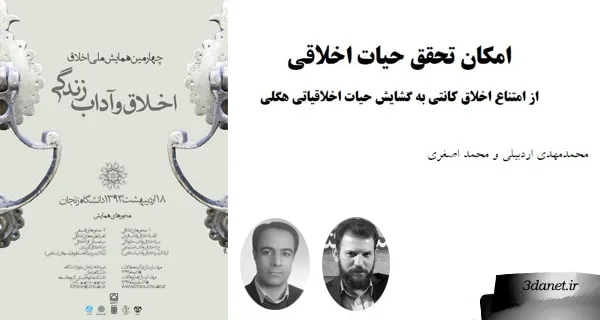
The problem of morality and its possibility has always been one of the difficulties confronting thinkers. In the realm of pure realism, accepting the universal causality governing phenomena logically leads to the destruction of freedom. On the other hand, the first victim of the impossibility of freedom and the dominance of deterministic causality over the world is morality. Therefore, various thinkers in different fields and with different motivations have tried to offer various solutions to defend morality and remove its impossibility. One of the most ingenious of these solutions was Kant's idea, which attempted to resolve this conflict by creating a separation between the realm of nature (theoretical reason) and the realm of freedom (practical reason). But Kant's moral theory was immediately met with various criticisms. Kantian morality, on the one hand, became so entangled in formalism and, on the other hand, distanced itself so much from human desire that in practice, its result was not the creation of the possibility of morality, but rather, through the absolute opposition of the moral law to human desire in Kant, it became another testimony to the impossibility of morality.
The present article attempts, after a brief outline of the problem of morality through the concept of freedom in the history of philosophy and an elaboration of the Kantian response to it (in the Groundwork of the Metaphysics of Morals), by pointing to some post-Kantian reactions to it, to address Hegel's criticisms of Kantian morality and his solution to the problem of morality. In this regard, Hegel's moral philosophy will be examined and analyzed, and finally, an attempt will be made to answer the question of whether Hegel, by elevating morality from the level of individual morality (Morality) to customary-social ethical life (Ethics), can truly move beyond the impasse of Kantian morality and open a path to a new conception of practical and living morality or not.
The Possibility of Realizing Ethical Life
From the Impossibility of Kantian Morality to the Opening of Hegelian Ethical Life
Authors: Mohammad Mahdi Ardebili and Mohammad Asghari
Introduction
Is morality possible? This question remains present in the political-ethical arena. The present article will first attempt, by delineating the relationship between the possibility of freedom and morality in opposition to deterministic and causal reality in the realm of metaphysics, to philosophically analyze the conflict inherent within them that leads to the theory of the "impossibility of morality," and to present the prominent responses to this problem throughout the history of philosophy. Finally, through Kant's innovative idea regarding the possibility of moral freedom in his practical philosophy, it will address Hegel's answer to this question and show how Hegel, by creating a new possibility for freedom, resolves the classical opposition between deterministic reality and voluntary morality and provides a real or spiritual ethical life (Ethics) which, unlike Kantian morality, will only be realized in the form of collective subjectivity.
Morality and Reality
In classical philosophy, reality is the very course of the world—that is, the hierarchical system of affairs that appear in the realm of objectivity. Reality is what the Greeks called physis, and the science of knowing it was later named physics: the ruthless and logical course of all affairs, placed from eternity to eternity in a cause-and-effect order, with no gap or rupture within it. But ethical freedom precisely demands the creation of a rupture in this reality. Ethics wants to disrupt the causal order and arrangement of affairs, to break apart the defective chain of events, and ultimately, within the heart of the deterministic totality of reality, to find a gushing spring of uncaused will—or, more precisely, a black hole—by means of which it can deliver a jolt to the totality and necessity arising from reality. Because of the inherent conflict between these two matters (we call it inherent because the ethics we have in mind is essentially tied to freedom in its traditional negative sense, which is nothing but the negation of a reality based on the order of things; consequently, in the domain of pure and absolute reality, ethics will necessarily become impossible—though at the end of the article, the defense of the possibility of ethics will teach us that any claim by reality to be absolute, unified, or necessary is fundamentally nothing but a deception), the battlefield is always surrendered to deterministic reality through the elimination of ethics. The root of the unconditional defense of reality also has a long historical precedent. The realist myth of “correspondence” has for centuries turned reality into the sole possible criterion of truth. It is in this atmosphere that the claim of the “impossibility of ethics” is raised. When reality governs everything, when reality is the only criterion, then that which is essentially against deterministic and causal reality must either transform itself from within (and become a minimal or resigned ethics) or confess its impossibility and withdraw from the battlefield. Consequently, as long as realism prevails, as long as independent objective reality, with all its attributed causal laws, is the sole source and criterion of truth, something called freedom, and a fortiori something called ethics (in the aforementioned sense), will be impossible.
The Kantian Solution
To solve the above dilemma, one can turn to an ontological analysis of reality itself. In the Critique of Pure Reason, Kant endeavors to determine the limits of human knowledge. There, he makes his famous distinction between the thing-in-itself and the appearance. The domain of theoretical reason, for Kant, is the domain of phenomena, and the sole law governing it is natural causality. In this domain, there is no possibility for freedom, and in Kant’s terms, any constitutive claim regarding the existence of a kind of freedom beyond natural causality is nothing but a transcendental illusion. As far as the present discussion is concerned, the phenomenal domain is the domain of pure reality, where everything is causally pre-formed—whether it exists independently outside us or arises from the application of the categories of the understanding to the world of appearances. In such a domain, freedom is not possible, and consequently, there is neither any news of ethics within it nor any news of ethical life in the sense of the collective subjective domain of freedom. But Kant, unlike many of his successors and predecessors, does not remain within this domain. He also proposes the possibility of a kind of non-natural causality that makes freedom possible. Although speaking of freedom within the limits of pure reason is an illusion, the domain of practical reason is to be founded entirely upon the free and autonomous subject—a subject that derives the criterion for the imperative of its action neither from natural causality nor even from external criteria and sources of power—whether outside itself (spatially external) or outside the world (transcendent)—but is itself its own lawgiver. Kant resolves the problem of the conflict between law and freedom—a problem that is essentially liberalist and based on the negative definition of freedom as “the removal of all limitation”—with the device that ethics is a positive concept, and consequently, the free, self-legislating subject’s obedience to the law is identical with freedom, because this subject is autonomous and derives the criterion for its action from its own practical reason. This idea can be considered Kant’s Copernican Revolution in moral philosophy:
No one before him had said that reason might be a cognitive and desiderative faculty of such power, enabling us to judge and act autonomously—that is, in complete obedience to “one’s own law.” Attributing such a power to us is equivalent to attributing a freedom and agency to us that is just as fundamental… In this way, Kant attributes to us a freedom and agency deeper than what anyone before him (and many after him) had thought possible. (Sullivan, 1380, pp. 179-180)
In this sense, Kant advances the “problem of morality” a step further by offering his innovative definition of the positive freedom of the self-legislating subject. Yet, for all that, Kant himself becomes entangled in new dilemmas from which he is theoretically unable to extricate himself:
a- To avoid falling into a kind of relativism arising from experience, this practical reason is compelled to transform itself into such a deontological formalism that it can (following Lacan) be linked to a kind of ruthless sadism. A morality that commands in the most merciless way possible and manifests itself only in the form of an “imperative”: “This rule is a kind of imperative, that is, a rule accompanied by the predicate ‘ought,’ which expresses the objective necessitation of the action” (Kant, 1385, p. 35). The main cause of this formalism is that Kant, in order to defend the certainty of the moral law, is forced to grant it a kind of independence and self-sufficiency separate from the objective world. For example, the first law is that I must act in such a way “that I could also will that my maxim should become a universal law” (Kant, 1369, p. 27).
In fact, the fundamental principle governing Kantian morality is the internal non-contradiction of a law in its universalization, and consequently it leads to formalism. But Kant, on the other hand, tries to escape formalism, and for this reason, Kant here faces a kind of contradiction that Hegel also specifically points out. “On the one hand, if the non-contradiction test is entirely formal, it is not clear that failing this test has any moral significance ... On the other hand, this test measures a content against itself, because in that case it has already presupposed a moral content as part of the test, whereas it should determine right and wrong through the test. Therefore, such a test will not be entirely formal” (Stern, 2002, pp. 131-132).
b- To avoid a morality derived from anthropology, and consequently to avoid moral pluralism, Kantian morality, by setting the law in opposition to every human inclination and desire, proceeds toward an inhuman, and perhaps even anti-human, morality. It can be claimed that, in Kant’s view, if by acting upon a moral law, even the entire human race were to be destroyed, this would not in any way impair the essence of the law itself or its validity. Kant himself has no qualms about presenting his morality as inhuman and even explicitly considers it applicable not to human beings, but to any rational being.
c- Kantian morality is a timeless and spaceless morality, as if situated in a vacuum, which Kant can extract a priori from practical reason itself prior to any experience. Hegel counts this Kantian test of universalizability as a sign of formalism and the establishment of a kind of history-less and timeless morality, and likens it to a swimmer who wants to learn to swim before entering the water. In the Groundwork of the Metaphysics of Morals, Kant also strongly warns against the mixing of experience and law, claiming that
the empirical element is not only incapable of assisting morality but even greatly harms the purity of morals. For the proper and immeasurable worth of an absolutely good will lies precisely in this: that the principle of action is free from all influence of contingent grounds, which only experience can furnish. (Kant, 1369, p. 69)
But in Hegel’s view, to swim, one must enter the water from the very beginning and commit oneself to history. For this reason, in the Phenomenology of Spirit, he draws the various stages of morality from the heart of culture and literature: pleasure and necessity from Goethe’s Faust, the madness of self-conceit from the character of Karl Moor in Schiller’s play The Robbers, the solitary knight of virtue from Cervantes’ Don Quixote, the struggle between divine law and human law in Greek ethical life from Sophocles’ Antigone, and other similar examples. Thus, for Hegel, casting the human being into the heart of history, and exiting the untroubled and error-free heavenly paradise, has the fruit of making morality, politics, and freedom possible. In Inwood’s words, “Hegel describes the myth of the Fall as an ascent, not a descent; for the Fall entails the acquisition of knowledge of good and evil, which is a necessary condition for goodness, not innocence” (Inwood, 1388, pp. 403-404).
d- Although the source and criterion of Kantian morality appears to be a kind of independent practical reason, in practice, due to the lack of self-evidence and sufficiency in discovering the moral law, the inadequacy of Kant's methods for testing the moral principle, and ultimately its dependence on a kind of personal analysis or judgment, this pure practical reason is reduced to a sort of individual conscience that determines it, and thus Kantian morality practically becomes something subjective.
e- Although Kant claims that "in the end, reason is one, but its applications differ" (Kant, 1369, p. 9), and despite attempting in the Critique of Judgment to build a bridge between practical and theoretical reason, he ultimately remains in a kind of two-world dualism and, in this sense, is incapable of reconciling reason with reason. This is one of the most serious criticisms Hegel levels against Kant. Unlike Kant, Hegel "rejects any approach that believes there are two [separate] worlds, an empirical world and a supersensible world accessible only to reason, a world of freedom and another governed by causal necessity, or a world of values and another of facts" (Inwood, 1983, p. 477).
The above discussions show why Kant is ultimately incapable of making morality possible, especially in its collective and emancipatory sense, and will finally be forced to abandon collective subjectivity and base his morality on individual conscience and his politics on defending the necessity and legitimacy of government.
From Kant to Hegel
Freedom is also Hegel's concern, but perhaps his primary problem and preoccupation. "All scholars agree that in Hegel's political theory, no concept is more important than the concept of freedom. ... Freedom, in Hegel's eyes, is the foundation of right, the essence of Spirit, and the end of history" (Beiser, 1391, p. 320). Hegel considers the ultimate end of all world history, the end of Spirit's development through the various stages of consciousness, to be the realization of freedom. "The end of the world Spirit in world history ... is the attainment of the gift of freedom" (Hegel, 1385, p. 77). Hegel accuses Kant of remaining stuck at the level of individual morality (Moralität) and, for this reason, being incapable of the objective realization of ethical life (Sittlichkeit). Hegel, however, on the one hand, through the innovative and revolutionary concept of "Spirit," seeks to negate the duality of practical and theoretical reason within the sphere of Spirit and, supported by the positivity of his dialectic, to preserve and redeem both forms of reason within the heart of "Absolute Spirit." On the other hand, he knows that freedom is essentially a universal and collective category, and for this very reason, he moves from individual morality (Morality) to collective ethics (Ethics) and considers the freedom of a single individual to be possible only through the freedom of all individuals, the entire world, and, in a word, the realization of Absolute Spirit. In Plamenatz's words, "Man cannot be free outside society, because it is within society that he acquires ends which he rationally pursues, and it is also within society that man can conceive of and demand freedom" (Plamenatz, 1367, p. 169). Or, a little later, he writes, "The free man is only the man who, as a member of the community, can accept the laws and covenants of that community out of moral conscience" (Plamenatz, 1367, p. 179). Solomon traces this Hegelian approach back to Rousseau. "What Hegel means by freedom is very close to what Rousseau means by it – a feeling of oneness with the whole, and this can be the 'general will' or 'Spirit.' One is never free in isolation, but only free within the context of a free and meaningful society" (Solomon, 1379, p. 86).
Hegel, like Kant, reacts strongly against the liberalist emphasis on purely negative freedom. The common view of freedom is nothing but the “removal of restrictions” from the individual. This freedom, in practice, will turn into its opposite, for the ultimate of negativity is nothing but a kind of pure despotism. In the Phenomenology of Spirit, he explicitly writes that this negative freedom “does not let anything escape it, lest it become a ‘free object’ that stands up against it. Hence, such a consciousness cannot attain any form of positivity” (Hegel, 1391, p. 70). This is why this freedom turns into anti-freedom, and the politics arising from it leads to a kind of negative violence, or terrorism. This freedom “can perform neither a positive deed nor a positive action; the only thing left for it is negative action; which is nothing but the fury of destruction” (Hegel, 1391, p. 72). “The fear of death is precisely the intuition and sight of the negative essence of this freedom” (Hegel, 1391, p. 75). Years after expressing the above statements in the Phenomenology of Spirit, Hegel advances a similar discussion in the Elements of the Philosophy of Right and considers our conception of freedom to be nothing but negative arbitrariness:
The most common conception we have of freedom is that of arbitrariness. ... When it is said that freedom, in general, means the ability to do whatever one wants, this thought shows only one thing, and that is the complete absence of intellectual culture; for this statement shows the least awareness of what constitutes the will, which is free in and for itself, or right, or ethics, and the like. (Hegel, 1378, p. 47)
In this sense, Hegel preserves both the positive and negative aspects of freedom simultaneously, so as not to fall, on the one hand, into the dogmatism of despotism and, on the other, into the relativism of liberalism and moral pluralism. Hegel also criticizes Kant’s dualism, or in other words, the belief in two essentially independent reasons, and identifies precisely this factor as the cause of the conflicts in Kantian morality. “From Hegel’s perspective, Kant’s shortcoming is that he considered reason to be the source of contradictions and conflicts. But in Hegel’s view, the conflict between freedom and necessity is not rooted in reason but in a world that has not organized itself according to the demands of reason and, in other words, has not reflected it. In Hegel’s view, the fault lies in the incomplete historical development and the failure of reason to fully actualize itself” (Moradkhani, 1384, p. 201).
Now, the question that seems necessary to answer is how Hegel can transcend Kant’s dogmatic and absolute morality and historicize it, without falling into a kind of moral pluralism. The answer largely requires an understanding of Hegel’s criticisms of Kant.
Hegel does not place reality in opposition to morality, but rather gathers and sublates (Aufhebung) both of them in Spirit. Spirit, on the one hand, is the dialectical synthesis of objectivity and subjectivity, and on the other hand, its objectivity is not a materialist-realist objectivity, but an intersubjective truth. This is why positivists liken the Hegelian Spirit to a dream, or materialists consider it unreal. Feuerbach explicitly writes: “The being with which the Phenomenology of Spirit begins, like the being with which the Logic begins, stands in direct contradiction with real being [or reality]” (Feuerbach, 1388, p. 52).
Consequently, freedom becomes possible only in the realm of spiritual community, and this spiritual community is not a totalitarian whole, but a kind of organic collective subjectivity that seeks the simultaneous realization of negative and positive freedom. When Hegel speaks of the state, he means, above all, a state constructed from below and resulting from the dialectical sublation of the family and civil society. Étienne Balibar, albeit with the aim of criticizing it, explains this process briefly. In his opinion, the Hegelian state,
دولتی است که خود را با هدف رهاسازی افراد برمیسازد. و هستۀ اصلی این امر نیز آشکار ساختن نوعی فرآیند وساطت دوطرفه میان امر خاص و امر کلی است که به فرد اجازه میدهد به «جماعات متکثر» ... تعلق داشته باشد. ... به بیان دقیقتر، ایدۀ هگل آن است که هویتهای اصلی و اولیه و انواع حس تعلق باید عملاً نابود گردند تا از این طریق به سادگی حذف نشوند، بلکه به مثابه تجلیات خاص و سویههای جزیی یک هویت سیاسی جمعی، یا شکلی از تعلق به یک دولت، بازسازی شوند. (بالیبار، 1392، ص 71)
از اخلاق به اخلاقیات جمعی
هگل در بخش روح از کتاب پدیدارشناسی روح ابتدا به بحث از جهان اخلاقیات عرفی-اجتماعی (Ethics) میپردازد و به بحث رابطۀ قوانین الهی و بشری پرداخته و تعارضات درونی آنها را با تکیه به نبرد آنتیگونه با کرئون در آنتیگونۀ سوفوکلس برملا میسازد. بنابراین بخش نخست روح را هگل چنین مینامد: روح حقیقی. نظم اخلاقیاتی (True spirit. Ethical order). اما روح در ادامه پس از طری فرآیند تکوین دیالکتیکی خود به بخش سوم میرسد که هگل آن را «روحی که به خود یقین دارد» یا «اخلاق (Morality)» مینامد. به بیان دیگر در اینجا هگل هنوز اخلاق (Morality) را فراتر و بالاتر از اخلاقیات عرفی-اجتماعی (Ethics) تصور میکند و علیرغم تمام انتقاداتی که به اخلاق فردی و انتقاداتی که در بخش عقل نسبت به اخلاق کانتی مطرح می کند، بازهم مجاب نمیشود که اخلاقیات عرفی-اجتماعی را فراتر از اخلاق فردی جای دهد. شاید بیش از یک دهه زمان لازم بود تا هگل در عناصر فلسفۀ حق بر این تردید خویش فائق آید. بخش اول کتاب حق انتزاعی (abstract right) نام دارد که مبتنی بر حقوق فردی است. اما بخش دوم کتاب را که به نسبت این فرد با جامعه (البته بازهم با تکیه بر فردیت فرد) مربوط است، هگل اخلاق (Moralität یا Morality) مینامد و بخش سوم و انتهایی کتاب که بناست تا حد اعلای حقیقت اجتماعی را بازنماید، «اخلاقیات اجتماعی» (Sittlichkeit یا Ethical life) مینامد. وی در همان ابتدای بخش اخلاقیات اجتماعی به پیوند آن با خودآگاهی اشاره کرده و خاطر نشان میسازد که «زندگیِ اخلاقیاتی «ایدۀ» آزادی است... بنابراین، زندگی اخلاقیاتی مفهوم آزادی است که جهان موجود و ماهیت خودآگاهی شده است» (هگل، 1378، ص 199). سپس همین اخلاقیات اجتماعی از به میانجی خانواده و جامعه مدنی به حد اعلای دولت برمیکشد. برای روشنتر شدن مراد هگل از این قسم اخلاق، پیش از ورود به مرحلۀ بعدی بحث و رابطۀ اخلاقیات و روح نزد هگل، میتوان به عبارتی نسبتاً مفصل، اما مفید، از ردینگ در دایره المعارف استنفورد دربارۀ نسبت اخلاقیات هگلی با فرهنگ اجتماعی-عرفی و به ویژه مفهوم خودآگاهی جمعی اشاره کرد که روشنی بخش مباحث آتی است:
Hegel’s discussion of spirit begins with what he calls ‘Sittlichkeit’ (this term can be translated as “ethical order” or “ethical substance” – the noun Sittlichkeit is formed from the adjectival (or adverbial) form ‘sittlich’, “customary,” from the root ‘sitte’, “custom” or “convention”). It may therefore be thought that Hegel holds the view that because social life is organized by customs, we can, by relying on the patterns of the customs or conventions themselves, approach the lives of those who live them – these conventional practices, in a sense, constitute determinate and shareable forms of life that are actualized in the lives of particular individuals; that is, individuals who have thereby internalized such general patterns in the process of acculturation. ... Undoubtedly, it is Hegel’s tendency to reduce abstract concepts of this sort, in his attempt to grasp the concrete nature of these customary patterns of life, as well as his tendency to embody them (just as he speaks of “spirit” becoming “self-conscious”), that justifies the traditional understanding of Hegel... . The [main] idea seems to be that the [result of human] presence in society is not merely mutual interaction [among individuals], but that humans collectively create relatively enduring cultural products (such as stories, dramas, etc.) through which they can recognize their own patterns of life as reflected patterns. We might find it reasonable to think that such products “hold a mirror up to society” by which “society can look at itself,” without thinking that we are thereby involved with a supra-individual social “mind” that is acquiring self-consciousness. Moreover, these cultural products themselves provide the conditions under which individuals are permitted to adopt specific epistemic attitudes. (Redding, 2010, pp. 10-11)
Ethical Politics; Sublating Reality within Spirit
The above discussions show how, in the history of metaphysics, from Plato to Kant, reality has always stood opposed to ethics. Reality represents the order of things and the causal relations governing it, and the law that represents it is physics. From Plato’s attribution of reality to the world of Ideas, to Aristotelian physics, and up to the modern rationalists, such as Spinoza and Leibniz, who ultimately considered freedom to be nothing but the subject’s illusion regarding the series of efficient causes motivating its will, reality was considered independent of the subject, and as a result of the idea of the ideal passive subject, it had cast such a shadow over all domains, and natural causality had become such a standard, that the only place where one could be freed from the bonds of necessity was considered the world of imagination and dreams. Kant, however, discovered and introduced another type of causality, another type of reason, which, although it made freedom possible, could only take the form of an “ought” because it was not situated in the world of phenomena and consequently because the categories could not be applied to it, thus leaving objective reality to itself and calling it the realm of necessity. Therefore, before Hegel, reality was, in a word, nothing but the absence of freedom and consequently the impossibility of ethics. For Hegel, however, due to ontological reasons based on force and consciousness, and the historicization of the essence of the world, reality not only does not make freedom impossible and not only does not stand in contradiction to the realm of freedom, but is dialectically sublated within reality and thus preserved. The only way for freedom to be realized is the freedom of all, and consequently, the only way for ethics to be realized is the realization of a collective ethics based on collective subjectivity, and here, perhaps for the first time in the modern world, intersubjective reality coincides with truth and makes freedom possible. It is for this reason that Nancy considers Hegel’s greatest legacy to be the possibility of ethics, or freedom itself:
What Hegel gives to thought above all is this: meaning is never something given nor present and ready-made; the issue is that one must prepare and open oneself to receive it, and this preparation is what is called freedom. (Nancy, 2002, p. 7)
And the master key to this dialectical process is the realization of “self-consciousness” in a subject, or, more generally, the becoming self-conscious of a society. “We become autonomous and free only when we become self-conscious of our freedom, that is, when we can make freedom the goal of our actions” (Beiser, 1391, p. 322). Consequently, morality becomes possible only when the gap between necessity and freedom is sublated by drawing reality into intersubjectivity, or understanding the world as understanding oneself (self-consciousness), and then, of course, reproduced once again, in another form and at another stage. Perhaps Hegel did not succeed in the final realization of this reconciliation (and he did not); perhaps, in Laclau’s words, “Hegelian dialectics was a failed attempt to provide a synthesis capable of reintegrating these two polar aspects into a form of unity” (Laclau, 1392, pp. 105-106), but one must not forget that, paradoxically, Hegel’s failure is itself a confirmation of his mode of confronting the problem of the link between morality and truth, or perhaps, as Adorno says, “even the signs of the failure and defeat of Hegel’s philosophy were captivated and influenced by truth itself” (Adorno, 1993, p. 51).Ultimately, to understand the place of the free moral subject in Hegel’s thought, one must note that Hegel places this free subject not as the result of his system, but at its foundation, alongside “truth” itself. In fact, the possibility of the free moral subject enables Hegel to ground truth, being, and history upon the liberation of this very free subject, and with this backing to claim that freedom is the end of history; and, of course, at the same time, its cornerstone. If we recall that this freedom is meant, as indicated, to pass through a kind of collective self-consciousness, then we can grasp the intertwined relationship of freedom, truth, and history, whose ultimate realization will come to the fore in “social ethical life” (what Hegel calls Sittlichkeit). This approach is observable not only in the Phenomenology of Spirit or the Elements of the Philosophy of Right, but even in the Logic. In the words of William Maker, “if we conceive of free subjectivity as substance, as the determinative foundation of [the entire] system, as the generator of the essentialities of things whose configuration it logically structures, and finally regard it as reality itself, then we realize that the Hegelian link between truth and freedom is far more fundamental than it might initially appear” (Maker, 2005, p. 4). And it is ultimately through this link between moral freedom and reality, and at the same time the dialectical sublation of the one-sidedness of each in isolation and their elevation to the stage of Spirit, that social ethical life becomes possible.
.
.
References
Hegel, 1977, Phenomenology of Spirit, translated by: A. V. Miller, Oxford & New York: Oxford University Press.
Inwood, M.J.,1983, Hegel, London: Routlegde.
Maker, William, 2005, ‘Hegels’ Logic of Freedom’, in: Hegel’s Theory of the Subject, edited by: David Gray Calson, New York: Palgrave Macmillan.
Nancy, Jean-luc, 2002, Hegel: The Restlessness of the Negative, translated by: Jason Smith & Steven Miller, London & Minneapolis: University of Minnesota Press.
Redding, Paul, 2010, The Stanford Encyclopedia of Philosophy: Hegel, Stanford University Press.
Stern, Robert, 2002, Hegel and Phenomenology of Spirit, London: Routlegde.
.
.
Inwood, Michael, 1388, A Hegel Dictionary, translated by: Hassan Mortazavi, Mashhad: Nika.
Balibar, Étienne, 1392, “Three Concepts of Politics,” in: Names of Politics, translated by: Morad Farhadpour and Baraneh Emadian, Tehran: Bidgol.
Beiser, Frederick, 1391, Hegel, translated by: Seyed Masoud Hosseini, Tehran: Phoenix.
Plamenatz, John, 1988, Man and Society: A Critical Examination of Some Important Social and Political Theories from Machiavelli to Marx, translated by Hossein Bashiriyeh, Tehran: Ney.
Sullivan, Roger, 2001, An Introduction to Kant's Ethics, translated by Ezzatollah Fooladvand, Tehran: Tarh-e No.
Solomon, Robert, 2000, Continental Philosophy since 1750: The Rise and Fall of the Self (A History of Western Philosophy, Vol. 7), translated by Mohammad Saeed Hanai Kashani, Tehran: Ghasideh.
Feuerbach, Ludwig, 2009, Principles of the Philosophy of the Future, translated by Amin Ghazaei, Tehran: Cheshmeh.
Kant, Immanuel, 1990, Groundwork of the Metaphysics of Morals, translated by Hamid Enayat and Ali Gheisari, Tehran: Kharazmi.
Kant, Immanuel, 2006, Critique of Practical Reason, translated by Enshallah Rahmati, Tehran: Noor al-Thaqalayn.
Laclau, Ernesto, 2013, "Populist Reason: Concluding Remarks", in: Names of Politics, translated by Javad Ganji, Tehran: Bidgol.
Moradkhani, Ali, 2005, Hegel and Modern Philosophy, Tehran: Mehrniyusha Publications.
Hegel, 1999, Elements of the Philosophy of Right, translated by Mahbod Iranitalab, Tehran: Parvin.
Hegel, 2006, Reason in History, translated by Hamid Enayat, Tehran: Shafiei.
Hegel, 2012, Notebooks of Modern Politics 1 (Selected Political Writings), translated by Mohammad Mehdi Ardebili, Tehran: Roozbehan.
.
.
* Article source: Ardebili, Mohammad Mehdi and Asghari, Mohammad, 2015, "The Possibility of Realizing Ethical Life: From the Impossibility of Kantian Morality to the Opening of Hegelian Ethical Life", in: Idrāk (The First Collection of Articles of the Tabriz Philosophy and Philosophizing Association), Tabriz: Darvish Publications, pp. 33-47.
.
.
PDF file of the article "The Possibility of Realizing Ethical Life"
.
.


Discussion0 comments
No comments yet; let yours be the first voice.