Religion
The Reason–Tradition Binary: A Replacement for the Religion–Reason Binary
In his “Rationality and Spirituality” project, Mostafa Malekian explicates the relationship between reason and religion through the idea of “rationalized religiosity.” He enumerates eight components for this religiosity, ranging from the comprehensiveness of a religious philosophy of life to the transition from heteronomy to autonomy.
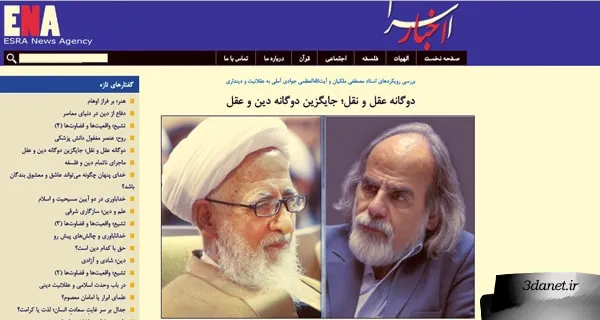
Asranews, in a comparison of the views of Mostafa Malekian and Ayatollah Javadi Amoli (January 16, 2017), wrote: Mostafa Malekian is one of the country's prominent intellectuals. He considers the project of "Rationality and Spirituality" to be the solution to the problems of the modern world. It is based on this intellectual project that Malekian also delineates the relationship between reason and religion. Although Professor Malekian has passed through various intellectual phases and may not currently endorse some of his former ideas, his view on religious rationality is noteworthy, even if it relates to his intellectual past. He has proposed the idea of "rational religiosity," and to explain this idea, he names eight components through which rationality enters the realm of religion.
1- A believer who is rational demands from religion a comprehensive, all-encompassing, and completely pervasive philosophy of life. One who is religious does not want their entire life to be like that of the non-religious, with only one compartment of their life differing from the others. The rational believer wants their religiosity to have permeated their entire life. In fact, non-rational religiosities are those in which one compartment, the rooms and sections of one's life, do not differ from those of the non-religious. If my difference from the non-religious is only that at specific times, in specific places, and in specific states and conditions, I perform actions that most non-religious people do not perform, but apart from these times, places, and states, the rest of my life is like that of the non-religious, this is a phenomenon that removes religiosity from rationality. Therefore, for the rational believer, religion possesses a comprehensive philosophy of life. But the meaning of a comprehensive philosophy of life is not that rational religiosity has commands and prohibitions for our smallest movements and stillnesses. Rational religiosity gives meaning to our smallest movements.[1]
2- Believers who possess a rational religiosity do not consider their religiosity to mean "possessing the truth," but rather to mean "seeking the truth." They do not take religiosity to mean ownership of the truth, but rather as the beginning of a goal and a journey and wayfaring to find the truth. We must make our conception of religiosity similar to the conception of swimming, not similar to the conception of sailing. There is a great difference between one who looks at religion through the lens of swimming and one who looks at it through the lens of sailing. Becoming religious is not boarding a ship; it is swimming. Therefore, a single moment of negligence in swimming causes one to fail to reach the destination. In this state, one can absolutely no longer say my religion is superior to your religion. One can no longer say my religion is more comprehensive or more complete than your religion, but rather one must say my religiosity is better or worse than your religiosity (religiosity, and not religion). One can judge concerning religiosity, but one cannot judge concerning religion.[2] In all religions and denominations, we have seen human beings who, through their religiosity, have attained peace, hope, and joy. On the other hand, in all religions and denominations, we have seen those who, through their religion and denomination, have not attained peace, joy, and hope. This matter indicates that one cannot judge in and of itself. Only if someone, in whatever religion and denomination they are, reaches the shore, it becomes clear they have swum well, and those who do not reach the shore, it becomes clear they have not swum well. The principles and rules of swimming are the same principles and rules.[3]
3- The practice of religiosity is entirely concomitant with critique and the deep understanding that critique necessitates. The practice of religiosity does not mean that I blindly submit and, without reason and without question, surrender to a series of beliefs, acts of worship, rituals, ceremonies, and ethics. In fact, I must maintain a completely critical stance within my religion; critique does not mean objection, but rather it means that I must examine the collection that has been delivered to me in the name of religion and denomination. If I see an apparent contradiction in this collection, there must be a deeper level at which those contradictions are resolved. Moving from the more superficial levels to the deeper levels is for the purpose of making religion rational.[4]
There must be no incompatibility between our sacred religious and scriptural texts and human findings. If revealed data were to be incompatible with human findings, I could not hold two beliefs within myself. We cannot reconcile contradictions. Our task must be to somehow reconcile revealed data with human findings.[5] One of the facets of critical thinking in religion is the various readings of religion, but it is not its only facet. If we wish to think critically about religion, we must allow those who engage in religious work seriously and sincerely to express their various readings.[6]
4- A person who possesses rational religiosity considers the world to have a moral order. This means they believe that not an iota of goodness is lost in the world, nor is an iota of evil lost in the world. Such a person believes the world is made in such a way that it perceives whether we do good or bad deeds, whether we do right or wrong—all of which are moral concepts. The world is made in such a way that it perceives whether we do good or bad, whether we do right or wrong, and whether we do what we should or refrain from what we should not. The universe is conscious of moral good and evil and, moreover, shows a proportionate moral reaction to good and evil.[7]
5- A rational believer firmly believes in self-restraint or personal discipline. By self-restraint, I mean not surrendering to immediate and fleeting desires. In rational religiosity, if a person considers only short-term, material benefits and harms in their calculations, they have, in fact, blinded the path of religiosity with their own hands. A rational believer is not someone who surrenders to transient benefits, wants, desires, and inclinations, or better put, their immediate and fleeting impulses; rather, a kind of self-restraint and personal discipline governs them. There are many short-term pains that we must endure, and many short-term pleasures that we must flee from. What matters is the final calculation and that which accrues to a person in the long run.
6- A rational believer must gradually reach the stage of "self-governance," not the stage of "other-governance." For example, when you fall ill, since you know nothing of medical science, you consult a doctor and follow their prescription. As long as you remain in a state of ignorance and unawareness regarding medicine, if anyone asks you why you follow this prescription, you will say because the doctor said so. In effect, you show yourself bound by the doctor's words, and of course, there is nothing wrong with this. But if, during the course of your illness, you gradually become interested in medical science and learn it, from then on you feel you are following that same doctor's prescription, but no longer because the doctor wrote it, but because you yourself understand that the prescription is the correct one, and you realize that for treating this illness, the most beneficial course of treatment is precisely what that doctor said. In this state, you will never again say, "I follow this prescription because the doctor said so"; rather, you will say, "Based on the medical knowledge I myself possess, this prescription is the unique and singular prescription for my illness, therefore I follow it." From this moment on, you are self-governing. There is no doubt that religiosity, in its first stage, is other-governance; in the first stage, anyone who becomes religious obeys one called God and one called the Lawgiver. Certainly, in the subsequent stages, this same individual must strive to gradually attain such religious depth and profound religious understanding that they slowly reach the conclusion that even if God had not said these things, they would still be right. Most of us will not reach this stage until the end of our lives, because we do not possess rational religiosity and remain in that state of other-governance until the end of our lives.[8]
7- The rationally religious person lives in uncertainty. This means that if one is to provide proofs for religious and doctrinal claims, there is no rational proof even in favor of a single religious or doctrinal claim. That is, just as I can prove that “the sum of the interior angles of a triangle is 180 degrees,” I can never prove that “God exists.” In other words, there is no reason for religious claims that no thinker could find fault with. Religious claims, although not anti-rational, are reason-evasive. Contrary to those who have said they are reason-accepting, they are not reason-accepting either, but rather reason-evasive. A reason-accepting proposition is one whose falsehood reason alone can prove, whereas a reason-evasive proposition is one that reason alone cannot prove to be true or false. All religious propositions are of this kind. This means that one cannot mount a rational argument for their truth or falsehood. Therefore, if the issue is rational proof, from an epistemological standpoint, religious propositions stand on the same level as their contradictions. The interesting story of rational religiosity is that the rationally religious person lacks certainty, yet possesses tranquility; he has no certainty, but he has tranquility. For example, if you look at Plato’s Apology, which recounts Socrates’ defense, you will see that wherever the discussion turns to the afterlife, although Socrates was not certain of the afterlife, he faced death with a courage unparalleled in history. Socrates was not certain of the afterlife, but he faced death with tranquility; tranquility in the absence of certainty.[9]
8- Rational religiosity is such that the rationally religious person performs altruistic service to their fellow human beings solely because the fellow human is a human being, and not from any other consideration such as ethnicity, nationality, religion, etc. As it is also stated in the hadiths, “People are my family, whoever brings them the most benefit is most beloved to me.” Similar to this view that “I am in love with all the world, for all the world is from Him.”
In fact, those who are saints possess a kind of tenderness, love, and compassion toward all human beings insofar as they are human, and not insofar as they hold a particular religion or creed.[10]
Religious and Rational Life in the View of Grand Ayatollah Javadi Amoli
It seems that the ideas and solutions presented by Mostafa Malekian can, in some instances, be taken into consideration and their good points highlighted. In this regard, however, Ayatollah Javadi Amoli has put forward a view and idea that can be considered as an independent approach and a holistic perspective, bringing rationality to the realm of religion as well.
1- Ayatollah Javadi Amoli fundamentally considers religious life to be equivalent to rational life. In his belief, conducting one’s life according to the religious model is the ultimate degree of rational life. If a human being in this world inclines toward worship and makes divine satisfaction the ultimate goal of their aims, in Ayatollah Javadi Amoli’s words, they have also realized a rational life. In an expression on this matter, he considers each person’s death to be commensurate with their way of life and living, stating that: “The death of every person is proportionate to their life, and the dying of people is like their living. Thus, when someone’s death is ignorant, their life will also have been ignorant, ending with an ignorant death. Since a rational life entails a rational death, and whoever departs this world for a garden among the gardens of paradise is certainly rational. For they have worshipped their Lord and earned paradise, and whoever is such is rational, because reason is that inner faculty by which the Merciful God is worshipped and paradise is attained.”[11] Ayatollah Javadi Amoli also introduces the existence of the Quran as a model in rational religiosity, stating that: “The existence of the scientific and objective Quran is the cause for the emergence of a pure, rational life.”[12] He also states that: “In general, the blessed life of the Quran is the very embodiment of rational life.”[13] In Ayatollah Javadi Amoli’s intellectual system, acting upon religious commands and engaging in worship is a sign of a rational life.
2—Ayatollah Javadi Amoli, in delineating the place of reason, believes that one must first grasp the limitations of reason and recognize its station, and only then place one’s trust in it. In his view, reason, in the realm of divine legislation and religious rulings, has nothing of its own to offer; it can only serve as a source for perceiving divine rulings. When it is said that reason issues a ruling, it means that it understands God’s ruling; otherwise, reason—whether in the domain of “is and is not,” i.e., theoretical wisdom, or in the domain of “ought and ought not,” i.e., practical wisdom—lacks any ruling of its own.[14] Based on this exposition, Ayatollah Javadi Amoli sets out the framework and limits of reason’s entry into the sphere of religion. In his view, reason does not have access to every sphere, and one cannot burden it with expectations beyond its capacity.
In another formulation by the Ayatollah: “Reason is like a physician: it possesses insight and knowledge, but not authority and governance. Hence, like a physician, it issues no masterful commands, for it is a perceiver, not a ruler. It has no dominion over the world of creation or the realm of legislation; it possesses only understanding, perception, and insight, not sway or sovereignty. It understands what things exist and what effects follow from them. It never possesses creatorship, lordship, or mastery.”[15]
The Ayatollah, in setting out the limitations and station of reason, also believes that reason has no access to the particulars of religious matters, and the expectation of resolving such matters should not be placed on reason’s shoulders. In his words: “Another of reason’s perceptual limitations concerns the category of religious particulars. Reason itself knows that it is not permitted to intervene in particulars; it has access to the precincts of religious understanding only in general domains and, like a lamp, can illuminate general regions. This perceptual limitation is not something imposed on reason by anyone; rather, theoretical reason itself confesses its own ignorance and deficiency in many cases. Hence, the best and most abundant proof of the need for revelation, prophethood, and divine religion is furnished by theoretical reason itself.”[16]
3—Ayatollah Javadi Amoli draws attention to the point that reason never comes into conflict with religion. Reason lies within the architecture of religious knowledge, and no opposition can be set up between reason and religion. Wherever religion is spoken of, reason is also present, and the two cannot be considered separable from one another. In the Ayatollah’s view: “Reason can conflict with transmitted reports, but the conflict of reason and religion is an unsound notion, just as the conflict of transmitted reports and religion is unintelligible, because reason is situated within the architecture of religious knowledge and is counted as one of its cognitive sources.” Ayatollah Javadi, in discussing the conflict between reason and religion, also believes that reason never comes into conflict with religion. If a conflict exists, it is between reason and transmitted reports. This conflict, moreover, can be resolved in various ways. In cases where reason and transmitted reports are irreconcilable, one must hold fast to certainty. For example, a narration or verse that is incompatible with a certain, demonstrative matter of reason is diverted from its apparent meaning and interpreted in a sense that accords with the rational proof; and if no plausible interpretation can be found, the narration that contradicts the explicit ruling of reason is interpreted, or, to put it differently, knowledge of it is consigned to those qualified to know it.[17] Ayatollah Javadi, of course, holds that there is no universal rule in cases of conflict between reason and transmitted reports: sometimes the transmitted proof takes precedence, provided that in terms of validity and signification it is stronger than the rational matter, and sometimes the rational content takes precedence.[18]
Moreover, some imagined conflicts between science and religion are the product of a failure to recognize boundaries on the part of certain scientists and some believers. If each of these two groups had fully identified the central subject of investigation and assessed its abstract, empirical, or composite identity through experience and abstraction, and then engaged in a scholarly and methodical clash of opinions on that subject, no disharmony would ever have arisen, and aversion or objection would have turned into welcome and enthusiasm.[19]
In the view of Ayatollah Javadi Amoli, someone who considers reason to lie outside the precincts of religion naturally looks upon it as a rival source to religion. Consequently, just as, in a manner of deficiency, he imagines the two to be in conflict with one another, so too, in a manner of excess, he sometimes imagines one to be a substitute for the other. It is from this point that the growth of reason constricts the space for religion, diminishes the expanse of its domain, and even brings its existence to an end.[20]
4- Ayatollah Javadi Amoli, in explaining the place of reason in the realm of religion and rational religiosity, draws attention to a point, namely that the presence of reason is not permissible in cases involving the opposition of contradictories. In clarifying this important matter, he states: “When the matter is confined to truth and falsehood, the truth and falsehood of contradictories, we must discern which is true and accept it. And where there is no rational exclusivity, where there is a third or a fourth possibility, we must seek the third, the fourth, and the fifth. The Holy Qur’an expresses this matter in this way, stating: ‘So give good tidings to My servants who listen to speech and follow the best of it’; here there is no longer room for innovation. If the best of statements is determined, the limit is determined, the truth is determined, there is nothing besides it. This is a place for listening, not for innovation, the production of knowledge, and the like. What do you want to bring? The matter is no more than these two: one is false, and the other is necessarily true. There is no room for a third or fourth statement. Where the matter is confined to two statements and nothing more, confined to contradictories, one is false and the other true, all our effort and endeavor must be to understand which is true and to accept it. So we have one domain which is the place of listening, not the place of innovation, because the matter is confined to two divisions; and another part pertains to innovation, technology, and creativity. Where technology is concerned, ‘O Lord, increase me in knowledge’ has its place.”
5- Ayatollah Javadi Amoli believes that there is a great difference between the multiplicity of religions and their truth. Mostafa Malekian has reached the opinion that on the path of faith, religiosity is important, not religion. In the sense that the manner of human beings’ conduct based on a religious method is the criterion and standard for truth-seeking and attaining truth, and not merely religious teachings. Ayatollah Javadi Amoli does not accept this view and considers religious teachings to be different and distinct from one another, and does not place all religions alongside each other. By raising the discussion of the single primordial nature of humanity, the Ayatollah believes that a single primordial nature demands a single law. Attending to this important point, he states: “Is the reality of humanity single or diverse and multiple? That is, are all human beings of one essence and differ only in the degrees of that single essence, or does each possess a reality mutually exclusive with the reality of others?... Both Qur’anic verses and rational, empirical evidence answer this question and consider all human beings equal in the essence of existence. Therefore, on the one hand, the path for the attainment of human perfections and geniuses will remain open, and on the other hand, incorrect theories such as religious pluralism and multiple straight paths will be invalidated; because for a single reality, diverse and mutually exclusive perfections cannot be correctly assumed” [21].
Ayatollah Javadi Amoli considers the single primordial nature to be the cause of a single coherent law, and deviation from it to be the factor preventing the primordial nature from reaching its fulfillment and being purified. In the Ayatollah’s interpretation, this single primordial nature is not changed by God, because He created it in the most beautiful form, nor by other than God, because other than Him does not have the power to change the order of creation. Therefore, if the Prophet, the Book, the Kaaba, the circumambulation site, the temple, guidance, primordial nature, etc., are one for all human beings, then all human societies possess a single reality. [22]
Conclusion
Professor Malekian, in proposing the idea of rationalized religiosity, has placed his finger on valuable points. He endeavors, by setting metrics and criteria, to outline a method and approach based on which the behaviors of the religious take on a rational character and do not fall into the trap of superstition and irrational emotions.
Malekian points to eight items that the religious must observe in their behavioral conduct to bring about a religious and rational life. In Malekian’s view, merely believing in an idea does not make one a possessor of truth; rather, on this path, acting upon the precepts and behavioral method is the most important goal in a rational and religious life. With this statement, Malekian emphasizes that in our judgments and assessments, we must make individuals’ religiosity the criterion, not the religion to which they adhere. He also believes that religious propositions do not represent the complete and total truth, and that truths can be derived from every school and creed. Professor Malekian also emphasizes the reason-averse nature of many religious propositions.
Professor Malekian has emphasized points that one can believe in and attend to. However, it seems that his view of rational religiosity is a piecemeal one. Ayatollah Javadi Amoli has, in this regard, expounded a system according to which every religious act necessarily takes on a rational character as well, and the two are not separable or distinct from one another.
In Ayatollah Javadi Amoli's belief, striving in the religious arena and acting upon divine commands is nothing other than rational conduct. One cannot perform a religious act unless it is adorned with the gem of rationality. Ayatollah Javadi Amoli, also emphasizing the issue of innate nature (fitrah), believes that a single innate nature cannot bear multiple laws. If one steps into the realm of religion, one must follow a single, innate, and eternal law, and encroaching upon various schools and sects causes one to trample upon pure innate nature and brings about misguidance.
It seems that Professor Malekian, in outlining his ideas, posits rationality as a criterion and standard, and based on that, judges religion and religious propositions by its measure. Ayatollah Javadi Amoli, however, does not distinguish between religion and reason. In his belief, if there is any disagreement or conflict, it is between reason and transmitted tradition (naql). Wherever a rational act is performed, the fragrance of religion is also perceived. Professor Malekian, by separating these two realms, has stepped into the arena of delineating rational religiosity, whereas Ayatollah Javadi Amoli interprets these two as being of the same category and sees no distinction between them.
Professor Malekian believes that revealed data must not conflict with human findings. In his words, one cannot believe two contradictory propositions. There must be no incompatibility between sacred religious and denominational texts and human findings. Our task should be to somehow reconcile revealed data with human findings. Ayatollah Javadi Amoli, however, distinguishes between two types of conflict. In some instances, one can consider third, fourth, and fifth theories and, through the clash of opinions, arrive at a single view. It is in this arena that one can engage in rational scrutiny and achieve scholarly production. But in other cases, there is no third or fourth proposition, and the matter revolves between two things: truth or falsehood. In these instances, accepting both propositions leads to the conjunction of contradictories. In such cases, there is no longer room for scholarly scrutiny and innovation, and the correct view must be deduced by clinging to religion.
Where Mostafa Malekian insists that in the conflict between reason and religion, one must side with reason, Ayatollah Javadi Amoli posits the conflict between reason and transmitted tradition, and believes that there is no fixed method for resolving this disagreement; sometimes reason prevails, and at other times transmitted tradition is accepted.
Endnotes
[1] In the Passage of the Wind and the Guardian of the Tulip, Mostafa Malekian, pp. 111-112
[2] Ibid., pp. 114-115-116
[3] Ibid., p. 117
[4] Ibid., p. 118
[5] Ibid., p. 120
[6] Ibid., p. 121
[7] Ibid., pp. 124-125
[8] Ibid., pp. 142-143
[9] Ibid., pp. 144-145
[10] Ibid., p. 146
[11] Ayatollah Javadi Amoli, The Wise Quran from the Perspective of Imam Reza (AS), p. 44
[12] Ibid., p. 44
[13] Ibid., pp. 152-153
[14] Ayatollah Javadi Amoli, The Status of Reason in the Geometry of Religious Knowledge, p. 40
[15] Ibid., p. 42
[16] Ibid., pp. 59-60
[17] Ibid., p. 179
[18] Ibid., p. 76
[19] Ibid., p. 82
[20] Ibid., p. 179
[21] Ayatollah Javadi Amoli, The Form and Essence of the Human Being in the Quran, pp. 90-91
[22] Ibid., pp. 91-92
.
.
The Reason–Tradition Binary: A Replacement for the Religion–Reason Binary
Source: Esra News
.
.



Discussion1 comments
دوگانه « عقل / دین » جامعِ دوگانه « عقل / نقل » است و افزون بر دربرگیرندگی « عقل / نقل » ، سازش / ستیز دانسته های تاریخی و باورهای علمی و فلسفی غیردینی با جنبه های غیرنقلی دین را هم دربر می گیرد . در این بحث ها معانی مختلف « عقل » باید به دقت تفکیک شود .