Religion
The Relationship Between Jurisprudence and Ethics: A Conversation Between Ali Mahjour and Abolqasem Fanaei
Abolghasem Fanai argues that the conventional understanding of the separation of the domains of these two sciences is mistaken, distinguishing instead between their 'potential' and 'actual' domains. In his view, the potential domain of both is absolute, but in the actual domain, there exists a region devoid of judgment.
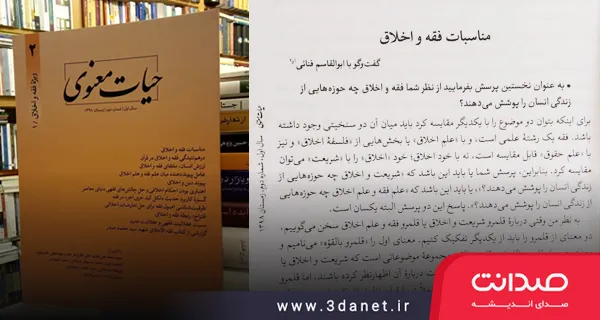
The Relationship Between Jurisprudence and Ethics[1]
A Conversation Between Ali Mahjour and Abolqasem Fanaei
As a first question, please tell us, in your view, what areas of human life do jurisprudence and ethics cover?
In order to compare two subjects, there must be some affinity between them. Jurisprudence is a scientific discipline, and it is comparable to the "science of ethics" or parts of "moral philosophy," as well as to the "science of law," not to ethics itself; "ethics" itself can be compared with "Sharia." Therefore, your question should either be: "What areas of human life do Sharia and ethics cover?" or "What areas of human life do the science of jurisprudence and the science of ethics cover?" The answer to these two questions is, of course, the same.
In my opinion, when we speak of the domain of Sharia and ethics, or the domain of the science of jurisprudence and the science of ethics, we must distinguish between two meanings of domain. We call the first meaning the "potential domain" and the second meaning the "actual domain." The potential domain is the set of topics about which Sharia and ethics, or the science of jurisprudence and the science of ethics, "possibly" and "probably" have commented, whereas the actual domain is the set of topics about which these two have actually commented—that is, the area where that potential and capacity has been actualized regarding those topics.
In light of distinguishing these two meanings of domain, it can be said that the potential domain of Sharia and ethics as two sources of value/norms, as well as the potential domain of the science of jurisprudence and the science of ethics as two scientific disciplines concerned with these two sources, is in principle "absolute," meaning that it is possible and probable that these two sources or these two sciences have something to say and a recommendation for how to live in all areas of life. In practice, too, both in ethics and in Sharia, we have "individual" rulings as well as "social" rulings; we have "political" rulings as well as "economic" rulings, and so on. I believe that even discovering the silence of one of these two sources, or both of them, on certain topics is significant. Because through this discovery, we understand that either we are completely free in that matter and have no duty from a religious and/or ethical standpoint, or we are obliged in that matter to decide how to act by referring to other norm-setting sources, such as custom or public opinion.
Therefore, if your intention is the potential domain, it can be said that since the potential domain of these two is absolute, they have complete overlap. Of course, the common view in Islamic culture completely separates the domains of these two sciences; in this view, the subject of the science of jurisprudence is introduced as "the act of the obligated" and the subject of the science of ethics as "the character of the obligated," but I believe this view is incorrect. However, if your intention is the actual domain of Sharia and ethics, or the science of jurisprudence and the science of ethics, this domain is limited; that is, both Sharia and ethics, and consequently both the science of jurisprudence and the science of ethics, have in practice remained silent in some cases and left humans to their own devices. In both cases, we have contexts and areas that, in the words of the martyred Ayatollah Mohammad Baqir al-Sadr, can be called "mantiqat al-faragh," meaning a region free from normative ruling and free from religious and/or ethical recommendation.
[1]. This conversation was previously published in the esteemed journal Hayat-e Ma'navi, Issue 2, Winter 2019, pp. 7-45. Its republication here is done with the permission of the dear and learned friend, Mr. Ali Bagheri-Far, the esteemed managing director and editor-in-chief of this journal. I thank him for agreeing to the request for its republication. Now, as we are on the eve of the fortieth day since the passing of my dear friend, the late Professor Reza Babaei, I dedicate this conversation to his pure soul.
.
.
PDF file of this conversation from Hayat-e Ma'navi journal
Download from Server 1 | Server 2
.
.
Those interested in obtaining this quarterly can visit in Tehran: Shariati Street, above Seyed Khandan Bridge, Khajeh Abdollah Ansari Street, Tisfun Street, Madaen Street, Antakieh Alley, Alaei Sharghi Alley, No. 14, Unit 5. Tel: 021-22883394; and in Qom: Moallem Street, Publishers Complex, First Floor, Unit 120. Tel: 025-37842348 and 025-37842349; or obtain the publication through the Tehran distribution center, Qoqnus: 021-66408640; and Qom, Ketab-e Taha: 025-37744624.
.
.

Discussion0 comments
No comments yet; let yours be the first voice.