Religion
Religious Ethics and Secular Ethics: A Conversation between Abolghasem Fanaei and Abdolhossein Khosropanah
In this conversation, Abolghasem Fanaei responds to Abdolhossein Khosropanah's critiques of the theory of the primacy of ethics over religion, defending the independence of ethics from religion in both its ontological and epistemological dimensions. The discussion addresses one of the fundamental questions in the philosophy of religion: the relationship between ethics, reason, religion, and the possibility of moral judgment in a religious and pluralistic society.
Religious Ethics and Secular Ethics: Sedanet's Question to Dr. Abolghasem Fanaei Regarding Dr. Abdolhossein Khosropanah's Recent Critique of the Theory of the Priority of Ethics over Religion
Sedanet's Question: Dr. Khosropanah recently published a piece on his Telegram channel that appears to be a critique of you. He stated:
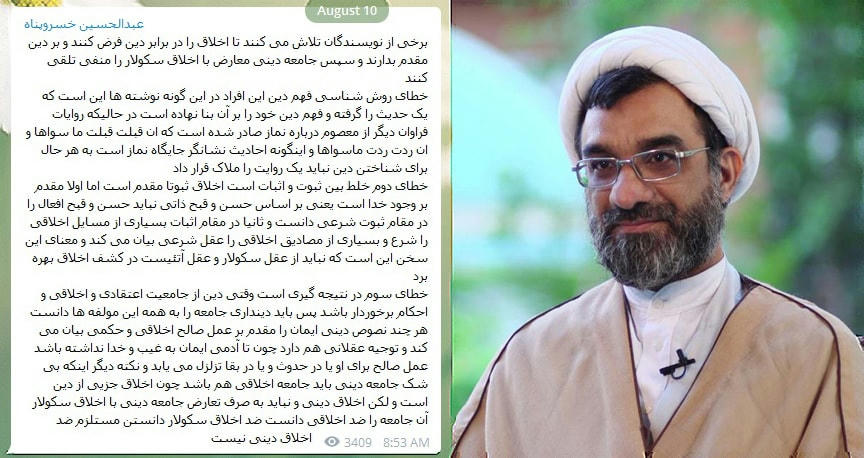
3) His formulation of the point of contention is incorrect. First, I do not posit ethics in opposition to religion, nor do I prioritize it over religion. Here, neither my supposition nor my will is involved. My claim is that ethics is, both ontologically and epistemologically, independent of religion, and, in a specific sense, is also ontologically and epistemologically prior to religion. This claim is a truth we arrive at through philosophical inquiry into the relationship between religion and ethics, and we discover it using the research method in philosophy.[1] Contrary to what he has claimed, I do not suppose that ethics stands in opposition to religion, nor do I prioritize ethics over religion; rather, I say that this is the case and it is not otherwise. This claim and its rival claim are philosophical theories that correspond to reality, not theories expressing the supposition, will, or decision of individuals. Adjudication among philosophical theories is also possible solely by relying on philosophical reasons, not by resorting to narrations, including narrations that indicate the status of prayer.
4) The word "secular," which appears in his speech and is considered equivalent to "atheist," has numerous meanings. The multiplicity and diversity of these meanings is such that it has practically rendered the word useless, an obstacle to understanding and communication, and susceptible to misunderstanding. I personally prefer not to use this word as much as possible, but in responding to Mr. Khosropanah's critique, I am compelled to use it. Mr. Khosropanah has taken this word as equivalent to "irreligious" or "anti-religion" or "godless." For example, when he says "secular reason" or "secular ethics," he means irreligious or anti-religious, or atheistic reason and ethics, that is, reason and ethics that presuppose the non-existence of God and an atheistic worldview. Furthermore, he sets "secular reason" in opposition to "religious reason" and creates a dichotomy between the two. My guess is that by religious reason, he means "juristic reason"[2]; otherwise, the Sharia as we know it recognizes the "conventional reason"/"secular reason" that all the world's rational people possess.
But the meaning I intend by this word is not this. In my view, "secular" is equivalent to "extra-religious." Thus, when I say "secular reason" or "secular ethics," I mean extra-religious reason and extra-religious ethics. Extra-religious reason means reason that is neutral between religion and irreligion, and because it is neutral, it has the competence to adjudicate between religion and irreligion, to resolve disputes between the religious and the irreligious, and even the competence to adjudicate between God and His servants. Extra-religious reason is a scale whose criterion is reason and whose goal is approximation to truth, goodness, beauty, wisdom, and understanding. This scale is sensitive only to reason in the general sense of the word, and operates within the framework of rational considerations/norms of rationality. Extra-religious ethics is also an ethics that is neutral between religion and irreligion, and precisely for this reason, it has the competence to adjudicate between the religious and the irreligious and to regulate social relations in a pluralistic society composed of both the religious and the irreligious.
Overall, he has attributed three errors to "some writers who try to posit ethics in opposition to religion and prioritize it over religion, and then portray a religious society in conflict with secular ethics negatively," and has criticized these errors. We will examine these errors one by one.
1) The First Error
The first error is a methodological error in understanding religion. In explaining this error, Mr. Khosropanah has written:
"The methodological error in these individuals' understanding of religion in such writings is that they have taken a single hadith and based their understanding of religion upon it, whereas numerous other narrations have been issued from the Infallible about prayer, such as 'If it is accepted, whatever else is accepted, and if it is rejected, whatever else is rejected,' and such hadiths indicate the status of prayer. In any case, to understand religion, one should not take a single narration as the criterion."
In response to such an accusation, I will point out a few things.
اولاً، این سخن ایشان که ”برای فهم دین نباید یک روایت را ملاک قرار داد“، سخنی کاملاً درست و پذیرفتنی است، و منکری هم ندارد، لااقل بنده منکر آن نیستم، و عملاً نیز هیچگاه در فهم دین به یک روایت اکتفا نکردهام. اما پرسش مهمی که در اینجا مطرح میشود این است که «اگر برای فهم دین نباید یک روایت را ملاک قرار داد، چه چیزی را باید ملاک قرار داد؟»، و دقیقاً در پاسخ به این پرسش است که راه بنده از ایشان جدا میشود. این پرسش درباره منابع معرفت دینی، و لذا معرفتشناسانه است، نه دینی.
پاسخی که از سخنان ایشان به این پرسش بدست میآید این است: «برای فهمیدن دین باید همه روایات را ملاک قرار داد»، و نقدشان بر بنده این است که من در فهم دین به یک روایت تکیه کرده و سایر روایات را عمداً یا سهواً نادیده گرفتهام.
در اینجا ایشان دو ادعای متفاوت مطرح کردهاند، بدون اینکه هیچ دلیلی به سود این دو ادعا اقامه کنند. ادعای اول یک ادعای کلی درباره روش درست فهم دین است و آن این است که «برای فهم درست دین باید به همه روایات مراجعه کرد»، و ادعای جزئی ایشان این است که «نگارنده در فهم دین فقط یک روایت را گرفته و فهم خود از دین را بر آن بنا نهادهام».
این دو ادعا نادرست است. زیرا:
مبنای معرفتشناسانه ایشان در دینشناسی نه فی حد نفسه قابل دفاع است و نه با مبانی عالمان سنتی سازگار است. اگر مقصود ایشان از فهم دین، اعم از شناخت اصول دین و فروع دین باشد، رویکرد مسلط در میان علمای سنتی شیعه این است که در شناخت اصول دین صرفاً باید به عقل و استدلال عقلی تکیه کرد، نه به آیه یا روایت. اما اگر مقصود ایشان از فهم دین، شناخت فروع دین/ احکام شرعی است، در این مورد فقط اخباریان با ایشان همدلی دارند. عموم اصولیان شیعه، دستکم در مقام نظر، براین باورند که شناخت شریعت/فروع دین مبتنی بر چهار منبع ـ قرآن، سنت/روایات معصومین، اجماع و عقل ـ است، نه مبتنی بر یک منبع، یعنی روایات.
اما دیدگاهی که بنده بدان باور دارم و در آثار خود به تفصیل از آن دفاع کردهام این است که در شناخت دین به هر دو معنای عام و خاص کلمه به همه منابع معرفت باید تکیه کرد، نه فقط به یک روایت، یا حتی مجموعه روایات، یا روایات به همراه آیات، یا به عقل منهای روایات یا آیات. این منابع عبارتند از: تجربه (به معنای عام کلمه که شامل تجربه حسی، تجربه ذهنی/شهود، تجربه وجدانی/درونبینی و تجربه دینی نیز میشود)، حافظه، گواهی و استدلال. بنابراین، بنده در مقام فهم دین نه تنها به یک روایت اکتفا نمیکنم، که برخلاف ایشان، به همه روایات نیز اکتفا نمیکنم، بلکه کلیه شواهد مربوطه، اعم از شواهد نَقلی، عقلی، و تجربی را در نظر میگیرم.
از اینکه بگذریم برای بنده اصلاً روشن نیست که روایات مربوط به جایگاه نماز چه ربطی به بحث از رابطه دین و اخلاق دارد، و چگونه سرنوشت این بحث را عوض میکند و چرا بر اساس این روایات ما باید بپذیریم که اخلاق جزئی از دین یا وابسته به دین است، و مستقل از دین یا مقدم بر آن نیست. درواقع این روایات نیازمند تفسیر است، و تفسیر موّجه آنها در گرو مفروض گرفتن نظریهای موّجه در باب رابطه دین و اخلاق است.
اگر نظریه تقدم اخلاق بر دین را بپذیریم و در پرتو آن بخواهیم این روایات را تفسیر کنیم، تفسیر موّجه این روایات به شرح زیر خواهد بود. این روایات میگویند: در مقام پذیرش اعمال بندگان، پذیرش نماز شخص توسط خداوند شرط قبولی سایر اعمال است. اما پرسش این است که چه نمازی؟ و از چه کسی؟ و چرا؟
The answer to the first question is that it is ethical prayer, not jurisprudential prayer. Ethical prayer is prayer that, in addition to fulfilling jurisprudential conditions, also fulfills ethical conditions. Ethical prayer serves the purpose of living ethically and remaining ethical, whereas jurisprudential prayer that lacks ethical conditions neither brings a person closer to God nor creates a positive transformation in their character, disposition, or actions. Such prayer is merely useful for discharging an obligation and escaping punishment, and this kind of prayer cannot be a condition for the acceptance of other deeds. On this basis, one can claim that the meaning of these narrations is that ethical prayer creates a positive transformation in the worshipper's character and turns them into an ethical agent. The other deeds that emanate from such an agent are ethical deeds and are therefore accepted by God. The relationship between prayer and other deeds is not a mechanical or legal one, but an ethical-spiritual one. If a person's prayer is ethical, their other deeds will also naturally become ethical.
The answer to the second question, the question of "from whom?", is this: from someone who possesses convincing reasons and evidence in favor of the existence of God, the prophethood of the Prophet of Islam, the obligation of prayer, and the obligation of worshipping God. Someone who does not possess such reasons and evidence is rationally and ethically excused, and it would be morally ugly for God not to accept the good deeds of such a person who has not prayed with a justified excuse, and not to reward them. There is a difference between a "culpable ignorant person" and an "inculpable ignorant person"; the "inculpable ignorant person" is equal to the "knowledgeable practitioner," meaning both are deserving of reward.
The answer to the third question, the question of "why is the acceptance of other deeds contingent upon the acceptance of prayer?", is that ethical prayer is communion with an ethical God; a God whose communion causes a person to become ethical, live ethically, and remain ethical. Once a person becomes ethical, their other deeds will also become ethical. The interesting point is that these narrations do not seek to separate those who pray from those who do not pray, but rather seek to distinguish two groups of worshippers from one another: a group whose prayer is accepted, and a group whose prayer is rejected. Therefore, the question "why is the prayer of a group of worshippers not accepted?" is entirely apt and reasonable. My answer to this question is that it is because these worshippers, in the interval between two prayers—that is, in their daily lives—perform deeds that neutralize and destroy the ethical and spiritual effect and property of prayer. Those deeds are, in fact, the unethical acts that a person's jurisprudential prayer does not prevent them from committing, but their ethical prayer forbids them from committing and practically prevents them from doing so, and even prevents the formation of the intention to commit them in the soul and psyche of the worshipper. This is one of the functions that God has enumerated for prayer in the Holy Quran.[3]
2) The Second Error
The second error that Mr. Khosropanah has attributed to the author is the confusion of the realm of actuality and the realm of proof. In this regard, he has written:
"The second error is the confusion between actuality and proof. Ethics is ontologically prior, but firstly, it is prior to the existence of God, meaning that based on intrinsic good and evil, the good and evil of actions should not be considered religiously determined in the realm of actuality; and secondly, in the realm of proof, many ethical issues are articulated by religion, and many ethical instances are articulated by religious reason. The meaning of this statement is that one should not utilize secular reason and atheistic reason in discovering ethics."
In response, I submit that:
Firstly, his claim, in simple and non-technical language, is that ethics is ontologically prior to religion, but epistemologically, in many cases, it is dependent on religion. The dependence he claims is not absolute but is qualified by the two constraints of "many" and "instances." The meaning of these two constraints is that ethics is not epistemologically dependent on religion in all cases. Therefore, the meaning of his statement is not that "one should not utilize secular reason and atheistic reason in discovering ethics," but rather that in some cases, one should utilize secular reason in discovering ethics.
Secondly, here too, both in his general claim concerning the epistemological dependence of ethics on religion in many cases and instances, and in his particular claim—namely, attributing to me the error or fallacy of confusing the realm of reality with the realm of justification, which is based on that general claim—he has merely repeated the assertion and has offered no argument in support of these two claims. In the first chapter of the book Ethics of Religious Studies, I have explained and criticized in detail four arguments that others have advanced or could advance in favor of this general claim.[4] Instead of responding to those critiques, he has contented himself with repeating the claim in this instance.
Thirdly, separating the realm of reality from the realm of justification, or the ontological aspect of the religion-ethics relationship from its epistemological aspect, is practically impossible, even if it is logically possible, because the main reason supporting the independence of ethics from religion, and its priority over religion, in the "realm of reality" is the independence of ethics from religion, and its priority over religion, in the "realm of justification." The actual recognition of certain moral values by secular reason/reason independent of revelation in the realm of justification—a capacity shared by all human beings, whether religious or non-religious—demonstrates that moral values are not dependent on religion in the realm of reality either. Secular reason, or reason independent of revelation, is that reason which the religious and the atheist, or theists and atheists and agnostics, all possess equally. An argument advanced by some Shiite and Sunni theologians in favor of the independence of ethics from religion in the realm of reality is that Brahmins and atheists, who are not committed to any revealed law, are certain in the realm of justification about the goodness of some things and the badness of others.[5]
This argument states: since all human beings, in the realm of justifying good and bad/identifying instances of good and bad without referring to revelation and without considering the religious ruling, know that justice and truthfulness are good and oppression and lying are bad, it follows that in the realm of reality, too, moral goodness and badness are not subject to religious ruling, because if they were, no one, whether religious or non-religious, could know that something is good or bad without referring to the Lawgiver's statement and without considering the religious ruling. Therefore, by attending to the realm of justifying good and bad, and the path to attaining moral knowledge, we discover a truth about the realm of the reality of good and bad.
The premise of the argument is: ethics is not dependent on religion in the realm of justification,
and its conclusion is: therefore, ethics is not dependent on religion in the realm of reality either.
In other words, the argument is that since the claim of ethics' dependence on religion in the realm of justification is false, the claim of ethics' dependence on religion in the realm of reality is also false. But why is the claim of ethics' dependence on religion in the realm of justification false? Because moral knowledge is not specific to, or accessible only to, the followers of a particular religion/revealed law; rather, all human beings, whether theist or atheist, actually know that some things are good and some things are bad. Good and bad are not religious, because good and bad are not transmitted. The meaning of this statement is that if someone, like Mr. Khosropanah, says: good and bad in the realm of justification are transmitted, and should not be known through secular reason, he will have no basis on which to claim that good and bad in the realm of reality are intrinsic and not religious. One who denies such a connection between the realm of reality and the realm of justification will have no way of discovering the realm of reality. The "connection" between the realm of reality and the realm of justification is different from the "confusion" of the realm of reality with the realm of justification.
Therefore, contrary to Mr. Khosropanah's claim, no one has confused the realm of reality with the realm of justification here; rather, an inference has been made about the characteristic of good and bad in the realm of reality through the characteristic of good and bad in the realm of justification; that is, the intrinsic nature of good and bad has been inferred from its rationality. Instead of demonstrating the incorrectness of this argument with reasoning, he has merely resorted to leveling the accusation of confusing the realm of reality with the realm of justification. But it is clear that just as confusing the realm of reality and justification is an error where these two realms have no connection, separating these two realms from each other is equally and for the same reason an error where these two realms are connected.
Thirdly, the conclusion he draws from this unsubstantiated claim is that “the meaning of this statement is that one should not draw upon secular reason and atheistic reason in the discovery of ethics.” This conclusion is in itself incorrect, does not follow from those premises, and is inconsistent with his other claims.
The reason this conclusion is in itself incorrect is that:
(1) Secular reason differs from atheistic reason; secular reason is common to the theist/believer, the atheist/non-believer, and the agnostic, meaning all three partake of this reason.
(2) If we do not discover ethics through secular reason, how are we to know that ethics, in the realm of reality, is not dependent on religion?
(3) If we do not discover ethics through secular reason, the discovery of ethics through religious law, or as he puts it, through religious reason, will be entirely blocked.[6]
(4) Let alone the fact that reason is inherently secular, meaning it follows evidence, not a religious or non-religious worldview or ideology, and therefore speaking of religious reason in opposition to secular reason is the very essence of relativizing reason and rationality, and by accepting relativism concerning rationality, one cannot even prove the existence of God, let alone religious rulings and religious ethics.
As for why this claim is inconsistent with his other claims, it is because on the one hand he says: one should not use secular reason to recognize moral values, and on the other hand he says: “in the realm of justification, many ethical issues are articulated by religious law, and many ethical instances by religious reason.” The qualifier “many” and the qualifier “instances” in his statement mean that in recognizing a few cases and in recognizing the general principles of ethics, there is no escape from using secular reason, and this is a clear contradiction. Furthermore, if in some cases, however few, we are compelled to use secular reason to recognize moral values, why should we not use this same reason in other cases? What distinguishing difference exists between these few cases and other cases, and between general principles and particulars, that justifies such a separation?
In my view, the answer to these questions reveals the source of the primary motivation of Mr. Khosropanah and his like-minded colleagues in denying the authority and validity of secular reason in the domain of ethics and religion. They see that there are verses and narrations whose apparent meaning is incompatible with secular reason’s understanding of ethics. Here, there are two ways to resolve this incompatibility: the first way is to abandon the apparent meaning of these verses and narrations and interpret them in a manner compatible with the ethics recognized through secular reason, and the second way is to discredit secular reason and deny its validity and authority in recognizing moral values, or to claim the relativity of rationality.
The Ash‘arites have a clear and consistent position here. They say: good and evil in all cases, whether general or particular, are dependent on religious law in the realm of justification, because they are dependent on religious law in the realm of reality. Therefore, if secular reason wishes to recognize the good and evil of something, it must inevitably refer to the verses and narrations. The Ash‘arites arrive at this conclusion without falling into the trap of relativism concerning rationality and ethics, and without discrediting secular reason. In their view, ethics is entirely and completely dependent on religion in the realm of justification, because it is dependent on religion in the realm of reality. But Mr. Khosropanah and his like-minded colleagues are not willing to explicitly accept the consequences of denying intrinsic good and evil and denying the authority of secular reason in the domain of ethics; hence they separate the realm of reality from the realm of justification, and based on this separation, they claim that in the realm of reality, ethics is not dependent on religion, but in the realm of justification, in many cases and in particulars, it is dependent on religion. These cases are, in fact, the very cases in which a verse or narration exists. Their criterion for separating the domain of dependence from the domain of independence is not a rational and logical criterion, but an arbitrary one.
Therefore, the starting point of these individuals in resolving a philosophical question concerning the relationship between religion and ethics is the preservation of the apparent meaning of the verses and narrations. This position, as is evident, is both a begging of the question, and blowing the trumpet from its wide end, and sitting on a branch while sawing it off. If we ask why ethics, at the level of justification, is dependent on religion in many cases and in its details, the real answer—which, due to the extreme obviousness of its invalidity, is not stated explicitly—is this: because we have verses and narrations whose apparent meaning is incompatible with the judgment of secular reason concerning ethics.
But one may ask: by what means has the authority of the apparent meaning of the verses and narrations been proven? And is this authority absolute or is it conditional upon the compatibility of the apparent meaning of the verses and narrations with ethics? Naturally, proving the authority of the apparent meaning of the verses and narrations by appealing to the verses and narrations themselves entails a circular argument. Therefore, the only remaining way to prove the authority of the apparent meaning of the verses and narrations is to appeal to secular reason. The meaning of this statement is that Mr. Khosropanah and his like-minded colleagues, in order to prove the validity of transmitted proofs/verses and narrations, are compelled to presuppose the authority and validity of secular reason, but after proving this desired point, they forget the foundation upon which they stand and, based on that very foundation, impugn the authority of this same reason in the realm of ethics. Moreover, who has said that the apparent meaning of the verses and narrations retains its validity even in the case of conflict with the moral values recognized by secular reason?
3) The Third Error
The third error that Mr. Khosropanah has attributed to the author is as follows:
” The third error is in the conclusion. When religion possesses comprehensiveness in beliefs, ethics, and rulings, then the religiosity of a society must be understood as encompassing all these components, even though religious texts present faith as prior to righteous moral and legal action, and this has a rational justification because as long as a person does not have faith in the unseen and in God, righteous action for them becomes unstable either in its occurrence or its continuation; and another point is that undoubtedly a religious society must also be an ethical society because ethics is a part of religion, but it is religious ethics, and one should not, merely because of the conflict of a religious society with secular ethics, deem that society anti-ethical. Deeming it anti-secular-ethics does not entail it being anti-religious-ethics.“
The summary of his claim in this regard is that we have two ethics: one secular and the other religious, and religious ethics is a part of religion, and therefore one should not, merely because of the conflict of a religious society with secular ethics, deem that society anti-ethical.
Firstly, the main discussion is not about the conflict of a religious society with secular ethics, but rather about the conflict of jurisprudential fatwas with secular ethics. Of course, one of the consequences of this conflict is also the conflict of a jurisprudential society with a secular ethical society. In fact, we have two conflicts here: the first is the conflict of jurisprudence with secular ethics, and the second is the conflict of a jurisprudential society with a secular ethical society. But it is clear that the second conflict originates from the first.
Secondly, the conclusion drawn from his premises is that a jurisprudential society is ethical in one sense, even if it is not ethical in another sense. If what is meant by ethics is that very religious ethics which jurisprudence articulates, then a religious society is an ethical society; but if what is meant by ethics is secular ethics, then in that case, a religious society based on existing jurisprudence is not ethical.
Secondly, this claim of his is stating the obvious and has no denier. Proving the morality of a religious society in this way is, in fact, circumventing the problem and erasing the question. The issue was never "Is a religious society compatible with religious ethics or not?" but rather "Is a religious society compatible with secular ethics or not?" and if not, "Where does this incompatibility originate, and how can it be resolved?" Mr. Khosropanah acknowledges the existence of this incompatibility, but instead of resolving it, he says: a religious society is moral in a different sense, other than this one. In fact, here, instead of answering the question "Is a religious society compatible with secular ethics?", he has presupposed another question and answered it. This other question is: "Is a religious society compatible with religious ethics?" But it is already clear that a religious society is compatible with religious ethics, because this is part of the meaning of a religious society, and in fact, such a question, due to its extreme clarity and obviousness, is fundamentally unaskable. However, the author has tried to take the original question, namely the challenge between religious ethics and secular ethics, seriously and to try to find a solution for it.[7]
The main issue here is "How can the conflict between religious ethics and secular ethics be resolved?" If someone, in response to this question, says: due to the existence of verses and narrations conflicting with secular ethics, this ethics is valid only in two cases: one, in cases where the authority and validity of verses and narrations are based on it, and the other, in cases where the verses and narrations are silent, this is in fact not an answer, but begging the question, because the validity of the apparent meaning of these verses and narrations is the very point at issue. How can it be proven that the apparent meaning of the verses and narrations is valid even if it is incompatible with secular ethics?
Let alone the fact that by dividing ethics into religious ethics and secular ethics, he has in fact destroyed the foundation of his own critique. Because one of the implications of accepting such a division would be that a religious society can be criticized both in the light of religious ethics and in the light of secular ethics. Now, what should be done if the result of evaluating a religious society in the light of religious ethics is positive and in the light of secular ethics is negative? In other words, he has presupposed the conflict between religious ethics and secular ethics and, based on that, has claimed that a religious society should only be criticized and evaluated from the perspective of religious ethics. But does no one have the right to criticize a religious society in the light of secular reason and secular ethics? Why do you have the right to criticize a secular society in the light of religious ethics, but others do not have the right to do the same to you? Where does this exclusive right come from?
But the independence of secular ethics from religion is like the independence of secular medicine and secular mathematics from religion. If someone says: in a particular religious society, hygiene is not observed because, since religion has not told people to wash their hands with soap, they do not use soap, one cannot tell him: "You have assumed medicine in opposition to religion and prioritized it over religion. A religious society observes religious medicine and is therefore a hygienic society, even if the members of this society do not observe secular medicine." Similarly, if someone, relying on empirical evidence, shows that lying, bribery, and embezzlement are more prevalent in a particular religious society than in some secular societies, and therefore this society is morally behind those societies, one cannot respond to him by saying that you have no right to judge a religious society with the values of secular ethics.
And the final word is that someone who denies the validity and authority of secular reason in the realm of ethics and the recognition of moral values will have no basis and no justification for criticizing the beliefs and behaviors of groups like ISIS and the Taliban. The ISIS members can also say: if you think our actions are immoral, it is because you have measured our actions with the scale of secular reason and secular ethics. Change your scale and replace secular reason and secular ethics with religious reason and religious ethics, to see that these actions are both religious and moral. In fact, the ISIS members also commit these atrocities by clinging to the apparent meaning of religious texts.
اما نکته مهم و کلیدی این است که هیچ کس بدون مفروض گرفتن نظریه خاصی در باب رابطه دین و اخلاق نمیتواند متون دینی را تفسیر و حکمی شرعی یا اخلاقی از این متن استنباط کند. داعش نیز نظریه وابستگی اخلاق به دین در مقام اثبات در جزئیات را مفروض میگیرد تا بتواند توجیهی برای رفتارهای ضد اخلاقی خود دست و پا کند. بدون چنین پیشفرضی این توجیه ناتمام خواهد بود. این پیشفرض باید به متن دینی ضمیمه شود، تا بتوان چنین رفتارهایی را توجیه کرد.
اما اگر این نظریه جای خود را به نظریه رقیب بدهد که میگوید: «اخلاق در مقام اثبات نیز وابسته به دین نیست، بلکه مقدم بر آن است»، آنگاه میتوان از این پیشفرض نتیجه گرفت که معنای ظاهری متون دینی به شرطی معتبر است که با ارزشهای اخلاقی شناخته شده توسط عقل سکولار سازگار باشد. بنابراین، کارهای داعش توجیه دینی ندارد، چون توجیه اخلاقی ندارد، و صرف وجود آیات و روایات برای توجیه دینی یا اخلاقی چنین کارهایی کافی نیست.
سایه صد عمر در این قصه به سر رفت و هنوز
ماجرای من و معشوق مرا پایان نیست
24/05/1396
قم، دانشگاه مفید
[1] شرح و بسط، بررسی و نقد تفصیلی نظریههای گوناگون دربارة ارتباط دین و اخلاق را در کتابها، مقالات و گفتگوهای صاحب این قلم میتوانید دنبال کنید.
[2] عقل فقهی برداشت خاصی از عقل عرفی است که بر اساس عقلانیت فقهی عمل میکند. این عقل حتی وقتی وارد قلمرو فلسفه میشود، دیدگاههای فلسفی را با ترازوی فقه میسنجد. برای آشنایی با ویژگیهای عقل و عقلانیت فقهی، و نقد آن، بنگرید به فنائی، الف. (1394) اخلاق دینشناسی (تهران: انتشارات نگاه معاصر)، فصل چهارم.
[3] «اتْلُ مَا أُوحِيَ إِلَيْكَ مِنَ الْكِتَابِ وَأَقِمِ الصَّلَاةَ ۖ إِنَّ الصَّلَاةَ تَنْهَىٰ عَنِ الْفَحْشَاءِ وَالْمُنكَرِ ۗ وَلَذِكْرُ اللَّهِ أَكْبَرُ ۗ وَاللَّهُ يَعْلَمُ مَا تَصْنَعُونَ» (عنکبوت: 45). «آنچه از كتاب آسمانى كه بر تو وحى شده است، بخوان و نماز را برپا دار، كه نماز از ناشايستى و زشتكارى باز مىدارد، و ياد كرد خداوند [از هر كارى] مهمتر است و خداوند مىداند كه چه مىكنيد» (ترجمة خرمشاهی).
[4] فنائی، الف. (1394) اخلاق دینشناسی (تهران: انتشارات نگاه معاصر)، صص. 32-77.
[5] حلّی، ج. (1408 ه) کشف المراد فی شرح تجرید الاعتقاد (بیروت: مؤسسه الاعلمی للمطبوعات)، ص 281.
[6] This is, in fact, the substance of one of the arguments that Khajeh Nasir al-Din Tusi presents in Tajrid al-I'tiqad in his critique of the Ash'arite view, based on the ontological and epistemological dependence of ethics on religion. On this, see: (Hilli: 1408 AH), p. 281. Khajeh states: "wa li-intifa'ihima mutlaqan law thabata shar'an": "[Good and evil are rational, not legal, because] if good and evil were to be established through the Sharia, they would be negated absolutely" (ibid.), meaning that in this case, neither rational good and evil nor legal good and evil could be established; rather, both would be negated. Allamah Hilli, the commentator on Tajrid al-I'tiqad, explains this argument as follows: "This is a second aspect indicating that good and evil are rational, and its explanation is that if good and evil were to be established legally, they would be established neither legally nor rationally. The consequent is false by consensus, so the antecedent is also false. The statement of the implication [between the consequent and the antecedent in this proposition is]: If we do not know the good and evil of things through reason, we will not judge that lying is evil. Therefore, lying would become permissible for God, whose station is far too exalted for lying, and [if lying were permissible for Him] when He informs us of the ugliness of something, we would not be certain of its ugliness, and when He informs us of the goodness of something, we would not be certain of its goodness, because [in this assumption] lying is permissible for Him, and in this case, we would have deemed it permissible for God to command us to do an ugly deed and forbid us from doing a good deed, because in this assumption, God's wisdom would be negated." (ibid.). In my belief, this very same argument can be raised against the view of Mr. Khosropanah and his like-minded colleagues, based on the epistemological dependence of ethics on religion.
[7] On this, see Fanaei, A. (1392) Religion in the Scales of Ethics (Tehran: Serat Publications) and Fanaei, A. (1394) Ethics of Religious Studies (Tehran: Negah-e Moaser Publications).

Discussion16 comments
با سلام محضر دوستان شرق و صدانت و دیگرانی که دانسته به ادامه این فضای یکجانبه ادامه می دهند.. قصدم ورود به نقد و پاسخ به نقد نیست صرفا نگاهی است به این روند ناعادلانه.. اگر در فضایی آرام فرصت گفتگو و نقد دو طرفه بین متفکران فراهم باشد بی شک نتایج خوبی خواهد داشت امااینکه در سیری هدایت شده از هر طرف به یک اندیشمند حمله شود باز شکی نیست که در فضایی آکنده از سیاست زدگی مثل همیشه!! این حقیقت شوربخت است که چشم بسته به مسلخ خواهد رفت! و جز تشفی نسبت به بعضی دلخوری ها و ایجاد کینه ها و سوء تفاهم های نو نتیجه ای نخواهیم گرفت! در ابتدا به نظر نمی رسد دوستان واقعا دغدغه تحری حقیقت داشته باشند یا در پی دفاع از ساحت علم و فلسفه برامده باشند که اگر چنین بود باید بدون پیش داوری و سوا کردنهای جهت دار! هرجا علم و فلسفه مورد کم لطفی و سوءاستفاده قرار می گرفت حاضر بودند! نه اینکه مثلا با همه وجود از کسی دفاع کنند که سالهاست عنوان مشکوک دکترا را به یدک می کشد و از عوائد مزید ان بهره برده و می برد! تا جائی که بزرگانی چون جناب ملکیان نیز از منظر اخلاق و مصلحت و ...خود را تا کسوت بازار گرم کن انتخابات پایین بیاورند و در نتیجه همه کم کاری ها و کاستی ها شریک شوند!آیا دوستان علم دوست و فداییان فلسفه از تعبیر گذاشتن قران در داشبورد و ساختن ماشین دینی که به عنوان نقد طرفداران علم دینی مطرح شد به وجد نیامدند؟! و چون مسحور شدگان کف قشنگ نزدند؟! همان تعبیر عالمانه که راه را برای این جریان منصف نقادی باز کرد!!یکجا مو را از ماست کشیدن و جایی دیگر شتر را با بارش ندیدن؟! از جناب سروش دباغ سوال می کنم: انبوه نویسی و تالیفات بی مرجع و مصدر، شاه کار کدام مدعیان اندیشه ورزی است؟ مگر نه این است که خواننده آثار پدر دانشمندتان (که نسبت به نقد دیدگاه هایشان به حق! حساسید) باید در انباری از غث دنبال سوزن ثمین بگردد؟! آقای دباغ خود جلسات مطهری شناسی و نقد ایشان داشته اند ..مگر ایشان فیلسوف اسلامی هستند که به خود حق ورود به این ساحت را داده اند و ادعا کرده اند که استاد مطهری متفکر نیست؟!!!؟ چطور یک فیلسوف تحلیلی حق چنین درشت گویی های علمی دارد اما فیلسوف اسلامی حتی حق ورود ندارد؟ دلخوش بودیم که نسل نو روشنفکری مخصوصا به اصطلاح دینی! از راه سلف نه چندان صالح خود عدول کرده و حداقل واقع بینانه تر و حرفه ای تر با سایر اندیشه ورزان برخورد خواهند کرد( با توجه به برخی مواضع مهر نامه) اما ظاهرا پسر همچنان نشان پدر را حفظ کرده ..امروز فیلسوف اسلامی را به صرف اختلاف نظر و یا حتی دیدگاه هایی قابل نقد در حد دانشجوی ترم اول فلسفه مطرح می کنند و او را مسبب انحطاط فلسفه در ایران میدانند ..حال انکه سالهاست دانشجویان علوم انسانی بین کلاسها و جلسات ایشان در چرخشند! دیروز هم اسلاف ایشان هر مخالفی را مکلا یا معمم! نشسته رو، بی سواد و پیاده و حکومتی چماق به دست و توصیف می کردند.. معلوم می شود خیال خامی بوده و این قصه سر دراز دارد..
آقای خسروپناه مورد تایید کسی نیست، یک وقت سوتفاهم نشود که ایشان نماینده تفکر خاصی است، خیر! ایشان صرفا یک انسان خنثی و بی خطر است که بنا به ملاحظاتی در پست فعلی قرار داده شده است. در نتیجه با نقد ایشان، این توهم ایجاد نشود که جریان فکری خاصی در حال نقد شدن است. اگر جریان خاصی را میخواهید نقد کنید به سراغ بزرگان آن جریان رفته و آنها را نقد کنید.
خیلی دوست دارم بدانم مخاطب آقای خسروپناه چه کسانی هستند که ایشان این مطلب را به این شیوه ارائه کردند.
سلام با نتیجه گیری انتهای متن چند تا سوال برام پیش اومد. "معنای ظاهری متون دینی به شرطی معتبر است که با ارزشهای اخلاقی شناخته شده توسط عقل سکولار سازگار باشد." 1- آیا یک اخلاق سکولار واحد وجود خارجی داره؟ در حالی که نظام ها، مکاتب و نظریات گوناگون اخلاقی داریم، و فصل مشترکشون هم ممکنه چیز کامل و جامعی به دست نده. 2- آیا این نتیجه گیری به معنی نوعی ماله کشی نیست؟ سرپوش گذاشتن بر روی دستورات و رفتارهایی که نه فقط امروز بلکه چه بسا در روزگار خودش هم لااقل در نقاطی از دنیا که متمدنتر از جزیره العرب بودن غیراخلاقی قلمداد میشده! 3- آیا اخلاق سکولاری که مقدم بر دین و ورای دین هست ما رو در بسیاری موارد بی نیاز از فقه و اساسا خود دین نمیکنه؟
لازم نیست یک وجه مشترک در بین مکاتب اخلاقی وجود داشته باشد بلکه شما به عنوان یک انسان نهایتا به یک سیستم اخلاقی منسجم می توانید معتقد باشید. وجود مکاتب مختلف نافی وجود اخلاق نیست. همانطور که وجود ادیان مختلف باعث نشده است شما دست از دفاع از دین بردارید.
جسارته جناب ss 1- اگر به اخلاق سکولار این اتلاق «اخلاقیات مطروحه در سکولار» شده بود ، کاملتر بنظر میرسید 2- در هر صورت در روزگار خودش «و در منطقه ی جغرافیائی مستعد رسالت» ، روش برتری بنظر میرسیده و کسانی به ادیان جدید گرایش پیدا میکنند که پویا و بدنبال روش های بدیع و نو هستند. دین «بعنوان یک روش» اگر لایتغیر باشه ، مولد کفر میشه و دکتر فنائی ها ، همان تغییر مطبوع هستند. 3-اقشاری از مردم ، نیاز به پلیس مخفی «درون» دارن. متشکرم
با تشکر از استاد گرامی وفیلسوف گرانقدر چقدر با این روایات ما بچهه ها در مدرسه مجبور به اقامه نماز میشوند در حالیکه هنوز از عقل و اصول دین چیزی نمیدانند متشکرم که معنای سکولار را یاد گرفتم
واقعا قصد توهین ندارم ولی، امثال "خسرو پناه" ها، هنوز گمان میکنند در هزار سال پیشن میزییند.. این طرز نوشتن ه "مبهم، بی سر و ته، کیلویی و زبان عربی پریشانه"، نه تنها از نادانی سرچشمه دارد، بلکه نشانه ی "صغیر پنداری" خوانندگان و نمایشگر "منیت و خودشیفتگی" نویسنده آن است... با تشکر از دکتر فنایی.
چقدر خوب شد قصد توهین نداشتی!
سلام علیکم با تشکر از دکتر فنایی به نظر بهتر بود ایشان ابتدا مقصود خود از «دین» و «اخلاق» و تفاوت آن دو را روشن می ساختند سپس به ارائه بحث می پرداختند.
واقعا خجالت آوره ، یا آقای فنایی واقعا مقصود آقای خسروپناه رو نفهمیده و یک تصویر از مقصود آقای خسروپناه ساخته و به اون جواب داده ، یا اینکه ..... جالبه اونهایی که بالا نظر دادن خودشون رو روشنفکر می دونن، یه ذره منصف باشید نه مثل صدانت که صدای اندیشه است و فقط صدای فنایی ، ملکیان و سروش و ... می شنوه .
شما لطف کنید و سخنان دکتر فنایی رو نقد کنید دقیقا بفرمایید کجای مطالب دکتر فنایی نادرسته و چرا نادرسته. شما به شیوه آقای خسروپناه عمل نکنید و لذا به تکرار مدعا نپردازید. این گوی و این میدان مطمئن باشید صدانت نقد شما رو منتشر میکنه
چه فرقی مکنه جناب ، استدلالهای شماهم با آقای خسرو پناه ، حکمی و دستوری است . هروقت توانستید با اشاره به مطلب مورد نقدتان ادعا کنید ، بنویسید . متشکرم.
آن "نحوه" بیان مطلب از کسی که ریاست عالیترین نهاد فلسفی کشور را به او عطا کرده اند، فقط جای تأسف دارد؛ زیرا آن "نحوه" سخن گفتن حتی از یک دانشجوی فلسفه هم قابل قبول نیست. در مقابل، آن "نحوه" پاسخ دکتر فنایی بسیار قابل ستایش است. احتمالا آقای خسروپناه به این نقد پاسخ دهد، اما امیدوارم پاسخ ایشان منبری و مبتذل نباشد و به تکرار مدعا اکتفا نکند و همانند دکتر فنایی مستدل بحث کنند.
واقعا پاسخ محکمی بود به آقای خسروپناه. خسته نباشید...
دست مریزاد، نقدی عالی و جامع بود. متاسفانه فضای تلگرام باعث شده یک عده کانال بزنند و یک تنه منبر بروند ولی در بحث و گفت و گو است که عیار هر شخص مشخص میشود. نقد کتاب، نظرات، و دیدگاهها و گفت وگو را ادامه بدهید، همانا صراط مستقیم همین است.