Philosophy
A Conversation with Abolghasem Fanaei on Moral Philosophy by the Young Ethics Scholars House
Fanaei considers any jurisprudential ruling incompatible with ethical principles to be epistemologically invalid, and by critiquing the Usuli scholars' discrimination between transmitted and rational proofs, he argues that understanding the Sharia is contingent upon its compatibility with the conduct of the wise and ethical principles.
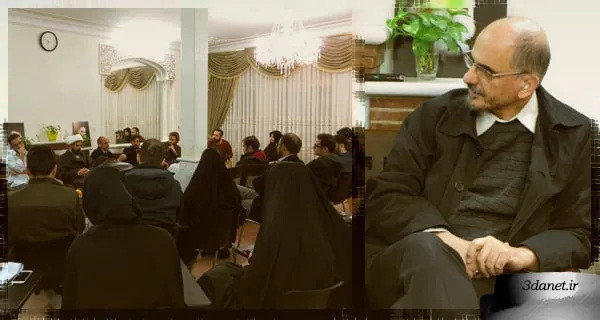
A Conversation with Abolghasem Fanaei on Moral Philosophy by the Young Ethics Scholars House
The consequences of conceiving religion or Sharia within the framework of ethics manifest in the derivation of rulings, the most important of which is that any jurisprudential fatwa, or any inference and interpretation of verses and narrations whose content is incompatible with one of the ethical principles, loses its epistemological validity. A more technical expression of this is the ethical falsifiability of jurisprudential fatwas.
Of course, what is falsified here is not the divine ruling itself, for our assumption is that in the Preserved Tablet or the noumenal realm, it is impossible to have a ruling in the domain of Sharia that violates ethical frameworks. This is because God, the Lawgiver, is a moral being, and His moral virtues require that He not violate those frameworks in the act of legislation. If we accept this metaphysical view regarding the relationship between religion and ethics, it entails epistemological implications, the most important of which is that the jurist, qua jurist, if they want the result of their inference to be valid, must add a new stage to the stages of jurisprudential inference. The religious and moral duty of the jurist is to check their understanding of the Quran and the Sunnah against ethical principles.
Question: So we can deem fatwas erroneous from a moral standpoint?
- Yes.
Question: What if we have a definitive ruling in religion?
- We do not have definitive rulings. Our assumption is that you do not have only one path available to know what Islam says. We have several paths alongside one another. The situation we have here is exactly like the situation where you have two conflicting narrations, or two conflicting verses, or a conflicting verse and narration. The same method that our scholars of legal theory propose in the discussion of balancing and preponderance (ta'adul wa tarajih) for resolving the conflict of narrations is the method we have in rationality. That is, when various sources of knowledge, including reason, experience, and transmitted reports, conflict with one another. However, our problem in legal theory is that, due to incorrect epistemological presuppositions they hold regarding authoritativeness (hujjiyyah), they have discriminated between conjectural rational and experiential proofs, and conjectural transmitted proofs. They say a conjectural transmitted proof is authoritative, but a conjectural rational and experiential proof is not, and you only have the right to abandon the content of that conjectural transmitted proof if that rational or experiential proof reaches the level of certainty. I have tried to show that this epistemological discrimination has no basis.
Question: Suppose you conduct research and it becomes established for you that Islam has sanctioned slavery, but you see that in moral philosophy, this is unacceptable. What is to be done here?
Fanaei: The late Motahhari says that slavery was imposed on Islam from outside, and in a situation where others grant themselves the right to take Muslims as slaves in wars, you cannot deprive Muslims of this permission. If we understand the ruling on slavery in this context, we see that it is a temporary ruling. Most of the problems we have in jurisprudence stem from a mistaken understanding of the commonality of the obligated among rulings and the negation of the ruling's context. If historical evidence confirms that a ruling existed in early Islam and was considered part of the Sharia, and there is also a verse or narration about it, it must be examined whether it is an eternal ruling or a temporary solution to a temporary problem under specific conditions. That is the discussion. In most cases, by setting aside the general and temporal scope of that verse or narration, the conflict between its apparent meaning and moral values is resolved. The conduct of the wise also demands this of us. Another problem we have in jurisprudence and its principles is that the principles and rules of jurisprudence are treated like mathematical rules. They say that if the authority of apparent meaning or the authority of a solitary report is proven, it has authority everywhere. But if you refer to the conduct of the wise, you see that this is not the case. We have a set of rules at our disposal that we must use proportionately. What we have in the conduct of the wise is that if you want to say that your duty in determining your obligation is to act based on certainty, three conditions must be fulfilled. First, certainty must be accessible; otherwise, it becomes an obligation beyond one's capacity. Second, that certainty, besides being accessible, must not impose an unreasonably exorbitant cost on you. The third condition is that the matter must be important. If the matter is not important, no rational person says you must first attain certainty and then act. In many cases, we act based on the preponderance of conjectures. Because our rational nature tells us that our duty is not to acquire certainty, even if certainty is accessible. But because the issue is not important, we do not seek certainty. Now, if one of these three conditions is not met, the necessity of acquiring certainty is lifted from us. The scholars of legal theory's conception of the conduct of the wise is incorrect. If we refer to the conduct of the wise outside the seminaries, we see it is something else. Regarding religious rulings, the assumption is that the subject is important. But those two conditions are often not met. Either certainty is not accessible, or acquiring it imposes an exorbitant cost on us. Based on this same conduct of the wise, when it comes to acting on conjectural evidence, no rational person differentiates between transmitted, rational, and empirical conjectural evidence, and if conjectural evidence conflicts, the wise say we must act on the stronger conjectural evidence. But the scholars of legal theory say that certainty is the mother of all authorities, and the authority of conjectural evidence must be proven by definitive evidence and also receive the Lawgiver's endorsement. I have criticized this view and said there is no convincing evidence in its favor. The Lawgiver did not come to bring us a new rationality, and it is impossible for the Lawgiver to divide the conduct of the wise in considering conjectures as authoritative into two parts and say, "I do not accept one part." Because the conduct of the wise is based on a logic that is general and non-restrictable, which is that if we act on conjectural evidence, our possibility of approaching the truth will be greater. This criticism applies to the scholars of legal theory who believe in the correlation between the ruling of the Sharia and the ruling of reason, and say that whatever exists in ethics has its counterpart in the Sharia. I have criticized this view and believe the most we can say is that whatever exists in ethics, its opposite does not exist in the Sharia. That is, the God of the Sharia, who is the God of ethics, does not issue a command that violates one of the moral principles. The scholars of legal theory, in theory, recognize reason, but in practice, they discriminate between reason and consensus on one hand, and the Quran and Sunnah on the other, and say that if the evidence from the Quran and Sunnah is conjectural, it is authoritative, but reason and consensus are only authoritative when they reach the level of certainty. The authority of rational conjectures is derived from the conduct of the wise. From the same source to which the authority of transmitted conjectures is also attributed. If we refer to the conduct of the wise outside the seminary, we see that most of the decisions that rational people make in daily life are based on conjectural evidence, and whenever conjectural evidence conflicts, they no longer look at which evidence is transmitted and which is rational or empirical; rather, they act on the stronger conjectural evidence. If we want our understanding of the Sharia to be a rationally defensible understanding, we must act based on this conduct of the wise.
Question: Does a jurist who has attained certainty not have the right to act according to his own opinion?
Fanaei: In the traditional view, an interesting distinction has been made between personal conjecture and objective conjecture, which is also correct. The scholars of legal theory (usuliyyun) have said that objective conjecture is authoritative, not personal conjecture. Objective conjecture, meaning conjecture that is based on evidence, has validity, not a psychological conjecture. The discussion is about whether, if you want to say that certainty is authoritative, it must be objective certainty, that is, a reason that constitutes authority and certainty for the type of ordinary human beings.
.
.
Audio of the Conversation of the "Young Ethics Scholars House" with Abolghasem Fanaei
2 hours and 9 minutes - 23.1 MB
.
.
Source: Young Ethics Scholars House
Young Ethics Scholars House Website
Young Ethics Scholars House Channel
.
.


Discussion2 comments
قطع آبجکتیو باشد یا سابجکتیو، اصلا تفاوتی نمی کند... شما تا وقتی قطع داری به اینکه الف ب است، هیچ منبعی نمی تواند خلاف آن را به شما دستور دهد... مگر قطع تو را از بین ببرد و منظور سائل در سوال اخر همین بود که جناب فنایی بحث را خوب پاسخ نداده اند... در اصول هست که ظن نقلی مستند به قطع است و از این رو تفاوت دارد با ظن تجربی و عقلی و لذا حجت است و دومی حجت نیست و این ساده سازی کلام اصولیون در سخنان جناب فنایی عجیب است... اصولیان ما مثل شهید صدر بسیار دقیق تر از این حرف ها سخن می راندند..
عالی بود...چه قدر روشن و صریح سخن گفتن؛ دلنشنین و دلچسب است....