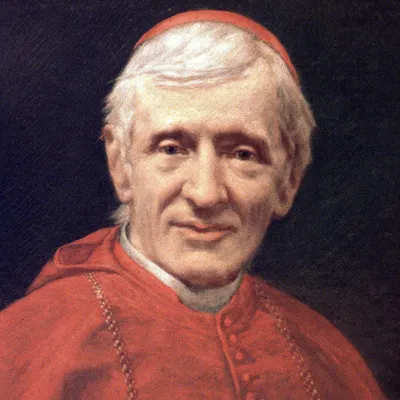
Foreign thinker
John Henry Newman
John Henry NewmanTheology, Philosophy of Religion, and Philosophy of EducationBritish
To live is to change, and to be perfect is to have changed often.
Life and Thought
John Henry Newman (1801–1890) was a prominent British priest, theologian, philosopher, and cardinal of the Victorian era. Initially a leader in the Church of England and the Oxford Movement, he later converted to the Catholic Church, becoming one of the most influential religious thinkers of the nineteenth century. His highly influential works, such as The Idea of a University and An Essay in Aid of a Grammar of Assent, have played a significant role in the philosophy of higher education and religious epistemology.
John Henry Newman was born in London in 1801. He was educated at the University of Oxford and subsequently became a Fellow of Oriel College, Oxford, and vicar of the University Church of St Mary the Virgin. In the 1830s, Newman emerged as a leading figure in the Oxford Movement, a movement within the Church of England that sought to revive its historical and Catholic roots. However, his deep historical and theological research ultimately led him to formally join the Catholic Church in 1845, an event that sent a major shockwave through Britain's religious and intellectual community.
One of Newman's most important intellectual achievements is his theorizing on higher education. His book The Idea of a University is a collection of his lectures in which he defends comprehensive education, free intellectual development, and the cultivation of the mind against pure specialization and a utilitarian view of knowledge. Newman regarded the university as a place for fostering a critical spirit and a pluralistic understanding, where various sciences, including theology and philosophy, coexist alongside one another.
In the field of philosophy of religion and epistemology, his other outstanding work is the book An Essay in Aid of a Grammar of Assent (1870). In this work, he examines the rationality of religious belief and introduces the concept of the 'Illative Sense' to explain how human beings arrive at firm beliefs based on a collection of indirect and converging evidence. Newman was elevated to the rank of cardinal by Pope Leo XIII in 1879 and eventually died in 1890. He was canonized as a saint by the Catholic Church in 2019.