Religion
Toleration and Acceptance of the Other in Religious New-Thinking: Moloud Bahramian in Conversation with Soroush Dabbagh
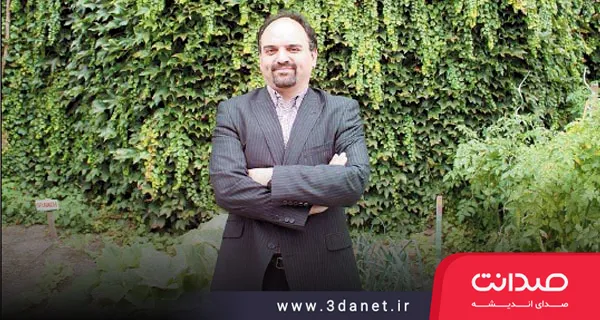
Soroush Dabbagh grounds toleration in the 'right to be wrong' and inviolable rights. For the liberal, following Kant, toleration means recognising the rights of the other, even without shared belief—including religious minorities and atheists.
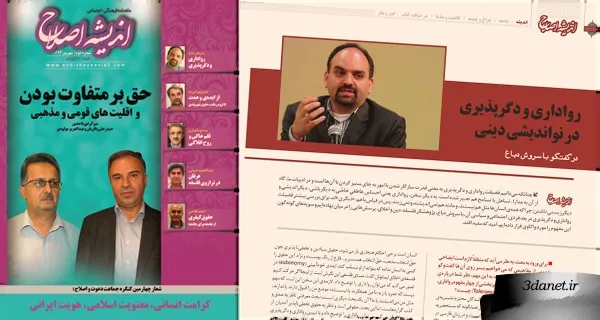
Note: As we know, the virtue of toleration and acceptance of the other means the capacity to adapt to things rather than to fight against them. In our literature, it has sometimes been expressed as forbearance, leniency, or indulgence. In other words, toleration means having a particular emotional feeling toward otherness, other-thinking, and other-living; for all human beings are not alike, do not think alike, and do not live alike, so in comparison with one another, they are “the other.” The inner and outer realms of each person differ from those of others; although the degree of difference from this or that varies, this very condition makes each person a being distinct from and opposed to the other. It is clear that everyone is attached to their own way of being, but if they are also attached to the way of being of the other, they will possess the virtue of toleration and acceptance of the other. To further examine the virtue of toleration and acceptance of the other in its individual, social, and political dimensions, we have posed questions in a conversation with Soroush Dabbagh, a researcher in philosophy, religion, and ethics, and have analyzed the various aspects of this concept, hoping it will be useful.
• To begin the discussion, it seems logically necessary to have a conceptual clarification of the terms we wish to discuss. With this in mind, what is your view on the doctrinal, practical, and distinguishing aspects of the four concepts of toleration, acceptance of the other, indulgence, and forbearance (Tolerance)? - In the name of God, greetings to the esteemed readers of the “Andisheh-ye Eslah” journal. It should be said that the word “ravādārī,” as you are aware, is the equivalent of the word “Tolerance” in English and has been translated into Persian in recent decades particularly as “ravādārī.” The teachings of leniency and forbearance have, of course, a history in our tradition, but what I wish to emphasize as constitutive of the category of toleration is this: an idea that has also been emphasized in the liberal tradition and culture, and which I have used in some of my interviews and writings: “the right to be wrong.” I think if we begin from here, it is a good starting point for providing a basis for justifying toleration. In the teachings of classical liberalism and the versions of it presented in the twentieth and twenty-first centuries, “the right to be wrong,” which has also been translated into Persian as “the right to be unjust,” I think “the right to be wrong” is a smoother and more expressive translation of this central teaching of this school of thought. In the phrase “the right to be wrong,” “right” stands in contrast to “duty” and means “to have a right.” “Wrong” also means making an epistemic error and saying something that does not correspond to reality, assuming, of course, that the chosen theory of truth is “correspondence with reality.” According to this meaning, I have the right to err, I have the right to make mistakes, and no one can take this right away from me, just as no one can claim to have granted me this right and that, for instance, it was their favor that I came to possess this right. Among the normative requirements of human rights teachings is that certain normative rulings apply to the human being qua human, fundamental and inviolable rights such as the right to choose one’s religion, the right to choose one’s spouse, and so on, regardless of skin color and race. No one has given these rights to the human being such that they could take them away. The idea of autonomy in Immanuel Kant’s moral philosophy is the philosophical foundation of this view. If we proceed from here, I think toleration can be explained. The implication of this statement is that it does not matter whether Amr or Zayd agrees with me or not; whether they accept my position or not, whether they think like me or not. That is a different discussion; it is an epistemic discussion concerning the truth and falsity of propositions, but this discussion is a legal one and concerns the inviolable rights of human beings. From this very point, I believe toleration can be explained, and by elucidating toleration and acceptance of the other, a theoretical basis for leniency and indulgence can be provided, and one can go further and possibly defend the rights of religious, ethnic, and sexual minorities as well. This statement does not mean that we must necessarily agree with so-and-so theologically, philosophically, and theoretically; nor is it supposed to be so. We practice forbearance in the sense that we recognize their inviolable rights. For this reason, I believe that living ethically requires that a Muslim defend the fundamental rights of religious minorities and, in a country like ours, of Sunnis, and, as I have argued in the article “God-disbelief instead of Atheism?”, even defend the fundamental rights of God-disbelievers; although it is clear that a religious person has an obvious worldview difference with a God-disbeliever.
Moloud Bahramian, [08.02.17 15:46] I think if we proceed from here, a justified basis for toleration has been provided. I have explained the genealogy of this claim in Kantian philosophy and the liberal tradition. I am not saying that traces and a basis for these statements cannot be found in other philosophical and political traditions and schools. In any case, I proceed from these foundations and principles, and as the saying goes, “affirming one thing does not negate others,” others may begin from different foundations and principles.
• What is the meaning of “acceptance” in accepting the other? What does accepting the other mean? Does it mean accepting that they exist? Accepting that they have equal rights? Does accepting them mean being emotionally open to them as well? - Consider this. One or two of the rights you enumerated, with the explanation I will offer, seem to me to be compatible with one another; that is, you can have your emotions stirred toward the “other,” just as Hume said: the principle of sympathy. He based morality on the feelings and emotions that are stirred toward the other; but what I am saying goes beyond this. That is, according to this basis, in the sense brought by Levinas, a twentieth-century continental philosopher, morality essentially begins with drawing in and safeguarding the other. In more technical terms, if we seek a normativity that constitutes our moral and normative relations and relationships, this depends on the “other” also being present for these relations to take shape. Egalitarianism, in the sense of equality before the law, originates from precisely this point—the egalitarianism that our forefathers sought to realize at the dawn of the Constitutional Revolution and referred to as “equality” and “parity.” This is the very meaning of accepting the other; that is, the other, regardless of their gender, race, religion, epistemic and educational background, is equal before the law. Moral “ought” propositions originate and emerge from here, norms that are based on the presence and appearance of the “other” before us. I am mindful that Levinas spoke in critique of Kantian doctrines and articulated his own philosophical teachings. What I have in mind here is the autonomous subject who is, at the same time, attentive and mindful of other minds and surrounding human beings, and regulates and ratifies their moral relations and relationships with their emergence and presence. In addition to the moral dimension, in legal terms, accepting the other also entails the acceptance of egalitarianism and equality before the law. Thus, in this sense, accepting the other can be sought and explicated in both moral and legal dimensions. All of these statements are among the requirements of recognizing the “right to be wrong.” If we proceed from this basis, we can provide an enlightening explanation of this matter.
• As one of the proponents of tolerance and accepting the other, what epistemic justification do you have for your position that opponents lack? In other words, what are the theoretical foundations of tolerance and accepting the other? Is tolerance a positive value (meaning it does not stem from ignorance or incapacity) or is it merely a tool and a means? - As I mentioned, the theoretical foundation of tolerance has substantive value and is not merely a tool and a means; rather, it is a constitutive matter, which is the legitimization and consideration of the “right to be wrong.” I firmly believe in this doctrine and I think this provides both a basis for the moral justification of toleration and accepting the other, and a legal basis. In this manner, the discussion can be advanced and a moral and epistemic defense of toleration, tolerance, and accepting the other can be made.
• Could you explain the types of beliefs and opinions (objective and subjective)? Fundamentally, to what matters do beliefs, opinions, and convictions attach? What is the relationship between each of these opinions, convictions, and beliefs and toleration and acceptance of the other? In which categories of belief can one tolerate the opponent, and vice versa? - One can tolerate a great many opinions, meaning that one “must” tolerate the holders of opinions, not the opinions themselves. That is, we should not tolerate the opinions themselves, meaning that a person should not stand on ceremony regarding whether beliefs are justified or unjustified, true or false, and epistemological inquiry and investigation must always continue in earnest, with knowledge-enhancing dialogues flowing in the public sphere or in friendly and interpersonal spaces. But it makes a difference whether or not I also tolerate the holder of the opinion; I “must” tolerate them, because they are an instance of “the other.” I must be open to “the other” speaking their piece; but being open does not mean agreeing with everything they say, just because they might become upset. This is not toleration of the holders of opinions, but the recognition of their rights. Otherwise, the “ethics of belief” requires that where I believe a certain claim is unjustified for such-and-such reasons, I critique it, and this does not conflict with toleration. At the same time, I believe one must oppose the holders of certain opinions and those who defend and set out to disseminate certain ideas, if a speech or action constitutes an instance of hate speech. Hate speech is speech that attacks a person or group based on characteristics such as race, gender, religion, and the like. The dissemination and propagation of ethnic, religious, and similar categories of hate speech must not be tolerated. As in that famous poem by Hafez, with one caveat: “The comfort of both worlds lies in the interpretation of these two words: / With friends, magnanimity; with enemies, toleration.” This verse has a caveat; yes, with friends magnanimity, with enemies toleration, except for the enemies of toleration, except for those who are hostile to toleration.
• Who is meant by those who are hostile to toleration? - Those who have set out to destroy the sapling and the institution of toleration among people, those who promote hate speech; ethnic, racial, religious hate speech, and so on. They are those who have set out among people to destroy the institution of toleration. They must not be tolerated; their speech must be censored. If strictness and intolerance are ever warranted, one of its instances is preventing the dissemination of “hate speech.” Another instance in the contemporary world is preventing the dissemination and propagation of pornography. Beyond these instances, other speech must be given the opportunity to be aired; speech that contains the ideas of people, whether they have delved deeply into them or not. One must tolerate the holders of opinions and views, not the opinions themselves. One can critique someone’s idea—if it is a philosophical discussion, for such-and-such philosophical reason; if it is a historical discussion, for such-and-such historical reason; if it is theological, for such-and-such theological reason—and this does not conflict with toleration and forbearance.
• Dr. Dabbagh, let me pose the question differently. Given that beliefs and convictions, in one classification, either pertain to matters of fact, or to values—which have an axiological dimension—or to beliefs concerning obligation or duty. In this tripartite division, in which of these can a kind of toleration be exercised and pluralism be accepted, scientifically and in terms of proof, and in which of them can this not be accepted? - In the theoretical realm, according to your classification, in beliefs oriented toward theory or those with a cognitive character, the points I enumerated are applicable and operative; meaning that speech which counts as instances of hate speech and is articulated in the theoretical realm should not be tolerated. The same applies in the practical realm; that is, if we separate “reasons that guide belief” from “reasons that guide action,” I think the dissemination and propagation of that which leads to action—what moral philosophers term “action-guiding”—and results in the dissemination and expansion of hate speech should be prevented; but if it is otherwise, its dissemination should not be prevented. Here, I see no distinction between beliefs pertaining to fact and beliefs pertaining to value; in both realms—with the qualifications I have mentioned—a multitude of beliefs can be disseminated, while some should not be permitted to be disseminated. • Popper, regarding toleration in its social dimension, said: toleration for all, except for the one who opposes the principle of toleration. In your view, what are the limits and boundaries of observing toleration? In the socio-legal dimension, what does toleration mean in legislation? Can the majority, on the pretext of being the majority, impose a particular lifestyle upon the minority as the other? - No. As John Stuart Mill said, the “dictatorship of the majority” has no relation to the democratic mechanism. Democracy is like a roof built upon several pillars; one of these pillars is the vote of the majority; another pillar is the safeguarding of minority rights, and another is non-violent mechanisms for the transfer of power; all of these are constitutive elements of the democratic mechanism. Thus, the dictatorship of the majority, or as you put it, the imposition of one lifestyle upon other lifestyles, does not constitute the democratic mechanism. I think the democratic political system, compared to other mechanisms, is a more ethical political mechanism, because it is based on recognizing different lifestyles and safeguarding minority rights. In societies where minority rights are not safeguarded, tolerance and toleration have not been realized. Since toleration is an ethical and acquired matter, one must be sensitive to its realization and defend it. In this sense, in a broad classification, governments are divided into two types: governments that submit to toleration and governments that do not. Now, these governments can be secular and submit, or they can be non-secular and submit. We have had governments that were secular, meaning their political legitimacy was not derived from religion, yet at the same time they were despotic and did not safeguard minority rights; for example, Pol Pot, the Cambodian politician (1925–1998), who proceeded to kill a quarter of the country’s population, about two million people; or the former Soviet Union under Stalin’s rule, or China under the rule of Mao Zedong (1893–1976). These governments were secular, but they did not safeguard minority rights; at the same time, this non-tolerant political mechanism can also be found in Islamic countries.
• What is the moral difference between absolutists and pluralists in dealing with the “wrong that is worthy of toleration” or, in your terms, the “right to be in error”?
- In the realm of ethics, this requires further explanation. You might be a deontologist like Kant and, in that sense, an absolutist, while also believing in the fundamental rights of individuals. You might believe in rule-utilitarianism and be a monist, while still incorporating fundamental human rights into your ethical system. Moreover, in the field of “normative ethics,” you can be a pluralist, like David Ross, and include fundamental human rights and toleration of others in your system. I think the relationship between toleration and being a pluralist or a monist is, in the old terminology, unconditional. One can be an absolutist in the Kantian sense and, according to the second formulation of the “categorical imperative,” also believe in fundamental human rights. One can be a pluralist and be tolerant. So, despite the differences that are observed, some important similarities can also be found here.
• Dr. Dabbagh, if we return to the concept of “the right to be wrong” or, in your terms, “the right to be in error,” in what sense are these two used? In other words, how is the virtue of accepting the other and toleration described and explained based on “the right to be wrong / the right to be in error,” what exactly does it mean, and what are its consequences?
- Since our discussion has a somewhat technical aspect, I am careful to use terminology precisely. According to a broad classification, three major schools in the field of “normative ethics” can be distinguished and recognized from one another: virtue ethics, deontological ethics, and consequentialist ethics. I have articulated the doctrine of the “right to be in error” not based on moral virtue—though perhaps someone could formulate this doctrine on that basis—but within the tradition of deontological ethics, and the meaning I intend has a Kantian lineage and is based on the second formulation of the categorical imperative in the Kantian system: the principle of ends.
In Kant’s moral philosophy, what constitutes the regulation of human relations and interactions is the “categorical imperative”; the categorical imperative has three formulations. The principle of ends is the second formulation of the Kantian categorical imperative. The “right to be in error” can be sought and deduced from precisely this point; the right to be in error of human beings who are ends in themselves, regardless of religion, gender, race, social class, etc. Such human beings, by virtue of being human, have the right to hold any opinion. Suppose we have four people: the first is a Muslim, the second a Christian, the third a Jew, and the fourth a Buddhist. It is clear that the Buddhist does not consider the theological doctrines of Judaism justified, the Muslim does not consider the beliefs of both justified, and the Christian does not consider the beliefs of all three justified. In their view, the Buddhist, the Jew, and the Muslim are in error. However, this “being in error” has a theological dimension and pertains to truth and falsehood, and this difference of opinions, in Rumi’s words, will continue until the resurrection. At the same time, morally speaking, each of these four individuals is entitled to express their own opinions and beliefs, and their fundamental right must be morally defended, even though each theologically considers the other’s position unjustified.
Furthermore, this position can also be defended from an epistemological standpoint. If, in epistemology, the position of “complex realism” is adopted, one of its requirements is to cut one’s coat according to one’s cloth, and in Sepehri’s words, “running after the sound of truth.” According to this doctrine, it is by no means certain when and where a person will grasp the pure gem of certainty and truth. This causes a person to recognize the other’s “right to be in error” while simultaneously striving to engage in dialogue with so-and-so through the Socratic method, because they too may very well not be on the path of rectitude—not as a mere formality, thinking in their heart, “I know I have reached the desired destination; it’s good for the other party to have their say so they don’t get upset.”
In addition to the moral dimension, if our chosen epistemological position is “complex realism,” as Kant articulated it in the “Critique of Pure Reason,” undertaking the critique of pure reason, tracing the “metaphysical subject,” and enumerating the components and constituents of “transcendental idealism,” an epistemological basis can also be provided for the “right to be in error.”
Thus, these two moral and epistemological foundations can be combined, and a moral and epistemological defense can be made of the “right to be in error.” In recent months, I have begun teaching a course entitled “Enlightenment and Kant’s Philosophy” at the Suhrawardi Foundation for dear compatriots and friends. I first spoke in detail about the history of the Enlightenment era, then moved into Kant’s philosophy of religion, and we are now in the process of expounding the epistemological principles and foundations of Kant’s philosophy. I imagine that Kant, as one of the heroes of the Enlightenment, was well acquainted with the background of Enlightenment discussions from Luther onwards (with the emergence of Desiderius Erasmus (1466–1536) and Jean-Jacques Rousseau, and after them David Hume and others) and breathed in that very atmosphere; he distanced himself from philosophical dogmatism, set forth his critical epistemology, critiqued pure reason and ordinary practical reason in the domains of epistemology and ethics, and proposed and provided foundations that serve to formulate and justify toleration and acceptance of the other. • Can a Muslim, while adhering to their religious/denominational faith, consistently accept the “right to be in error” within their own intellectual-religious/denominational system? In other words, can a Muslim, insofar as they are a Muslim, recognize the right to freedom and choice of human beings? Depending on whom you ask this question, the answer differs. If you ask me, the answer is affirmative; that is, “I recognize the right of others to be in error.” For this very reason, I have written an article entitled “Apostasy on the Scales of Ethics” criticizing the ruling on apostasy, which entails recognizing the right to freedom of thought and choice for all human beings. In this article, I have put forward moral arguments; according to these arguments, taking someone’s life for expressing an opinion and changing their religion is not a moral act. However, if you ask traditional jurists, the answer of many of them to this question is not affirmative, and they believe that if someone is a Muslim, they do not have the right to change their faith; in their view, this act is unjustified and carries a heavy punishment.
• As a modernist Muslim or religious new-thinker, what is your chosen position on this matter?
- In my view, to demonstrate the validity of changing one's belief, one can offer ethical arguments as well as refer to the sacred text. We have a number of verses in the Quran, such as: وَأَن لَّیْسَ لِلْإِنسَانِ إِلَّا مَا سَعَىٰ (al-Najm: 39), "that man shall have nothing but what he has striven for." And: لَا یُکَلِّفُ اللَّـهُ نَفْسًا إِلَّا وُسْعَهَا (al-Baqarah: 286), "God does not burden any soul beyond its capacity," and He never demands duties and obligations from a person beyond the measure of their ability. Or certain verses addressed to the Prophet: فَذَکِّرْ إِنَّمَا أَنتَ مُذَکِّرٌ لَّسْتَ عَلَیْهِم بِمُصَیْطِرٍ (al-Ghashiyah: 21-22), "So remind, for you are only a reminder. You are not a controller over them," to compel them to faith.
Recently, on the occasion of Ramadan, I devoted two sessions to the exegesis of Surah 'Abasa. In several places throughout this surah, which is one of the Meccan surahs of the Quran, the matter of the Prophet being a mere reminder is emphasized, and it is explicitly stated that he must not oblige or compel others to what he says. In Surah al-Insan, we also read: إِنَّا هَدَیْنَاهُ السَّبِیلَ إِمَّا شَاکِرًا وَإِمَّا کَفُورًا (al-Insan: 3), "We have shown him the way, whether he be grateful or very ungrateful."
May God have mercy on the late Ayatollah Montazeri and Ahmad Qabel; both of these esteemed figures spoke in critique of apostasy. However, not from an ethical perspective, but rather they argued that this ruling was specifically directed at the Jews of Medina in the early years of Islam's formation. It was as if the Jews had risen to uproot the sapling of the Islamic tree in those days; of course, in the present day, when we have over a billion Muslims, the story is entirely different. Those two jurists offered a historical-jurisprudential explanation; I, too, have articulated my discussion from an ethical standpoint and criticized the ruling of "apostasy."
In my opinion, freedom of belief must be seriously recognized. If someone arrives at a certain unexpected conclusion they did not previously believe in, if they have followed their own reflections and reached it sincerely and diligently, it is of course justified; thereafter, it is between them and their God. The fact that, in the Quran, apostasy carries no worldly punishment supports this meaning. Apostasy has an otherworldly punishment, and whatever it is, it is between the individual and God. The corollary of this is that from the perspective and sight of us, the inhabitants of this terrestrial sphere, no judgment can be made about it.
• What are the intra-religious principles and foundations for accepting the guiding principle of other-acceptance and toleration, the "right to be wrong / right to be in error" at the political and social level, which are rooted in traditional jurisprudence and theology?
- Some have made such an assessment and sought to proceed from intra-religious principles and foundations in this matter, articulating the discussion through, so to speak, localized patchworks and "ijtihad in secondary rulings" and defending their positions. I imagine this method leads nowhere. Our view must be paradigmatic; the corollary of this statement is that the anthropological, epistemological, and ethical foundations that underpinned the issuance of jurisprudential rulings such as the death penalty for the "apostate" and the "blasphemer against the Prophet" must be seriously revisited and re-examined in the present day.
• You said that the strategy of ijtihad in the principles is the remedy for our predicament and the key to our unopened lock. I think that, in addition to ijtihad in the principles based on new anthropological, epistemological, and ethical foundations, we must pay more attention to the difference between the new human and the new world, including the expiration of the era of duty-centeredness and breathing in a rights-based atmosphere.
- Yes, this is how our burden is loaded; by means of "ijtihad in the principles" and from this perspective, reconstructing the religious tradition and offering an ethical-epistemic defense of it. Of course, these localized patchworks may work on some occasions, but in a methodical and comprehensive way, this is not the case, and one must seek other human and ethical foundations, appropriate and consonant with this age, and reconstruct the jurisprudential rulings of the realm of transactions around them anew.
• Some thinkers believe that in order to become tolerant, we need epistemic-political pluralism and, consequently, religious pluralism. What are the overt and covert dimensions of pluralism, and how is its existence prior to toleration and acceptance of the other? - If we subscribe to pluralism, it can be said that this approach serves as a good admonisher. What I have in mind here is religious pluralism. At the same time, “religious pluralism” is not a necessary condition for tolerating those around us. That is to say, when you recognize pluralism, meaning different lifestyles, it is very good; especially in societies like ours, where different lifestyles do not flourish much and the society is not multicultural, this serves as an admonisher and plays a fine cautionary role. In societies like America, Canada, and Northern Europe, you become acquainted with the category of multiculturalism naturally and inevitably. Beside you, there is a Cuban, a Filipino, a Chinese, an Indian, a Korean, an Italian, a Palestinian… and Buddhist temples, synagogues, mosques, and churches exist. All these matters are before your eyes and naturally lead you to think about defending a kind of plurality and pluralism in actuality; this is good and illuminating in its own right. That is, someone who has a lived experience in multicultural countries like Canada, England, and America is certainly more open to accepting toleration, forbearance, and acceptance of the other compared to those who have not undergone such an experience. However, if we wish to formulate the discussion epistemologically, an exclusivist can say that they believe only Christians are saved; but other lifestyles can exist, and they see no obstacle or impediment to their presence in society, provided they abide by the law. Unlike an exclusivist, I am personally a pluralist in terms of how religions are actually explicated in the world around us, and I am inclined toward the pluralism of salvation, not the pluralism of truth. But an exclusivist believes that, for instance, only Buddhists, or Muslims, or Christians are saved. Yet in practice, such a person can say they recognize the rights of adherents of other religions, even though they believe that only Muslims, or Jews, or Christians will be saved. In other words, there is no logical entailment between these matters. If someone is a pluralist in the domain of religions and believes in the pluralism of salvation, they can easily recognize different lifestyles. At the same time, if someone is an exclusivist, they can also recognize different lifestyles, even though they believe that only their own creed and religion is true. At the same time, there are those who are exclusivists and believe that their own lifestyle must be imposed on others, such as the situation of “compulsory hijab” in Iran. As I have written before on this matter, “compulsory hijab” is unethical and indefensible. I recall in one of my classes at the University of Toronto, there was a veiled woman in my class who had come to Canada because of the enforcement of the compulsory unveiling law in Turkish public universities, as she wanted to attend university wearing the hijab. She recounted in class that she had an Iranian friend who wished to attend class in her preferred style of dress—unveiled; for this reason, she too had immigrated to Canada. It was very instructive for me that two individuals born Muslim could not continue their education in their own homeland and both had come to a non-Muslim country that recognizes different lifestyles. One wants to attend class veiled and the other unveiled, and both have ended up in another country, far from their homeland. Based on what has been said, it can be assumed that the inculcation and imposition of one lifestyle is not necessarily and essentially linked to religious exclusivism, although in practice you see exclusivists who defend the imposition of a single type of lifestyle. On the other hand, one can find many pluralists who recognize and defend different lifestyles.
• Dr. Dabbagh, if we take religious pluralism not as something necessary and requisite, but, in your words, as a preliminary stimulant prior to toleration, the question is: in which domains should religious pluralism be disseminated? In the domain of jurisprudence, ethics, philosophy, or theology? Given that a pluralistic approach to each of these brings its own specific consequences. - I think that in the story of toleration, one must present ethical and epistemological arguments. Religious pluralism, a doctrine opposed by exclusivists and inclusivists, is a theological discussion that is raised in the two domains of modern theology and the philosophy of religion. For example, in contemporary American society, one can find religious exclusivists, religious inclusivists, and pluralists in various circles. But in the public sphere, the government must be unconditional towards all positions, adopt neutrality, and recognize different lifestyles. I imagine that, socio-politically, the government must be neutral towards different lifestyles, though the safeguarding of certain fundamental moral principles by the government is necessary—this and nothing more. What must be realized in our religious society is the incorporation of the concept of right, and the construction of a jurisprudence in politics and transactions that is based on the concept of right. This matter, which is primarily a jurisprudential discussion, is nourished by theology. Alongside the rights of God, one must seriously seek out the rights of human beings; the issue must begin from here, not from the difference between religious pluralism and religious exclusivism. A new theology must be founded, built upon different anthropological and epistemological foundations; a jurisprudence formed under the influence of such a theology can make way for tolerance, toleration, and the safeguarding of the rights of religious and political minorities. The discussions that some religious new-thinkers have raised in recent decades are from this perspective; that is, a kind of jurisprudential inquiry that begins with a change in anthropological and theological foundations and principles, and this new theology also gives rise to a transformed jurisprudence.
• You are aware that in recent decades, the current of religious intellectualism that has taken shape in Iran has sought, and still seeks, to bridge the gap between tradition and modernity by preparing theoretical groundwork and devising a new plan. How do you assess the achievements and performance of this school of thought in fostering a kind of toleration and acceptance of the other within Iran? - On the whole, I see the record of religious new-thinking in Iran as successful in this regard. I believe that the explanations they have offered concerning religious pluralism, and their defense of a kind of religious pluralism as a theological matter, have greatly enriched the literature of the discussion. Likewise, the emphasis on the category of "rights" and the incorporation of human rights teachings into religious style and religiosity—and, in Mohammad Mojtahed Shabestari's phrase, the necessity of accepting human rights in the religious mode of life in the present age—have been good achievements; the discussions Abdolkarim Soroush has put forward regarding the opposition between rights and duties have also yielded fine results. Personally, I have many friends from the Sunni community, who are not Shiite in religious terms, and I receive many messages from them. My impression is that religious new-thinking has taken important theoretical steps toward explaining and institutionalizing tolerance and forbearance; the extent to which this has been realized in practice and what its external counterpart amounts to is another matter. It is clear that someone who is theologically a Shiite has fundamental and serious differences with someone who is a Sunni; but this does not prevent a Shiite from defending the fundamental rights of a Sunni, and vice versa. In a society where Shiites are in the majority, it is the duty of Shiites to defend the fundamental rights of the Sunni minority. The fact that, for example, Sunnis do not have an official mosque in Tehran is an unjust matter. Religious new-thinking has spoken of such matters and defended the rights of religious minorities, and, as I said earlier, has articulated the position of pluralism as a stimulus in defending the fundamental rights of human beings. Despite the considerable opposition, on the whole I see the record as positive. Many of these teachings have become institutionalized in minds, and this is a blessed and positive development. • In the current administration of Prudence and Hope, there is an emphasis on observing citizenship rights, and a charter under this very title was drafted and published. To what extent can an emphasis on acceptance of the other and toleration—with the acceptance of its foundations and prerequisites, of course, instead of the idea of unity—be effective in creating a culture of tolerance? - The emphasis on citizenship rights is an extraordinarily blessed matter and can be effective, provided it is put into practice and realized. Recognizing the rights of citizens entails recognizing the "right to be in error." If this is the case, the state is obliged to recognize the rights of religious and ethnic minorities. In the discussion of the unity of religions, emphasizing a common enemy as the foundation of unity leads nowhere; I repeat that the issue must be resolved in ethical-legal terms. If we turn to complex realism in epistemology and consider it justified, and recognize the "right to be in error" in the ethical sphere, the firm pillars of toleration have been provided. If "citizenship rights" are realized in a religious society like Iran, the rights of religious-denominational minorities such as Sunnis, Zoroastrians, Jews, Christians, etc., as well as the rights of the ethnic minorities existing in our country, will be recognized, which is a blessed and path-opening matter. Let me give an example. Iranian children living in Canada attend Canadian schools. Compared to America, this country is a secular country, but whatever it is, the dominant religion in Canada is Christianity. At the same time, if a student goes to public schools, unlike Catholic schools, all religions are discussed to the extent that an elementary or middle school student needs; there is no preference without a preponderant reason regarding the teachings of any religion. This is precisely the operationalization of the story of citizenship rights. The same is true in the realm of institutions. In a secular country like Canada, where the vast majority of the religious are Christian, we have twenty Shiite studies centers in Toronto alone. From religious centers to religious institutions, there are numerous churches, mosques, synagogues, and Buddhist temples. You yourself read the detailed account from this summary! This is the very toleration and neutrality of the state that is path-opening in practice. At the same time, due to political developments, in recent years we have seen some deviations from this neutrality. These are political matters that must be taken into account and considered in their proper context. The media plays an important role in highlighting many matters on a global scale; a friend recounted how much is said in the media about ISIS and their hateful acts.
It is clear what our judgment about them is, but a fundamentalist Christian group in one of the African countries, which in these ten years, if it has not killed more people than ISIS, has certainly killed no fewer, and numerous cases of child abuse have been reported about them, has received far less news coverage than ISIS or Al-Qaeda, because they are Christians. Or consider the crimes being committed by Buddhists against the Muslim minority in Myanmar, yet this issue is not addressed in the media as it should be. Political calculations are prominent and abound in these kinds of relations and interactions. But firstly, these two spheres must be separated; secondly, one must continue to emphasize the theoretical foundations and consider them justified. Thirdly, it is at the international level that many political considerations are at play; but lessons should be learned from the type of relations and interactions Western statesmen have with their own citizens at the national level. • As a final question, I would like to ask, what could be the moral-epistemic duty of religious intellectuals and religious dissidents in creating and promoting a culture of non-violence and fostering a kind of toleration and acceptance of the other, in reducing the devastating religious conflicts in the region and creating greater convergence within our own country? - To spread the culture of toleration, if we look at the experience of multicultural countries and learn from their lived experience; for example, when speaking of a democratic mechanism, this mechanism is based, above all, on a democratic culture. A country cannot have a democratic political mechanism if a democratic culture and mechanism are not institutionalized among its people. To institutionalize a democratic culture, work must begin with training in schools and the family institution, as the most important and central institutions. I think if the culture of tolerance, forbearance, and toleration is taught to our children in schools, and if children observe these relations among parents, relatives, and kin in the family, they will naturally learn it. In recent years, in private, I have thought a great deal about how democratic culture has become institutionalized in this part of the world. Unless one has the experience of living for several years in the West, one does not see these things with one's own eyes. What is the secret of this? In my view, it is that this part of the world started from the most elementary stages, and they teach children through the content of school lessons. For instance, they strongly defend children's rights and their privacy; children are taught in this regard that if your tablet or laptop has a password, even your parents are not supposed to know it. If you wish, tell them; if not, do not tell them. They have no right to it; this is your privacy. This statement might offend some fathers and mothers in Iran, but in this part of the world, you must respect the privacy of a ten-year-old child. If the child wants, they will give you the password, and if not, they will not. This very small issue has important implications and consequences. Children see different lifestyles here and become familiar with them in practice; later, when they grow older, they learn the moral and epistemic foundations of recognizing different lifestyles. In our country, the story of recognizing different lifestyles falls within the domain of the authorities and duties of statesmen. We hope that one day such a thing will also happen in our society, but for now, we can think about institutionalizing the culture of toleration and acceptance of the other at the level of civil society, and start from our own homes, from the level of intra-family relations to education. These two points, although they may not seem very noticeable, are extraordinarily important. After that comes the arena of politics; politics is a mirror of what happens in the heart of society. Politicians and statesmen are also people who have emerged and grown from the heart of society. Politicians are not a separate breed, set apart from the people and citizens. We saw the experience of Mr. Ahmadinejad's eight years in power; regardless of any judgment about Ahmadinejad's record, one should not, in any case, ignore the reality that he arose from within this society, and the Ahmadinejadi culture had its counterpart and implication in our society. We hope that in our country, too, populist relations will give way to a culture based on toleration, the safeguarding of human rights, tolerance, and forbearance, and that all religious, sectarian, and ethnic minorities will attain their fundamental rights. At the same time, we must not forget that if something is to happen, it will be through awareness; for "awareness is a path to liberation." Raising awareness also depends on education, which begins in homes and schools and then flows and spری میگردد: زین روش بر اوج انور میروی ای برادر گر بر آذر میروی.
.
Toleration and Acceptance of the Other in Religious New-Thinking: Moloud Bahramian in Conversation with Soroush Dabbagh
Andisheh-ye Eslah (Reform Thought) Journal, Issue No. 2
.
.

Discussion2 comments
این که بگوییم من حق دارم خطا بکنم حتی conceptiom زبانشناختی موجه ندارد. حق داشتن برای بر خطا بودن قابل توجیه نیست. آقای دباغ. می توان گفت می توانم بر خطا باشم. اما حق دارم بر خطا باشم که در نگاه دینمدارانه که من نمی شناسمش قابل دفاع نیستو. در چارچوب دین می توانی خطا کنی. اما مدعی حق داشتن بودن از دسته همان خظاها ی جزم آلود فلسفه غرب است. اگر چه برای تو هر آنچه از فلسفه غرب برآید Gospel Truth وحی منزل است و sacrosanct غیر قابل تصور برای رد کردن یا مخالفت کردن.
سلام و عرض ادب لطفا ایمیل جناب بهرامیان را بفرستید مشورتی از ایشون میخام تشکر و در پناه حق