Philosophy
Transcript of a Conversation with Karim Mojtahedi on the Occasion of the Third Printing of Philosophy in Germany: From Luther to Nietzsche
On the occasion of the third printing of his book Philosophy in Germany: From Luther to Nietzsche, Karim Mojtahedi attributes the work's success to its combination of intellectual depth with accessible prose, and traces the profundity of German philosophy to historical crises and the struggle for unity.
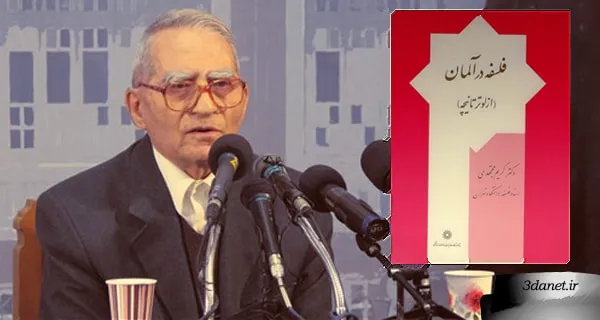
In this conversation, held on the occasion of the third printing of the book "Philosophy in Germany: From Luther to Nietzsche," Dr. Karim Mojtahedi speaks about the topics of this book, explains the reason for its republication, and raises some other discussions about German philosophy and his motivations and thoughts concerning philosophy in our lives today.
Seyed Mehdi Mousavi: The news that a purely philosophical book has reached its third printing can be a suitable motivation for a conversation with its author about its aims, contents, and functions in Iran. "Philosophy in Germany," with the subtitle "From Luther to Nietzsche," is a 624-page account of German thought and philosophy from the 16th to the 19th century, penned by Dr. Karim Mojtahedi. This conversation is a review of the topics of this book, the reason for its republication, and the raising of some other discussions about the book's subject and the author's motivations and thoughts.
— In your opinion, what characteristic does the book "Philosophy in Germany: From Luther to Nietzsche" possess that has led it to a third printing?
The first point I must make is that this book is not purely philosophical, and perhaps the reason it has sold well and gained renown is that it has an interdisciplinary aspect; meaning, in addition to its philosophical aspects, it can also be of interest to historians and those interested in German literature and German poetry. In any case, this book is primarily dedicated to analyzing the thoughts of the great German philosophers, and an effort has been made to ensure the content is understandable while remaining profound. After all, I have been a philosophy teacher for many years, and as a result, I have found an accessible language for expressing concepts, which is also evident in this book and has been influential in the attention it has received.
Furthermore, over 45 to 50 years of teaching at the University of Tehran and, more recently, at Sharif University, I have perhaps, if I am not mistaken, seen close to 40,000 students or more. People have seen my face on television or read interviews and articles by me in newspapers and magazines. All of these have influenced the reception of this work. Of course, if we consider these factors and compare the printing and publication of this book with that in foreign countries — where a single book sometimes reaches print runs of hundreds of thousands of copies — one might say that nothing particularly special has happened. But in any case, in a situation where a philosophical book cannot sell more than 10,000 copies in Iran, when a serious philosophy book is printed two or three times, it perhaps indicates that it has something to offer.
What was your goal in writing this book, and what void did you feel that prompted you to write it?
Books exist on some of the topics I have covered in "Philosophy in Germany," but I saw only one void, and that void was depth. There are many superficial discussions that address topics in a list-like manner, but my duty is not to fill a formal void. I wrote this book to fill the void that exists in the depth of the content. Everyone in Iran has heard the name Luther, but where are the accurate accounts to inform people? I am not at all a supporter of Luther, but the issue centered around Luther is one that engaged the German people for 200 years and caused internal wars. We in Iran must know this. In any case, this book is not for rejecting or accepting a particular view, approach, or philosophical tradition, or even the philosophy of a specific philosopher. Fundamentally, no book should be read for rejection or acceptance; rather, a book should be a source for gaining depth and nourishing thought. I wrote the book "Philosophy in Germany" to fill such a void. Let me be honest; I think this very spirit, considering the limited position and resources I have had, has also been influential in the attention given to this work.
You mentioned our need for awareness of the history of ideas. I want to ask whether engaging with German philosophy stems from the importance this subject has held for you personally? That is, does "Philosophy in Germany" hold a particular significance and implication in your view? What is this implication and significance?
"Philosophy in Germany" is in fact quite specific because it emerged with a kind of delay. In the 16th and early 17th centuries, the philosophies of Francis Bacon and Descartes were prominent in England, France, and some other parts of Europe, but in Germany, due to the wars that were taking place there in the 17th century and the rather unfavorable conditions prevailing in universities, scientific centers, and even the daily lives of individuals, there was not much opportunity for the growth of philosophical thought. However, at the end of this same century, Leibniz appears, and in a sense, German philosophy begins with him. In other words, German philosophy began with a kind of delay compared to other European countries, but it achieved an extraordinary flourishing in the second half of the 18th century and the first half of the 19th century. In truth, German philosophies and philosophers are the heirs of English and French philosophies, but they have practically reached greater depths than them; that is, European thought found depth and brilliance in these philosophies. This matter can be seen in comparing the philosophy of Kant, Fichte, and Hegel with the philosophy of Bacon and Descartes. German philosophers think multi-dimensionally and, for example, do not limit themselves solely to the rationalist school or the empiricist school, but rather raise issues more profoundly.
In your opinion, why did such a thing happen in Germany, and why did German philosophy acquire such a characteristic that you refer to as depth and multi-dimensionality of thought?
It seems that this was influenced by Germany's history. In the book "Philosophy in Germany," I have referred to this history and have especially dedicated a discussion to Luther's reform movement. The currents of this movement were a crisis in which the Germans were situated. They went through severe social crises, and for this reason, various issues are addressed in German thought. For example, Leibniz's philosophy can perhaps be said to be an attempt to confront these very crises through the creation and proposal of a harmony. Leibniz's philosophy is a kind of philosophy of harmony, and after him, other philosophers did this in their own way. Even the actions of Frederick II — who is one of the main princes of Prussia and to whom a discussion in the book is dedicated — can be explained in this same direction and within this same framework. He specifically strove for the advancement of Germany and tried to regain and unite all the territories that Germany had lost. In a sense, his actions are the prelude to what created the unification of the Germans in the 19th century and gave a central unity to the country of Germany.
I wanted to ask what relevance philosophy in Germany and your book have for us Iranians in the present era? Of course, the fact that the Germans, through the crises they endured and the efforts they made in practice and theory to overcome these crises, achieved a distinguished and profound philosophy can to some extent indicate the aspect of this relevance, but I wanted you to state this matter specifically.
Anyone can have their own thoughts and stance on this matter, but in my opinion, there can be no doubt about the role and contribution of philosophical progress in the elevation of German culture and society. I do not know to what extent we in Iran attribute such a contribution to philosophy, but I personally hold the belief that thought and philosophy are the depth and essence of culture. Science, industry, art, and so on are also influential in culture, but where this culture finds depth is in human thought. I believe that philosophy creates reform, creates progress, frees us from superficial thinking, and gives depth to perspectives. Philosophy can even transform our planning. For example, one of the issues that has been talked about a lot in our country for some time, and especially these days, is the problem of environmental pollution, which has affected our entire lives. Well, I tell you that the cause of this environmental pollution is also a kind of cultural pollution. Philosophy can create deep awareness regarding this and similar issues.
Someone might say, "I don't attach importance to philosophy." Well, that is their opinion, but I believe it is very important. I have studied history, and history shows me that philosophy can have a fundamental presence in all these matters, and it must be given a great deal of attention.
I once gave a lecture on the Italian cultural revival. After my talk, a young man said to me, "I heard what you said, but where can I talk about Pico della Mirandola?" In fact, he imagined that he needed to find a conversational use for what he had heard from me and, by employing these things, to have a place to display his learning and express an opinion. What I can say in response to such notions is that by reading a philosophical book, by reading Descartes and Kant, you gain depth and your mind becomes stronger. It is like taking vitamins or exercising to compensate for a physical weakness. Philosophy is this, and not a matter of acceptance or rejection. Kant's philosophy was called into question by the refutation of Newtonian physics. In this case, if someone writes a book about Kant's philosophy, it does not necessarily mean an invitation for you to accept Kant's philosophy. What is at issue here is that teaching Kant and showing the ups and downs of Kant's thought cultivates the young person's thinking and creates a profound mentality for them, who may then also become interested in studying and examining Kant's thoughts further. There is no harm in this either, and the principle is that we prevent a state of stagnation.
In any case, one reason for writing the book Philosophy in Germany was the lack of a comprehensive book on this subject, another was to compensate for the lack of depth in the material on this topic, and a fundamental motivation was to encourage and stimulate young people to study with this book. Our youth must find motivation and not be afraid of studying and knowing. We must not fear the unknown.
Certainly, many people are still not familiar with this book of yours, and for this reason, it would not be amiss to also refer to the book's contents. The book Philosophy in Germany has a historical beginning, and you first address Germany in the modern era in an introduction, and then the Lutheran movement, and through this, you enter into the subsequent discussions.
Yes. In explanation, I must say that the 60-page introduction to this book is very important, and in it, the relationship between the socio-economic situation and the beliefs of the German people is discussed. This introduction is more historical in nature and is dedicated to the period of the cultural revival in the West, that is, the late 15th and early 16th centuries. In fact, this discussion connects with the subsequent discussion—namely, the discussion of Luther and the Lutheran movement—and together they occupy 100 pages of the book. These discussions are a kind of report on the history and politics of Europe and Germany in that period, which was accompanied by war. These discussions, which can also be used by non-philosophy scholars in terms of historical studies, show how today's Europe was formed from the conflicts and agreements of the countries of Germany, France, Italy, and Spain during the Thirty Years' War. In this context, the Lutheran movement—from which modern Germany also, in a sense, emerged, and without attention to which the history of Germany cannot be understood—is discussed.
Subsequently, in the following chapters of the book, you have addressed Germany and German culture in the 17th century and spoken of Leibniz's philosophy. Also, in this period, you have paid special attention to the enlightened despotism of Frederick the Great and have also addressed Wolff's philosophy. Please refer to the discussions in these chapters. Also, tell us what philosophical importance Frederick the Great—as one of the rulers of Germany—had that you included him in your philosophical book.
Yes. Regarding these chapters, I must say that after analyzing German culture from the mid-17th century, I speak of Leibniz as the first famous philosophical figure and, in a sense, the father of German philosophy. The influence that Leibniz had on German thought and, through this, on the whole of Europe, is a very, very remarkable influence. When you examine the history of philosophy with Leibniz, you are at the same time examining the history of modern sciences, including mathematics, mechanics, and geology. It should also be noted that Leibniz was a philosopher who also engaged in politics and was a statesman. These discussions are well analyzed in the book.
Note as well that Leibniz's thoughts led to the emergence, in 18th-century Germany, of a figure like Frederick II — whom I mentioned earlier and who is one of the renowned German princes of that century. Frederick II is famous for having devised a very, very meticulous plan, despite Germany's social, political, industrial, and financial backwardness, to raise the standard of living of the German people and to increase Germany's cultural and military power. In fact, if the new Germany is philosophically the result of Leibniz's work, militarily, culturally, and in terms of military strength, it is the result of Frederick II's reforms. This is a matter of great importance, because it was these reforms that elevated Germany — which was a backward country compared to France, England, as well as Italy and Spain. The term applied to Frederick II is 'enlightened despotism,' which indicates that although this individual was a despot, he created a spirit of modernity and reconstruction in Germany by relying on force and power. The notable point in this regard is that Frederick II's precise plans were implemented with the support of the universities. He is perhaps the greatest European prince who honored universities, turned to them, and empowered them. Despite being a warrior and constantly at the front with his troops, Frederick understood that a genuine, comprehensive advancement is impossible without attention to culture. It was with this view that he revived and empowered the universities in Germany, and most importantly, he well understood the value of thought in progress and made philosophy prevalent again in the universities with extraordinary vigor. This is while in the 16th and 17th centuries, German universities had no prestige whatsoever, and people would go to Italy for education. But the growth trajectory of universities in Germany, through Frederick II's actions, progressed to the point that in the 18th century, a reputable university was established in every city, and renowned professors were present in them.
Christian Wolff is also a philosopher considered one of the main elements of the transformations brought about by Frederick II and is among those who popularized enlightened despotism, their idea being that progress must be achieved by any means necessary. Wolff is, in fact, the philosopher-spokesman for Frederick II and his official philosopher in the universities, and in a sense, Frederick II's cultural planner. From one perspective, Wolff is the founder of German universities, giving them form and depth.
Of course, Wolff's philosophical thoughts are not particularly significant and are tedious, but he can be described as a good administrator and educator who had considerable influence.
The philosophical tendencies of the eighteenth century, including Kant's philosophy, Romanticism, and the thought of certain German poets of this period, are the main topics of the subsequent chapters, and then we arrive at Fichte, Hölderlin, Schelling, and Hegel.
Yes; one of the book's discussions is dedicated to Kant, and his critical philosophy is analyzed from a theoretical, practical, and artistic perspective. Of course, because I have previously written several books about Kant and readers can follow the material on Kant in those books, this section is not very long. Then we come to the Romantic movement and the discussion of poets, and here analyses are carried out regarding the thoughts and especially the aesthetics of figures such as Lessing, Goethe, and Schiller.
Given that I have tried in this book to write more about individuals I have addressed less in my previous works, I have dedicated a detailed chapter to Fichte. In this chapter, spanning about 100 pages, I have — so to speak — pulled out all the stops. This chapter contains material that is entirely new.
Following this, there is an interesting discussion, which may be one reason for the book's reception, and that is a chapter titled
My expectation is that when people read a philosophical book, or a book about a philosopher, or a translation of a philosopher — and unfortunately, our translations are unreadable — they will not necessarily want to agree or disagree with it. We read in order to enrich our minds. Take it from me that philosophy, in the first place, has an educational aspect. This may seem extreme, but I believe that no discipline has the educational aspect and educational effects that philosophy does. When they ask what the use of philosophy is, the answer must be that the use of philosophy is education. A person who reads philosophy finds their mental horizons broadened, and the world becomes vast for them.
When you read this very book, Philosophy in Germany, you are no longer in a corner of Iran, and because you see, to some extent, the geographical, historical, economic, political, and intellectual situation of Western society, a breadth of mind emerges for you, and your thinking is no longer limited. This is education itself, and we must value it.
Regarding education, I must also emphasize that we need to pay more attention to reading, books, and the classroom. This is something that has perhaps faded at the societal level. Perhaps because everyone considers themselves knowledgeable. Many also engage in deception in this regard, passing themselves off as scholars and thinkers, but these people are recognized very quickly.
I also ask people of books and the pen to safeguard the Persian language. We have a good language, but I do not know where our national pride has gone, that we so easily place ourselves in captivity to foreign and English words. This is very bad, and we must also stand against this matter.
.
.
Transcript of a Conversation with Karim Mojtahedi on the Occasion of the Third Printing of Philosophy in Germany: From Luther to Nietzsche
Source: IBNA
.
.



Discussion2 comments
با آرزوی طول عمر برای استاد عزیز دکتر مجتهدی
با سلام ممنون از سایت خوبتون