Philosophy
A Conversation with Musa Akrami on Mir Shamseddin Adib-Soltani’s Prominent Place in Iranian Philosophy
Mir Shamseddin Adib-Soltani forged a singular style in Iranian philosophy through his translation of the Critique of Pure Reason and his coinage of new equivalents from Persian roots. In this conversation, Mousa Akrami examines the scholarly record and legacy of this renowned philosophical researcher.
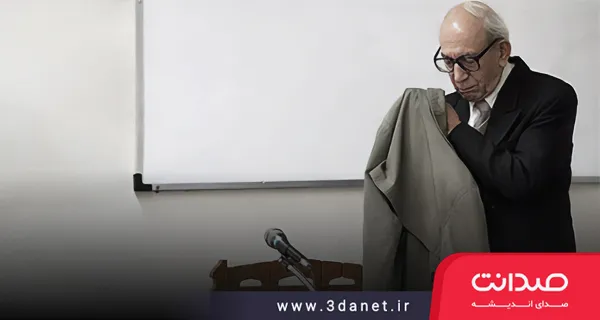
A Conversation of Ham-Mihan Newspaper with Dr. Musa Akrami
The Place of Dr. Mir Shamseddin Adib-Soltani in Iranian Philosophy
Saturday, 14 October 2023, Page 15 (Culture)
Mir Shamseddin Adib-Soltani, the renowned physician, linguist, translator, author, painter, editor, and philosophy scholar, passed away on the morning of Thursday, 12 October 2023, at the age of 92 in Iranshahr Hospital. Proficient in English, German, French, Ancient Greek, Arabic, Italian, Russian, Hebrew, Armenian, Latin, Pahlavi, Avestan, and Middle and Old Persian, he was the first to propose a distinctive style in the translation of philosophical texts to Iranians with his translation of the Critique of Pure Reason; a unique method in which an attempt was made to coin new equivalents for certain philosophical concepts by utilizing the capacities of the Old Persian language and attending to the etymology of words. Reactions to this scholarly innovation were varied. Some considered its unconventionality a clear sign of the audience's lack of reception for this immense effort and, consequently, its futility. There were also those who resorted to sarcasm and irony, and deemed the preference of tashnik over technique, taradad over tradition, nagiray over denial, hamdushesh over adhesion, arvini over empirical, metagitik over metaphysics, dvimchaguyik over dialectic, shayad shush-e nirumand over strong probability, and parhun over circle as nothing but the creation of an artificial language, which, in the words of some, was called "Adib-Ma'ani-k." Others, however, praised Adib-Soltani's extraordinary precision in choosing equivalents and the entirety of his project, and hailed his unparalleled experience as a monumental work, arguing that the Persian language has no choice but to tread this path if it is to become a philosophical language capable of understanding the concepts of this field of knowledge. Adib-Soltani remained silent in the face of most criticisms, but his legacy now lies before us in the form of his translations of Kant's Critique of Pure Reason, Russell's Philosophical Essays, Wittgenstein's Tractatus Logico-Philosophicus, and Shakespeare's To Be or Not to Be and The Tragedy of King Richard III. On the occasion of his passing, we sat down for a conversation with Musa Akrami, a professor of the philosophy of science who also has a hand in translation, to speak about the scholarly record of one of the most prominent scientific geniuses of contemporary Iran, of whom perhaps Mother Time will not bear the like for centuries, and who was a treasure in a corner and a guide without a follower. Hamidreza Rahmanizadeh-Dehkordi, Associate Professor of Political Science at Allameh Tabataba'i University, also spoke with us about Adib-Soltani's scientific ethics and his unique character, which led him to so lovingly dedicate himself for decades to the acquisition and dissemination of knowledge.
The path he opened was attention to the philosophy of translation and the transformation of translation into a highly precise art, for creating the original text in the target language, while remaining faithful to the source text.
When did your acquaintance with Adib-Soltani begin?
Before the revolution, I had heard his name as a very learned and esteemed person working as an editor at the Franklin Institute. From the very beginning, a kind of grandeur in his first and last name became intertwined in my mind with the image that had formed of his erudition. After the revolution, in 1980, his authored book on logical positivism, titled Risāla-yi Viyan: Bāznamūd va Sanjish-i Maktab-i Falsafī-yi Tahassul-garāyī-yi Mantiqī yā Ārvīn-garāyī-yi Mantiqī-yi Ḥalqa-yi Viyan (The Vienna Treatise: An Exposition and Assessment of the Philosophical School of Logical Positivism or the Logical Empiricism of the Vienna Circle), was published by the Iranian Center for the Study of Cultures, which I bought and read at the earliest opportunity and was astonished. That book appeared like a hard rock or the carving of a difficult inscription upon a hard rock, and it was completely evident that we were faced with a difficult philosophical practitioner of steadfast thought. That book, which was called a 'treatise' (resonating with this word in our own philosophical-literary tradition and equivalents such as tractatus and treatise in the Western tradition), possessed a majesty despite its small volume (about 200 pages), yet in the atmosphere of that time, it did not find much reflection except among philosophy enthusiasts and professional philosophy researchers. It was in 1983 that the publication of Adib-Soltani's translation of Immanuel Kant's book, under the title Sanjish-i Khirad-i Nāb (Critique of Pure Reason), was like the appearance of a very bright star in the dark sky of culture and publishing. The printing of this book, apart from the philosophical importance of the original work itself, attracted much attention in its translation and even its typesetting and page layout. Adib-Soltani had written an astonishing introduction to it, a mixture of philosophical and linguistic knowledge and various exercises of taste, and all this showed that we were encountering a wondrous phenomenon in the translation and printing of books, and a translator who was a philosophical practitioner, a philologist, and a linguist. The following year, Adib-Soltani published Bertrand Russell's Philosophical Essays, which, regardless of the content of the work itself and its excellent translation, contained important footnotes analyzing terminology and the reasons for choosing equivalents or coining words. Then, in 1986, the astonishing book Rāhnamā-yi Āmāda Sākhtan-i Kitāb: Barā-yi Mu'allifān, Mutarjimān, Vīrāstārān, Kitābdārān, Nāshirān, Chāpkhānah-hā va Dūstdārān-i Kitāb (A Guide to Preparing a Book: For Authors, Translators, Editors, Librarians, Publishers, Printers, and Book Lovers) was published, which demonstrated the knowledge of a masterful author in understanding the nature of the book and how to present it to the audience, within the framework of the highest publishing standards and creative exercises of taste, both regarding content and form. I think the next book was Wittgenstein's Tractatus Logico-Philosophicus, published in the early 1990s, which was itself an important philosophical and linguistic event in the country. The translation of Aristotle's Logic, the Organon, was a very auspicious event, carried out for the first time from the Greek text with the translator's very important notes, and published in 1999. It was probably in the late 1990s that Shakespeare's important tragic play or tragedy, Hamlet, was published, and immediately thereafter, a book by Hilbert and Ackermann titled Bunyād-hā-yi Mantiq-i Nagarīk (Principles of Theoretical Logic) was released. Every book that Adib-Soltani translated, regardless of the importance of the work itself, was an important event in the Persian language and in the very act of publishing a book at the highest level of precision and sense of responsibility for presenting the text to the reader. It is a pity that, despite publishing his own Guide to Preparing a Book, he never again undertook authoring a work, although his supervision and meticulousness in typesetting and page layout showed to what extent he himself adhered to those principles in preparing a book.
What was the distinguishing feature of Risāla-yi Viyan, Adib-Soltani's first authored work, compared to other authored philosophical works in Persian?
If we set aside The Course of Wisdom in Europe by Mohammad-Ali Foroughi, Inquiries in Theoretical Reason by Dr. Mehdi Haeri Yazdi, a few works in political philosophy by Dr. Hamid Enayat, and one or two books by Manouchehr Bozorgmehr, there was virtually no significant authored philosophical book in Persian, especially in Western philosophy. This book demonstrated that the author had complete mastery of the necessary primary sources and of topics such as the formation of logical positivism in the Vienna Circle and the intellectual atmosphere of that era, employed a distinctive language and a vocabulary all his own, and differed greatly from practitioners of philosophy in the academy, both in knowledge and in commitment to presenting discussions as precisely as possible. I recall that at the beginning of the book, the author had a quotation from Aristotle in Greek, using the word "Anakavik" for "analytics," which indicated from the very outset that we were faced with an author who was a difficult writer, precise to the point of magnificence and a display of erudition—someone I had heard described before the revolution and who had become firmly established on the horizon of my mind. In this book, he had put on display a special language, terminology, and perspective, which later became apparent he had attained and solidified within himself from that time and even before. In the bibliography section, he had also referred to his translation of the Critique of Pure Reason, which was a great promise, and it later became clear that he had arrived at his unique method years earlier.
Even today, there is a gap between the Iranian philosophical tradition inside and outside the university, and many of our philosophical elites have no place in the academy. From this perspective you mentioned, perhaps Adib-Soltani is one of the pioneers of extra-academic philosophy who, at the same time, moved beyond the academy in terms of precision and mastery of the subjects.
That is exactly right. First, he apparently did not submit to the usual methods and bureaucracy of university teaching and learning. It was evident that he was an eagle who, though soaring above the peaks, was also a recluse, yet he did not sit idle and was engaged in his own special alchemy. This became particularly apparent with the translation of the Critique of Pure Reason. This book is itself a colossal work that no one had tackled, especially since we generally still did not have any significant translations of other major works of Western philosophy, apart mainly from the translations of Plato's works by Foroughi, Kaviani, Lotfi, and Sana'i. Now an individual had stepped into the arena who had not only translated the book from the original language, but it was also clear that, along with his mastery of the text, the history of philosophy, and language, he had founded a unique school of translation that, even after forty years, remains his exclusive domain. Adib-Soltani's hundred-page detailed introduction was a remarkable example of the translator's necessary attention to paratextual, intertextual, and textual matters, the likes of which were rarely seen even in European languages for translations of classical works. In this same introduction, he also had a particular classification of philosophy and philosophers, dividing philosophers or philosophies into two categories: cold and hot, which bore a striking correspondence to the division of philosophy into analytic and continental. Cold philosophy proceeds with reason, logic, argumentation, and step-by-step, whereas hot philosophy draws more on emotion, provocation, methods of persuasion, passion, and poetry. Moving beyond the introduction, the translation of the book from the German language was also, and remains, very important in this context. In Iran, translations of philosophical works were mainly done from French or English because our translators were primarily trained in French and secondarily in English. In such an atmosphere, Adib-Soltani had directly turned to the German language. I myself, who had become very interested in Kant before the revolution, turned to Norman Kemp Smith's translation of his important work, namely the Critique of Pure Reason, read it, and became engaged in translating it. When I encountered Adib-Soltani's translation, both from the German text and with that quality, it was natural that I would yield to Adib-Soltani's translation and not permit myself to one day offer my own goods alongside his precious wares and give my translation to a publisher.
Some, like Abbas Zaryab Khoi, have said that Adib's translation is very precise, but many find reading it cumbersome and heavy.
That is exactly the case. Reading Adib-Soltani’s translation still presents difficulties for me, despite all my interest in Kant and Adib-Soltani, and despite teaching this very text of Adib-Soltani’s at the doctoral level in Arabic philosophy. Therefore, understanding this translation requires practice and exercise in Adib-Soltani’s language, along with careful attention to the original terms (primarily in German, and secondarily in one of the European languages cognate with German), so that one may gradually become accustomed to it. In this translation, Adib-Soltani drew upon Middle Persian, Pahlavi, and Avestan languages for coining words or selecting parts of compound words. Of course, he also employed sometimes difficult Arabic words. This greatly unsettles the mind of the reader who prefers ease or is accustomed to the words of the standard language. Adib-Soltani combines extreme purism and Arabicism, all, of course, in service of his effort to render the text into Persian as precisely as possible, even at the cost of a difficult style that indeed greatly unsettles the minds of ordinary readers.
Has Adib-Soltani also authored books in English? What is the prose of those texts like?
Yes. Within the framework of his enduring concerns for justice and socialism, Adib-Soltani authored a book in English, published in 2008 by Hermes, entitled The Question of the Left and Its Future: Notes of an Outlooker. I read this roughly two-hundred-page book in a single seven- or eight-hour sitting because it is written very fluently. The book possesses both beautiful prose and highly readable content from someone who, at the age of twelve, became a member of the youth organization of the Tudeh Party. I should mention here, in parentheses, that after a conversation with the late scholar, it was decided that we would hold an event to introduce, review, and critique this book. On the eve of the event, he, with his own particular considerations, declined to attend the session, and unfortunately, the session did not take place. In contrast to the fluency of that text, reading Adib-Soltani’s Persian text is difficult. Perhaps Persian is still a language that has not attained the requisite maturity for a uniform philosophical writing style, and one must practice and exercise within it. Perhaps the path is precisely that of Adib-Soltani, and he should be considered an outstanding master for translators, especially translators of literary and philosophical works. He teaches translation, and the special language of translation, to philosophical and literary translators. Individuals such as Mohammad Reza Nikfar believe that the future language of our philosophy is precisely this language of Adib-Soltani. This statement may be somewhat exaggerated, but in any case, if our philosophical language is to become a powerful and rich language, capable of conveying the semantic load of Western philosophy and philosophizing in the present and future, we must more or less tread a path like Adib-Soltani’s. This does not necessarily mean imitating him, but in any event, one must become ever more familiar with language, the nature of language, the roots of language, the capabilities of language, the resources of language, and the history of language. Yet, alas, the reader sometimes prefers ease, while the standard language truly lacks the capacity to convey the concept. However, readers accustomed to the standard language have difficulty with a language that even prefers ordinary Persian words over Arabic ones.
I myself, in the book An Introduction to the Philosophy of Cosmology, have endeavored to use Persian words. For this reason, it was necessary to provide a glossary at the end of the book, which is essentially Persian-Arabic, because the reader is more familiar with the Arabic word. Abu Rayhan Biruni, in his book Al-Tafhim, which he wrote in Persian, also prepared a glossary that lists Arabic equivalents for original Persian words! Some, of course, say that the common Persian language has become mixed with Arabic, and that Arabic, at the level of vocabulary and not grammar, is a part of our language. This is acceptable, but if we accept that one day the Persian language must become a powerful philosophical language, just as the German language became a philosophical language through the efforts of people like Hegel, we are compelled to follow the same path that Adib-Soltani and others have taken and are taking. Perhaps on this path we need to be more patient and create better, more euphonious equivalents that, while observing the rules of word formation, are also psychologically pleasing to the audience. In any case, Adib-Soltani's work, in its complete and steadfast adherence to his chosen method, is unparalleled, although it has its difficulties. Of course, it has also had its own particular influence to some extent, and many have finally accepted that we must pay more attention than before to the historical identity and evolution of words and concepts, as well as to Persian words and etymology.
Did Adib-Soltani's work have no parallel among his contemporaries?
One can point to examples of word selection or coinage by predecessors. In the past, Ibn Sina, Biruni, and even Suhrawardi, Baba Afzal, and others paid attention to writing in Persian. In the modern era as well, some have focused on word coinage using the Persian language; for example, one can mention the Persian words of Ahmad Kasravi and others, even Foroughi's terms darun-zat (in-itself) and birun-zat (outside-itself). The First Academy showed that there was a significant, methodical tendency in word coinage. It is a pity that this tendency did not become a tradition, although the followers and students of that Academy's members or their like-minded peers paid attention to the past heritage. Those who collaborated on the Mosahab Encyclopedia, or the preparation of the scientific glossary for Pocket Books Publications and the multi-volume dictionary, held this same view. Others like Zabih Behruz, Mohammad Moqaddam, and the authors of the Iran-Kudeh collection also shared these concerns. They even played a significant role in word selection for the army. Unfortunately, after the revolution, the Institute for Humanities and Cultural Studies could not remain faithful to the duties and goals of its predecessors (i.e., about 12 centers like the Iranian Center for the Study of Cultures and the Foundation for Iranian Culture, etc.). Of course, a number of students and followers of the path of those great founders of those centers and foundations were present and made efforts, but the dominant will over the Academy and political managements prevented the continuation of that path and the elevation of the level of expectation in cultural, linguistic, and historical research. Among individuals unaffiliated with centers and institutions, Adib-Soltani's approach, more than the approach of other wayfarers, represented a methodical, full-fledged, and comprehensive adherence to linguistic, literary, and philosophical values. Later, the late Ahmad Aram acted very conscientiously in word coinage in his translation of the Family Medical Guide. Similarly, a group consisting of professors such as Dr. Ebrahimzadeh, Dr. Dianatnejad, Dr. Farhoud, and Dr. Karami had the same approach in their biology glossary. The language of medicine and plant and animal biology is rooted in Latin, which uses prefixes, infixes, and suffixes in word formation. In Arabic, the possibility of word formation in the manner of languages derived from Latin does not exist because that language is based on the conjugation of triliteral and quadriliteral bare roots in a few patterns. But in Persian, which is an Indo-European language, this capability for word formation, similar to Latin, exists. In the utilization of the Persian language, Dr. Mir Jalaluddin Kazzazi is also world-renowned. Others can also be named, but addressing them requires another opportunity.
Was the fundamental and theoretical basis of Adib-Soltani's discussions merely this expansion and opening of the philosophical capacity of the Persian language?
It is not only this. He is attentive to the fact that words, like living beings, possess their own personality, identity, history, interconnections, and transactions, and it is necessary to pay attention to these components in translation. Therefore, one cannot simply choose equivalents for words. That is the work of translating from a dictionary. Through etymological discussions, Adib-Soltani strives to attend to the origin of the word, its meanings, its kinship with other words within a living, interconnected history. For example, in finding an equivalent for paradox, he argues that “para” existed in precisely this sense in Old Persian, and for dox or doxa, which is “opinion,” one can use “dakhsh” and write “pârâdakhsh” instead of paradox. These equivalents are cognate in the two languages and are also very precise in conveying meaning. This kind of equivalent selection or coinage, moreover, allows us to use lexical components to build other cognate words, to make the language agile, and to avoid the Arabicized tradition of our language. In translation, Adib-Soltani rightly seeks isomorphism; isomorphism in paragraphing and sentence structure down to the words. In his view, when an equivalent is chosen, that same equivalent must be used throughout the text, and for all cognates of the original foreign word, cognate equivalents in the Persian language must be used. There are translators who, for the word object in a single paragraph, use several different equivalents such as mowzu' (subject), shay' (thing), obzhe (object), and so on. The reader, however, is unaware of this. It is better for the translator to always use one equivalent for this word, and for the cognates of object, to use cognates of that same equivalent. Sometimes, of course, Adib-Soltani himself has not remained faithful to this correct method.
So you have no doubt that in Adib-Soltani’s translations, the concepts of Aristotle, Kant, and Wittgenstein are rendered more precisely?
Yes, more precise but somewhat more unfamiliar. To convey the author's meaning as accurately as possible, one must sometimes coin a new word. Or one must select only one from among synonymous words. I myself believe that synonymous words do not enjoy one-hundred-percent synonymy. It is here that the translator or writer must carefully and delicately select a word from existing words or engage in word-coinage. Word-coinage within the framework of adherence to isomorphism and the belief that no word can take the place of another synonymous word is truly difficult and fraught with scrupulousness. I myself sometimes become entangled in this scrupulousness and am compelled to make a choice that may be difficult for the reader. For example, after extensive examination of the equivalents for evidence in the Persian language and the fact that some of them are also used for warrant, I ultimately, by referring and alluding to Ferdowsi's Shahnameh and the Borhan-e Qate' and several other dictionaries, selected the word 'āvand' and explained my reasons for not using shāhed, qarineh, govāh, and bayyeneh. For other examples of such concerns of a translator, one can refer to the book A Descriptive Dictionary of the Philosophy of Science, which I have translated, and see why we are sometimes compelled to go beyond the level of standard language, to defamiliarize the reader's mind, and to engage them in a serious challenge with the character, identity, and history of the word. This is not anti-Arabism. Rather, it is the perception that the familiar words existing in the tradition of our philosophical language and literature lack the necessary capacity to carry the intended meaning, or are incapable in forming cognate words as equivalents for the cognate terms of the main source-language term. In word-coinage or word-selection, referring to Persian texts, for example from the fourth century AH, from the Shahnameh to the Daneshnameh-ye Ala'i and the works of Abu Rayhan Biruni and the writings of Abu Sa'id Abu'l-Khayr, is very helpful, both in their boldness in utilizing uncommon words and defamiliarizing the reader's mind, and in the words they have chosen. We must utilize the capacity of those works. I have always enjoyed the translations of the late Abbas Zaryab Khoi. But he, like many others, was more concerned with conveying the concept than with fidelity to the text. I do not favor this kind of translation, especially in philosophical works and even literary works, and I learned this view from great figures like Adib-Soltani. Within the framework of that same maximal isomorphism and precision in selecting equivalents, he rightly believed in maximal fidelity to the text. With this view, I believe a philosophical text must be translated in such a way that if another person were to translate that translated text back from the target language into the source language, over ninety percent of the same original text in the source language would be obtained.
Have such controversies also existed in similar Arabic, English, and French translations of Kant?
Yes. Examples can be given here. But allow me to draw an example from my own experience. Having been engaged since before the revolution in reading and translating Kant’s Critique of Pure Reason from Norman Kemp Smith’s English translation, I became increasingly aware of the importance of finding equivalents for Kantian terms. Later, when Adib-Soltani’s translation was published, I was very pleased that someone with such vast knowledge in various relevant fields had rendered the text directly from German into Persian. Subsequently, precisely because of the difficulty of reading his translation, I was tempted several times to complete my own translation and submit it to a publisher. But I refrained for two reasons: 1) the great and erudite Adib-Soltani had translated this text from German, and, as the saying goes, my own modest means were so meager before his that I ought not to present my own possession alongside his monumental work; 2) Kemp Smith had been criticized for translating Kant’s text in an overly positivistic manner, within the dominant positivistic climate of his time. Later, when the translation by Paul Guyer and Allen Wood was published by Cambridge University Press, the very difficulty of Adib-Soltani’s translation for students once again tempted me—with Adib-Soltani’s own permission—to align my translation with that of Guyer and Wood and prepare it for publication. That great man, with his unique courtesy, humility, and erudition, encouraged me in this endeavor. In any case, the selection of terminology and the conveyance of the meaning intended by the author is very important. The established terms in the tradition of our philosophical language have their own history and their own specific capacity for conveying meaning, and one should not necessarily always remain bound to those terms. If, in our tradition, the words ‘critique’ (naqd), ‘reason’ (aql), and ‘pure’ (mahz) have always been used in a particular philosophical context and acquired a specific identity, this leads us to try to escape the obligation of always using them for critique, reason, and pure. We can argue, as Adib-Soltani does, that ‘assessment’ (sanjesh), ‘intellect’ (kherad), and ‘pure/naked’ (nab) are more precise and closer to Kant’s view and to modern philosophy.
Did Adib-Soltani’s literary translations of Shakespeare also possess this same characteristic of being difficult to read?
Yes, they are also like that, but if precision, fidelity to the source language, and genuine learning through reading the text are our priorities, we must read Adib-Soltani’s translation, even though we can respect the translations of Hamlet by Masoud Farzad, M. A. Behazin, and Alaeddin Pazargadi. From adolescence, having made a habit of comparing certain translations with the original text, I had encountered serious problems with the existing translations of that famous soliloquy of Hamlet.
By these descriptions, Adib-Soltani is a translator for the future. Do you agree?
Yes. Of course, I would also add ‘translator for the present.’ The path that Adib-Soltani opened was one of attention to the value of words, the value of grammar, the philosophy of translation, and the transformation of translation into a very precise art for creating the original text in the target language while remaining faithful to the source text. If we do not give in to laziness, and if the Academy of Persian Language and Literature and other relevant responsible institutions also lend their support, a particular language such as Adib-Soltani’s will gradually become comprehensible. Let us note that there are still those who cannot even tolerate ‘Parsi’ instead of ‘Farsi.’ Not to mention other examples such as ‘Espahan’ instead of ‘Esfahan’! They are not even willing to use ‘vazheh’ instead of ‘kalameh’ and its cognates, even if we cite Abu Sa’id Abi’l-Khayr, for instance, on how he used ‘bovazh’ in the imperative mood to mean ‘say,’ et cetera!

Discussion0 comments
No comments yet; let yours be the first voice.