Literature
A Moment with Dr. Shayegan and the Magic Lantern of Time
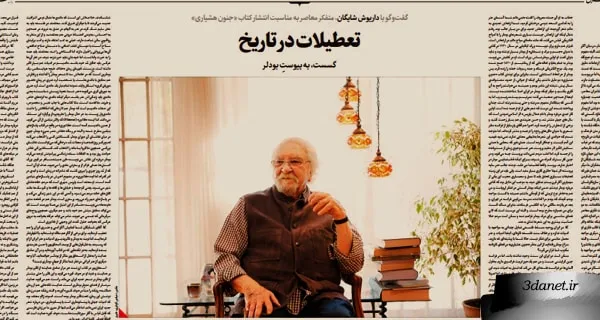
The Magic Lantern of Time, Shayegan's final work, offers Iranian readers a pathway into the vast ocean of Proust's In Search of Lost Time. By exploring concepts such as memory, time, and the psychology of space, it charts an ascetic pilgrimage.
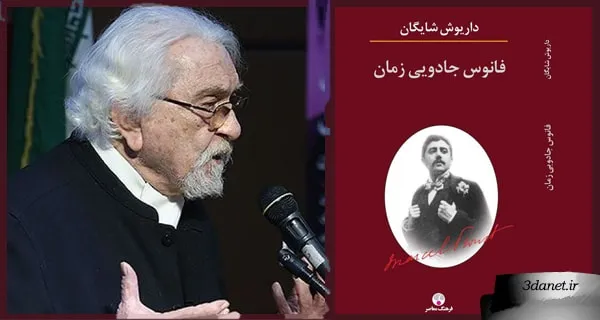
Now the great Dr. Dariush Shayegan has fallen into a deep sleep, and I, with his final monumental endeavor, The Magic Lantern of Time, am accompanying him and the masterpiece of the French Marcel Proust, In Search of Lost Time.
A book that appears to be a tribute from Shayegan to Proust and a greater introduction of him to the people of his own region. In this work, as in an album by a master illuminator, Shayegan looks at a book which, like many, he had read the first of its seven volumes long before the six subsequent books, and returns to it again; this time he becomes so immersed in it that he sees writing about Proust, alongside Baudelaire, as one of his unfinished tasks before his final departure.
When Shayegan spoke of a "patchwork identity" and declared "dialogue" the only way out of the current situation, he himself, through his conduct and writings, visibly became an exemplar of such a path. It seems to me that this characteristic is clearly traceable in this book as well; while we are faced with a text by someone who has not merely read about the two civilizations of East and West, but has lived them in the depths of his soul.
In any case, and apart from what has been said, Dr. Shayegan himself states the reason for writing such a book as follows: "Through a careful study of In Search of Lost Time, I found this novel to be like a vast ocean that leaves the reader without a compass bewildered and lost amidst its waves. So it occurred to me that illuminating the purpose and essence of Proust's unparalleled novel would be a guide for the Iranian reader..." (p. 13) And indeed, with such a book, as Dr. Kamran Fani has said, the master caused many to turn once again towards this immense and voluminous masterpiece.
The substantial introduction of the book is a summary of the reasons for addressing this novel and its importance, as well as Proust's desire, motivation, and ultimate goal in writing In Search of Lost Time.
From within the introduction, the reader becomes acquainted with the novel's keywords such as "resurrection of memory," "involuntary memory," "the question of sleep," "psychology in space," and so on, and through Shayegan's sharp-sighted view, becomes aware of other aspects of Proust's personality and thought: "... Proust, by incorporating the concept of time into his psychology, in fact emphasizes the multidimensional levels and the different, contradictory facets of personality, and by rejecting flat, one-dimensional characterization, constructs a three-dimensional human volume in space whose multiple dimensions emerge not immediately, but with the passage of time, revealing their hidden facets." (p. 26) By addressing Proust's views on the category of time and dealing with it comprehensively, Shayegan goes so far as to see his idea, from the perspective of Camille Vettard, as similar to Einstein's hypotheses.
Further in the introduction, the concepts of "signs" and "mysticism" from Proust's perspective are briefly discussed, the detailed clarification and elaboration of which we see in separate sections. From Shayegan's view, "the reader of the Search is not a mere audience; just as the novel of the Search is not a mere story. To read it, one must roll up one's sleeves and endure the tedium of the path of discipleship, setting out on an ascetic spiritual journey towards the destination of truth. Yes, only in this way can one endure the exhausting search for lost time until the final abode." (pp. 37 & 38)
The book is structured in six chapters, and in the opening chapter, "Marcel Proust before the Creation of the Novel In Search of Lost Time," Shayegan addresses the author's state of mind before writing his masterpiece: "It is true that the novel of the Search was written during the years of Proust's seclusion, but it must not be forgotten that the glorious and highly detailed world of the novel, with its precise and meticulous micro-depictions, was the product of a lifetime of observation by its creator..." (p. 54) This alone is enough to address Proust's circumstances and is, in fact, a prerequisite for a better understanding of the novel. In this chapter, we become somewhat familiar with Proust's life, his family situation, his travels, his completed and uncompleted works, and most importantly, his iron will: "He spent the last three years of his life in bed and lived his unfinished book to the point of coma. His resolute will guaranteed the health of his mind until the final moments. In creating the masterpiece of his life, in pious solitude, he girded himself to refine the countless sketches that were the product of a lifetime of observation, polished them repeatedly with ascetic meticulousness, and like a painter, layer upon layer, page by page, wrote and wrote, until his manuscripts grew so much that, like a creeping plant, they finally swallowed their creator." (p. 80)
In the second chapter, “Dream—Memory,” these two key concepts, which in fact form the very foundation and basis of the novel, are addressed. The “dream” with which the novel begins, along with “memory,” which, as if like a “magic lantern,” encompasses both and, from beyond time, pours various darknesses and lights experientially into the heart and consciousness of the narrator, creates a “resurrection” that becomes the substance of a spiritual journey and a pathfinder for entering Proust’s questing world. “...He who opens his eyes in an unfamiliar and strange space suddenly becomes aware of the depth of his loneliness, and the feeling of loneliness is the beginning of his anxiety... Proust’s novel is the story of a search. Continuous efforts to recover something lost, the struggle of a being in search of its essence” (pp. 88 & 89)
In the same chapter, in the section “Involuntary Memory,” Shayegan, with numerous references to the novel and the author’s statements, speaks of the “self” in Proust’s intellectual geometry and writes: “...This is why Proust pays little attention to reality, because they are not identifiable. He relies on explaining his inner impressions and believes the only way an artist can show the world to the spectator is by delving into his own deep ‘self.’” (p. 107) “...The author’s gaze is continually a retrospective one that emphasizes the manifestation of the past in the present...” (p. 108)
In the third chapter, “Psychology in Space, the Circle of Self—Time—Place,” Shayegan reveals Proust’s profound psychological gaze to his reader and, from this perspective, explores the three categories of “self,” “time,” and “place” in the novel: “The multiplicity of manifestations that take shape and volume on the screen of the narrator’s mind speaks of the multiplicity of ‘selves’ that, layer upon layer, like colored strata for a painter’s depiction, constitute the human personality... In the narrative of the Search, there is no character who can be followed under a specific and fixed definition throughout the story; Swann, Odette, Gilberte, Bloch, Rachel, Saint-Loup, and others appear in different colors under the spotlight of years and emotions, like a dancer whose white dress appears in shades of yellow, green, and blue under the glow of the stage’s colored lights. The selves within us each have an independent character and identity and are sometimes entirely alien to one another. The loving self has no conception of our detached self; the young self within us scoffs at the surge of passion and lust of the elderly, unaware that the spotlight of old age will eventually cast its inevitable ray upon it as well. In truth, the dissolution of the self is a perpetual death. And the stability we naturally attribute to others is as illusory as our own stability” (pp. 120 & 121). This exploration is shown by Shayegan in its deepest form regarding “time” from Proust’s perspective, and by revealing it, prepares the reader for the next, voluminous chapter of his book, “The Search: The Tale of a Spiritual Journey”:
“...Proustian time consists of a succession of isolated moments. Characters and social groups are also subject to this same principle, without gradually undergoing transformation, and they suddenly appear in another form. They change in an instant, as if time’s task is to actualize the potential multiplicity of existence... The concept of time in this novel is coupled with a kind of meaningful confusion, and logical, prescribed temporality is sometimes somewhat annulled...” (pp. 142 & 143). Shayegan continues, citing passages from the novel, to address the concept of time and place, explaining these key Proustian concepts for his reader.
In the fourth chapter, Shayegan examines the novel’s seven books one by one and, by explaining their requirements, pursues Proust’s particular spiritual journey, which is not necessarily related to the spiritual journey as Eastern and even Western man has seen it, with its specific metaphysical and transcendental coordinates. Shayegan begins this chapter with questions, the most important of which, in my opinion, is the reason for the “search” from Proust’s perspective.
"... In this complex struggle, is the narrator of the story in 'search of' reviving his forgotten memories? Does the author mean by 'lost time' the past? And is the narrator in quest of finding his lost past? What is that strong thread that gives unity to this long and sprawling tale? ... The answers to these questions and ambiguities become clear after studying the entire collection. We eventually realize that all of this is the tale of a spiritual journey whose ultimate goal, unlike the mystical and spiritual path, is 'Art'..." (pp. 151 & 152) Shayegan patiently captures this particular journey for his reader from amidst the movements and gestures of the characters in Proust's novel, and by elucidating the trajectory of the novel, shows the goal of Proust's spiritual journey, consequently writing: "... The entire book can be divided into what the narrator has seen and known, and what he has been in search of seeing and knowing... Ultimately, the hero realizes that truth cannot be learned from anyone, and the beauty of the work of art is merely a reflection of the inner vision of the artist's personal self, which he strives to convey to others through his work." (pp. 156 & 157)
In the previous chapter, the goal of Proust's spiritual journey was seen in art; in the fifth chapter, "Art and Essence," Shayegan examines this goal of the author and presents his own findings, based on the novel and its commentaries, to the reader of his book. The author of the book, following the writings of Gilles Deleuze, sees the unifying thread of the novel in a concept called 'apprenticeship or the recognition of "signs"' in the book, and distinguishes the various signs he has seen in the book from one another and then examines them. Among these signs, one can briefly refer to 'signs of society,' 'signs of the world of love,' 'signs of the world of impressions or sensible qualities,' and finally, which is also the highest, 'signs of the world of art.' Although the combination of these signs sometimes appears chaotic, from Gilles Deleuze's perspective, this itself is the unifying thread of the story. "... The astonishing multiplicity of the novel arises from the abundance of heterogeneous signs that have different modes of emergence and logically require different interpretations. Thus, the novel In Search of Lost Time 'derives its unity from the very thing that constitutes its astonishing multiplicity': from signs." (p. 354) Living in this heterogeneous state, which the hero perhaps enters involuntarily, itself becomes the very path of conduct for him and the way to reach his goal: "When the hero of the Search steps onto the path of apprenticeship, he in fact does not know many things, and as he advances on the path of life, he learns them and gradually deciphers their code until he finally reaches the station of illumination..." (p. 362)
Shayegan continues, and after an extensive discussion regarding signs, arrives at the essence of art and asks: "Now let us see what is the 'essence' that reveals itself in the work of art? Essence is difference, the ultimate and absolute difference. This very difference constitutes being; it is what makes the perception of being possible. Therefore, art, which is the revealer of essences, is capable of granting us that which we desperately seek from life..." (p. 368)
"... If we wish to find a counterpart for these eternal essences in life, we must seek it not in the person, but in a profound state: in sleep. The sleeper 'holds the thread of hours and the order of years and worlds in a circle around him,' a wondrous freedom that ends with awakening, when the individual is forced to make choices according to the unfolded order of time. The artistic subject similarly benefits from the illumination of eternal time, a time that is coiled and concealed in essence and contains all the series and dimensions of time. This is the meaning of 'time regained.' Time regained in its pure and absolute state is perceived only through the signs of art... Art, like sleep, is beyond memory. Because it guides towards a pure thought that is the faculty of recognizing essences. What art allows us to regain is time coiled in essence and the very essence of eternity. The work of art bears the highest signs, whose original meaning lies in that eternal intertwining in true eternity, in absolute fundamental time." (pp. 372 & 373)
In a section of this same chapter, Shayegan addresses the question, "Is Proust a mystic?" and, considering the mystical schools that have formed around his ideas, explores this topic. He emphasizes that even if we accept the hypothesis of Proust's mysticism, we cannot impose mysticism in its conventional sense upon him. "...The Proustian spiritual journey is of a kind that can only be realized in the modern world, in a world where all the traditional coordinates of metaphysics have collapsed, and the sole refuge for the human being inhabiting this world, the sole path to attaining truth, is art." (p. 377) Continuing this discussion and while explaining the various "selves" of the human being, Shayegan, while emphasizing Proust's this-worldly mysticism, also makes a reference to Rumi's thoughts on this matter and provides an example of the similarities between the two. "...Does the talk of the collection of contradictory 'selves' within the human being not serve as a reminder, a reviver of an ancient poetic sensibility in the Iranian audience? Can one fail to hear the echo of the word 'self' in Iranian mystical poetry, especially in the poems of Rumi, and remain indifferent to the similarity of its resonance with Proust's 'selves'?" (p. 380)
Shayegan then, by way of conclusion, addresses Proust's beliefs and states: "Marcel Proust believes that on earth and beneath the sky, there are wonders that cannot even be imagined. He knows that life is full of undiscoverable unknowns, and it is precisely these unknowns, with the various forms they assume, that are full of enchantment for him: in the guise of nature, in the form of the ardor and excitement of love, in the shock of memory, in the miracle of dreams. Scientists see the world like a transparent glass house; Proust sees the world like a garden filled everywhere with boxwoods and their shadows. He is a partner to all the landscapes that inspire mystery and elevate him to a sublime realm..." (pp. 388 & 389)
The sixth chapter, "Time Regained," centered on the 'resurrection of memory' and the miracle of sleep, is the arena of the author's "illumination." "Each of the resurrections of memory connects him to a place, for instance, Venice, Balbec, Combray, while these sensory perceptions essentially have no logical connection or demonstrable affinity with those cities... Their commonality is that they are all felt simultaneously in the present moment and in a distant moment in the past..." (pp. 398 & 399) And this is the state in which the author's illumination takes shape for him in such dimensions. If we wish to show the dimensions of mysticism from Proust's perspective, it is undoubtedly eloquent in such a form.
But Shayegan, still questioningly in this final discussion, once again asks Proust and receives answers, so that he might serve as a lantern for the magic of Proustian time:
"But the question is, what is truth? Truth is the knowledge of essence. Where should this essence be sought? Beneath matter, beneath experience, beneath words. Who is capable of this excavation? The artist. By resorting to which tool? Suffering. 'If happiness is beneficial for the body, it is pain that strengthens the powers of the mind.' Of course, the truth that emerges from pain is not compatible with felicity and health; the shattered face of the aged Rembrandt and the troubled visage of the elderly Beethoven, which were a source of ridicule for the ignorant, bore the marks of the erosion of pain, fertile pain. From the seed of pain, from the grain of sorrow, the idea sprouts, and with this transformation, a measure of its corrosive activity on the human heart subsides..." (p. 412)
.
.
A Moment with Dr. Shayegan and the Magic Lantern of Time
Author: Masoud Ghorbani
.
.

Discussion4 comments
با تشکر از جنابعالی به خاطر مطلب بسیار مفید و زیبایتان. سوالی که برای بنده به عنوان کسی که هنوز جلد اول را نتوانسته تمام کند مطرح است این است که آیا قبل از خواندن خود رمان باید کتاب استاد شایگان را خواند یا در کنار آن.
عالی است بسیار عالی متشکرم
آقای قربانی بی نهایت از مقاله ی شما لذت بردم و بهره مند شدم و از آقای نوبری که این نوشته ی شما را در اختیار من گذاشتند به جان سپاس میگزارم
ممنون از شما آقای قربانی که اندیشه های مرد متفکری همچون داریوش شایگان را برای ما تشریح می کنید تا بلکه به این وسیله میزانی از فعالیت فرساینده اندوه بر قلب ما فروکش کند.