Religion
A Progressive Research Programme
Religious intellectualism is a 'progressive research programme' that explicates revelatory data and generates theory. Fanaei's work, especially in the ethics of religious studies, testifies to the programme's progressiveness and its critique of both tradition and modernity.
The current known as “religious intellectualism” has two different faces: a socio-political face and a thought-oriented face. The most suitable framework for examining the thought-oriented aspect of religious intellectualism is the methodology of the “research programme.” Since I have discussed this topic on other occasions, I will refrain from elaborating further here. My claim here is that the research programme of religious intellectualism, which can be called “religious new-thinking,” is a “progressive research programme.” In Lakatos’s view, a “progressive research programme” stands in contrast to a “degenerating research programme.” Research programmes are classified according to the theories they produce. A progressive research programme produces a chain of theories with the following characteristics:
1- Each new theory in the chain of theories is capable of explaining the previous successes of the theory before it. In other words, all the testable, unfalsified results or predictions that exist in the previous theory also exist in its successor theory (the new theory).
2- The new theory has more testable results than the previous (superseded) theory.
3- Some of the new and additional testable results or predictions pertaining to the new theory have been confirmed by reproducible empirical tests.
The first two characteristics are theoretical in nature, and the third is empirical. A progressive research programme is progressive both theoretically and empirically.
When a research programme is applied in the field of religious studies, it deals with “revealed data.” A research programme must be able to produce a set of theories that are directed at “revealed data.” What is meant by theory here is “a network of concepts, constructs, and propositions that are logically connected to one another and explain the existing data in a specific field.” The dominant paradigm in the seminaries and among traditional clerics has also produced and cultivated various theories to explain revealed data. The set of traditional theories in our society is structured in such a way that it can also be referred to as a “research programme.” One might ask: what would a progressive research programme mean in the context of religious studies?
First, it must produce theories that can explain data interpreted by other theories and leave no previously explained data without explanation. Furthermore, it must be able to explain data that were not explained by previous theories. We may have had theories before that seemingly explained the existing data, but after a while, the adequacy of these theories in terms of internal coherence, comprehensiveness, or relevance to the data is called into question. The new theory must be able to explain the data while defending its adequacy against the criticisms raised.
Second, it must be generative and productive. A progressive research programme must have the capacity to present more theories and, in fact, answer more questions. Degenerating research programmes have no answer to new questions and try to ignore them and deliberately consign them to oblivion.
Third, it must be able to disambiguate vague and unclear cases and yield specific, understandable, and evaluable results. Its clear and distinct results must enjoy the support of arguments and information derived from the data and possess acceptable validity.
A comparison between the research programme of religious intellectualism and other research programmes can convince us in judging the progressiveness of this programme.
The body of writings by Dr. Abolqasem Fanaei is, in my opinion, a very good indication of the progressiveness of the research programme of religious intellectualism. In particular, his recent book (The Ethics of Religious Studies) is among the most outstanding works carried out within the framework of the research programme of religious intellectualism. I will point out some of the distinguishing features of his works, which more or less also indicate progressiveness.
First. The perfection of religious intellectualism lies in the simultaneous critique of “tradition” and “modernity.” Although religious intellectuals belong to the modern discourse, they do not welcome the “monologue of modernity.” They engage in dialogue with modernity, and a critical dialogue at that. One of the main afflictions of religious intellectualism is surrender to the “monologue of modernity”—an affliction that has blighted some works of religious intellectuals in recent years. Fanaei has shown that he does not submit to the wholesale acceptance of everything new or passivity in the face of modern products, and he adopts a critical approach toward them everywhere.
Second. Familiarity with tradition and the capacity for deep critical engagement with it has been one of the strengths of religious intellectuals. In Fanaei’s case, however, we encounter not merely familiarity but a profound mastery of seminary learning. Every part of this book demonstrates his acquaintance with traditional teachings and his ability to analyze them critically.
Third. Fanaei’s critical approach extends even to the achievements of religious intellectualism itself. He analyzes the prior achievements of religious intellectualism, provides new arguments to support them, refines and reconstructs the form of their reasoning, disambiguates them, and removes confusion and weaknesses. On the whole, he reinforces the strengths and eliminates the weaknesses.
Fourth. Fanaei does not merely answer existing questions; he poses new questions and opens up fresh horizons before us. The questions he raises are not merely a kind of mental exercise; he poses important and effective questions, the answering of which is considered a significant step forward.
Fifth. His language is refined and his method is analytical. He classifies well, argues clearly, selects appropriate words to convey meanings, and creates new combinations. His writings, on the whole, bespeak a disciplined, well-trained mind and a language capable of conveying concepts. An Iranian philosopher (Dr. Shayegan) once said that he considered analytic philosophy to be more hygienic for Iranians. Fanaei’s writings show what a palatable fruit can be borne if we place the clarity and precision of analytic philosophers at the service of the fundamental issues of our own society. In his writings, we encounter no undefined concepts or unsupported claims, and this must be regarded as a great achievement for the new generation of religious intellectuals.
Sixth. Appropriate and correct utilization of revealed texts is another feature of Fanaei’s works. He offers fresh interpretations and construals of concepts found in revealed texts, which, in addition to covering the previous applications of these concepts, also find new applications for them. In particular, by clearly demonstrating the incompatibility of certain ancient interpretations with other components of the geometry of religious knowledge, he effectively points out the weakness of traditional interpretations of religious concepts, despite their apparent strength.
Seventh. Religious intellectuals have striven greatly to interpret religion in a way that answers the theoretical questions and provides solutions to the practical problems of “our age.”
Moreover, in their understanding of religion, no contradiction is seen between religious beliefs and the credible sciences and accepted values of “our age.” This focus on demonstrating the “capability and dynamism” of religious thought sometimes makes them neglect to emphasize the necessity of religiosity and faith in religion for having a desirable life. The prominence of Fanaei’s works lies in the fact that one can constantly perceive his emphasis on the necessity of religiosity in the modern age and his effort to establish the truth that “religion is a necessary condition for the happiness of contemporary humanity.” Fanaei’s works, in addition to strengthening the modern outlook in a person, also strengthen their need to cling to religion.
Dr. Fanaei’s writings and books should be welcomed for living a faithful life in the modern world. His research program promises us sweet and enchanting fruits.
.
.
A Progressive Research Programme
Author: Alireza Alavitabar
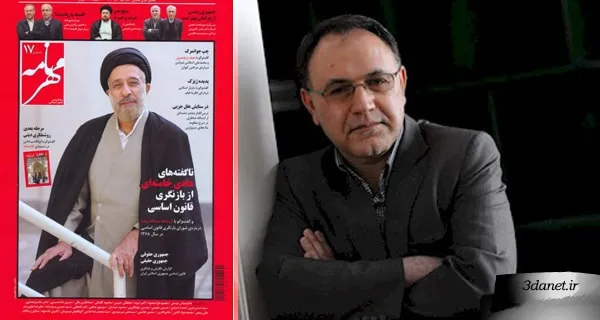
Source: Mehrnameh Monthly, Issue 17, Azar 1390
.
.



Discussion0 comments
No comments yet; let yours be the first voice.