Religion
Examining the Record of Religious Intellectualism in Iran: A Conversation with Alireza Alavitabar
Alireza Alavitabar identifies four defining traits of intellectuals—modern discourse, a critical outlook, human-centeredness, and social commitment—and examines the record, challenges, and current standing of religious intellectualism in Iran from the Constitutional Revolution to the present.
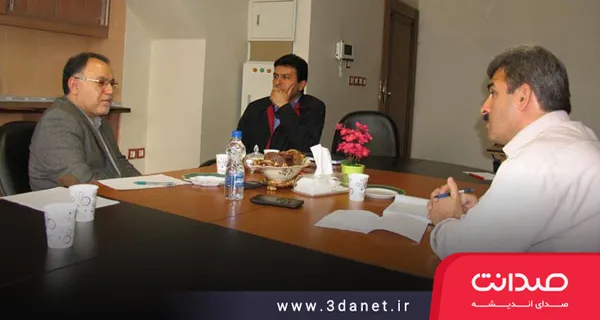
Moloud Bahramian: The subject of religious intellectualism in Iran, which began at the time of the Constitutional Revolution and has continued to the present day, has witnessed its own ups and downs throughout this period. Various opinions and perspectives have been presented regarding the duties of religious intellectuals and the context of their enlightenment, considering the economic, political, social, cultural, and religious conditions of society, which have sometimes aligned with and sometimes opposed one another. Furthermore, the definitions offered for religious intellectualism each delegate specific responsibilities, commitments, and duties to them. Generally, what is common in the definition of religious intellectualism is the discussion of enlightenment, which considers the commitment and duty of this spectrum of society's intellectuals throughout their lives to be the illumination of public opinion, increasing their awareness and knowledge of the conditions of their time, and bridging the gap between tradition and modernity. In the meantime, a new definition of intellectualism is derived, which is based on two foundations: first, a socio-political function, and second, an intellectual function. We aim to discuss the religious dimension of intellectualism in a conversation with Dr. Alireza Alavitabar, journalist and religious intellectual, to explore what ups and downs it has undergone since the topic was first introduced, and what factors from the beginning of the Enlightenment period in Iran have led to the formation of this dimension of intellectualism? Have religious intellectuals been able to fulfill their duties? At what juncture in its history does religious intellectualism currently find itself? Is religious intellectualism grappling with problems and obstacles? If there are problems, in what principles does the way out of these difficulties lie? Has religious intellectualism been able to play a special role in the direction of pluralism and the convergence of Iranian ethnic groups, religions, and minorities? These questions and others have been raised in this conversation, which you will read below.
- The subject of our inquiry is the phenomenon of religious intellectualism, which has had an effective and undeniable presence in our country for about the past century. As an entry point to the discussion, I would like to ask: by what characteristics is the intellectualism that has been realized in developed and developing societies distinguished from other social currents?
Usually, attempts have been made to provide various definitions of the intellectual; I try to make an inductive definition of intellectualism; in this way, let us suppose we come to an agreement on fifty individuals as intellectuals. Then, we extract the characteristics of all of them and call that an intellectual. Because any other path might cause us problems. Other definitions posit a kind of "essence" for the intellectual, whereas the intellectual has no essence. Or their definitions are a form of orientation and valuation, describing the intellectual as they "ought to be" rather than "as they are."
If we bring to mind a neutral meaning of intellectualism, that is, a meaning to which we do not necessarily attach a positive orientation, I think the intellectuals upon whose status as intellectuals we agree in our country mainly share four characteristics: Their first characteristic is that their discourse is a modern discourse. In the sense that they employ a specific manner of speaking, which uses a network of words and information that is based, on the one hand, on a new system of livelihood and, on the other hand, on a new system of thought (the system that took shape in the world after the emergence of modernity). Their terminology and manner of speaking somehow refer back to the modern mode of livelihood and modern systems of thought, and they all have a modern discourse.
The second characteristic is that their encounter with existing reality (behaviors, relationships between individuals, beliefs and viewpoints, social structures) is a critical one. That is, they call all of these into question using certain criteria, they critique them, and sometimes they criticize the existing situation in favor of a situation they deem desirable in their minds. The third characteristic is that they look at issues from the “standpoint of the human being.” That is, their gaze is directed at the human being and the issues afflicting the human being. Even when they discuss religion, they examine it from this angle: what need does the human being have for religion, or which of the human being’s problems has religion come to solve? That is, all issues are about and revolve around the human being, and it is from this angle that they even examine divine and religious matters. In a way, the human being and the issues afflicting them hold a central place in their discussions. The fourth characteristic is a sense of “social commitment.” They feel that in the society in which they live, they cannot be indifferent to its issues and problems. In other words, they see a kind of mission within themselves, that they must do something for society and advance it from the existing undesirable situation toward a non-existent, desirable one, unlike scholars whose work is purely scientific and whose commitment is solely to scientific standards and who do not feel a social commitment. Academics feel a kind of social mission far less often.
In my opinion, these four characteristics define intellectuals: modern discourse, a critical outlook, looking at issues from the standpoint of the human being, and a sense of social mission.
- Dr. Alavitabar, regarding the fourth characteristic, which is a kind of sense of social mission, do you think religious intellectualism and the act of intellectualism is a prophetic mission, or is the intellectual among the people merely a cultural arbiter?
It depends. In the case of the prophets, after the revelatory experience that befalls the prophet, it transforms them completely (in the existence of all major religions, there is an event in which the prophet gains a direct, unmediated, and non-inferential perception of God or something attributed to God, which we call the revelatory experience). That is, you encounter a person whose beliefs have changed, whose emotions and feelings have been transformed, a new will has been created within them, and their speech and behavior have also changed. That is, a profoundly transformative event occurs for the prophet, and this prophet, in fact, becomes a model that must later be realized in the community. Many intellectuals have not experienced this transformation with such depth and profundity, but they are nonetheless different from the existing situation and maintain a critical distance. I want to say that it is true that prophets have a critical distance from their existing situation, but this distance is more based on a deep existential transformation that has occurred within themselves. In many intellectuals, this deep existential transformation has not occurred; that is, we cannot say they are a breed apart from society. The prophet in the Age of Ignorance, after revelation, is something else; that is, they simply do not fit into that structure. Intellectuals really do not have that much existential distance from the existing state of society, but they feel this state is not good and must be transformed. That is, as you said, they have a kind of judgment and critique, and they may very well not be different from the society they criticize. For example, look at the Prophet: when he says, “Do not lie,” he himself is a person who truly does not lie, or when he says, “Do not commit indecency,” you do not see this characteristic in him at all. But in intellectuals, the distance from the existing situation may not be that great. At the same time, intellectuals bear a resemblance to prophets in that they share the “critique of the existing situation” and the “call to move toward a [different] situation,” but because they are not existentially like the prophets, the situation changes completely. The reality is that prophets are of a different nature.
- That is, do intellectuals have the right to prescribe something, or should they merely judge in a truth-telling and truth-seeking manner?
Intellectuals, regardless of whether they have the right or not, really do prescribe. Any kind of critique requires some kind of criterion. When you reject the existing situation, you must have a defining criterion; in fact, every kind of critique is also a kind of prescription. But the difference is that the intellectual experience does not create that prophetic transformation.
- One of the issues raised today in our society regarding intellectualism is its relationship with modernity. Some scholars have defined intellectualism as reducing and bridging the gap created between tradition and modernity, viewing the intellectual as an individual fulfilling their duty in this transitional state. Whether it was the intellectuals before the time of Seyyed Jamal al-Din Asadabadi, Sheikh Muhammad Abduh, etc.—who noticed this gap—and after that, from the 1940s onward, figures like Engineer Mehdi Bazargan, Ayatollah Taleghani, Dr. Yadollah Sahabi, Professor Mohammad-Taqi Shariati, and later Dr. Ali Shariati, and after the revolution, Dr. Abdolkarim Soroush, Dr. Mohammad Mojtahed Shabestari, Dr. Mohsen Kadivar, and others—how do you assess the efforts of this school of thought? Has their endeavor to reconcile tradition and modernity been a futile effort? In this transitional state, have these intellectuals been able to play their role well or not?
Look, a characteristic of all intellectuals, whether religious or non-religious, is that their discourse is modern; that is, they use a set of terms, words, and a semantic network for speaking that is somehow linked to modern life and thought. However, we do not see a single type of approach among intellectuals in dealing with modernity. A portion of our historical intellectuals have, in fact, arrived at a monologue of modernity, meaning they merely listen to what the modern world says and try to adapt and conform themselves to this discourse of modernity. The late Ali Shariati called this "adaptive Islamology"; that is, this type of intellectual passively accepts what they have learned from the world of modernity and merely introduces it into conversation. Another perspective, which we usually see in religious intellectualism, is entering into a critical dialogue with modernity. That is, we see individuals who, while having a critical dialogue with tradition, also have one with modernity and do not accept modernity passively. In their enlightening practice, it is not a monologue of modernity but a dialogue with modernity.
In my opinion, for implementing modernity in an endogenous way, the monologue of modernity is not sufficient. That is, if we deal with modernity in a completely passive manner culturally, modernity will never become endogenous; meaning we will not become modern from within, unless we enter into a critical dialogue with modernity. Our religious intellectualism is, in principle, based on a critical dialogue with modernity; that is, what Shariati called "comparative/adaptive Islamology." Meaning here, as an intellectual, you are not purely passive but are influential; you accept some things. To the extent that religious intellectualism has moved from a critical dialogue with modernity toward a monologue of modernity, it has been emptied of its identity and undermined, and to the extent that it has remained faithful to a critical dialogue with modernity, it has acted more successfully both in transforming society and in producing a new discourse within society. In my opinion, religious intellectualism has, on the whole, been successful in providing a groundwork for endogenous modernity in Iran, depending on how committed it has been to a critical dialogue with modernity. A passive approach and a monologue of modernity benefit no one, neither the moderns nor the traditionalists; especially today, when we are in a situation where the absolute authority of modernity has also been questioned and modernity has revealed its negative aspects. Overall, I believe that if our religious intellectualism had been able, socially, to provide the necessary social force to advance its perspective, it could have laid the groundwork for an endogenous modernity within the country.
- Dr. Alavitabar, if we speak about intellectualism in an a posteriori manner, viewing religious intellectualism as a characteristic of an "individual" with individualism in mind, and intellectualism as a socio-intellectual project, where do you see the similarities between these two, and what distinctions might they have from one another?
Religious intellectualism has two different faces that we must distinguish from one another. It has had a socio-political face and an intellectual face. Usually, religious intellectualism has tried to act as the leader of a social movement. At times, this movement has been reformist and ameliorative, and at other times, revolutionary and radical. Its other face can be called "religious new-thinking." In fact, religious intellectualism has had a socio-political role that has mostly been directed toward the role of the political or cultural movements of its time. Intellectualism also has an intellectual face, which can best be explained within the framework of a Lakatosian Research Program. A research program where every research program has a hard core and a protective belt of positive and negative heuristics. The "religious new-thinking" aspect is a research program. If you look closely, there are distinct pillars in this research program. One point is the core interpretation of religion; that is, how we understand religion in a way that is appropriate to the credible sciences and accepted values of the modern age, and how we understand religion in a way that is directed at solving the problems and difficulties of the modern world. This is, in fact, the core interpretation of religion. But a point that is often forgotten and is the second pillar of religious intellectualism is that, while it is true that religious intellectualism looks at modernity, modern sciences, and its accepted values, enters into critical dialogue with them, and utilizes them in its religious studies, religious intellectuals have actually also sought to "facilitate religiosity in the modern world"; meaning they not only wanted to offer a core interpretation of religion but also sought how one can live a religious life in the modern age. Of course, their analyses have varied. For example, Dr. Shariati believes that one of the most important characteristics of a religious society is "brotherhood." Believers have a brotherly relationship with one another, and in his analysis, if there is no "equality" somewhere, "brotherhood" cannot be realized. Therefore, he believes that to build a religious society in the modern world, creating "equality" is a necessary condition; because brotherhood cannot be created without equality. Or, for instance, the views held by the likes of Dr. Soroush, who believe a religious society is one where people have faith freely. Therefore, anything that hinders the freedom of a person's inner self, including political despotism, must be confronted. That is, intellectuals are not only focused on critical dialogue; they also have a kind of religious concern about how people can live a religious life in the modern world, and facilitating religiosity in the modern world is one of the pillars of religious intellectualism. The third pillar that is proposed is that religious intellectualism, considering the modern view, the modern interpretation they have of religion on one hand, and the effort they make to facilitate a religious life in the modern world on the other, critiques the existing situation, meaning a major part of their work is "critique."
These three pillars can be seen in all the works of religious intellectuals: an effort for a modern reading of religion, an effort to facilitate religiosity in the modern world (religiosity in the modern world has obstacles, some of which are mental, including doubts that arise about religion and cause skepticism towards religious beliefs, and the modern way of life which can deprive us of a faithful life.) -critique of the existing situation in light of the view of religion and the effort to facilitate religiosity in the modern world.
In fact, in the intellectual aspect of religious intellectualism, we are faced with an intellectual project. Because these three pillars create diversity. They also behave in a very diverse manner. That is, sometimes you see them grappling with the religious text, sometimes their critique is a social critique of what in society prevents us from living a religious life. Sometimes they confront atheistic schools and say these create doubts that distance our minds from religiosity, which is why there is diversity in their works, while we also see a vast expanse that cannot be placed under a single project. I want to say that religious intellectualism does not only mean being a religious believer; rather, a part of it is a socio-political project, and it also has an intellectual part that can be called "new-thinking."
- Where do you see the distinguishing aspect between religious intellectualism and religious reform, religious revivalism, religious new-thinking, and critical traditionalism?
We must see in what sense we are using these terms. For instance, reform means that you preserve a whole and remove its damaged parts, that is, you conduct a kind of pathology of religious thought and behavior and then eliminate the damaged aspects and replace them with other things. Or, for example, religious revival, if it is understood as the "re-Islamization" or "re-religionization" of society or the individual, has a certain application.
Religious intellectualism, within the project of religious new-thinking, is an aspect of facilitating religiosity in the modern world; for this reason, if it succeeds, it brings about a kind of revival of religion; that is, it tries to remove all the obstacles that exist in the path of our faith and religiosity. Some of these obstacles are of the nature of thought, namely the doubts that exist, and some are of the nature of social systems, as you are aware, the efforts of religious intellectuals are also directed in some way toward social reform. If religious intellectualism succeeds and facilitates religiosity in the modern world, in the sense that it removes all the intellectual and social obstacles that exist in the path of faith and religiosity, it will lead to a kind of revival of religion, and we will once again have a kind of turn toward religion; if we accept religious revival as meaning "renewed turn," "re-Islamization," and "becoming religious again." In fact, religious intellectualism, with the project it pursues, is striving for religion to find its proper place within the framework of modern life and for society not to move toward a society devoid of religion and indifferent to religion. To put it more succinctly, religious intellectualism considers religion a necessary condition for human happiness; it may not be a sufficient condition. To be happy, we need many things besides religion; we need welfare, science, and technology; but we cannot be happy without religion either. That is, nothing can fill the place of religion in human life, not art, not philosophy, not metaphysics, nor anything else, not even new techniques of concentration and meditations—these are techniques. Religious intellectualism is, in reality, the revival of this meaning that you actually need religion, and the necessary but insufficient condition for your happiness is religion; whereas in the traditional view, the necessary and sufficient condition for becoming happy is "religion."
- Dr. Alavitabar, for further conceptual clarification, what is your definition of "religion"?
In fact, I see religion in relation to the Prophet's revelatory experience. That is, perhaps this interpretation is an amalgam of the Prophet's revelatory experience and the interpretation of this experience in the form of a set of theoretical and practical teachings. That is, the "revelatory experience" (I deliberately use revelatory experience instead of religious experience) of the Prophet is the central core of religion. I want to say that religion has a core that is mixed with the interpretation presented in the form of a series of theoretical and practical teachings, but the connection to the revelatory experience must be preserved within it. Religion is meaningless without the revelatory experience. In all the major religions of the world, there is a revelatory experience; but this experience is an interpreted experience. Let me put it this way: this is a model of religious studies where the event of the Prophet's revelatory experience occurs, but this experience that the Prophet has is personal and transient, and only he perceives it; in such a way that even those around the Prophet did not benefit from the revelation, and the revelation was only for him. If the Prophet passed away, he would take the revelation with him. To transform this personal experience of his into a lasting and collective message, the Prophet articulates it in the form of the "language/tongue of his people." It does not matter whether you say the Prophet does this or God commands him to. I will not enter into this difference of opinion. Whichever we accept, ultimately the "revealed text" is born. The revealed text is born when the Prophet presents his revelatory experience in the form of the "language of his people." As soon as this happens, a "descent" occurs in the revelation; that is, the first interpretation of the revelation happens when it is cast into the mold of language, and there is no escape from it. One cannot escape this degree of interpretation. Either we had to leave the revelation internal and within the form of the Prophet, or now that it is in the form of language, we must accept the limitations that the language of the people imposes upon it, and religion is born here: an amalgam of the Prophet's revelatory experience and the interpretation of this experience in the form of theoretical and practical teachings.
- If we want to approach the issue a bit more fundamentally, in your definition of the concept of religion, what is its essence and core, and what can we, as individuals endowed with rights in this relatively modern world, expect from religion?
Two discussions arise here. At one point we say that in all religions there is a basic core called the revelatory experience, meaning no religion exists without this experience, but what is the gift of this revelatory experience to humanity? We can ask this question negatively; that is, ask what is it that religion gives us that nothing else can? It seems to me that throughout their history, religions have carried burdens that were not related to religion, they have done other things, they have organized civilization, brought humanity out of savagery, made it law-abiding—that is, they have had a historical legacy, and it is not necessarily clear that these things still need religion today. The main core of religion is "God's transtemporal and transpatial message to humanity." God has given a message to all human beings in all times and places, part of which relates to the world—a specific view we call a "religious worldview" that creates a particular kind of outlook in us; plus a set of guidelines for action. That is, God's message is not only a description and explanation of the world from God's perspective, but also guidelines for behavior; I want to say that religion must have theoretical teachings, meaning it must provide us with a kind of worldview and divine explanation of the universe. In addition, a set of theoretical teachings that are usually either used to organize the outward form of our behavior, which is "jurisprudence" (fiqh), or to organize the content of behavior, which is "ethics"—that is, religious teachings can be summarized in three parts: "religious worldview," "jurisprudential teachings," and "ethical teachings." However, these teachings have been cast in the language of the people, meaning our religious teachings have transtemporal and transpatial principles, and then a series of interpretations in the mold of the conditions of time and place, and the task of the jurist (mujtahid) is to separate that transtemporal and transpatial core of religious teachings from that core bound to time and place.
- Regarding the concept of religious intellectualism itself, some critics of this current believe that this combination is inherently contradictory and paradoxical, because the argument is that intellectualism itself is based on a kind of reasoning and autonomous rationality, while religiosity is based on devotion. You mentioned that one of the characteristics of intellectuals has been to facilitate religiosity; one of the problems and difficulties is that the modernist individual, being reason-centered, cannot be devoted to someone without reason or accept matters from them unquestioningly. What is your opinion on this? Is this objection really valid or not?
Look, those who say these are irreconcilable attribute an “essential” meaning to intellectualism. The word “intellectual” has no meaning beyond our usages; that is, it has no essential meaning that would allow us to say an intellectual is someone who lacks these characteristics. In the real world, how many intellectuals do you know who have no intellectual orientation? I mean, look at the actually existing historical intellectual. If we think this way, we would have to discard all Marxist intellectuals who are recognized as intellectuals, discard the existentialists, discard the liberals—then who would be left? That is, an intellectual who has no line of thought, is indifferent to everything, and holds no fixed intellectual position. Do we even have such an intellectual in the world? This, in my view, is a prescription for intellectuals to try not to be dogmatic and to think freely, which is a very good prescription, but it is not the definition of the actually existing intellectual. The existing intellectuals of our world are intellectuals who have positions and perspectives. You might say they enter into dialogue—yes, they enter from their own perspective. But even in science—where the issue of faith and belief is not raised—if you subscribe to a scientific theory, are you readily willing to discard that theory? The image that exists of acceptance and rejection is, I think, somewhat incorrect. Even in science, we do not easily let go. Philosophers like Imre Lakatos and Popper believe that it is simply not the case that even empirical scientists look at the world with a completely free mind; everyone has theories in the back of their mind, and there are dominant paradigms. What no one today even expects from empirical scientists, they expect from intellectuals. No one’s mind is completely clear and free; we are all oriented toward our theories. This is a reality. The intellectual has no essential meaning, and we all think within the framework of paradigms. Philosophers who say that when you discuss within the framework of a language, you become bound by certain frameworks—meaning our thought is not absolutely free; rather, it is confined by situation and even by language. They present a definition of the intellectual as a non-conditioned being who has no kind of constraint and can change their views and opinions completely freely. Of course, this is a good thing, but it does not correspond with the real intellectual.
You can advise me to be free-thinking! But do you know of an intellectual who has no orientation? Name them. Are the very people who make this argument directionless intellectuals, or do they have an orientation? Each of them pursues a project, has a research program. Those who say that being an intellectual means you must be completely subject to theories—how can they claim that we are pursuing an intellectual project? For instance, suppose we want to reconcile “rationality” and “spirituality.” Well! You have already accepted the primacy of rationality from the outset. The project of rationality might even lead to anti-rationality; it is from within these very modern dialogues that postmodern and anti-rational projects have emerged. On one hand, we accept a project centered on axes like spirituality and rationality and declare our loyalty to it in advance, and on the other hand, we advise others not to do such a thing. I want to say that the directionless intellectual is neither desirable nor possible. It is not possible because of the reality we see in the external world. The mechanism of the mind is simply not such that it enters the world completely without a project and with an empty mind. And if we strip a human being of a set of basic beliefs, and if we want to carry this project to its conclusion, life becomes impossible. The fact that I am now walking on the floor of this room means that the floor of this room is not made of vapor and is solid enough that we can walk on it. If you want to question all your beliefs to the very end and be free, you cannot take a single step. The fact that intellectuals live means that, in practice, they have accepted a set of general rules in the world. The fact that they light a fire and do not throw it on the carpet means they have accepted general principles. But the project of non-dogmatism toward anything has no end and does not stop at religion; it destroys science entirely as well. That is, the postmodern discourse is not such that only religion is damaged in it; nothing remains healthy in it, not even rationality. It leaves nothing of rationality itself remaining, to the point that you become completely indifferent to everything.
From this endless critique, no stability emerges. It is a good prod, but religious intellectualism, firstly, has no essential meaning; you can offer a descriptive definition of it that is compatible with religiosity, just as it can be compatible with Marxism—we also have Marxist and liberal intellectuals. If we arrive at a definition of the intellectual that no intellectual in the world fits, we have done nothing to clarify the concept of intellectualism.
The next point is that there is nothing wrong with religiosity being based on ta'abbud (devout adherence), but adherence to what? The religious adherence that I understand—once "understanding" is brought into it, the question immediately arises: what does ta'abbud mean here? A religious person accepts that the Prophet is a model for behavior, but must they not understand the Prophet and the Prophet's behavior? Can the effort to understand be reconciled with ta'abbud? That is, is religiosity possible without the effort to understand religion, or not? It was possible for the Prophet. Any effort to understand—understanding meaning "the process of discovering meaning, unveiling meaning, and grasping meaning"—once this process begins, "ta'abbud" no longer has meaning. I want to say that because of the distance we have from the Prophet, we are not the Prophet; we are, in fact, confronted with the revealed text left behind by the Prophet, and we place authentic tradition along the same lines. Authentic tradition is also a kind of "revealed text" that others have brought to us; hadith, too, if its provenance is authentic, is a kind of "revealed text." For religiosity in the modern world, you are inevitably compelled to understand religion. When understanding is raised, it means the effort to unveil meaning. Once you enter this discussion, even those who hold an objective view of meaning say that meaning is the discovery of the author's intent—they are attributing an intention to the author; you are doing such a thing. I say God revealed this book to His Prophet to convey this meaning. The very moment I do that, I have stepped out of that space.
- So, is a Kantian position being adopted here?
No, I fear that if we take it to a Kantian position, we will make it difficult. Look, in order to be religious, you are inevitably compelled to understand religion. If you enter into understanding, and if you adopt the perspectives on the interaction between author and reader, you have entered another phase. I say even those views that insist, no, understanding must be grasping the author's intent—those called intentionalists in textual interpretation—you cannot say you are asking the author himself about his intent; after all, he wrote his book, and it is you who must discover it. Any effort at discovery, the unveiling that is the condition of understanding, distances itself from ta'abbud. That is, religiosity in our world is not truly ta'abbudi in any form, even in its traditional view; all of these involve discovering meaning, and discovering meaning is a process of reasoning, whether I accept it or reject it. I want to say that in the real world, neither is religiosity entirely ta'abbudi, nor is intellectualism entirely free from adherence.
- An epistemological objection raised against religious intellectualism is that the epistemological authority of revelation, which is among the sources of knowledge for the religious person, has not yet been established. That is, they have not been able to reach a consensus on it, as with other sources of knowledge, and have moved on to hermeneutics, interpretation, and the third phase of intellectual work. Or, in terms of historical reliability, the principled and methodical work that should be done has not been carried out—whether this existing text has been distorted by omission or addition, and whether this revelation is truly the very experience transmitted directly from the Prophet to us or not. You mentioned that in the transmission of this oral concept and this inner experience, a kind of "descent" has certainly occurred. In my view, this objection is valid: that more argumentative work needs to be done on this, and the epistemological authority of revelation is not very clear to the modern individual, and one cannot establish a strong argumentative foundation for it. What is your opinion on this matter?
We must separate two issues. We can have a historical discussion about the authenticity of the revealed text. That is, has the revealed text available to us been distorted or not? Is this existing muṣḥaf the same revealed text that the Prophet himself shaped? Suppose it was compiled and given a particular order during the era of the Rightly Guided Caliphs, or was it something else entirely, with parts of it lost? This is a “historical-textological” discussion. I have seen the evidence presented regarding distortion; but on the whole, it seems to me that to the extent one can attain certainty in a historical discussion—note that attaining certainty in a historical discussion can be very different from laboratory experiments and must be judged based on sources and transmission—we can be confident that we are dealing with a book possessing “historical reliability,” and I personally have not seen any convincing reason for the distortion of the Qur’an and its lack of authenticity, and the definitiveness of the revelation’s issuance can be accepted to an acceptable degree. On this matter, I look at it more from a critical traditionalist perspective. Why should I set aside this belief of mine? If the reasons presented are not convincing, there is no reason for me to abandon my beliefs regarding the authenticity of the revealed text.
But regarding the authoritativeness of this experience, assuming the historical authenticity of the text is accepted, is this acceptance of the text authoritative for people other than the Prophet himself, or not? This discussion, of course, is raised in the West concerning religious experience: does religious experience have epistemological authority or not? This subject depends somewhat on one’s view of the issue of “justification.” In defining knowledge, it has been said that knowledge is “justified true belief.” Regarding justification, there are various theories with different classifications. We have views of a doxastic or non-doxastic nature, internalist and externalist views. With some of these views, one can defend the epistemological authority of revelation for others—other than the Prophet—and vice versa. For example, an epistemologist like Alvin Plantinga has proposed views on the epistemological authority of the revealed text in which, with that same historical reliabilism, he defends the epistemological authority of revelation. It seems to me that this discussion depends on accepting which epistemological view we adopt. Within the framework of some of these views, authenticity is defensible, and in others, it is not.
If we look at the issue in another way, we actually have a revealed text, we extract certain perspectives from it, and through it we have arrived at a belief; what reason is there to abandon it? This is the same critical traditionalism. For example, suppose you have arrived at the belief through revealed texts that “an absolutely benevolent, omnipotent God exists.” There is no reason to abandon this belief unless strong doubts, such as the problem of evil, are raised against it. If the problem of evil is answered, there is again justified reason to hold this belief. In my view, within this perspective, religious people should have confidence in their religious beliefs; in other words, I defend critical traditionalism to some extent, and the principle is that our religious views are correct and there is no reason for us to abandon them, unless their contrary is proven. Wherever they present evidence and we are able to refute it, it is reasonable and justified for us to maintain our beliefs. For instance, the “problem of divine hiddenness,” which attempts to call the existence of God into question, if we can refute that doubt with sound reasons, it is reasonable to maintain our previous beliefs. For the reasonableness of religious people’s beliefs, it is sufficient that they do not hold beliefs contrary to reason, but it is not necessary for all their beliefs to be provable by reason. Wherever there is no reason to reject religious beliefs and convictions, the principle is to maintain prior beliefs, and in the absence of reason, we suspend judgment there, which may lead to changing a religious belief and rejecting it.
I want to say that this passive atmosphere that existed regarding religiosity, where we as religious people feel embarrassed and ashamed of being religious, the modern world has moved past that, and religious people need not be ashamed of their religiosity.
- What do you consider the successes and failures of religious intellectualism in Iran? (Achievements, obstacles, and problems on the path of this project) Has religious intellectualism been more of a macro-oriented and center-focused project, or has it also functioned as a socio-political project? For example, what has been the role of this current and its relationship with convergence among ethnic groups, ethnicities, and religious minorities? Has religious intellectualism fostered tolerance, forbearance, non-violence, and acceptance of others within Iran's diverse and variegated society, or not?
I mentioned that religious intellectualism has two faces: it has had a socio-cultural face, which has been more present in movements, and an intellectual face. We can conduct a pathology of both. You see, in the intellectual dimension, we had a period of excess in the monologue of modernity. That is, religious intellectualism began with a critical dialogue with the West, then fell into a kind of passivity and avoided critical dialogue. It tried to adapt itself to modernity. I think in recent years we have been emerging from this state. That is, gradually, sprouts of a generation of religious intellectualism have appeared that seek to compensate for the monologue of modernity and have entered into a critical dialogue with modernity. This was one type of pathology.
Another pathology of religious intellectualism is that this current had a problem in its dialogues. It seems to me that we did not enter into a serious dialogue with the Islamic world. For example, we heard the words of Mohammed Arkoun or Nasr Hamid Abu Zayd marginally; but the reality is that intellectualism could not become a current that speaks with its counterparts throughout the Islamic world and engages in dialogue with them, transcending the historical Shiite and Sunni sects; because these sects have been formed historically. Even in a period when we could have, we did not want to or were unable to establish communication with these intellectuals of the Islamic world, bring them to Iran, have intellectual exchange and discourse with them, and have them express their positions and views.
If religious intellectualism wants to survive, it must transcend this sectarian framing. Meaning that before we have a sectarian discussion, the Quran itself—on which we apparently have no disagreement—is an issue for us, and we must reach an agreement on it. Starting from the Quran, as dialogues prior to sects, is a trans-sectarian topic. It seems to me that religious intellectualism was not successful in this regard.
Another pathology of religious intellectualism is that it was not successful in institution-building. Given the growth of new, easily accessible technology, we could have had an encyclopedia on religious intellectualism that anyone wanting to study topics of religious new-thinking could refer to, but we could not achieve this. We could not produce continuous and sustained journals, and it has mostly been sporadic. Of course, part of this failure can be attributed to the crooked circumstances and times; but it seems to me that this is a kind of excuse-making and self-justification. In this virtual world, could we not have had an online journal where we wrote continuously? Or, for example, suppose regarding the lack of institution-building, during the months of Ramadan and Muharram, we have no place to express our ideas. No one knows what our relationship with supplication is. Whereas we could have had centers where we held supplication ceremonies and stated that our relationship with supplication is not one of negation. We may oppose distorted supplications and supplications that insult the wives or companions of the Prophet (PBUH), but we are not opposed to the principle of supplication, which has a serious place in religion. We could not have our own specific mosque. For all these cases, we have excuses to shift the blame onto others, but the reality is that we did not invest seriously in it.
It seems to me that we should have certainly fostered a Sunni reformist movement within the country, assisted it, connected with it, and entered into dialogue with it, but we have not invested in this matter either. For example, in Sunni regions, there may be a danger of fundamentalism, and apparently, these types of movements attract the youth better than we do. I emphasize again that our reformist movement failed to become trans-sectarian, and there needs to be an Islamic religious reformism in which both Shias and Sunnis are seriously active, one that goes beyond these historical sects and makes Islam itself its main subject.
In the center and in large cities, we have almost defeated the opposing side ideologically and emerged victorious. However, in the peripheries and rural areas, we have not been able to take the ideas there, and regarding many of the discussions we have raised, we have not been able to delve into the details and behavioral patterns; for instance, how does a reformist believer worship and how do they establish a relationship with God? We have spoken a great deal about these matters theoretically, but we have not been successful practically, whereas the existence of a mosque would fill this void. One of the most significant dangers threatening religious intellectualism is following the common people. Our intellectuals criticize the government more easily than they do the common people, and they fear the people; for this reason, they constantly praise the people, whereas the people are not so praiseworthy. And there are times when they should be criticized—more than the government—saying, 'O people, you provide the groundwork for many deeds, and governments then carry them out.'
- So you believe in a kind of cultural development and the primacy of culture?
No! I am saying that the state and government are important, but social forces must not be neglected. Our intellectuals only praise the people, whereas the people often err and follow certain paths, and bad governments feed off these very people and ride on the people's ignorance and greed. Yet we, as intellectuals, do not criticize the people. Another harm to religious intellectualism is feeling passive and fearful in the face of secularists. Sometimes religious intellectuals think they must do things to please the secularists; there is no reason for this. It is our duty to defend their human rights, but there is no reason to follow behind them and confirm whatever they say. That is, it seems to me that by blurring our identity boundaries, we help neither the people nor ourselves. While insisting on our identity boundaries, we must defend the citizenship rights of everyone, whether secular or non-secular. For example, my presence in politics is an ethical matter; why should they mock it, claiming it is not so and that presence in politics is aimed at gaining power? I do not want political power because, in my belief, for a religious person, status, wealth, and power do not hold primary authenticity. And if this idea can be promoted, it would be a very good thing in the world of politics. But sometimes we fear accusations, and this has been one of our flaws in recent years. Secular intellectuals have insisted in places that religion should not be in the public sphere, and we too confirmed that it should not be present. We must defend the democratic presence of religion in power and in the public sphere, because this is compatible with both being an intellectual and being a democrat.
But regarding the successes of religious intellectualism, I must say:
- The establishment and introduction of academic disciplines such as philosophy of science and epistemology in Iran have been carried out by religious intellectuals.
- Aiding the defense of democracy, aiding the defense of a trans-ethnic perspective, and helping to shape the concept of citizenship above ethnicities and tribes.
It seems to me that religious intellectualism, in the current circumstances, has a damaged but relatively acceptable record, and the most important achievement of this movement was bringing questioning into our traditional domains, and now the questions of religious intellectualism have become projects in our traditional centers. For example, something has been briefly mentioned about religious experience, the expansion of the Prophet's experience, religious pluralism, etc., and dozens of books have been written on these subjects.
- One of the subsequent questions regarding religious intellectualism concerns its relationship with secularism and secularization. What is the relationship of religious intellectualism with irreligiosity and secularization?
I emphasize that we must distinguish between secularism and secularization. I take secularism as equivalent to "irreligiosity" and secularization as equivalent to "the separation of religion." Secularization is the name, description, or theorization of a process, and as far as I know, the term secularization was used in 1646 by the Duc de Longueville, the French representative, in the negotiations concluding the Thirty Years' War (the Peace of Westphalia); whereas secularism is a type of orientation, advocacy, and ideology in the strict sense of the word, and its emergence dates back to 1896 when it was used by George Jacob Holyoake in his book The Origin and Nature of Secularism in England. Secularization had one main claim: that in a modernizing society, the importance and role of religion in directing, organizing, and guiding human thought and behavior diminishes. This process was defended by development sociologists, and it seems to me that today, it has lost its validity. The very person who first proposed this idea later wrote a book titled Disecularization and declared that the theory he had proposed did not occur in the world. In America, the most industrialized country in the world, religion was revived again.
Secularism has no intrinsic meaning and depends on its usage by people, and its historical roots are easily found. We Iranians use it inductively in five senses: 1_ Organizing worldly life independently of religion. That is, living in this world as if there is no God, and if there is, He has nothing to do with us. This meaning is entirely in contradiction with religious intellectualism; because religious intellectualism says, live in such a way that there is still a God, God exists, and one must act accordingly. 2_ The compulsory privatization of religion: that is, religion must be removed from the public sphere and reduced to the inner thoughts of individuals, behaviors of individuals that do not affect anyone, or relationships that are entirely selective, specific, and occasional. What Atatürk in Turkey and Reza Shah in Iran tried to do. Religious intellectuals are not sympathetic to this meaning either and believe in the democratic presence of religion in the public sphere—without imposition, force, or coercion, and accompanied by entering into dialogue with others and establishing religious civil institutions, etc. The three other meanings of secularism relate to the relationship between religion and politics: 3_ The separation of religion from political motivation, discourse, and behavior. For example, when on a hunger strike, do not say we have taken a political fast. Do not say we intervene in politics for the sake of God and His command. In other words, they oppose the use of religious language in the political sphere and the introduction of religious motivations, believing it harms politics. 4_ The separation of religion from the State: that is, in governing, no special privileges should be granted to the religious, religious scholars, theologians, or different religions. That is, you, as a Muslim, Shiite, Sunni, or religious scholar, have no special rights in politics. In addition, laws do not gain legitimacy merely because their roots go back to religious rulings; that is, there is a separation between the rulings of Sharia and statutory laws, and statutory laws have their own specific procedures and are changed through specific procedures, while the rulings of Sharia also have specific procedures for their derivation and change. 5_ The separation of religion from the Government: that is, the government, in public policymaking, implementation, and evaluation, should not be influenced by religious rulings, beliefs, and values. Thus, secularism has five different applications, only one of which—the separation of religion from the State—is necessary for democracy. In this sense, we should not grant special rights to the religious and should accept the equality of citizens independent of their religion and the extent of their religious knowledge, which is necessary for democracy. However, the other four meanings are not necessary in a democracy.
In my view, religious intellectualism comes into conflict with some of these secularisms (for instance, the first conception of secularism). “Live as though there is no God, or if there is, He has nothing to do with us”—this is not at all compatible with religiosity. Religious intellectualism opposes the second meaning of secularism, namely “the compulsory privatization of religion.” However, the separation of religion from government in the sense of eliminating discrimination, accepting the equality of citizens, and accepting the legislation of positive laws is compatible with it. The state can also be religious. We can have a “national government” and a “religious state.” That is, a government based on the equality of all ethnicities and nations, sects and religions, but just as we have socialist states in the West, in our own country we can also have a religious democratic leftist new-thinking state. I believe that a state can make a public commitment that it will not permit or prescribe any conduct that is in definite contradiction with the definitive rulings of the Sharia. There is no problem; it may not win votes in the next term and step aside. And a state may come to power whose prescriptive rulings are in contradiction, but we have no reason to follow their path just to please others.
- In recent years, another classification has been made by one of our country’s renowned religious intellectuals under the titles “political secularism” and “philosophical secularism.” To what extent do you sympathize with these two terms?
The philosophical secularism that has been proposed is the same first type of secularism that I have in mind. What is meant by political secularism is the separation of religion from the state. In fact, I think my classification is more detailed and precise than this division; because I have catalogued the usages in the works of Iranian intellectuals. That is to say, if political secularism is considered to mean “the negation of special rights,” then I, too, accept such a distinction, but for the other four types of secularism, we have no reason to defend them, and we can take a position on them, and as I said, they are not necessary for democracy either.
- Has the hegemony of a kind of liberal discourse over religious thought and the promotion of anti-ideology among some of our country’s religious intellectuals led to the emergence of a generation with hedonistic self-centeredness and a kind of pleasure-oriented individualism or not? If the answer is yes, how?
The reality is that a kind of global atmosphere, opposition to ideology, and the prevalence of various schools of liberalism—and the idea of leaving everything to spontaneous orders or pursuing your own interests, and the public good will be secured—has had a profound impact on our youth who were in the circle of intellectualism. Perhaps one of the Achilles’ heels of religious intellectualism in Iran is “critique without an alternative.” For example, we do not accept the traditional manner of mourning and have always been in conflict with it, and we have very strong and solid reasons for criticizing it that others cannot answer; but merely having reasons against this phenomenon is not enough; we must think about the people’s religious fervor so they can express it somewhere. As a theoretical effort, we have negated the reprehensible matter, but we have not had a substitute or alternative for it. Or, for instance, worship, which is a kind of self-transcendence—religious intellectualism has always been in conflict with rituals accompanied by dogmatism and exaggeration, but it has not replaced them with its own desired congregational prayer. We are dissatisfied with the conventional Friday prayer, but we also do not have our own specific Friday prayer, and we have not been able to introduce alternative institutions.
- How do you assess the future of religious intellectualism in our country?
The reality is that religious intellectualism in Iran is currently not in a very good state. Because it has lost all its platforms and, unfortunately, has been largely paralyzed by peripheral issues, meaning it does not even have the opportunity to write and read. But I think the future situation, especially with the work of the fourth generation of religious intellectualism in Iran, is promising. For example, the recent works of Mr. Arash Naraghi are much more mature than his early and previous works and are progressing, and the same is true of Mr. Abolghasem Fanaei. It seems to me that a new generation of religious intellectualism is taking shape, similar to what exists in the seminaries. From the work I have seen in epistemology from seminary graduates, I see a bright horizon for it, and in a sense, religious intellectualism is being strengthened more than before.
- If you have any views on religious thought in general and religious intellectualism in particular, in the Sunni regions of Iran, I am eager to hear them.
Of course, I feel I must say that I am also concerned about religious thought in the Sunni regions. On trips I have made to Kurdistan and Baluchistan, I have noticed the emergence of a kind of unconventional appearance and attire in those two regions that did not exist before, or at least I had not seen before, and that Salafist views have been greatly strengthened. The reality is that the Salaf, meaning a return to the righteous predecessors, is respectable to us; but I suspect that these currents have somehow appeared stronger than moderate reformist currents in attracting young people — of course, perhaps this kind of formalism also involves a kind of identity-seeking, and one should not judge harshly — it seems to me that the fundamentalist current in the center, despite holding power, has lost its legitimacy and has failed; but I am concerned about these extremist currents gaining legitimacy among Sunni youth. We have had a history of reformism in the Sunni regions that counts as religious intellectualism; it seems to me that this reformist effort has weakened within the community; whereas my impression is that in the center, religious intellectualism has taken away the legitimacy of the opposing current, and that current is only sustaining itself through coercion.
- As a final question, how do you see Mr. Mostafa Malekian's recent approach, and can his recent work be placed under the umbrella of religious intellectualism?
It seems to me that Mr. Malekian has exited the project of religious intellectualism, and by his own admission, he no longer has any concern in this area. When he comes to the history of religion, he acts very rigorously, and I have asked him once or twice myself: Do you apply the same rigor you have regarding the history of religion to the history of science? Do you apply the same rigor you have regarding the compilation of the Quran during the era of the third caliph to the matter of Napoleon's historical defeat? I have also said to him, where does the authority of Western rationality come from, and why must we accept whatever they say? Where does this monologue of modernity come from?
- Dr. Alavitabar, thank you for coming to the magazine's office and answering our questions.
I thank you and the staff of Andishe-ye Eslah magazine.
.
.
Examining the Record of Religious Intellectualism in Iran: A Conversation with Alireza Alavitabar
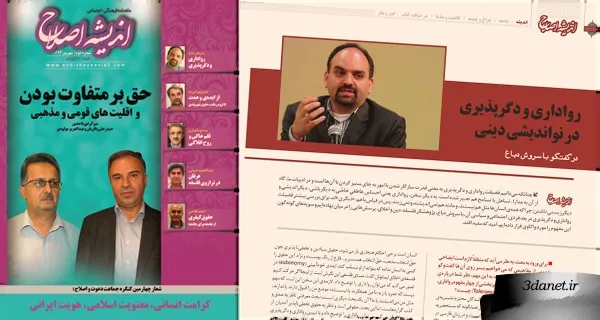
Published in the first issue of the Andishe-ye Eslah Monthly and winner of the Best Interview award at the First Transborder Press Festival of Ilam - Ordibehesht 1395
.
.


Discussion0 comments
No comments yet; let yours be the first voice.