Religion
A Reflection on Religious Intellectualism
Religious intellectualism is not a contradiction; it is the necessity of religious reform for those who regard religious experience as authentic yet find its social forms incompatible with common sense—a challenge that merits reflection from a traditionalist perspective as well.
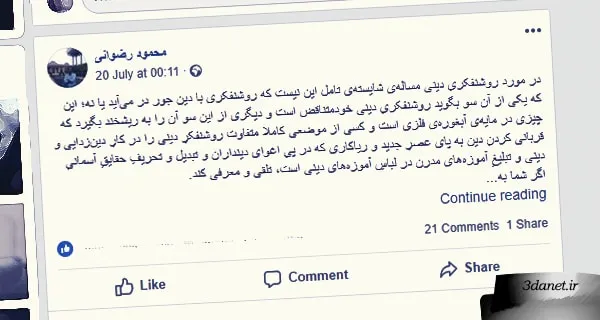
Regarding religious intellectualism, the question worthy of reflection is not whether intellectualism is compatible with religion or not; it is not that one person says from one side that religious intellectualism is self-contradictory, and another ridicules it from the other side as something akin to a metallic verjuice, while someone from a completely different position perceives and introduces the religious intellectual as engaged in secularization and sacrificing religion at the altar of the modern age, a hypocrite who seeks to seduce the faithful, transform and distort heavenly religious truths, and propagate modern teachings in the guise of religious doctrines.
If, for whatever reason, you believe in the necessity of the principle of religion and consider religious experience an authentic aspect of the human essence, belonging to a realm irreducible to secular human tendencies such as self-preservation, personal gain, domination, hedonism, etc.; if you consider the search for meaning not as an accidental and incidental pastime, a kind of neurosis, or an instinctive reaction for a sense of security and overcoming the unpredictability of human life and its dangers, but rather as representing an authentic aspect of human truth, and on the other hand, you feel that in the socially formed and externalized forms and institutions associated with this spiritual and religious inclination, and even in the individual manifestations and precepts connected to spiritual religious teachings, there is something of the nature of obsolescence and incompatibility with common sense and public interest, and excrescences contrary to nature, incongruous, and mind-numbing, you will inevitably be drawn towards a kind of religious reformation and new thinking in the foundations and derivatives of religious teachings, and this will be a real and thought-provoking problem for you, not a pseudo-problem or a hollow, self-contradictory puzzle arising from a confusion of issues and a failure to understand conceptual boundaries.
On this basis, the path of "religious reformers who are believers" diverges from two other groups: the path of those who deny the sacred or have in some way washed their hands of it and severed their hearts from it, and also those who think that religion must be confronted on its own terms and by its own force, and its roots torn out. The first group are those who reproach the religious reformers, asking why the blossoms of the established teachings and values of the modern age should be grafted onto the rotten stalk of the old and degenerate traditional world, and whether it is not better, instead of dissipating energy on the path of reconciling religion and the modern world, to either wholly refute religion or, with indifference and disregard, devote oneself to promoting the accepted and reasonable teachings, values, and relations of the modern age? In their view, the modern age owes no explanation to religion and the religious that it should need to involve itself with them. Mohammad Reza Nikfar's objection to Abdolkarim Soroush, asking why the consolidation and strengthening of rationality should be pursued through the revival of Mu'tazilite reason, symbolically reveals this tendency. Soroush seeks to revive an experience of rationalism that at the same time acknowledges and honors the share of religion and faith, which in his opinion are ineliminable, but this is precisely what is of no importance to Nikfar; indeed, it is contrary to his intentions. The second group are those who believe in neither the truth nor the necessity of religion, nor in its utility, and a fortiori, not in any share or right for it. They only seek to use the appearance of religion for its metamorphosis and to move beyond it. These individuals, more than any other group, may be confused with religious reformers who are believers and faithful. In the realm of religious reformation by the faithful, the main challenge is determining the limits of the authority of conventional reason. Accepting the necessity of religion inevitably requires a metaphysics, however minimal, which presupposes human finitude and the limitations of all human faculties, including analytical and judging reason (in the domain of truths) and evaluative reason (in the domain of values), as well as the existence of generally transcendent truths revealed through exceptional means, providing a theoretical foundation for justifying certain difficulties in understanding the world and the human position in relation to conflicts and ugliness, and a basis for religious hope. Where the boundary lies between the essential and the accidental in what is considered religious, how the divine core is distinguished from the shell adapted to the human condition, and by what criterion the dust of the age should be wiped from the face of the core doctrine, keeping it aloof and immune from historical exigencies, is challenging. The internal difficulty of every religious new thinking becomes apparent here: at the point where we must decide/realize whether we are facing a symbolic and multi-layered expression or a mystery, or a superstition, or an excrescence suited to a bygone historical era, now useless and inefficient... it is there that the difficulty shows its face.
Finally, I find it useful to cast a brief glance, by way of a mere indication, at this religiously-motivated refinement of religion and its concerns from the perspective of Traditionalism/the Perennial Philosophy.
Frithjof Schuon, in two short passages, provides indications that can serve as a basis for understanding his approach to concerns of this kind:
I quote the first passage from the essay “The Meaning of Caste” (translated by Babak Alikhani). Schuon says of a group of critics of the functioning of the caste system: “there have been persons with a religious tendency who have wished to eliminate from the social system what they considered to be injustices that have increased over time… {This} point of view, in determining the value of the facts relating to castes, has often been mistaken and has even frequently erred in the remedies it offers; at the same time, on the basis of a correct assessment of those same facts in the light of traditional wisdom, one can agree with it. The desire to remove defects—which represent a misuse that fallible human beings (inevitable in this world) can introduce even into a sacred institution—is in no way contrary to the traditional way of thinking, provided it is combined with an understanding of proportion and also, generally, with a respectful point of view.”
The second passage is somewhat more general and, in a sense, more explicit. In the essay “The Human Margin” from the book Islam and the Perennial Philosophy, Schuon says (I quote from Forouzan Rasekhi’s translation): “From a wholly different perspective, it must be admitted that the progressives are not entirely wrong in thinking that there is something in religion that is no longer effective; in fact, the individualistic and sentimental argumentation with which traditional piety operates has lost almost all its power to penetrate hearts, and the reason for this is not merely that modern man is irreligious, but also that the customary religious arguments, because they do not plumb the depths of things sufficiently—and previously had no need to do so—are psychologically somewhat outmoded and cannot dispense us from causality. If human societies, on the one hand, degenerate with the passage of time, on the other hand, by virtue of their aging, they accumulate experience, however much their experiences may be mixed with error. This conjunction of opposites is something that must be taken into account if the teachings of the clergy are to be effective; not by extracting new guidelines from collective error, but on the contrary, by using arguments of a higher order, which are more intellectual than sentimental; as a result, at least some will be saved—a greater number than we might suppose—whereas the demagogic, science-struck cleric saves no one.”
What Schuon means by “arguments of a higher order, which are more intellectual” is reliance upon sapiential intellect. That is, instead of recalibrating and censoring! religious matters by relying on modern, secular reason or the “spirit of the age,” they must be reconsidered and interpreted in the light of sapiential principles such as the Absolute Goodness and Divine Justice, or the Transcendent Unity of Religions and the fundamental rightness of creation and, consequently, its natural inclinations. On this basis, for example, divine ordinances cannot hinder the flourishing of a human being’s natural talents under the pretext of their gender, nor can they serve as a license for the persecution and condemnation of a person because of a natural, involuntary inclination. If the relationship between humanity and God can take various forms, the followers of one form should not condemn or denounce the followers of another. Religious relations cannot, by ignoring the realities and ongoing processes within the system of nature, turn into their opposite and defeat their own purpose. Piety cannot give free rein to clearly unethical practices, and so on.
.
.
A Reflection on Religious Intellectualism
Author: Mahmoud Rezvani
.
.
Discussion0 comments
No comments yet; let yours be the first voice.