Religion
Sufism and Religious Intellectualism: From Incompatibility to Convergence
Tracing the lineage of religious intellectualism back to mysticism is mistaken, for these two currents have been essentially divergent. Their recent convergence is a strategic move to bypass the Sharia and attract the younger generation to secular spiritualities; it yields nothing but their decline and alienation from religion.
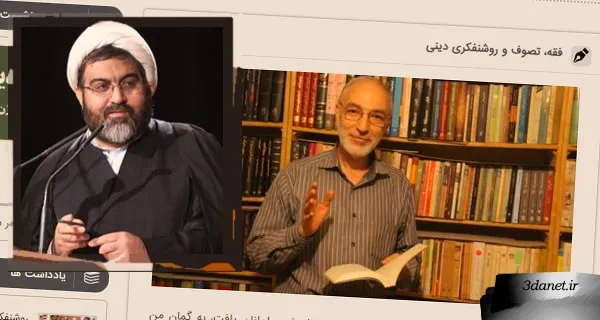
One respected writer (Reza Babaei, in the article Fiqh, Sufism and Religious Intellectualism), has recently written that “if one can find a documented lineage for religious intellectualism in the history of Muslims, I believe it is mysticism and Sufism,” and added: “If Attar, Sanai, Rumi and Muhyiddin are taken away from religious intellectuals, it is as if a helpless youth has been abandoned in a lonely stony place.” This piece was, of course, written to expose the incorrectness of the Sufism conference, and it seems they wish to make the organizers of the conference aware of the importance of the Sufis’ work and the necessity for intellectuals to follow them, and to warn the jurists that in the new world, they have no choice but to join the coalition of Sufis and intellectuals, and before it is too late, they must seek refuge in their camp to save themselves and religiosity! This piece is deeply astonishing and shows that the study of currents and historical scholarship among us is still ailing and oppressed, and individuals think they can command history at will and write the fate of the past with their wishful thinking about the future:
1) Fortunately, the first scientific step regarding critical Sufism studies was formed with the “National Conference on Sufism; Characteristics and Critiques,” and with the continuous pursuit of its research programs in the near future, appropriate scientific literature will be produced on this subject, and it is hoped that thereafter, the chaotic market of biased judgments and simplistic perceptions will give way to precise and realistic viewpoints.
2) The extent to which intellectualism or religious intellectualism traces its lineage to Sufism can be studied in two parts: descriptive and prescriptive. I will briefly outline these two parts and hope that in future research, this subject will be examined in a documented and methodical manner.
3) Between Sufism—as an intellectual and practical system—and religious intellectualism—in its intellectual and behavioral dimension—there has been incompatibility in many respects: ? From a historical perspective, such a lineage cannot be demonstrated, and the founders of religious intellectualism have not accepted such a “family tree”; rather, they have often engaged in denial and disavowal. To trace the lineage of Nakhshab, Bazargan, Sahabi, Sami, Peyman, and Shariati back to Adham, Bayazid, Attar, and Hallaj requires both scholarly force and carries legal consequences. ? There is also no relation in the “discourse” and “terminology” of these two groups. What connection do central signifiers and keywords such as seclusion and forty-day retreat, dhikr and contemplation, master and disciple, wayfarer and the attained, ecstasy and rapture, effacement and sobriety, voluntary poverty and annihilation in the Essence and Attributes… have with democracy, progress, Islamic renaissance, women’s rights, anti-colonialism, scientism, rationalism, justice-seeking, social freedoms, jihad, migration, martyrdom, scientific management, and development programs…?! ? Regarding “ideals” and “tools,” there is also no clear overlap between these two currents. While Sufis sought the annihilation of the self in Pure Truth and saw the darkness of the world as due to distance from the Divine Realm and the Celestial Kingdom, and considered the path to salvation to be within and the liberation of the soul from the body and the lowly world, religious intellectuals sought to build a better world for living and to overcome decline and backwardness, and sought the path to liberation in the struggle against poverty, corruption, superstition, and irrationality. ? Perhaps it is due to this deep gap between Sufism and intellectualism that in the tradition of contemporary religious intellectualism—except for figures like Abdolkarim Soroush, for reasons I will explain—they did not benefit from the heritage of Sufism and avoided attributing themselves to this current.
4) In recent decades, a kind of “affinal kinship” has been established between religious intellectualism and traditional Sufism from three directions:
Firstly, after the revolution, religious intellectualism turned to the critique of religion, jurisprudence, and Islamic government, and positioned personal religion, relativism, and secular spiritualism as bridgeheads for bypassing Sharia, theology, revelatory sources, and the system of religious authority and clergy. In this atmosphere, the Sufi heritage could undoubtedly serve as a good instrument for breaking down the sanctities of Sharia and social norms and for transcending the rules of religious understanding and the criteria of faithful living. Yes, Sharia-avoidance, esoteric interpretation, distrust of reason, introversion, and the cultivation of ecstatic utterances were the best pretexts for religious intellectuals to attract the wandering and helpless youth of the post-revolutionary era, and someone like Soroush skillfully employed all capacity and ability in this field, relegating religion to the realm of the heart, religious knowledge to the embrace of contraction and expansion, and revelation to the dreams of the prophets [Sufis].
Secondly, another hallmark of intellectualism over the past two decades has been absolute tolerance and liberation from constraint and devotion, seasoned with hedonism, nonchalance, and aesthetic judgments—a task somewhat achievable through the logic of opportunism (ibn al-waqt) and the customs of Qalandari and Malamati spirituality, which also resonates with the audience through poetry, passion, and sweet-talking.
Thirdly, experience has shown that Shi‘i society and the Iranian individual cannot be separated from spirituality, introspective ethics, and rituals and ceremonies. Sufism is an alternative and suitable experience to fill this void and a convenient pretext to draw this child from the bosom of jurisprudential customs, religious ethics, and traditional ceremonies into the embrace of gatherings of dhikr and sama‘, quenching their thirsty souls with readings of Rumi and recitations of Hafez. These are things that resonate with elements of modern and postmodern thought and do not bring intellectuals into conflict with religiosity.
5) From this angle, the convergence and alignment of some intellectuals and Sufis is understandable, and this bond has undoubtedly borne offspring, examples of which can be clearly seen among academics and seminary scholars. Of course, throughout history, Sufism has produced both legitimate and illegitimate children and has been intertwined with extremism and Satanism, Salafism and anti-Shi‘ism, Babism and Baha’i nurturing, and dozens of other sects and schools, and it is not unlikely that this one, too, will take root and bear fruit. Especially in the era of fragmented postmodern reason and in the world of new quasi-religions and the tendency toward private, handmade religions, the emergence of such a discordant offspring is not at all unexpected.
6) Without wishing to speak about the angles of this nascent project or discuss its validity or invalidity, I foresee two points: Firstly, this movement will lead both to the decline and isolation of the religious intellectualism project and will empty Sufism of its spiritual heritage, leaving its proponents with a "problematic hermaphrodite" that is of no use to either party—unless the Sufis, despairing of attracting devoted disciples, content themselves with meddlesome intellectuals, and the intellectuals, having reached their end and despairing of reform and community-building, wish to rest for a moment in trance and fantasy and soothe their restless souls with poetry and passion or with music and song. Secondly, even if this project yields no other result, it is highly effective for separating the younger generation from under the banner of religion and jurisprudence and delivering them into the hands of the whirlwind of spiritualist sects or disillusioned social and political groups. I suspect there is no other way to deliver students disillusioned with the revolution and despairing of the situation into Sufi circles and from there to the multi-faceted shops whose numbers increase daily. For these two predictions above, one can both present theoretical reasons and cite the abundant evidence gathered by researchers in recent years. If there is an opportunity, I will also present this section to the people of theory and practice.
.
.
Sufism and Religious Intellectualism: From Incompatibility to Convergence
Author: Mohammad Taqi Sobhani
Source: Mohammad Taqi Sobhani's Information Channel
.
.




Discussion1 comments
جالب بود