Philosophy
A Reflection on “The Gay Science,” or the Bond Between “Wisdom” and “Joy”
“The surest sign of wisdom is constant cheerfulness”: an interpretation of Montaigne’s dictum that sees the link between wisdom and joy as dialectical. Drawing on Hafez and Nietzsche, constant cheerfulness is presented not as a psychological state but as an ontological stance in the struggle with suffering and the affirmation of life.
Constant cheerfulness should not be regarded merely as a psychological state and interpreted behavioristically. Although the wise person should not be imagined with a bitter, dry face and a sullen, gloomy countenance, neither should one suppose that he is someone without pain or sorrow, for whom life passes in nothing but pleasure-seeking and revelry. The cheerful individual is not someone who is perpetually laughing and guffawing, or dancing and jesting. One could say that this conception of happiness describes not only an undesirable state, but an impossible one. Federico Fellini, the great Italian film director, masterfully depicted the disgust of these foolish pleasures and the oblivion of suffering in his film La Grande Bouffe...
.
A Reflection on “The Gay Science,” or the Bond Between “Wisdom” and “Joy”
(Based on an interpretation of a sentence by Montaigne, with allusions and evidence from the poetry and thought of Hafez)
Masoud Zanjani
A reflection on the bond between “wisdom” and “joy” can begin with a reflection on this sentence by Montaigne, the sixteenth-century French essayist and philosopher:
“The most certain sign of wisdom is constant cheerfulness.”
It seems this sentence can be interpreted in two ways: the first interpretive framework could be based on the idea that “wisdom is the effect and product of cheerfulness,” and from the effect one can infer the cause. In the words of Hafez:
How can a sorrowful mind inspire fresh verse? We have said one point of this meaning, and let that suffice
Thus, “fresh verse,” that is, “Hafezian wisdom,” is the result of a joyful (and free) mind.
But the second interpretive framework could be based on the idea that “wisdom is the cause and producer of cheerfulness,” and from the cause one can infer the effect. In the words of Hafez:
Drink wine, for whoever saw the world’s end Rose light from sorrow and took up the heavy goblet On the rose petal, in the blood of the poppy, it is written: He who became ripe took up the wine like arghavan
In Montaigne’s view, true human happiness is the result of his wisdom. Of course, this does not mean setting aside the first interpretation, and one could say that wisdom, too, is, in a sense, the result of joy. Therefore, both meanings and interpretations can be reconciled. It is as if there is a dialectical relationship between the two: wisdom and joy are interdependent, and each is in some way conditioned by the other.
But “having constant cheerfulness” should not be interpreted as having absolute comfort and ease, and suffering no pain at all. Nietzsche, more than any wise person, emphasizes the point that whoever wants the highest joys must also want the highest sufferings. In Nietzsche’s view, pleasures can never be enhanced one-sidedly; that is, one cannot increase pleasure without simultaneously and commensurately increasing pain. That is why Nietzsche says that true joy exists only where there is a victory; a victory over the hardest things.
One could say that Montaigne’s statement, “No one has ever invested more in farewells than I,” means precisely that he finds farewell, as his most agonizing experience, simultaneously the best capital for his own felicity. Therefore, “the most certain sign of wisdom is constant cheerfulness” means that the sign of wisdom is always being in battle; a battle to overcome sufferings and calamities; and in Hafez’s words, it means always undertaking something to bring an end to sorrows! In other words, the joyful person is not someone who has no grief, but someone who, despite grief, and even in days of mourning, possesses inner abundance and outward cheerfulness.
In fact, constant cheerfulness should not be regarded merely as a psychological state and interpreted behavioristically. Although the wise person should not be imagined with a bitter, dry face and a sullen, gloomy countenance, neither should one suppose that he is someone without pain or sorrow, for whom life passes in nothing but pleasure-seeking and revelry. The cheerful individual is not someone who is constantly laughing and guffawing, or dancing and jesting. One could say this conception of happiness describes not only an undesirable state, but an impossible one. Federico Fellini, the great Italian film director, in his film La Grande Bouffe, masterfully depicted the disgust of these unwise pleasures and oblivious suffering.
Constant cheerfulness must be seen, beyond a psychological state, as an ontological mode and a way of being in the world; a mode for whose explanation, more than anything else, one can draw on the example of “Nature.” Can one not say that Nature possesses perpetual cheerfulness, even when it is in autumn or winter? One can say Nature is always joyful, because it is always in a state of dynamism, generation, and creation. True human joy, too, should be seen as nothing other than dynamism and creativity. Heinrich Heine, the German poet, summons us to such wisdom:
“Do not be sad, my heart, and bear your fate, A new spring will give back, All that winter has taken from you.”
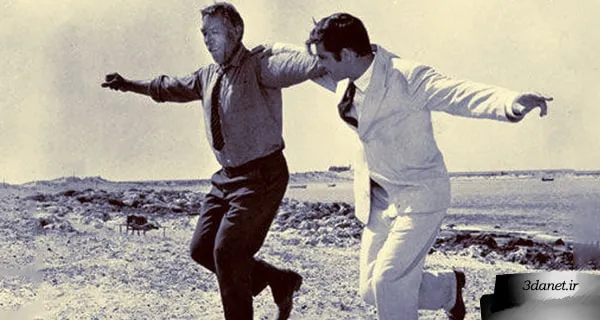
One could say Zorba the Greek is the best example of that “gay wisdom” of which Montaigne, and following him, Nietzsche, speak. Zorba’s dance is a metaphor for his dancing thought and attitude, but it is very important that this question be asked:
When did Zorba dance for the first time in his life?
I have no doubt that someone who has not read this masterpiece by Kazantzakis cannot guess the answer to this question, just as hearing the answer would be shocking to them.
In any case, it is unbelievable that Zorba dances for the first time after bidding farewell to his dead young son, while moments before his body had grown cold and lifeless in his arms. Montaigne’s gay wisdom, too, like Zorba’s wisdom, is a thought brimming with life; not like the raw and abstract wisdom of his educated and bookish masters, to whom one must say, with Hafez:
Take this raw wisdom to the tavern, So the ruby wine may bring its blood to a boil
“Gay wisdom” is not only not indifferent to human suffering and sorrow, but it also teaches us the difference between two kinds of grief*: “Man-eating griefs,” of which even a little is too much and from which one must flee on a hundred legs, and in Hafez’s words:
To spend a moment with grief, the whole world is not worth it Sell our cloak for wine, for it is not worth more than this
And “grief-eating griefs,” of which even a lot is too little and toward which one must run headlong. Again, in Hafez’s words:
My advisor told me, “What art does love have but grief?” Go, O wise master, an art better than this Or: It is an age that the passion for idols is my religion The grief of this affair is the joy of my sorrowful heart.
As was seen, there is a great intellectual affinity between the insights and thoughts of Montaigne and Hafez.
* Iqbal Lahori: One grief is that grief which devours man That other grief which devours every grief That other grief which is our companion Our soul, through its company, is without grief
.
.
A Reflection on “The Gay Science,” or the Bond Between “Wisdom” and “Joy”
Author: Masoud Zanjani
Author's Website Address
Author's Telegram Channel Address
.
.

Discussion1 comments
عالی بود سایر متن های زیبای استاد زنجانی رو هم منتشر کنین با تشکر از زحمات دوستان صدانتی