Political Science
A Review of the Book “Exercises in Good Governance for the Protection of Human Rights”
In his review of Exercises in Good Governance for the Protection of Human Rights, Zeydabadi described development as a right for which the state is responsible. He identified the indicators of rule of law, accountability, and public participation as the key to sustainable development and the preservation of human dignity.
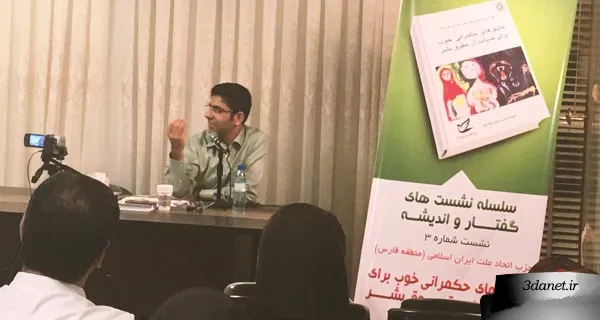
The third session of the series of meetings “Discourse and Thought” was held at the office of the Islamic Iran Unity Party, Fars Province branch. The topic of this meeting was a review of the book “Exercises in Good Governance for the Protection of Human Rights”, and Hassan Asadi Zeydabadi, the book’s translator, delivered a speech at the session.
Given the book’s subject, Zeydabadi elaborated on the foundations of good governance and its impact on the protection of human rights.
What follows is a summary of the points presented by the book’s translator:
The idea of good governance is one of the theories of development. According to this idea, the state is responsible to the people in the matter of development, and for this reason, development is a right that attends to the improvement of the material and spiritual quality of life. In the final decades of the twentieth century, the world came to the conclusion that the underdevelopment of certain countries is one of the factors threatening world peace. Advanced countries realized that the gap between them and underdeveloped nations also affects their own situation. Thus, development became a global ideal.
There have been two major currents in development theories: one is the theory of the big state, and the other is the theory of the limited state. In the first case, which entails the elimination of the private sector, the state is posited as the agent of development, while in the second intellectual current, the focus is on the minimal state. After the collapse of the Soviet Union and the decline of the big state theory, the minimal state theory grew further. Gradually, however, theorists also recognized the weaknesses of this theory and realized that other realities exist on the path to development. They noticed that in some countries where suitable political contexts and structures are absent, development is not institutionalized in a sustainable manner, and moreover, the path of development is not considered humane, meaning that human dignity and human rights are violated along the way. In these countries, the benefits derived from development are placed at the disposal of the ruling power, and autocratic governments use the advantages of development to strengthen their despotic foundations. In these countries, people’s rights are trampled, and world peace may even be endangered.
At the beginning of the 1990s, in a study conducted by the World Bank in African countries, taking a critical view of the conventional approach to development, parameters were proposed that formed the core of the idea of good governance. If sustainable development is to be created alongside human development and the promotion of human rights, the parameters considered the core of good governance must be taken into account. Good governance can be defined as the management of public affairs based on the rule of law, a fair judiciary, and broad public participation in the process of governance.
From the perspective of development theorists, the idea of good governance is the key to the puzzle of development—a development that is both continuous and in the service of human rights, a development that benefits local communities, national society, and humanity as a whole.
Indicators of Good Governance:
1- Stability and Absence of Violence: Development commensurate with good governance proceeds along a non-violent path. In environments where instability exists and tribal and religious conflicts and wars are prevalent, good governance is impossible, and development cannot occur.
2- Rule of Law: The value of the rule of law lies in elevating the citizen to a questioner/interrogator of the government. The law must be comprehensive and enforced in such a way that equality and parity of all before it are observed.
3- Effectiveness: Good governance depends on the effectiveness of the government, and a government that cannot resolve its country’s issues is not considered an effective government.
4-Accountability: The government must be accountable to its citizens. Article 9 of the Constitution of the Islamic Republic establishes “enjoining good and forbidding evil” as a universal duty. The existence of this principle in the constitution means that citizens not only have the right but also the duty to question the governing authority; its mechanism must be specified, and the government must be accountable. When a “right” is discussed, there are three aspects: first, the person who holds that right; second, the person upon whom the fulfillment of that right is incumbent; and third, the institution that oversees the realization of the right (the discharge of the right). The purpose of the third aspect, which unfortunately is often neglected, is that an institution must actualize that right as an overseer.
5-Transparency: In the theory of good governance, the free flow of information is something beyond freedom of expression, freedom of the press, etc. Transparency in good governance means the awareness of members of society about how decisions are made and implemented.
6-Public Participation: The possibility for people to express their views must be provided in all political, social, cultural, and other processes. Fundamentally, participation is a right that is also mentioned in the Constitution of the Islamic Republic.
Reforms in good governance are based on public participation. The development process cannot proceed within the framework of development as articulated in the concept of good governance without creating grounds for people's participation.
A point that must be noted is that all these parameters are interconnected. For example, creating grounds for public participation depends on the existence of the transparency parameter. Just as it is said in the field of human rights that “human rights are interdependent and interconnected.” For instance, regarding the elimination of discrimination against women in our country, it is said that 60 percent of the country's educational environments are occupied by women, yet we see that their participation in the political affairs and governance of the country is at most 2 percent.
The reform of governments based on the good governance model relies on the aforementioned parameters, and it is in such an environment that one can expect governments to respect human rights.
The four chapters of this book address four parameters of good governance and examine their relationship with the subject of human rights through 21 case studies.
Chapter One: Strengthening Democratic Institutions
If democracy exists, it has levels, and to elevate it to higher levels, strengthening democratic institutions is necessary. If one is to move towards the protection of human rights, one must work on strengthening democratic institutions.
As a socio-political activist, one must first identify democratic institutions and then pursue methods for strengthening these institutions. For example, regarding the institution of elections, we must see how our approach to this institution can help strengthen it.
Chapter Two: Improving Public Service Delivery
In the discussion of good governance, the government is recognized as responsible. The minimal state, negative liberty, and non-intervention of the government in the realm of public services is a superficial view. For example, regarding torture in human rights texts, there are three settings: detention centers, schools, and clinics/medical centers. It is incorrect to tell the government that it merely does not have the right to torture in detention centers; rather, the government not only does not have the right to torture in detention centers but is also obligated to prevent the occurrence of violence in schools and medical centers and must intervene directly in these cases so that human rights are not violated.
In our country, unfortunately, people are indifferent to discussions concerning approved budgets and expenditures made in the area of public services, especially in the education and health sectors.
Third Axis: Combating Corruption
Perhaps the most important chapter of this book is this very subject. Corruption means the abuse of power; an individual enters into power and uses that power for their own benefit, or for the benefit of their party or their ethnicity. As long as corruption exists, one should not expect sustainable development to occur and human rights to be protected. Because corruption is the source of discrimination and the antithesis of transparency. It seems that in Iran today, the first priority of socio-political activists and civil society should be the fight against corruption.
Fourth Axis: The Rule of Law
At one point in time, in the field of human rights promotion, efforts were focused on standard-setting and drafting laws, but in reality, the problem is not the absence of law, but rather the issue of the rule of law. While governments write and sign laws, they do not accept the rule of law.
Why are human rights laws and standards not implemented? The answer is that human rights are realized in a democratic space and in a society founded on democratic principles, and in other societies, the implementation of human rights laws is not possible. A society is based on democratic principles when democratic values are institutionalized in schools, among the people, in parks, and so on, and a democratic society is the product of good governance.
After Asadi Zeidabadi's speech, the session continued as a two-way dialogue between the audience and the speaker.
It should be noted that the book Exercises in Good Governance for the Protection of Human Rights contains an analysis of twenty-one reform experiences in various countries by the United Nations High Commissioner for Human Rights. The experience of these reforms has been in various fields of services (such as providing educational services), strengthening democratic institutions, the rule of law, and the fight against corruption, which are considered the main indicators of good governance, and it has been translated by Hassan Asadi Zeidabadi. This book was published in 2015 by Nahid Publications. Asadi Zeidabadi was born in 1984 and holds a master's degree in Human Rights from Allameh Tabataba'i University.
Previously, Asadi Zeidabadi had translated the book Water and Human Rights: The Right to Water, Legal and Political Dimensions by Salman M. A. Salman, Siobhán McInerney-Lankford, and Lankford.
Mohammad Reza Kadivar


Discussion0 comments
No comments yet; let yours be the first voice.