Philosophy
A Separatist-Style Intellectual
Mostafa Malekian shares a descriptive commonality with the School of Tafkik in distinguishing between religion, philosophy, and mysticism, but differs in prioritizing the philosophical life over the devotional one. Hence, the title 'Khorasan School of Ma'arif' is more fitting for this school.
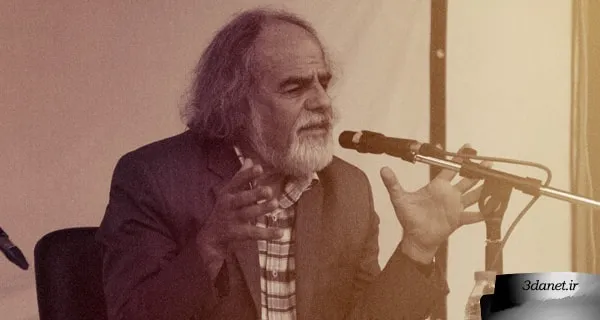
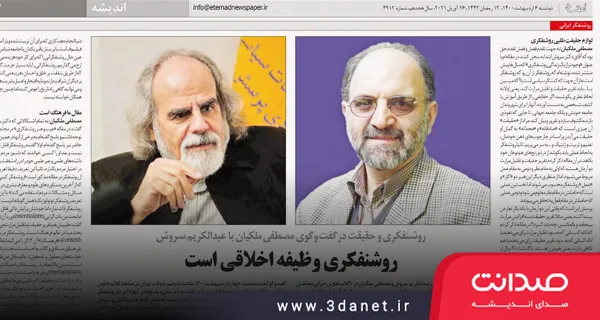
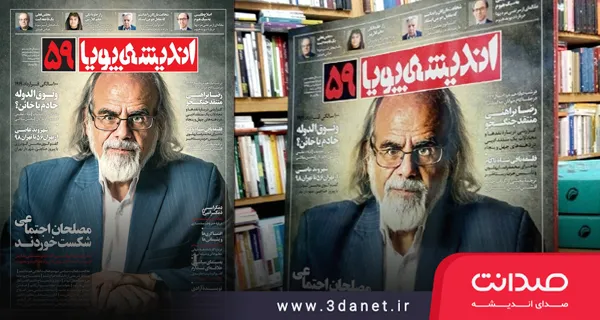
The renowned Iranian philosopher Professor Mostafa Malekian has made remarks concerning the School of Tafkik (Separation). In these remarks, we see no trace of him being a follower of Tafkik, and he states: "Tafkik leads nowhere." However, in other interviews and lectures, he advocates for a separation among the three sources of human knowledge.
According to the account of Allameh Mohammad-Reza Hakimi in the book "Maktab-e Tafkik" (The School of Separation), one of the most important, and perhaps the most important, criteria for being a follower of Tafkik is that one must separate the three sources of human knowledge, namely religion, philosophy, and mysticism. This is contrary to the famous saying of Allameh Hassanzadeh Amoli, who states: "The Qur'an, mysticism, and demonstration are inseparable from one another."
Mostafa Malekian says: "I believe the story of 'religion, creed, and revelation' is one narrative, the story of 'demonstration, reason, and philosophy' is another narrative, and 'mystical unveilings and experiences' is a third narrative. These cannot be reconciled except through the contrived and artificial efforts made by the likes of Ibn Arabi, who, in my opinion, were never successful. Because Ibn Arabi tried to create this reconciliation, his work fell into contrivance and artificiality. He was neither faithful to the sacred religious and creedal texts enough to satisfy at least the believers, nor faithful to demonstration enough to satisfy the philosophers and those of a philosophical disposition, nor faithful to mystical unveilings and experiences enough to satisfy the mystics." (Interview: Ata va Liqa-ye Eslami, Islah Journal) "Undoubtedly, whoever has turned seriously to philosophy has distanced themselves from religion. Those who approach and draw near to religion with their common-sense understanding have been and remain more committed to religion. What positive function does philosophy have for a specific religion that we are so enamored with the idea of our philosophy bearing the hue and color of that specific religion?" (What is Islamic Philosophy?)
"(Followers of mystics) sometimes distort the message of the religion and creed under which they define themselves. For example, when someone considers themselves a follower of Attar, they are in fact defining themselves under Islam and believe they are committed to Islam, the Qur'an, and the prophetic traditions. They may interpret the Qur'an and prophetic traditions in such a way as to conform to the beliefs of Attar of Nishapur. This act means that, scientifically, they violate the principles of exegesis, and ethically, they betray the Qur'an and prophetic traditions. Many times we say we are Muslims, but we offer an interpretation of the Qur'an and prophetic traditions that is 'something its author would not approve of.' I am not just saying that the teachings of the Prophet should not be distorted; the message of no human being should be distorted. These individuals sometimes see opinions and beliefs in their intended figure—here, for instance, Attar—and then say that these words of Attar are perfectly, down to the last detail, compatible with the Qur'an and prophetic traditions. This leads them to produce an unhealthy interpretation of the Qur'an and prophetic traditions—an interpretation that lacks scientific soundness because it violates hermeneutic rules, and lacks ethical soundness because it distorts the words of the founder of the religion and creed." (Ata va Liqa-ye Erfan-e Eslami)
"There are two groups of people who have no choice but to resort to esoteric interpretation (ta'wil). The first are individuals who sincerely believe that the Qur'an, mysticism, and demonstration are inseparable from one another, and therefore see verses in the Qur'an whose apparent meaning does not correspond with the mystic's claim. To perform ta'wil, they are compelled to move from the exoteric to the esoteric and are forced to say that the apparent meaning of the Qur'an is incompatible with mysticism. The second group are those who extract several types of ta'wil from a single verse, which are sometimes contradictory to one another." (Hamshahri Online report on Malekian's lecture about Ibn Arabi)
I will not seek further examples. The totality of Malekian's views on the philosophical life, the mystical life, the devotional life, Islamic mysticism, Ibn Arabi, ta'wil, etc., shows us that Malekian believes: 1- Mysticism, philosophy, and revelation (religion) are separate from one another and are not one. 2- The essence of mysticism is intuition, of philosophy is demonstration, and of religion is devotion. 3- Philosophy, mysticism, and religion cannot be combined. 4- Ta'wil without a scientific methodology and based on hermeneutics is scientifically and ethically invalid. 5- Primacy and superiority belong to the philosophical life. (Interview: Ata va Liqa-ye Erfan-e Eslami) The principles of the School of Tafkik, based on Professor Hakimi's article "Aql-e Khod-bonyad-e Dini" (Religious Self-Founded Reason):
1- The separation of philosophy, mysticism, and religion. 2- The superiority and primacy of religious knowledge. 3- The grounding of religious knowledge in the Qur’an and Hadith. 4- Reliance on the apparent meaning of verses and narrations. 5- The rejection of any esoteric interpretation (ta’wīl). They are nearly identical except for two important points: 1- In Mr. Malekian’s thought, the method for discerning the limits and boundaries of interpretation is hermeneutics, whereas in ‘Allāmah Hakīmī’s thought, it is reliance on the apparent meaning of the Qur’an and, of course, the discussions of jurisprudential principles (uṣūl al-fiqh) concerning textual understanding. 2- Primacy in Mr. Malekian’s thought lies in the philosophical life, while in ‘Allāmah Hakīmī’s thought, it lies in the devotional life, or more precisely, the religious life. Primacy belongs to religious knowledge. From this discussion, one can conclude that the principal descriptive claim of the Tafkīk school—namely, the separation of humanity’s three sources of knowledge and the interpretation of Qur’anic verses and narrations by mystics and philosophers—is also present in Professor Malekian. However, at the prescriptive level, a divergence arises. Professor Malekian says one should lead a rational, philosophical life, while ‘Allāmah Hakīmī believes in a religious, devotional life.
There is another shared prescriptive feature between them, which is that both are opposed to esoteric interpretation (ta’wīl) and say that one must discover the speaker’s intended meaning, not impose one’s own meaning upon them. Yet here again, their paths diverge. One follows the methodology of jurisprudential principles, based on the approach of the Islamic seminaries and traditional thought, while the other considers hermeneutics the arbiter. For this reason, the name “The Khorasan School of Teachings”—which some still advocate—is more appropriate and useful than “The Tafkīk School,” because if this school were merely to assert the separation of the three sources of knowledge, Malekian and those like him would also fall within its circle, an inclusion that is, of course, mistaken.
.
.
A Separatist-Style Intellectual
Amir Hossein Shojaei
.
.




Discussion2 comments
موضوع زبان است ؛ واژه ها و حروف فهم ها از کجا می آیند؟ باید "حروفیه" را بررسید.
اسطوره ، دین ، فلسفه ، کلام ، علم و داستان ؛ کلاً آفریده های زبانی / فکری انسان درهمند ، به هم راه دارند و کاملاً قابل تفکیک نیستند . اسم گذاری و تفکیک حوزه های و جریان های فکری از هم مانند نام گذاری جانوران و گیاهان و دسته بندی های باستانی ، نیازمند بازنگری است : ما به لینه و مندلیف معرفت شناسی نیاز داریم ! تا آن زمان می شود گفت که متن « دینی » تهی از استدلال نیست ، متن فلسفی با خیال ( متجلی در زبان : قصه و داستان ) آمیخته است ، « دین » ریشه ها و رگه های « شهودی » دارد و « شهود عارفان » متأثر از باورهای « دینی » محیط پرورش شان ، متفاوت بوده است .... در واقع اگر بین « دین و فلسفه و عرفان » دیوار بکشیم و آنها را قلمروهایی ویژه و جدا تصور کنیم ، ارتباط و بده بستان ـ خواه ناروا انگاشته و زیرزمینی شده ، خواه روا و آشکار ـ آن سه را نمی توان انکار کرد و مانع شد .