اندیشهفلسفهخردگفتگوحکمتمعناپرسشفرهنگ
Philosophy
A Series of Talks with Professor Michael Ruse; Session Three: Metaphor and Literalism in the Bible. Intelligent Design Theory in America
Michael Ruse, a philosopher of science, examines the apparent conflict between evolutionary theory and Christian belief. By distinguishing between literal and metaphorical readings of the Bible, he shows how one can be both a Darwinian and a Christian.
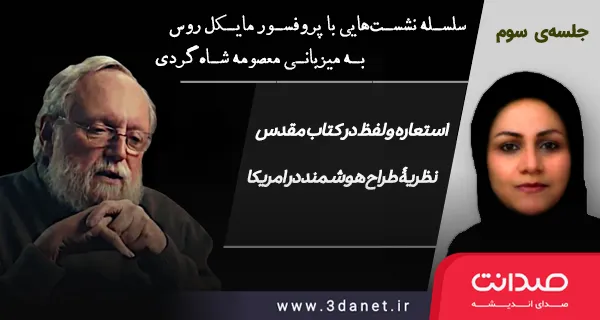
A Series of Talks with Professor Michael Ruse
Session Three: Metaphor and Literalism in the Bible. Intelligent Design Theory in America
In the Name of the Most High
Interview with Mr. Michael Ruse, philosopher of science and biology
Interviewer: Masoumeh Shahgordi, author and translator
Date of Interview: August 19, 2020
Professor, please tell us how it is possible for someone who accepts Darwin's theory to also be a Christian?
Let us begin, like all philosophers, with a few definitions. What does "Darwinian" mean? A "Darwinian" is someone who believes in the theory of evolution, that is, someone who believes that your and my great-great-great-grandmother and great-great-great-grandfather were monkeys. This might not be very hard to discern about me, but it is very difficult about you, yet it is really true. And if you go back even further, our great-great-great-grandmother and great-great-great-grandfather were fish. So, that is the theory of evolution.
Then, in 1859, Charles Darwin, a man from England, wrote a book called "On the Origin of Species," and what he claimed was not only evolution, but a cause or mechanism; and Darwin called this cause or mechanism "natural selection." What Darwin said was that there is always a population explosion, more population than can survive and reproduce. So, there is always something that the English clergyman Robert Malthus called a "struggle for existence"; some survive and some do not. And those that survive are different from those that do not, and the reason they win is usually that they are better at doing it. So, in a sense, your great-great-great-grandmother—I hate to say this—was sexually more attractive than many other individuals in her group, and that is why your great-great-great-grandmother had offspring, and perhaps her best friend did not. And in this way, this process continued in subsequent generations, leading to evolution and leading to us and all animals and plants, and this is the meaning of being a "Darwinian."
Now, let us see what being a "Christian" means. Clearly, being a Christian means believing in the existence of God, and believing in the same God that you Muslims believe in; that is, the God of the Jews, Christians, and Muslims. And that is a creator God who created all of them, and a God who created all of them Himself. Well, so a Christian believes that this is a creator God who is benevolent and merciful. In other words, this creator God did not simply create us only to later give us all cancers just for a laugh. He cares about us. Although Christians differ from Jews and Muslims in this point, believing that God saw we were in trouble, so He sent His son, who was in a way a part of Himself, down to earth, and he was crucified for our sins; so God intervened in creation. Clearly, this is different from the Jewish and Muslim perspective. You Muslims believe that Christ was a great prophet, but only a prophet, not God. And the same for Muhammad. In fact, you believe that if someone says Muhammad is God, they have left the faith. Muhammad was not God. He was the most important prophet of God, but he was not God. So, that is Christianity.
Now the question is: can a Christian also be a Darwinian? Well, what is the problem? One problem is that Christians, like Jews and Muslims, believe that the stories of the Old Testament (we Christians say the Old Testament or the Jewish Bible) are actually true. And the Hebrew Bible or Old Testament says that God created two people, a man named Adam and a woman named Eve. And these two were created from dust, from mud, and then they had children; Cain[1] and Abel[2] and others. And others were added in the same way. So this story contradicts evolution because evolution says there was not just one unique, special pair, but there were always, always other humans. And in fact, I think today the belief is that there were never fewer than ten thousand humans. So in other words, there was not just one pair named Adam and Eve, and part of Christian theology is that Adam, and also Eve, very soon committed sin and ate the apple and were cast out of paradise, and this brought "sin" to earth, and that is why Christ had to come and suffer on the cross as a sacrifice, as a substitutionary atonement—a phrase Christians use. Meaning that God died on the cross so that our sins might be taken away.
Well. In other words, the Bible says there was no sin before Adam and Eve ate that apple. Of course, Darwinians say this is not true. Your great-great-great-grandmother was like the rest of us. Sometimes she was good and sometimes she was not good. But more importantly, her parents were like that too. They were not always bad, but they, like other people, were sometimes jealous and greedy and fought with each other over these things. In other words, they were not "perfect." I mean, no one is perfect. So you see there is a contradiction here; between Christianity and Darwinism. How do you resolve it? Well, there are ways to resolve them, and you should know that these are very traditional methods in Christianity. These are not methods that Darwinians have thought up. Especially in America, you have the Creationists; a group known as Fundamentalists or Biblical Literalists who believe that the Bible is true word for word; completely literally. Well, it is clear that if you accept this view, then you believe in that Adam and Eve and that original sin, and that there was no sin before them, but if you are an evolutionist, you do not think this view is correct. Although this Christian view, and I mean Fundamentalism or late-nineteenth-century American Anglican Protestantism. Because the Christian tradition, which goes back at least to the fourth century and therefore to Augustine, quite clearly claims that the Bible is often not literally true; it is true; but it is true metaphorically or allegorically, and Augustine (who was a fourth-century Roman man and a sophisticated person for that era, who if he were alive today would hold the equivalent of a professorship) said we should not expect traditional Jews to be capable of understanding modern science. Moses, or if we go back to Abraham, probably could not read or write. Abraham probably had no understanding of physics, or chemistry, or biology, and why should he? He was a Bedouin and a nomad. He was busy doing the things he did, and he did them correctly. But from our point of view, he was a primitive human. Not in the sense that he was not an important part of God's story, but he was not a sophisticated Roman man like us. So in other words, God could not talk to Abraham and say, Abraham, I want to tell you about Darwinism and how you got here. Abraham could not understand what God was talking about. So God had to speak to Abraham in the form of a story or a myth. A good example is Noah's flood. Have you heard about Noah's flood?
Yes
Well, so you have thought about it. An American Anglican Creationist would say that at one time in the past, the entire earth was covered with water, and a specific man named Noah built a ship; Noah's Ark, and then put all the animals and everything like that in it.
An American fundamentalist says this story is literally true. Now, how about this? That it is a story, and a true story. But it is not meant to be understood word for word and literally. Think about it. The world was corrupt. Full of sin. And God said, oh, it's very simple, I will destroy all people and get rid of all of them. Except Noah. But what happens at the end of the story? There is a part you never tell children. When the flood is over, Noah goes to his tent and starts drinking until he is completely drunk and starts taking off his clothes. His sons come in and laugh at him. In other words, what the story of Noah tells you is that simplistic solutions to difficult problems are of no use at all. And what I like to say is, I wish George Bush and Tony Blair had understood this when they were marching into Iraq in 2003. When they said it is very simple, we just have to get rid of Saddam Hussein and start everything over. It was no use, and we now have more problems in Iraq than before. So I personally want to say that the story of Noah is a very important story and a very true story. But this story is not a story about shipbuilding. Anyone might say, oh, how did they get rid of all that manure those animals were making? But know that the story is not about these things. Rather, the story is about simplistic solutions—or whatever interpretation you want to make of it. Well, so I want to say that this is the way to deal with such conflicts between Darwinism and Christianity. I mean, Darwinism accepts that people are simple. And of course, that is why the struggle for existence arose, but it also accepts that people are sometimes good, and it is clear that Christians do not say—except for Calvinists—that we are always evil. Can we say that what we are doing now is sinful? No, that is foolish. So no one wants to say such a thing. So Darwinians are completely in agreement with such things.
Well, so that is for issues like sin. But what about subjects related to miracles? A miracle in the sense of boom! and something happens! A famous story in the Bible. It goes like this: Jesus goes to a wedding at Cana[3]; and the wine runs out there. (You are Muslim, and I know you consider this a big problem) but for the ancient Jews, this was a very big problem. Well, so their wine ran out. So what were they to do? So Christ said, fill your jars with water, and then he recited a spell, and it all turned into wine. This is not a Muslim wedding ceremony. It is a Jewish wedding where they can drink wine. Well, so this is a miracle. But science says there are no miracles like this. Well, don't you think there is a conflict here? Well, many Christians say no, miracles are not like boom! and water turned into wine! No, it is not like that. The real miracle is that Jesus said to the person who was holding the wedding, I am sure you still have some very good wine in your cellars that you have not brought out, and the man said, yes. That is true, and you have made me feel ashamed. I will go and bring it now. That was the miracle! Not boom!
But Jesus convinced the man about his commitment to his guests. Meaning that he must bring out the best wine he has and give it to them; even if he did not intend to. And in this way, I think many people will say that this is what explains miracles. When something happens, everything always happens according to law, but not necessarily boom! Like the example of Aladdin! Recite a spell! Boom! Oh my God! It's a rabbit coming out of a hat!
So my argument is this. What is in my book "Can a Christian Be a Darwinian?" is this.
So you believe in a metaphorical and literal difference in the holy scriptures?
Yes. And this is a very important point. Let me return to this subject once more, just to explain in detail what I am talking about.
A literal interpretation is to say this is black or white. Something happened. Noah built a boat. Noah's Ark. And then everyone boarded it. And all the animals entered it in pairs. And then the rain began. And the water rose and rose, and then Noah steered the ark, and everyone who was outside died. They drowned. And then Noah returned. This is the literal reading.
The metaphorical reading is to say, yes, the story wants to tell us something very important. Very, very real. I am sure you tell moral stories to your children, like the stories told to children in kindergartens. But these are not merely kindergarten stories; rather, you want to show children, for example, the story of a pig, a sparrow, or a dog that shares its things with others. Such a dog is happier than a dog that wants everything only for itself. You tell this story to the children, and they happily fall asleep, and they probably believe it about real dogs, but you know we are not really talking about dogs! We are speaking metaphorically about this and trying to make the children understand that someone who gives is happier than someone who does not give! Someone who says, I want everything for myself! What you are saying is strange [the story of the dog's generosity], but someone who says, okay, take this. I want to give this to you, this person will be a happier person in life; compared to someone who says everything is for me and I want everything for myself and I give nothing to anyone. And you tell such stories about animals, dogs, or others to your children. These are stories that are metaphorically true, not literally. These are fables, but they contain an important truth. You do not tell your children that someone who is stronger and bigger and kills everyone will be a happier person. You do not tell such stories to your children.
When you want to put your children to bed, they probably say, Mommy, tell me a story. You do not tell a story about someone who takes everything and cares about no one, and that this is the right way. Rather, you say that someone who gives is happier, and someone who does not give is unhappier. So, I want to talk about the difference between metaphor and literalism. And that this is a very important point in understanding the Bible.
And the point I made before, and I want to make it again now because good things are even worth repeating three times, is that thinking metaphorically is the traditional doctrine of Christianity. This is what Christians have always believed and practiced. Christians have never clung to the idea that the sun stopped for Joshua, or that Noah's Ark was literally true. Or that Noah spent a long time building such a thing. That Adam literally ate that apple. Christianity has always believed that the story of Adam and Eve is very important. This story is real, but it is not about the apple, and eating the apple, and so on. It is about sinning. It is about disobeying God. God says, I want you to do such things. And Adam and Eve freely disobeyed it.
Now think about it more generally. God wants you to be kind to children. If you are a Christian, a Muslim, or a Jew and you see a child in distress, you don't laugh at them. You don't strike them and walk on by. That is not what God wants you to do. Although we all know that sometimes we don't do what we ought to. Not that we mean to kick that child. But perhaps you pretend you don't see them. For instance, if you are in a park and a child is crying, and you are busy doing something, you might say, well, someone else will see that child. I'll go the other way and pretend you didn't notice. This is what the Bible tells us about. About sinning. If you do such a thing, it is not a good deed. It will make you a lesser person. And you yourself will ultimately suffer from that act—you, a normal human being—will suffer from it. That means something inside you is spoiled, and when you associate with others, they will not like you. And you will not have the happiness you might normally have. So, this is a very traditional view. Well, what I wanted to say was that Darwinism is a theory about how we got here.
Excuse me, Professor, some people on the line are asking whether God is a construct of the human mind. What is your opinion?
Well, if you are a Christian, Muslim, or Jew, you believe that God exists and you don't think that God is a construct of the human mind. I don't think that you are a construct of my mind. I use my brain to see you. To understand you and to talk to you. But you are a human being who really exists. I didn't make you up. You are a real entity. And if you are a Christian, you certainly believe that God is real just as you are real. Perhaps even more real. If you are like me, it's not that I think God doesn't exist. Rather, it's that I don't know. I don't have that inner feeling. It's just that I don't have that feeling. I live in a wonderful world. I am eighty years old and time is running out, and it has been a wonderful world and a very interesting world and all that sort of thing. But is there a special meaning? Is there a God who brought it into being? I don't know. So, I ask myself, how is it that you believe in God? And I say, perhaps He doesn't exist. So, why do you believe in God and I don't? Clearly, if I don't believe in God, well, my thought is that what you believe in doesn't exist. I don't mean you consciously make it up, but a part of your being, your psychology, thinks this way. And I say, why do you think this way? Well, it gives your life meaning; when you get old and tired, you don't think, Waaaaah! It's coming to an end. Well, you are not going to have seventy houris [and he laughs]; in the West [Christianity], we are told that. And it is your husband who, after death, is to be given seventy houris. And I think that's wonderful.
Professor, there is a discussion about neurotheology. Have you heard about it?
No, I haven't heard of it.
It is said that during communication with God, or prayer and worship, a part of the brain becomes active that exists only in humans and is completely absent in chimpanzees, monkeys, and so on.
Well, I might look at your brain and examine it and say which parts become active when you are talking, and whether this part is different from the part you use when you look at your husband and think about how wonderful he is. This is what you do in love. A part for when you are talking and a part for when you are loving your husband. I think it is a very good thing to investigate which parts are used during these two different activities.
Very well, Professor. I will send you some links on this topic via email so we can discuss it further. Now, if you'll allow me, let's move on to the next question.
Very well.
The next question is about your criticisms of Intelligent Design theory.
The Intelligent Design theory or movement, which emerged about thirty years ago, was an attempt by literalists, creationists, and fundamentalists to introduce their literal translation, their literal reading of the Bible regarding biology, alongside regular science, into biology classes. In such a way that a student in class would study both conventional, regular science—that is, Darwin's theory—and Biblical lessons, literal Biblical lessons. In other words, they would study both that we all evolved and the Bible, and that Adam and Eve were the first people.
Well, this is what I say about America. In America, you must keep religion and politics separate. This is part of the law. They don't always do it, but it is the law. And so the American court ruled that "Creationism is religion; not science, and therefore it must be set aside and not taught." So the creationists said: Oh, we can't get into schools just because we are religion. So how about we give what we do a scientific cover to make it look like science? In other words, so that it is teachable in schools? This is what Intelligent Design theory intends to do. And it says, no, we are not talking about the literal reality of the Bible. And I think most of them believe this, but that was not their intention. They said that the only way to explain living beings, like you and like me, is through the performance of miracles, at every moment and everywhere, by God. In other words, you could not have evolved from apes in that way. God must have intervened at some stage and said, very well, I want to upgrade this ape to better conditions of communication compared to previous apes. Not in the sense of explicitly speaking English or Persian, but in the sense that:
Boooom! Get better at talking!
Booooom! Speak!
And then the final miracle, boooooom! We all speak English. [This is a joke].
So in a sense, proponents of Intelligent Design theory say that we are not talking about the Bible. We are talking about science. But science requires intervention. They said that it is an intelligent designer. We are not saying that it is the God of Christianity, the God of Abraham, the God of Muslims, or the God of Jews. No. What we are saying is that there is an intelligent designer. But of course, they were not telling the truth. They were not telling the whole story. Of course, they have said that the designer is God. They did not think there was a demonic force at work here. You know, an extraterrestrial being who is like, I like to do this. I like to do that. No, it is God. The Christian God. So in other words, Intelligent Design theory is what I, or we, call a trick in English, or a ruse. I hate to say this, the English word is ruse[4] . My last name is pronounced "Ruse." But this word, with the same spelling, is pronounced "rooz" and means a trick or a ruse.
Thank you, Professor. I personally think there must be an evolutionary perspective on religion. Now, please tell me your view on sexism, which I think is an important issue.
Very well. The anti-woman attitude. I think this is a very important issue. Because this matter is raised only about science, but science is exactly the same for you and for me. You are Iranian, I am English. You are a woman, I am a man. You are young. I am very old. ... Do these things enter into science? In other words, does the fact that I am a man make a difference in how I do a particular thing in science, in a way that places men above women? Does such a thing exist?
This is something that has been said in many feminist critiques and elsewhere. And this is something that happens particularly in evolutionary theory, and especially in Darwinism. Because Darwinism says that men are bigger and stronger, and women are small, emotional creatures. Men have larger brains and women have smaller ones. Well, looking at you, I don't see that you have a very small brain; it is probably smaller than mine, but you are a woman and not as large as I am. You see, a whale has a much larger brain than I do. So it is an important issue. Many people have said this.
But the remarkable thing is that Charles Darwin lived in the nineteenth century, and they lived in England, and there, yes, there was sexism. They really thought that men were superior to women, or at least that the great cavemen were men. Whereas women are emotional. Men should go out and women should stay home and look after the children. Men should go to university, but women cannot go to university. Perhaps they can play the piano and sing. Perhaps learn a foreign language. But they cannot cope with mathematics or anything like that. This was the nineteenth century. And Charles Darwin clearly believed these things. But today, I think most of us have at least moved away from that view. Because you are a lady, it never crosses my mind that you are supposed to be intellectually inferior to me. Of course, I know more because I have worked more on these subjects, but that does not lead me to think that, for this reason, I am in a profound sense more intelligent than you. I think Darwinians today say, look. You know, men and women are different. You bear children. I do not. When a baby is born, you are more interested than I am in keeping the baby close and feeding it. Whereas men can love their own children, but men cannot feed their own children. I think most Darwinians say this is likely to be true, but not in the way you might say it, that men are superior to women. There is nothing in evolutionary biology that says men are going to be better at mathematics than women.
It is true that, at one time, going out and hunting was necessary for humans. Well, men have larger and stronger bodies. But nowhere is it said that hunting, say, a giraffe requires more brainpower than looking after children. And it seems to me that women must be as intelligent as men, if not more so, to look after the children and make sure they have eaten and raise them until their husbands return, and of course, there must be food because it is not always the case that the men have succeeded in hunting a giraffe.
So, it seems to me there is really no reason for a Darwinian to claim that men are superior to women, and of course, another issue is the matter of black and white. That in the nineteenth century, it was said that if someone is in Africa, they don't have to work much. It is warm there and there is fruit on the trees, but if someone lives in England or in Germany, the weather is cold. And then you have to think about how to survive. How to make clothes. Go out and... Therefore, you need a larger brain. Oh, these things are not very true. But apart from anything else, fifteen thousand years ago, we were all one color. The difference in skin colors is a very recent and new phenomenon. So, the idea that this could be a very, very important and influential idea is, in my opinion, not correct. It is clear that people are different. Men and women are different. Thank God they are different. But these differences do not make them superior.
I have now been a professor for fifty years, and if you ask me whether my experience shows that male students are more intelligent than female students, I would reply: What did you say?!!! Or if you ask whether boys have gotten more A grades than girls? I would say I haven't looked into it. But if such a repugnant thing were true, I would be very surprised. And it is not true. Fifty years ago, far more men than women went to university, and very, very few women went to university. And today in the West, more women go to university. And certainly, there is nothing in Darwinian theory to suggest that such a thing would exist.
Thank you very much, Professor. Thank you very much for your time.
.
.
[1] Cain
[2] Abel
[3] A village in southern Lebanon — Ed.
[4] A spelling similar to their own surname
.
.
Watch this segment on YouTube
Session One of this conversation
Session Two of this conversation
.
.





Discussion2 comments
چه خانم نازنینی
علامه حسن زاده آملی در رساله (رتق و فتق) به خوبی در مورد ""نحوه خلقت زمین و آدم و حوا "" بر اساس آیات قرآنی توضیح داده اند. فرق است بین" تولد و توالد" .. (تولد) به موجوداتی اطلاق می شود كه بدون پدر و مادر خلق شده باشند ، مثل حضرت آدم و موجودات اوليه از حيوانات خشكی كه هر كدام همانند آدم از گِل خلق شده اند. اما ( توالد) به موجوداتی گفته می شود كه با واسطه پدر و مادر خلق شده باشند، كه در توالد ، ناگزير ازدياد نسل از طريق پدر و مادر است. موجود انسانی قبل از خلق هر موجود دیگری به صورت و شکل و شمائل انسانی خلق شده است. و اینگونه نیست که نسل انسان از میمون و یا ماهی بوده باشد.. https://iqna.ir/fa/news/2023793/%D9%85%D8%A7%D9%87%D9%8A%D8%AA-%D8%AF%D8%AD%D9%88%D8%A7%D9%84%D8%A7%D8%B1%D8%B6-%D8%A7%D8%B2-%D9%85%D9%86%D8%B8%D8%B1-%D8%B9%D9%84%D8%A7%D9%85%D9%87-%D8%AD%D8%B3%D9%86-%D8%B2%D8%A7%D8%AF%D9%87-%D8%A2%D9%85%D9%84%DB%8C-