اندیشهفلسفهخردگفتگوحکمتمعناپرسشفرهنگ
History
Achaemenid Inscriptions
The article “Achaemenid Inscriptions” by Touraj Daryaee examines the history of the discovery, decipherment, and study of Achaemenid inscriptions and Old Persian cuneiform, tracing the path of research from the earliest observations to the investigations of modern linguists. It also introduces the works of scholars such as Rüdiger Schmitt and Pierre Lecoq in understanding the language, script, and history of the Achaemenid period.

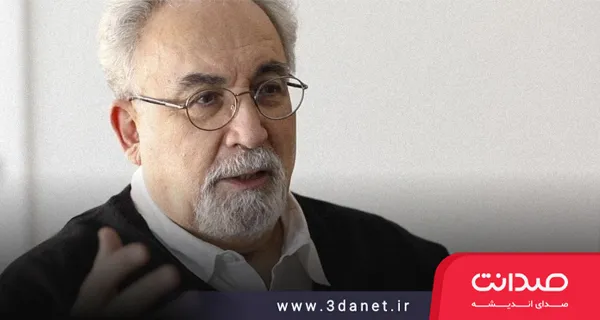
Touraj Daryaee
Author### FIELD: متن
Old Persian inscriptions are important in themselves, but they also led to the discovery of cuneiform script. In 1618, the Spanish ambassador to Iran, Garcia Silva Figueroa[1], identified Persepolis, but it was the Danish scholar Carsten Niebuhr[2] who realized in 1770 that there were inscriptions in cuneiform script at Persepolis. In the same century, a German secretary named Georg Grotefend[3] began deciphering Old Persian cuneiform, and in the eighteenth century published a list of the Old Persian alphabet. However, this script was not alphabetic but syllabic. In the nineteenth century, it was Henry Creswick Rawlinson[4] who, while serving as an adviser to the governor of Kurdistan, observed the Bisitun inscription and, at great risk, by hanging himself from Mount Bisitun, examined more of the inscription and prepared a copy of it. This work took about ten years, and he succeeded in reading the letters of the Achaemenid kings in 1846. From that time, the translation of inscriptions began, and it was Ronald Kent[5] who brought to fruition the work that had begun more than three centuries earlier. In his book, Kent was able to provide a comprehensive and valuable overview of Old Persian grammar, vocabulary, and inscriptions. Until the past decade, this book was the primary work used for learning Old Persian, and it remains useful today.
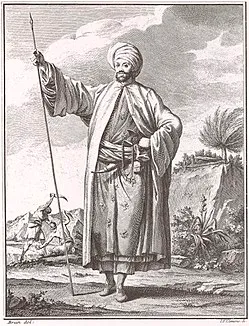
. Carsten Niebuhr (1733–1815).
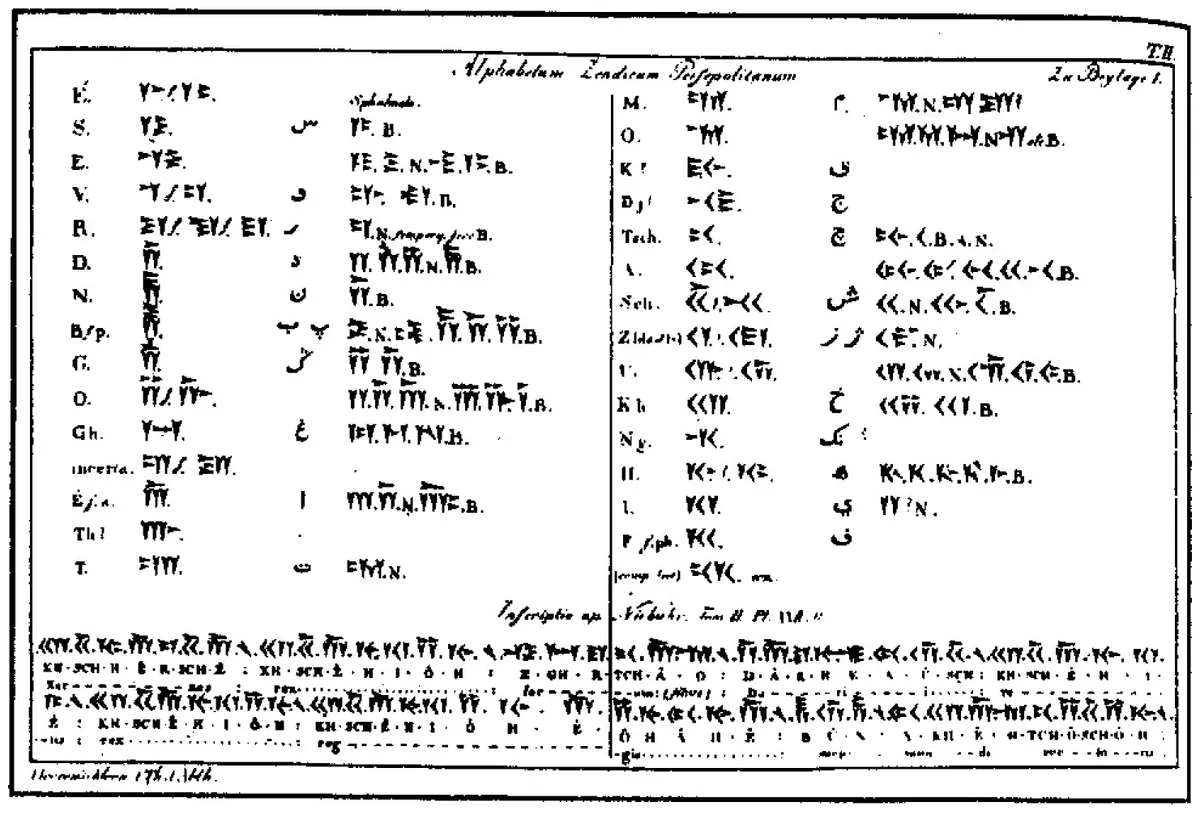
. Table of Old Persian letters, written by Grotefend.
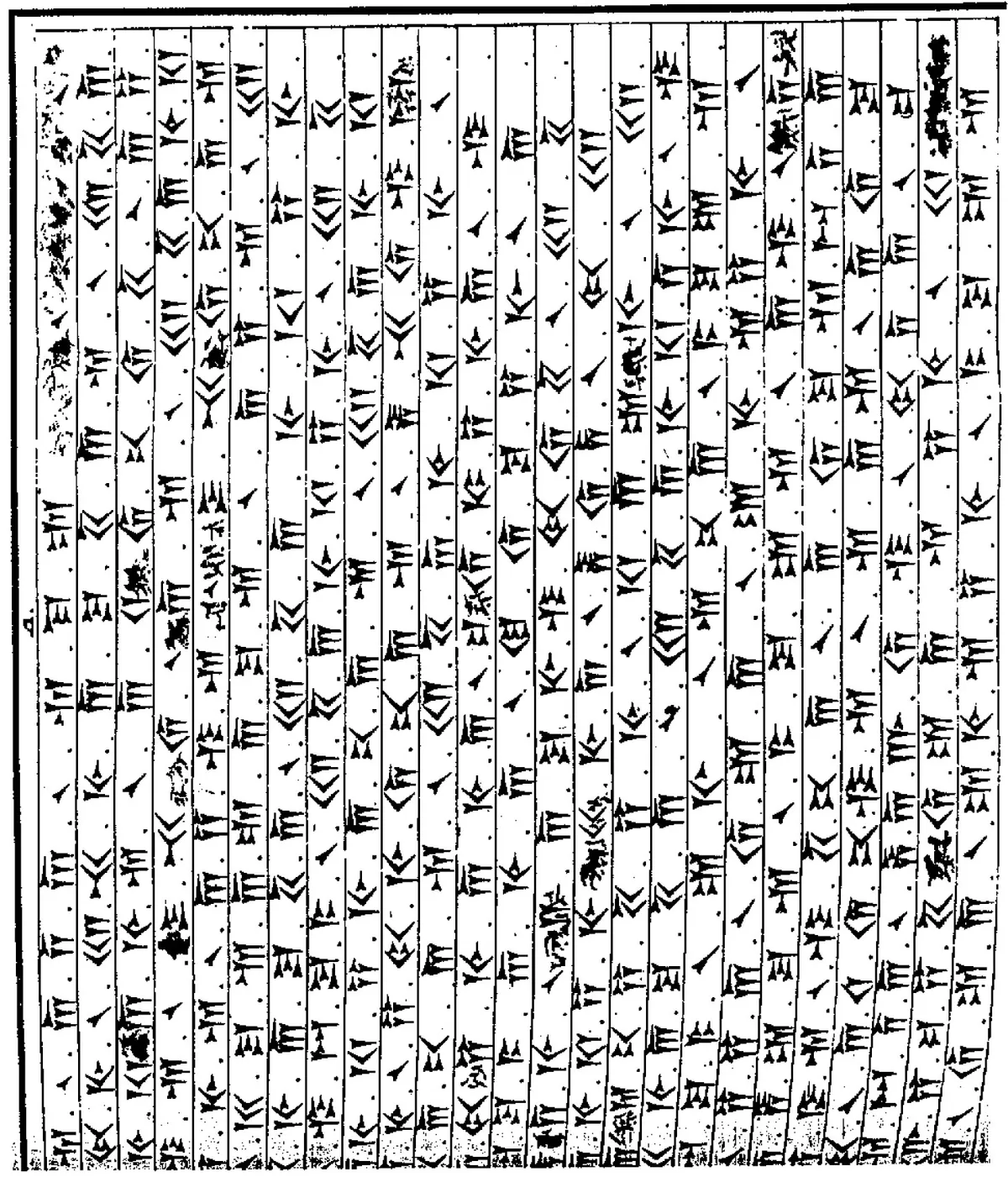
. An inscription depicting Carsten Niebuhr.
The question now is how this script was created for the Persian language and by which king it was commissioned. Because of the existence of inscriptions attributed to Ariaramnes, Arsames, and Cyrus, many scholars in the past believed that Old Persian script had been created before Darius. However, in 1970 Diakonoff demonstrated that it was Darius who initiated the creation of Old Persian script, and that the fabrication of the Ariaramnes, Arsames, and Cyrus inscriptions was an attempt to conceal the issue of the seizure of the throne from the Cyrus dynasty, because in these inscriptions Cyrus was presented as belonging to the Achaemenid family, whereas he was originally from the Teispid family.
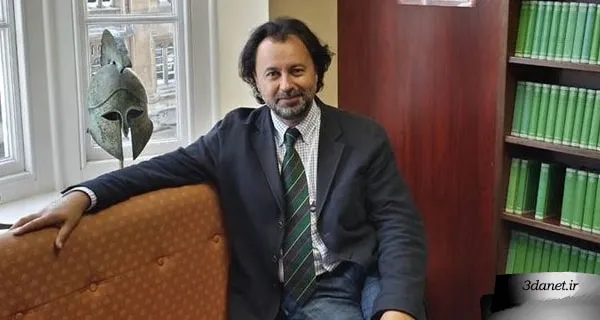
In the past decade, Achaemenid inscriptions have once again become the focus of close attention by Iranologists, and two scholars have retranslated the Achaemenid inscriptions. First, we should mention the most important scholar in the field of Old Persian, Rüdiger Schmitt[6]. In 1991, he published Darius’s Bisitun inscription in a single volume, containing an important introduction, a complete bibliography, a new transliteration, translation, and photographs of the inscription. The footnotes clarified textual problems, and together with the Elamite and Babylonian translations in two separate volumes, it remains the most important work on this inscription. In 2000, Schmitt also published the Old Persian inscriptions of Naqsh-e Rostam and Persepolis, applying the same precision and refinement in that work. This book includes photographs of the Naqsh-e Rostam inscriptions. In this book, we observe the development of Old Persian into Middle Persian; after the inscriptions of Xerxes, grammatical errors appear. The question is whether the scribes had forgotten Old Persian or whether the language itself was undergoing change.
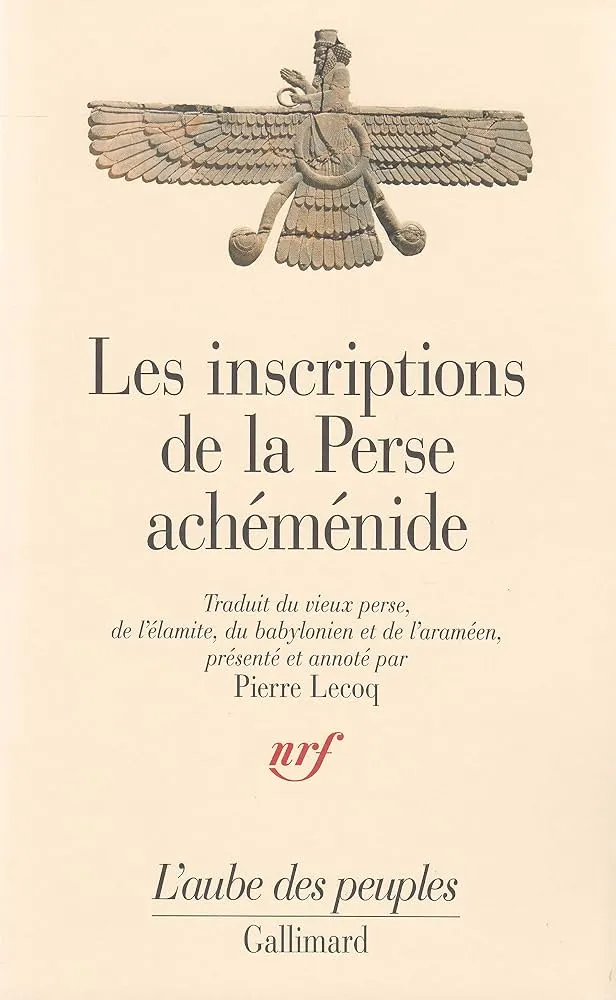
. The book Old Persian Inscriptions of the Achaemenid Empire by Pierre Lecoq
The other book is by Pierre Lecoq [7], the French scholar, and is titled Old Persian Inscriptions of the Achaemenid Empire. In this book, he presents everything necessary for understanding Old Persian language, script, history, and more. The first section of the book contains two excellent maps, one of which shows the Achaemenid satrapies. It then presents the genealogy of the dynasty. The first chapter discusses the mysterious history of the discovery of cuneiform script. The second chapter concerns the Aryans in Iran. The third chapter is about the Achaemenid period and discusses Median, Elamite, Babylonian, Aramaic, Egyptian, and Greek languages. The fourth chapter is devoted to Old Persian cuneiform, and the fifth chapter is about the name of Cyrus in Babylon and the palace of Pasargadae. The sixth chapter discusses Darius and the Bisitun inscription, examining the inscription section by section. The seventh chapter concerns Darius and the palace of Persepolis; the eighth concerns the palace of Susa; the ninth concerns the tomb at Naqsh-e Rostam; and the tenth concerns Hamadan, Suez, and other locations. The eleventh chapter is about the citizens of the empire. The twelfth chapter discusses religion in the Achaemenid period. The thirteenth chapter concerns Achaemenid institutions.
The second part of the book is a translation of Old Persian inscriptions, from the Ariaramnes inscription in Hamadan to the inscription of Artaxerxes III. Then a Greek inscription, which is a letter from Darius, is also translated. Schmitt’s two books are intended for detailed study of inscriptions and a linguistic approach to them. Lecoq’s book is highly useful and comprehensive for historians, but because it does not include transliteration, it does not reach the completeness of Schmitt’s work. The work of both scholars is admirable.
[1] Garcia Silva Figueroa
[2] Carsten Niebuhr
[3] George Grotefend
[4] Henry Creswick Rawlinson
[5] Ronald Kent
[6] Rüdiger Schmitt
[7] Pierre Lecoq
Important sources for studying Old Persian inscriptions:
W. Brandenstein and M. Mayrhofer, Handbuch des Altpersischen, Wiesbaden, 1964.
W. Hinz, Altpersischer Wortschatz, Leipzig, 1942.
W. Hinz, Neue Wege im Altpersischen, Wiesbaden, 1973.
K. Hoffmann, “Zur altpersischen Schrift,” Orientalia Romana, vol. 52, 1983, pp. 31–39.
R. G. Kent, Old Persian Grammar, Texts, Lexicon, New Haven, 1953.
P. Lecoq, “La langue des inscriptions achéménides,” Acta Iranica 2, 1974, pp. 55–62.
P. Lecoq, “Le problème de l’écriture cunéiforme vieux-perse,” Acta Iranica 3, 1974, pp. 25–107.
P. Lecoq, “Observations sur l’écriture vieux-perse,” Orientalia Romana, vol. 52, 1983, pp. 31–39.
P. Lecoq, Les inscriptions de la Perse achéménide, traduit du vieux perse, de l’élamite, du babylonien et de l’araméen, présenté et annoté, Gallimard, 1997.
M. Mayrhofer, Supplement zur Sammlung der altpersischen Inschriften, Wien, 1978.
M. Mayrhofer, Die altpersischen Namen, Wien, 1979.
A. Meillet and E. Benveniste, Grammaire du vieux perse, Paris, 1931.
H. H. Paper, The Phonology and Morphology of Royal Achaemenid Elamite, Ann Arbor, 1955.
A. V. Rossi, “La varietà linguistica nell’Iran achemenide,” AION, vol. 3, 1981, pp. 141–196.
R. Schmitt, “Altpersisch-Forschung in den Siebzigerjahren,” Kratylos, vol. 25, 1980/1981, pp. 1–66.
R. Schmitt, “Altpersisch,” Compendium Linguarum Iranicarum, Wiesbaden, 1989, pp. 56–85.
R. Schmitt, The Bisitun Inscriptions of Darius the Great. Old Persian Text, CII, Part I, vol. 1, Texts I, London, 1991.
E. Voigtlander, The Bisitun Inscription of Darius the Great. Babylonian Version, CII, London, 1978.
.
First published in Bukhara bi-monthly magazine, sixth year, issue 3–4 (consecutive issues 33–34), pp. 81–86
### END

Discussion0 comments
No comments yet; let yours be the first voice.