History
Avoiding Politicisation in Writing the 'Comprehensive History of Iran': A Conversation with Touraj Daryaee
The 20-volume Comprehensive History of Iran has been published after 14 years of work by Iranian and international scholars. In this interview, Touraj Daryaee stresses the work's freedom from politicization and sees the diversity of its contributors as a guarantee of its impartiality.
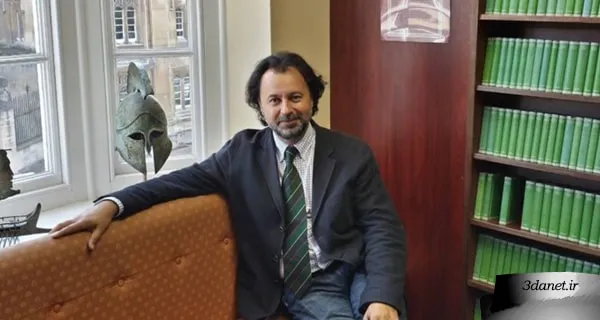
At last, the 14-year effort of 143 Iranian writers and historians and 25 European, American, and Asian writers and researchers on the history of Iran has been published under the title 'Comprehensive History of Iran'. The 20-volume set, produced under the auspices of the Centre for the Great Islamic Encyclopaedia and under the supervision of Kazem Mousavi-Bojnourdi, was unveiled in Tehran last week. A work that, given the distinguished Iranian and foreign names associated with it, has aroused great expectations.
The book begins from the era before the formation of the Achaemenid Empire and continues until the end of Qajar rule in Iran.
One of its authors is Touraj Daryaee, Professor of Ancient Iranian History of the Sasanian period at the University of California, Irvine. I invited this researcher and professor of ancient Iranian history, who authored two important entries in this collection, to be our guest this week on the programme 'Distant View, Close-up View'.
.
.
Mehrdad Ghasemfar's Conversation with Touraj Daryaee about the 'Comprehensive History of Iran'
Welcome to our programme this week. Perhaps the first question upon encountering this extensive and large historical collection is, despite the existence of numerous studies, research, and books on the history of Iran, why should such a collection of this size be published, a collection that required years of effort and work to prepare?
Every society and country needs to update its history in each era or decade. I can only speak about the section of this book concerning ancient history, as I am somewhat familiar with it, and I wrote two of its chapters. The situation in our country in this field was truly chaotic. Every week, many students would contact me looking for books and reference works related to various periods of ancient Iranian history. I think that with the publication of this book, we can update history. That is, in the 21st century, there is now a reference book that students from our own country or Afghanistan, Tajikistan, Uzbekistan, and anywhere the Persian language is common and Iranian culture has had an influence, can review this history in their own language.
Another issue is that this collection is not a translated work that was first published outside Iran and then rendered into Persian, contrary to what is common in our country, especially regarding ancient Iranian studies. I think the importance of this 20-volume book is that we, the Iranian and foreign writers and researchers, wrote these articles for the Persian publication of the book, meaning the articles have not been published anywhere before. I think we have never had a collection like this.
Consider the Cambridge History of Iran, which is eight volumes. Its publication began around 1970, meaning it dates back to the late 1340s or early 1350s Solar Hijri; in a sense, it shows us the knowledge of thirty years ago. But this book brings history into the 21st century.
You emphasised the use of new sources. But to what extent can someone using this book be confident that the latest research findings in the field of archaeology and possibly discovered texts and documents related to the history of Iran were used in the writing and compilation of this large collection?
One of my concerns is the politicisation or the politicised nature of our historiography. I can say that the 'Comprehensive History of Iran' collection has not fallen prey to politicisation. The circle of authors for this collection is very broad; researchers from Eastern Europe to Western Europe, America, Iran, and Asia have played a role in it. Therefore, the book's chapters are not uniform, reflecting a single particular view or approach.
As far as I know, the individuals who wrote the articles for this book are researchers and authorities in their own fields. It was not the case that we let just anyone write, for example, the history of the Achaemenids. The matter is far more serious than that. For instance, Mr. Pierfrancesco Callieri, one of the authors of this book, is a specialist in the Achaemenid period and has recently conducted excavations at Persepolis. He was asked to incorporate what he knows into a chapter of this book. The work was carried out in this manner. It is not simply a matter of finding someone at random and asking them to write an article based on findings that might have been important 40 years ago but are no longer influential today.
The issue of history and historiography usually finds a very direct connection with the political matter. One of the concerns and worries that has always existed regarding historiography in Iran, especially after the revolution, relates to this very issue. Now, the question that arises about the 'Comprehensive History of Iran' collection is whether this collection, in confronting the history of Iran, has adopted a directed approach with ideological goals in favor of official propaganda, or whether it has been neutral and solely reliant on existing facts? How optimistic can we be about this?
I must say that we can be completely optimistic. One of my concerns about Iranian historiography is this politicization, or the politicized nature of our historiography. Historians, or scholars in general, should not involve their personal or political beliefs in the text they write. Of course, every book must be critiqued. This book, in my opinion, is very important and has not fallen prey to politicization, especially the early parts of the book that deal with the ancient period. The circle of authors for this collection is also very broad, from scholars in Eastern Europe to Western Europe, America, Iran, and Asia; all have played a role in this. Therefore, the chapters of the book are not uniform, reflecting one particular perspective and approach. Now, it is possible that the person editing these writings might give them a certain direction. Every book is like this. But I am very optimistic and think it is good that this type of work is published in our own country, which is so politicized.
If you will allow, let us set aside the general questions and turn to those parts of the collection in which you collaborated, namely the section on the administrative system in ancient Iran. What exactly did this administrative system focus on in pre-Islamic history?
I think they were somewhat kind to me in asking me to write this section on the administrative system in ancient Iran, and also the section on the army in ancient Iran, which amounts to two chapters in total. When I had just finished my studies and was a professor of ancient world history here at California State University, Fullerton, the bulk of my thesis was about the administrative situation of the province of Fars in the Sasanian period. That is why I think I was asked to write about this issue for them. Well, by that time, I had reviewed everything that was available. My own professor was one of the specialists, and I was familiar with all the articles and new works that had been published, and based on those findings and evidence that existed 14 years ago, I wrote this article, and likewise the article on the army. Of course, if I were to write this article after 14 years, I would revise it somewhat, because more findings have come to light.
What do you think is the most important difference between the articles you authored on the army in ancient Iran and on the administrative system of ancient Iran, which appear in this collection, and what interested readers or students of this field have read before?
We do not have a lengthy article that reviews Iran's administrative system from the Achaemenid period to the late Sasanian era and the Iranians' perspective on this administrative system. Usually, specialists of the Achaemenid, Parthian, or Sasanian periods focus on one of these. I tried to address all of them and also show the evolution of a series of titles. In the article on the army, I did the same thing again. That is, I traced the evolution of titles in the Iranian army up to the late Sasanian period. To some extent, I have tried to show the history of the army's evolution. Naturally, there are much better articles than mine. One of the most important works done in this field is the Encyclopædia Iranica. It has not been supported as much as it should have been. You can always look at the Iranica entries and then go to other entries. But all of those are encyclopedias. Whereas this is a historical book, meaning it is written in a narrative style.
.
.
Audio Mehrdad Qasemfar's Conversation with Touraj Daryaee on the 'Comprehensive History of Iran'
.
.

Discussion0 comments
No comments yet; let yours be the first voice.