Philosophy
Aeen Monthly: Introducing the Book Religion in the Scales of Ethics by Abolghasem Fanaei
The book Religion on the Scales of Ethics by Fanaei examines new dimensions of the relationship between religion and ethics in two parts. The author critiques their mutual dependence and elucidates the possibility of secular ethics and the relation of Sharia to moral values.
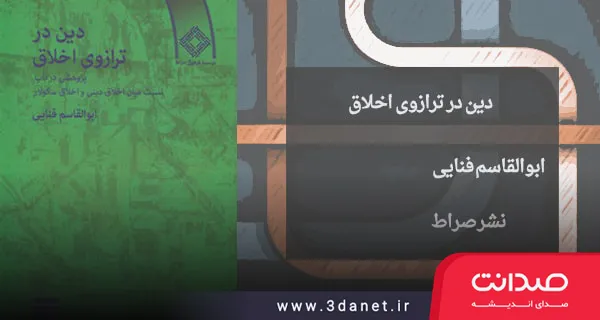
Although philosophers and theologians have long addressed the question of the relationship between religion and ethics, in the modern era this issue has taken on new and novel dimensions. *Religion in the Scales of Ethics* is among the works that, while looking back at the history of this discussion, also delves into its new dimensions in the present age. This work consists of two main parts and seven chapters. In the first chapter of the book's first part, while providing a brief yet illuminating account of the history of this discussion among Muslim and Christian philosophers and theologians, the author emphasizes two fundamental points: first, that the aims of Muslim and Christian philosophers and theologians in entering this discussion have been different. Muslim philosophers and theologians have addressed this issue in order to provide a coherent explanation of God's attributes, whereas the aim of Christian philosophers has been to resolve the conflict between religious and moral teachings by offering an acceptable theory about the relationship between religion and ethics. In other words, Muslim philosophers and theologians had a theological aim, while their Christian counterparts had a philosophical one. The other point is that in the modern era, Muslims' understanding of ethics differs greatly from that of Westerners. Muslims consider ethics to be an individual and otherworldly matter that deals with the inner and esoteric dimension of the human being, and therefore, they expect it, first and foremost, to help purify their souls and attain otherworldly happiness and salvation, and secondarily, to aid in regulating human social relations. In the modern era, however, the primary expectation of ethics is to regulate the relations of human beings and social institutions and to secure the collective, worldly welfare and happiness of humans, while its effect on individual, otherworldly happiness and salvation is of secondary importance. For this reason, the author believes that moral philosophy in the modern era holds the same role and position that jurisprudence holds in Islamic civilization, and indeed, moral philosophy is the jurisprudence of the modern world, and moral philosophers are the jurists of the modern world. (p. 39).

In the second chapter, the author clarifies the concepts of "religion" and "ethics" and, by his own account, has pursued two goals in doing so: first, he believes that analyzing and examining the various modes of the relationship between religion and ethics depends on presenting a clear understanding and picture of each of these two concepts. Second, through their conceptual clarification, one can discern the difference between the views of Muslim and Christian philosophers on ethics. To this end, he first explains that each of the concepts of "religion" and "ethics" has general and specific meanings; the general meaning of religion includes religious experience, principles of belief, ethics, and sacred law, and the specific meaning of religion is equivalent to sacred law. Likewise, the general meaning of ethics includes the ethics of conduct, belief, thought, and inquiry, while the specific meaning of ethics includes only the ethics of conduct. In his view, Muslim philosophers have not only limited the domain of ethics to the ethics of conduct and paid no attention to the ethics of belief and inquiry, but within the domain of the ethics of conduct, they have also reduced social ethics to jurisprudence. In the modern era, however, ethics encompasses all three domains of conduct, belief, and inquiry, and social ethics is not reduced to anything else (pp. 51-52).
The second part of this work analyzes and examines the various modes of the relationship between religion and ethics in the realm of legislation. The titles of the chapters analyzed and examined in this part are as follows:
"The Dependence of Ethics on Religion," "The Dependence of Religion on Ethics," "The Services of Religion in the Realm of Ethics," "The Ideal Observer and the Moral Point of View," and "God as the Ideal Observer."
In the first chapter of the book Religion in the Scales of Ethics,
In light of these two distinctions, the author ultimately shows that if we consider ethics to be maximal and the dependence to be positive, then psychologically and rationally, religion is not dependent on ethics, because religious commitment can be justified on the basis of prudential rationality, and the rational motive for following religion can also be a prudential one. For this reason, the rational justification of religious commitment and the rational motivation for religiosity do not necessarily originate from ethics, even though religiosity can also be justified on the basis of moral values.
However, if we consider ethics to be minimal and the dependence to be negative, then religion will be psychologically and rationally dependent on ethics; that is, people are only entitled to follow religious commands insofar as those commands are compatible with moral values and obligations; otherwise, there will be no rational justification or motivation.
In the next chapter, the author attempts to show that the independence of ethics from religion and its priority over religion does not contradict the fact that religion can serve ethics. To this end, he explains and elucidates a number of services religion renders to ethics:
Shaping human attitudes toward worldly life; expressing the unseen forms and otherworldly consequences of actions; presenting a religious anthropology; the impact of religious worship on the morality of believers; linking moral concepts to religious concepts; providing moral exemplars; presenting the moral system inherent in the universe; influencing moral education and upbringing; presenting God as the ideal observer; curbing and moderating human egoism.
The discussion of the necessary conditions for a justified moral judgment is the subject of the next chapter. Indeed, the occurrence of error in moral judgments and the disagreement among humans in discerning the moral judgment of issues are two undeniable facts of human life, and moral philosophers, by offering their theories, seek to help people discern justified moral judgments and prevent, or at least reduce, errors in their assessments. In the author's view, a justified moral judgment is the judgment of an ideal observer who looks at the issue from a moral point of view (p. 199). In other words, a justified moral judgment is one that is, first, issued by an ideal observer and, second, in which the ideal observer looks at the issue from a moral point of view.
For this reason, the author has endeavored to enumerate the characteristics of an ideal observer and a moral point of view. Sufficient knowledge of the facts related to the issue, possession of moral experience and insight, fairness and impartiality, benevolence, kindness and honesty, possession of a moral point of view, appropriate appeal to moral principles, coherent judgments, the ability to resolve moral conflicts, and intellectual humility are among the characteristics he lists for an ideal observer.
On the other hand, in stating the characteristics of a moral point of view, he notes that the characteristics of a moral point of view are embedded in human intuitions; moral philosophers have tried to systematize and reconstruct these intuitions and present them as a moral theory. In other words, a moral theory articulates the moral point of view, which is expressed in the form of one or more basic moral principles, by means of which one can judge other moral issues and determine whether they are moral or immoral, justified or unjustified.
Theories of moral realism, virtue ethics, universalizability-based ethics, utilitarian ethics, and error-avoidance-based ethics are among the theories through whose explanation and critique the author has sought to present various perspectives on the moral point of view.
In the final chapter of the book, the author defends the point that with the help of the ideal observer theory, not only can a new account of the difference between religious ethics and secular ethics be presented, but by its aid, one can both resolve the difference between the two and offer a correct explanation of the nature and essence of moral judgments. In his view, if we say that moral norms originate from the will and desire of the moral God, that is, God as the ideal observer, then no difference will remain between religious ethics and secular ethics; that is, these two ethics, with the different presuppositions they may have about the instance of the ideal observer, lead to a single normative ethics (p. 262).
Providing a brief yet eloquent account of the historical background of the problem of the relationship between religion and ethics among Muslim and Christian philosophers, presenting a clear and systematic picture of the problem, comparing the views of Christian and Muslim philosophers, and striving to resolve the conflict between religious and secular ethics are among the merits of this book, which makes it worth reading for enthusiasts of such discussions.
Author of the text introducing the book *Religion in the Scales of Ethics*: Mohammad Reza Bayat
Source: Aeen Monthly
.
.
Back cover text of the book *Religion in the Scales of Ethics*:
The primary motivation for this research is to find a reasonable and satisfactory way to resolve the conflict between religious ethics and secular ethics. In the author's belief, the prevalent political and social disputes and conflicts in our country, and perhaps in other Islamic countries, are largely the product of two different outlooks and ways of thinking about the relationship between religion and ethics, and in fact, the product of the conflict between two different ethical, value, and normative systems. These two ethical systems originate from two fundamental assumptions regarding the origin and limits of the "right of obedience to God the Lawgiver" or the "obligation to obey God the Lawgiver." On one side are those who claim that the right of obedience to God the Lawgiver, or the obligation to obey Him, is "absolute," and therefore ethics is based on religion, and in the event of a conflict between divine values (= jurisprudence or religious ethics) and human values (= secular ethics), divine values must be prioritized. On the other side are those who claim that the right of obedience to God the Lawgiver and the obligation to obey Him is "bound" by ethical constraints, and ethics is not only not based on religion but takes precedence over it. This book is, in truth, a fair and impartial critique and examination of these two viewpoints.
.
.
Bibliographic details of the book *Religion in the Scales of Ethics*:
Author: Abolghasem Fanaei Format: Octavo Binding: Paperback Publisher: Serat Language: Persian Number of Pages: 274 Publication Year: 2005 Edition: 1st ISBN: 9645633176
.
.
Table of contents of the book *Religion in the Scales of Ethics*:
Preface Foreword Part One
A Historical Introduction 1.1 Introduction 1.2 The Relationship between Religion and Ethics in the Islamic World 1.3 The Relationship between Religion and Ethics in the Western World 1.4 Final Word
Defining Religion and Ethics 2.1 Introduction 2.2 What is Religion? 2.3 What is Ethics? 2.4 Final Word
Part Two The Dependence of Ethics on Religion 3.1 Introduction 3.2 The Historical Relationship of Religion and Ethics 3.3 The Linguistic Dependence of Ethics on Religion 3.4 The Ontological or Normative Dependence of Ethics on Religion 3.5 The Psychological Dependence of Ethics on Religion 3.6 The Rational Dependence of Ethics on Religion 3.7 Final Word
The Dependence of Religion on Ethics 4.1 Introduction 4.2 The Linguistic Dependence of Religion on Ethics 4.3 The Ontological Dependence of Religion on Ethics 4.4 The Rational Dependence of Religion on Ethics 4.5 The Psychological Dependence of Religion on Ethics 4.6 Final Word
The Services of Religion in the Realm of Ethics 5.1 Introduction 5.2 Religion and the Human Attitude toward Worldly Life 5.3 Expressing Unseen Forms and Otherworldly Consequences of Actions 5.4 Linking Moral Concepts to Religious Concepts 5.5 Presenting Moral Exemplars 5.6 The Moral System of the Universe 5.7 Religious Anthropology 5.8 The Role of Religious Devotions in the Morality of Believers 5.9 Religion and Moral Education and Training 5.10 God as the Ideal Observer 5.11 Curbing and Moderating Egoism 5.12 Religion's Emphasis on the Importance of Reason, Rationality, and Morality 5.13 Final Word
The Ideal Observer and the Moral Point of View 6.1 Introduction 6.2 Why Do We Need an Ideal Observer and a Moral Point of View? 6.3 Characteristics of the Ideal Observer 6.4 Characteristics of the Moral Point of View 6.5 Final Word
God as the Ideal Observer 7.1 Introduction 7.2 God as the Ideal Observer 7.3 The Ideal Observer, Religious Ethics, and Secular Ethics 7.4 The Ideal Observer Theory and Resolving the Paradox of Religious Ethics 7.5 Final Word
Bibliography


.
.




Discussion0 comments
No comments yet; let yours be the first voice.