Religion
Akbar Ganji's Critique of Abdolkarim Soroush's Theory of the Prophetic Dream
Akbar Ganji critiques Abdolkarim Soroush's 'Prophetic Dream' hypothesis, raising fourteen objections and arguing that the theory requires greater conceptual and evidential precision. The critique centres on the contrast between the traditional model of revelation and Soroush's reading of the Quran as the Prophet's dreams.
Akbar Ganji: For several years now, Abdolkarim Soroush has proposed a rival hypothesis called the "Prophetic Dream" in opposition to the traditional hypothesis of revelation. This hypothesis has been controversial, but as far as I understand, it still needs refinement of its concepts, claims, and evidence in order to become a proper hypothesis. In the attached article, I have raised 14 objections to this hypothesis. Read it and favor me with your critical opinions.
.
Interpreting the Words of God or Expounding the Dreams of Muhammad
Abdolkarim Soroush has presented a rival hypothesis to the traditional model of revelation accepted by the majority of Muslims. The essence of his claim is this: Exegetes have hitherto interpreted the Quran as the words of God, but now it is the turn of dream interpreters to expound the dreams of Muhammad.
Soroush rejects the traditional model of the "letter-receiving and letter-delivering prophet." This model had also created many problems for philosophers such as Farabi, Ibn Sina, and Mulla Sadra, who tried to overcome them by constructing weighty metaphysical systems. Muslim mystics also grappled with this same issue in a different way. Among religious modernists, Arash Naraghi, in his article "Critical Traditionalism in the Realm of Religion: A Theory on the Logic of Reforming Religious Thought in Islam (Part One)", tried to offer a modern understanding and defense of the traditional theory of revelation. My limited understanding and knowledge could not bear that defense, so I questioned it in the article "Arash Naraghi's Contradictory and Uncriticizable Traditionalism."
I find myself in a similar situation regarding Soroush's hypothesis. Naturally, it is Soroush's right to present a new hypothesis for understanding revelation and the Quran, but this hypothesis must be sufficiently clear and precise to open the door to critical dialogue. In this writing, I try to argue that Soroush's hypothesis faces at least 14 objections, which are: 1- Oscillating between a personal God and a purely formless God. 2- The theory's limitation to the Quran alone or its generalization to revelation. 3- Epistemological problems of the hypothesis. 4- Oscillating between interpreted dreams and uninterpreted dreams. 5- The entire Quran lacking visual content. 6- Strange psychological consequences. 7- Repeating the polytheists' view in a new guise. 8- Insensitivity to the Prophet's behavior and speech. 9- An invalid inference to the best explanation. 10- The hypothesis being unacceptable to the community of believers. 11- The theory being ahistorical. 12- Neglecting the guiding purpose of religion. 13- The dissolution of prophethood. 14- The problem of life after death.
Stating these points emphasizes the need for Soroush to open the path for dialogue and critique through conceptual clarification and by clarifying his claims and their evidence. Conceptual clarification and the precise statement of claims are the first steps of scholarly and hypothesis-formulating discourse.
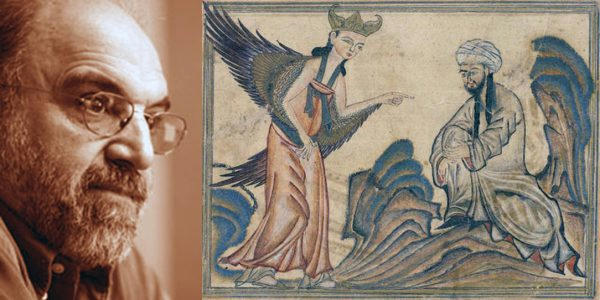
Muhammad is the Messenger of God, meaning, as depicted in this old image, he receives God's message from Gabriel to convey to the people. Soroush does not accept this simple narrative. Instead, he speaks of "Prophetic Dreams." How convincing is this hypothesis?
Fundamental Differences Between the Traditional Model and the Rival Model
According to the traditional model or explanation of revelation:
A- God is a personal being, distinct from the world, who—like human beings—possesses mind, intellect, understanding, and self-consciousness, and has the ability to speak and convey meaning (such a God can be called anthropomorphic). In other words, God has thoughts and can use the human construct of language to transmit those thoughts to human beings.
B- The Qur’an is the speech of God, made available to others through the Prophet.
C- Prophethood means the selection of a particular human being by the personal, anthropomorphic God to convey His words and messages—His commands and prohibitions—to the people.
D- God’s words are subject to interpretation, and believers and exegetes have interpreted them throughout history and continue to do so.
Soroush has constructed a rival model to the narrative held by the general body of Muslims, according to which:
A- God is pure formless existence, identical with the world, who has no mind, and since He has no thoughts, He also lacks the ability to transmit them through speech. Because God has no mind or will, not only can He not speak, but He also cannot comprehend a thought, or hear and approve or ratify a speech, prayer, or entreaty.
B- The Qur’an is the dreams of Muhammad and a prophetic dream-book.
C- Muhammad is not the transmitter of God’s words and messages; he merely recounts the dreams he himself produced. He has total and complete involvement in the production of his dreams.
D- Dreams must be interpreted by dream interpreters.
In Soroush’s view, considering the Qur’an to be the words of God is not intelligible, but considering it the product of the Prophet’s dreaming is entirely intelligible to everyone. He said on the program “Pargar” (BBC):
“Look, when I say they dreamed, this, incidentally, we understand, but that God spoke—a God who is without direction, without likeness or similitude, without limbs and organs—how does He speak with His Prophet?… The product of this revelation is very important; if you say it was of the nature of a dream, then its product requires dream interpretation… I believe that the Jews turning into apes and swine, which is mentioned in the Qur’an, was seen in a dream.”
A God who does not speak is also incapable of hearing. Hence, in Soroush’s hypothesis, supplication is not speaking with a specific, anthropomorphic God; it is soliloquy and meditation.
Some of the problems that the present writing addresses are as follows:
First Problem – “The Anthropomorphic Personal God” or “Pure Formless God”?
Different Gods, or different conceptions of God, will completely alter the nature and destiny of prophethood, revelation, and the Qur’an. In other words, one God makes revelation—the words of God—and prophethood—the selection of a specific individual and commissioning him to convey God’s words and messages to the people—intelligible and possible, while another God leaves no room for revelation and prophethood.
Thus, when a thinker grapples with this “problem”—that God is not a personal, anthropomorphic being and that God’s speaking and hearing are not possible—he is compelled to devise a new scheme that gives new meaning to revelation, prophethood, and the Qur’an. Abdolkarim Soroush has wrestled with such a great problem.
In my belief, Soroush’s primary motive for proposing the theory of the prophetic dream is to harmonize his theory about the Qur’an with his theory about God. However, as I will explain in this section, Soroush’s theory about God has weighty theological consequences to which Soroush himself, in his various writings, has been unable to remain faithful, and as a result, his statements across different writings are incoherent and inconsistent. Also, in this section, I will show that the theory of the prophetic dream is logically independent of Soroush’s theory about God, and if Soroush remains faithful to his theory about God, the Qur’an does not enjoy a special theological status compared to human writings.
Consider Soroush’s problem in this sentence where he writes:
“As long as we see God’s hand directly at work in the Quran, regard Muhammad as purely passive in the experience of revelation, and consider the Quran the product of the Almighty’s infinite knowledge, these difficulties [of the Quran] will never be resolved. It suffices to turn the page and see a divine human being as the agent and creator of this magnificent work… [the Quran is the result of] his total and complete agency… God composed Muhammad, and Muhammad composed the Quran.”
Soroush rightly writes in response to Jafar Sobhani: “Until we have a correct picture of the relationship between God and the world, prophetology and the study of revelation will not reveal their true face either.” Soroush says that his God is the God of the proponents of the unity of existence.
W.T. Stace, in his classic book Mysticism and Philosophy – translated by Baha’ al-Din Khorramshahi, Soroush Publications, first edition 1979 – distinguishes between objective and subjective unity of existence. According to objective unity of existence, God is one with the world, and the entire world is God. God is everything, and everything is God. Muhyiddin Ibn Arabi said: “Existence is only God” (Al-Futuhat al-Makkiyya, vol. 2, p. 69), “There is nothing in existence but God” (ibid., vol. 2, 114), “Existence is nothing other than the very essence of the Real, and there is nothing in being besides Him” (ibid., vol. 2, p. 516), “There is no existent but God” (ibid., vol. 2, 216), “There is no existent other than Him” (ibid., vol. 2, p. 563). “By Him in Whose hand is might, majesty, and pride, there exists nothing other than God, the Necessary Being” (ibid., vol. 1, p. 701). “God encompasses everything because He is the very essence of everything” (ibid., vol. 3, p. 386), “The gnostics see Him as the very essence of every thing” (ibid., vol. 3, p. 410), “He for whom God has opened the door sees Him in every thing or as the very essence of every thing” (ibid., vol. 1, p. 592).
But according to subjective unity of existence, the world is distinct from a personal, anthropomorphic God, and the mystic, through spiritual wayfaring, ascends to the summit and, in moments, becomes one with God.
According to Soroush, most of our problems concerning God – including the problem of evil (God’s absence in the Holocaust, the Indonesian tsunami, and the massacre in Gaza) – stem from conceiving of God anthropomorphically. God was actively present in all these events, did everything Himself, and Himself burned the Jews. God is not human, and one should not have human expectations of Him. Muhammad dreamed that God was seated on the throne (arsh). Muhammad dreamed that on the Day of Resurrection, eight beings were carrying the God seated on the throne. God does not speak and does not command.
According to Soroush, at first glance, one should have a conception of God akin to time, number, or meaning. If we have such a conception of God, it is unclear why we should attribute causal power to God. Numbers do not have causal power. Beyond this, Soroush says that according to this conception of God, prayer and intercession have no effect on a non-anthropomorphic God, and according to Mulla Sadra’s theory, influence from this side to that side is absolutely blocked. There is no rational or philosophical justification for praying – indeed, we have a hundred arguments against it – and if Moses and Muhammad had not prayed, I would not pray either. All forms [including Muhammad] have an equal relation to God. For Mulla Sadra, causality signifies that God Himself becomes formed into forms.
Thinking is impossible for God. God has no thought, no solicitude, no tenderness, and no compassion. Why should we concern ourselves with a God who has nothing to do with us? When you resolve, God has resolved. When you will, God has willed. God has no mind and no language, and does not command or prohibit. He has no aim or purpose. Muhammad saw all of existence in prostration in a dream, fell to the ground, prayed, and commanded us to pray.
Shiites regard God as the grandfather of Muhammad, Ali, Fatima, Hasan, and Husayn, who have private relationships with one another and run the world according to their own whims. God has special compassion for these and no one else; this is anthropomorphism, idolatry, and polytheism. God was in the midst of the Holocaust, kindling the fire and burning. God does nothing in the world other than creation. Religion is entirely the production and product of Muhammad and his dreams.
Soroush believes in a “pure, formless, infinite, eternal, and everlasting God” devoid of spirit and human attributes (mercy, anger, wrath, vengeance, contentment, creator, creation, compassion, speech, sustainer, life, knower, wise, all the Beautiful Names, knowledge of otherness, command and prohibition, having purpose and intent, etc.). He says the most important criticism leveled at his theology is that it has severed the relationship between humans and God, and one cannot have a relationship with a formless God. Wherever there is existence and being, there is God. The universe is God's exhibition. When we say stone, flower, and thorn exist, it means God Himself has appeared and manifested. All forms are masks upon God. It is impossible for the effect (the human) to influence the cause (God), and one cannot bring about a change in God through supplication and worship/prayer. Fear of a formless God and love for a formless God are meaningless. Prayer and supplication are a repetition of the Prophet's experience, not a conversation with a formless God who lacks the ability to hear. “God is in us, with us, and is our very selves.” Prostration is participation in the universal orchestra.
According to this conception, all beings in the universe—including humans—are God. But Soroush does not remain faithful to this conception in all circumstances. When he denies God's speech, he invokes the formless God who does not speak and for whom the entire universe is Himself. Soroush writes about the relationship between God and creation:
“The vulgar mind fashions a material and human form from that ineffable relation, and enthrones a God who is not separate from creation like a mighty king upon the seat of sovereignty, so that He may send messages to His servants from afar. But as soon as the glass of this illusion shatters and the sustaining co-presence of the Real with His creation is properly understood, that metaphysics of separation will transform into a metaphysics of union, and the manifestation and hiddenness of the Real in things, as witnessed in the sacred dream of the Prophet, will appear, and, in the words of Sadr al-Din Shirazi, things will be seen as the modes and attributes of the Real. Not only was God in the Prophet, but the Prophet was in God, and whatever he thought was His thought. And this is for no other reason than that the God of the monotheists is present, without distance or veil, in all existents and contingents, and all contingents and existents are also in Him. The world is divine. And this was the most important discovery of Muhammad (PBUH)” (Muhammad, the Narrator of Prophetic Dreams, 2).
From the proposition that “God is a pure, formless, non-anthropomorphic existence,” Soroush deduces the proposition that “God does not speak, and the Qur’an is the words of Muhammad.” The second proposition is a necessary condition of the first. However, the proposition that “revelation/the Qur’an is identical to a dream/vision” is independent of the two previous propositions and is neither a consequence nor a requisite of either of them. The claim that God does not speak and that what is in the Qur’an are the words of Muhammad has embroiled Soroush in countless problems, forcing him to introduce the new proposition that revelation/the Qur’an is identical to a dream/vision, although it is unclear what help this new proposition offers those problems, other than creating newer problems of its own.
Soroush’s hypothesis raises the issue of prophethood and revelation, and to remain faithful to them, he once again brings the anthropomorphic, personal God into the picture. For example, he says: “Muhammad is filled with God.” Are not all other beings in the world filled with God and are they not God themselves? If any being were empty of God even to the slightest degree, God would lose His infinity and boundlessness and would no longer be the God of Mulla Sadra and the proponents of the Unity of Existence.
In his latest writing, titled “Apostolic Dreams; What a Marvelous Coquetry of a Dream, Better than Wakefulness,” Soroush is also constantly shifting between one of these two Gods and the other. For example, he writes:
“Muhammad (PBUH) is filled with God, and God takes on the stature and measure of Muhammad (PBUH), and therefore Muhammad’s speech is commensurate with Muhammad’s knowledge, not with God’s knowledge. Like a colorless light shining through a colored bubble, taking on the color of the bubble…and God still has words left unsaid; and it cannot be said that with the coming of the Qur’an and the last prophet, revelation and inspiration came to an end and no new word remained for God; yes, there are words remaining, and thus the expansion of prophetic experience is possible.”
See what happened? The same God who did not speak and had no mind, now that the time for the repetition of prophethood has arrived, possesses knowledge, speaks, has not yet said all His words, and will show His new words to new prophets in dreams. Has Soroush forgotten that he told us:
“God did not speak and did not write a book; rather, a historical human being spoke and wrote a book in His place, and his speech was the same as His speech…it is not the case that Muhammad was the addressee of voices and that words were recited into his inner ear and he was commanded to convey them…he was not told, go and tell the people God is one…he was not told, go and tell the people that God, the angels, and those possessed of knowledge bear witness to God’s oneness…he was not told, go and tell the people that there is a resurrection, a scale, a hell, a garden, the gathering of creatures, and the unfolding of books…he was not informed that everything glorifies God” (Dream 1).
“This notion that an angel was pouring verses into Muhammad’s heart and he was reciting them back must give way to the notion that Muhammad (PBUH), like a life-giving, image-making reporter present at the scene, was reporting events. Instead of the proposition that in the Qur’an, God is the speaker and Muhammad is the listener, now this proposition takes its place: in the Qur’an, Muhammad (PBUH) is the observer and Muhammad is the narrator. There is no addresser and addressee, no informer and informed, no speaker and speech; rather, it is all observation and narration. It is not from that realm, but from this realm.”
If God is a pure, formless, non-anthropomorphic existence, then all beings, including Muhammad, Soroush, Aswad al-Ansi, polytheists, and infidels, are also God. Muhammad is not filled with God; Muhammad himself is God, recounting his dreams. Hitler, too, is himself God, and the book Mein Kampf is the book of God. The challenge facing Soroush is this: what difference is there between the Qur’an and Mein Kampf in their relation to the pure, formless God? Based on Soroush’s theory, all books—in terms of being divine—are similar to one another. The same God who burned the Jews in Auschwitz also wrote Hitler’s Mein Kampf.
In his critique of the traditional model of revelation—including in his dialogues with Jafar Sobhani and Abdolali Bazargan—Soroush invokes Mulla Sadra's theory of causality and the relationship between God and the world according to this theory. The "individual unity of existence" is the basis of Mulla Sadra's theory, and being and existence are confined to the single individual reality—the Necessary Being. Effects are the modes, manifestations, phases, aspects, and existential dimensions of the single cause. On this basis, no existent exists except God; the effect is a mode among the modes and an aspect among the aspects of the cause. With the absolute presence of God, no other remains, and what appears to be other is nothing but the manifestation of that absolute, all-encompassing reality.
According to this theory, whatever is, is God Himself. The non-anthropomorphic, impersonal God, just as He does not speak, also does not approve or endorse anything. Hence, it is not justified to claim that Muhammad speaks and his words are approved and endorsed by the purely formless God. In his critique of the traditional model, Soroush resorts to Sadra's theory, but whenever he arrives at his own model, he does not remain faithful to the logical and practical implications of this position. Just as the "Say" verses of the Quran are Muhammad's own words to Muhammad, the endorsements and approvals are also Muhammad's own endorsements and approvals.
Thus, when Soroush writes: "God, by answering this prayer, increased his [Muhammad's] knowledge, cast him upon the path of evolution, and made him more of a prophet" (Prophetic Dreams 1), we ask him: Does the purely formless God have ears? How does He hear?
Therefore, if Soroush's God is the purely formless, non-anthropomorphic God, the articles on prophetic dreams must be completely rewritten on this basis and made consistent with this principle. Let us not forget that Soroush said no mission was given to Muhammad by God. With the purely formless, non-anthropomorphic God, prophethood and mission from God dissolve, and prophecy is reduced to the reporting of dreams. What remains is the interpretation of dreams, which in Soroush's hypothesis is not clearly the duty of Muhammad or of future anthropologists and psychoanalysts?
There is another central point. The "purely formless God" or the "impersonal, non-anthropomorphic God" is also not a creator. When all existence is God Himself, all movements, growths, and births are also God's own movements, growths, and births. Every mother who gives birth to a child, it is God who is in the process of birthing and generation. Muhammad was no exception in the births of the purely formless God. Let us not forget the waves of the ocean. All acts of giving life and causing death are God's own work. For this reason, Soroush said that in the Holocaust, God Himself burned the Jews. Of course, Soroush has elsewhere pointed to the difficulty of speaking of creation by the purely formless God.
Second Problem—A Hypothesis about Revelation or a Hypothesis Solely about the Quran?
Soroush does not explicitly clarify whether he has presented a rival hypothesis about revelation or whether his hypothesis pertains solely and exclusively to the Quran. As far as I understand, Soroush has considered the nature and essence—in the language of essentialists—of revelation to be a dream and has established an identity between revelation and dreams. Is every dream a revelation, or are only some dreams revelations? If only some dreams are revelations, what difference exists between dreams that are revelations and those that are not? And the more important question: with which presuppositions and arguments can revelation be considered identical to dreams? If the purely formless God is the basis, one cannot deduce the dream-like nature of Muhammad's words from God's lack of speech.
If Soroush were to say my hypothesis is about revelation, the community of Jewish, Christian, Baháʼí, and Mormon believers would not accept it and would be greatly angered that we reduce their sacred texts to the dreams of their prophet. But if Soroush were to say my theory is solely and exclusively about Muhammadan revelation and the Quran, they might be pleased that he has reduced the entire Quran to Muhammad's dreams and has eliminated a rival from the field.
On the one hand, Soroush denies the proselytizing role of religious intellectualism, and on the other hand, he has spoken of the prophetic duty of religious intellectualism and even of his own act of converting a non-Muslim to Islam. It is not clear to me how Soroush converted a non-Muslim to Islam. But one can ask: If Soroush, in the position of guidance, had told that non-Muslim to have faith in the dreams of an individual from 1,400 years ago, would he have become a Muslim?
Third Problem—Unacceptable Epistemic Consequences
Imprecise expression of concepts and claims is part of the “Prophetic Dreams.” The concept of dream is the foundation of Soroush’s hypothesis. When critics critique the dream hypothesis, Soroush blocks the path of critique by bringing in concepts such as vision, unveiling, intuition, imagination, and so on. The dream hypothesis can be critiqued when it remains a dream, but when it is expanded into intuition, vision, mystical unveiling, the imaginative faculty of the philosophers, and so on, it becomes so ambiguous that the path of critique is closed and the hypothesis is immunized against criticism.
On the other hand, we know that epistemologists have introduced five sources of knowledge: sense perception, memory, introspection, reason, and testimony. It is as if Soroush considers dreams to be one of the sources of knowledge and grants it authority. For he says, for the same reason that you grant authority to revelation, grant authority to dreams as well. Firstly, it must be independently discussed and demonstrated whether revelation, as an independent source, possesses epistemological authority or not. Secondly, even if revelation possesses epistemological authority, one cannot claim that because revelation has epistemological authority, dreams therefore also have epistemological authority. Soroush has not precisely distinguished these from one another and does not clarify their status in his theory. Unless he says he considers dreams to be an instance of introspection. Can this claim be taken seriously?
It seems that if we consider revelation to be of the same nature as dreams, it is difficult to defend the authority of revelation. This is a problem that Muslim modernists have pointed to. When Mohsen Armin raised this critique, Soroush wrote in response to him:
“It has been said that dreams are not authoritative, and the necessary consequence of considering revelation to be a dream is ‘the negation of the authority of the Prophet’s teachings and doctrines and, beyond that, the impossibility of prophethood.’ Very well; but is the claim of revelation itself authoritative? Believers, for whatever reason they consider prophetic revelation authoritative, must also consider the Prophet’s dream, which is identical to his revelation, as valid. Although calling revelation a dream will pave the way for a more correct conception of it (and perhaps even its affirmation)” (Muhammad (PBUH); The Narrator of Prophetic Dreams, 4).
Believers consider prophetic revelation authoritative because they consider it to be words that God spoke to the Prophet. It is clear that if revelation is not the word of God, believers cannot consider the Prophet’s dream authoritative for the same reason that they consider the Prophet’s revelation authoritative. If the Prophet is God, then Hitler is also God; what difference is there between the dream of the former and the latter?
As far as I understand, the authority of the following three propositions is not on the same level:
First: Accept my claims and statements based on the rational reasons I provide to justify them.
Second: All of my claims are the words of the Omniscient, Omnipotent, and Perfectly Good God, and I have merely and solely conveyed His words to you verbatim. Accept these words because they are the Word of God.
Third: All of my statements and claims are dreams that I have seen and am recounting to you. Accept my dreams.
That is to say, even the community of believers, who have faith in the Prophet’s truthfulness and whose presupposition drives them to accept his other claims, place enormous differences between the words of Muhammad and the words of God, let alone the distinction between the dreams of Muhammad and the words of God.
Fourth Problem: Oscillating Between Interpreted and Uninterpreted Dreams
Did Muhammad present his dreams to the public interpreted or uninterpreted? All observations and dreams are theory-laden and take on the color of knowledge, livelihood, the culture of the time, and geography. The important question is: Were Muhammad’s theory-laden observations and dreams presented to others interpreted or uninterpreted? Observations and dreams are made available to others after an initial interpretation by the observer and dreamer, so that they may interpret them anew.
In Soroush’s hypothesis, the status of these stages is not precisely clarified. He accepts that Muhammad’s dreams are theory-laden. He says Muhammad plays a completely active role in the dream, and his imagination and intellect:
“Upon His formless unveilings they bind the form of language, time, and place, and around the kernel of His insights they spin the husks of accidents, and clothe them in the garment of history and nature” (Dreams 5).
But his position on the interpretation of dreams by Muhammad for presentation to others is paradoxical. That is, the basis of his hypothesis is that they are uninterpreted dreams that anthropologists and psychoanalysts must interpret. But this claim leads to insoluble problems—we must address those insoluble problems independently—which Soroush, in order to escape them, in some instances puts forward the claim that Muhammad presented his dreams to others after reconstructing and manipulating them. Observe his several modes of speaking:
A- Soroush writes on the one hand that the Quran: “is the very scenes and vistas of the Messenger of Islam’s dream-visions, and are just as he saw, experienced, tasted, and heard, and with a tongue devoid of misleading metaphors he has shared them with us, making us partners in his savors and companions at his imaginal banquet” (Dreams 5).
B- But on the other hand, in interpreting (interpreting!?) this verse “لا تُحَرِّکْ بِهِ لِسانَکَ لِتَعْجَلَ بِهِ: Do not move your tongue with it to hasten it” (Qiyamah/16), he writes that the verse indicates that upon seeing his dreams, Muhammad: “hastily and out of extreme excitement wanted to share them immediately with the people. An inner/outer observer (God or Gabriel in theological language) forbids him and says let the dream reach its conclusion and let us teach you how to report it, and then recite them to the people (إِنَّ عَلَیْنا جَمْعَهُ وَ قُرْآنَهُ* فَإِذا قَرَأْناهُ فَاتَّبِعْ قُرْآنَهُ* ثُمَّ إِنَّ عَلَیْنا بَیانَهُ* Qiyamah/17-19). That is, let it be written out in fair copy. Do not recite them unadorned and unedited. Then We shall tell you their meaning.”
So Muhammad did not place his dreams, bare and naked, at the disposal of others; he first “adorned” and “edited” them and then presented them to others. He even told himself “their meaning,” what it was, and then made them public. Given that one does not interpret a dream, we conclude that Muhammad interpreted his dreams and presented them to others.
C- Soroush also considers all the jurisprudential rulings of the Quran to be interpretations of Muhammad’s dreams. So in this case he acknowledges that Muhammad himself interpreted his dreams. He writes:
“The fact that the Prophet himself performed ablution, prayed, acted upon the rulings of the Sharia, and demanded others act upon them too, is the best sign that those rulings require no further interpretation, but are themselves interpretations of higher truths.”
On this same basis one can write: The fact that Muhammad invited polytheists and infidels to a personal, anthropomorphic God and a material, corporeal heaven and hell, and promised them houris and ghilmān, is the best sign that these require no further interpretation, but are themselves interpretations of higher truths. Soroush must not employ a methodology in a double-standard manner.
Fifth Objection – The Entire Quran Does Not Have Visual Content
In Soroush’s view, the language of the entire Quran is the language of dreams. He says:
“There is no doubt that the whole Quran has a single language: it is either the language of wakefulness or the language of dreams; it is neither other than these two nor a mixture of the two. But by the rule that the space of revelation is a dream-space, one must not doubt that the language of the Quran is also entirely the language of dreams.”
The claim that the entire Qur'an is visual is astonishing. There are universal propositions in the Qur'an. There are ethical propositions, counterfactual propositions, conditional propositions, negative propositions. How can such propositions—for instance, universal or counterfactual propositions—be expressed through images? Can ethical and immaterial concepts be expressed through images? How can the concept of God be expressed? Suppose, for example, the Qur'an states that God will reward whomever He wills. How can this proposition be expressed through an image? Perhaps God appears like the old man in Michelangelo's painting of creation, and two groups of people stand before Him, and God gives chocolate to the first group and not to the other. Very well, why does such an image convey that God rewards whomever He wills? Perhaps this image only says that God gives chocolate to the five people in the first group (and not everyone). Moreover, perhaps God was not inclined to give chocolate to these five people and someone forced Him. How does this image say He gives chocolate to whomever He wishes, and if the reward is not chocolate but something immaterial, how should one show through an image that He gives an immaterial reward? Well, what about the verse 'There is no god but God'? Perhaps Michelangelo's old man is shown in the middle of the image, but how is the non-existence of other gods expressed through an image? Does non-existence have an image? Or for another example, how can 'There is nothing like unto Him' be expressed through an image? What about God being the First and the Last, the Outward and the Inward (Hadid, 3)? What is the image of being the First and the Last, the Outward and the Inward? We have no choice but to think that a part of the Qur'an was not transmitted visually, and then what is the problem with saying that the entire Qur'an was transmitted non-visually?
Of course, Soroush also considers all the jurisprudential rulings of the Qur'an to be matters that the Prophet saw in his dream, with the difference that these Qur'anic rulings, unlike other verses, have been interpreted. He writes:
“The truth is that the jurisprudential rulings of the Qur'an are the product of the Prophet's dream experience and its interpretation. The Prophet of Islam saw spiritual purity, which is a prerequisite for performing prayer, in the form of washing the hands and face in the revelatory dream and was commanded to do so.”
The problem raised can also be explained in another way. If what is seen in a dream is to be expressed as a proposition, that proposition will lack “every” and “no.” Like: a lion attacked me and I fled. I saw four women and three children in a dream. But universal propositions—universal affirmative and universal negative—are not seen in dreams. The Qur'an is full of universal affirmatives and universal negatives. Such as: Every human being is such and such, every believer is such and such, no disbeliever is such and such. Look at the following instances in the Qur'an:
“Everyone upon it [the earth] is perishable, yet the essence of your Lord, full of majesty and honor, remains” (Rahman, 26-27).
“Everything is perishable except His essence” (Qasas, 88).
“And those who disbelieve and deny Our signs are the inhabitants of Hell, abiding eternally therein” (Baqarah, 39).
“God has promised the hypocrite men and hypocrite women and the disbelievers the fire of Hell, abiding eternally therein. It is sufficient for them” (Tawbah, 68).
“Whoever kills a believer intentionally, his recompense is Hell, abiding eternally therein; and God's wrath is upon him, and He curses him and has prepared for him a great punishment” (Nisa, 93).
“Whoever among you turns back from his religion and dies as a disbeliever, their deeds have become worthless in this world and the Hereafter, and those are the inhabitants of the Fire, abiding eternally therein” (Baqarah, 217).
“Those who commit evil and are engulfed by their sins are the inhabitants of the Fire, abiding eternally therein” (Baqarah, 81).
“And those who return to this [usury] are the inhabitants of the Fire, abiding eternally therein” (Baqarah, 275).
“So taste [the punishment] because you forgot the meeting of this Day of yours; We have [also] forgotten you. And taste the eternal punishment for what you used to do” (Sajdah, 14).
“And be not like those who forgot Allah, so He made them forget themselves” (Hashr, 19).
“They have forgotten Allah, so He has forgotten them. Indeed, the hypocrites are the defiantly disobedient” (Tawbah, 67).
Soroush says that the Resurrection is the most visual part of the Quran, constituting one-third of its verses. All those images were seen in a dream and must all be interpreted. Question: How were the universal affirmative propositions mentioned seen in a dream? Soroush has also cited this example:
“Everyone [in the Hereafter] will know what he has prepared” (Takwir, 14).
How did Muhammad see this one in a dream:
“If all of mankind and the jinn gathered together to produce the like of this Quran, they could not produce the like thereof, even if they helped one another” (Isra, 88).
In the same vein, there are many conditional propositions in the Quran, but how can a conditional proposition be seen in a dream or in wakefulness? One might see the antecedent or the consequent of a conditional proposition, but what about the conditional proposition itself? Perhaps we first see the image of the antecedent and then the image of the consequent. But that is equivalent to the conjunctive combination of the antecedent and consequent, not its conditional combination. What about counterfactual conditional propositions? For example, we read in the Quran:
Had there been within them [i.e., the heavens and earth] gods besides Allah, they both would have been ruined (Anbiya, 22).
Had We sent down this Quran upon a mountain, you would have seen it humbled and coming apart from fear of Allah (Hashr, 21).
A counterfactual conditional is a conditional proposition that is not about the actual world, but about a possible world, for example, a world where the Quran was sent down upon a mountain. What is the image corresponding to this counterfactual conditional? Perhaps the Prophet saw that the Quran was sent down upon a mountain and the mountain became humbled (let alone the fact that it is unclear what the image of a mountain becoming humbled is like). Well, why does such an image not say that in the actual world the Quran was sent down upon a mountain and the mountain became humbled? Perhaps the image is that we first see the mountain in its normal state, then we see the Quran sent down upon it and the mountain becoming humbled, and then we see the mountain in its normal state again. But why is the expression of these images not that temporally the mountain was first normal, at a subsequent time the Quran was sent down upon it and the mountain became humbled, and after that the mountain became normal again? How can an image express a proposition that is not about the mountain at different time intervals in the actual world, but about the mountain in different possible worlds?
Not only conditional, negative, and universal propositions, but even imperative propositions cannot be expressed through images. For example, look at this verse:
And if you are in doubt about what We have sent down upon Our Servant, then produce a surah the like thereof (Baqarah, 23).
On the other hand, seeing something in a dream that cannot be seen in wakefulness is not possible. Alterations in waking observations are possible in dreams. In wakefulness, we see horns on the head of a goat, but in a dream, we can see a “horned horse.” In wakefulness, we see “white snow,” but in a dream, we can also see “black snow.” That is, the components of the imaginary forms of any dream have been seen in their sensory forms in wakefulness.
But the Quran contains a large number of verses that lack sensory form. Such as:
“Everything will perish except His Face.” What is the sensory form of this proposition?
Allah, the Face of Allah, perishable, piety, repentance, faith, disbelief, hope, doubt, good, evil, reward, punishment, and so on… lack sensory form and cannot be seen either in wakefulness or in a dream.
Sixth Objection – Strange Psychological Consequences
Soroush introduces two groups—anthropologists and psychoanalysts—as dream interpreters. Among his claims, certain anthropologists have a serious presence. He considers Muhammad to have possessed a pre-logical mind. He writes:
“The visual and auditory invention and imagination, the playful dreams of Muhammad (pbuh), and his pre-logical thought and his mysterious, mist-shrouded revelation, have produced an artistic text and a disordered, paradox-filled dream-book, from top to bottom, wherever you look, secrets sit, unopened and unopenable, and this is what makes it distinguished, novel, challenge-provoking, and astonishing” (Dreams 3).
This is the theory of Lévy-Bruhl, who said that “primitive people” think in a “pre-logical” and mystical way. Lévy wrote:
“[Primitive thought], unlike our thought, and above all, does not bind itself to avoiding contradictions. The logical necessities [present in our thought] do not always exist in primitive thought and do not always govern it. What appears to us as impossible or absurd and vain is sometimes accepted without any problem in primitive thought” (Lévy-Bruhl, 1931, p. 201).
As it happens, Bruhl greatly emphasized the poetic and dreamlike character of so-called primitive thought. Soroush’s problem is that the Quran is full of paradoxes and contradictions. The Quran is replete with errors (conflict with empirical science and philosophical reason). What is Soroush’s solution? Muhammad’s pre-logical mind saw them in a dream.
Thus, Soroush’s claims are as follows:
A- God is a purely formless existence that does not speak, does not hear, and does not confirm or approve.
B- The Quran is the words of Muhammad.
C- Muhammad is a human being belonging to the ages of the pre-logical mind.
D- The Quran is full of paradoxes, contradictions, and errors arising from incompatibility with empirical and philosophical reason.
E- Muhammad saw all of them in a dream.
But Soroush’s anthropologist is not only useful here; his psychoanalyst must also tell us what kind of personality Muhammad has that he constantly dreams of houris and ghilmān. What characteristics do psychoanalysts attribute to such a personality?
Seventh Objection – A New Hypothesis or a Repetition of the Hypotheses of the Polytheists of Mecca?
The newness or oldness of a hypothesis has nothing to do with its truth or falsehood, or its being justified or unjustified. What matters is being able to justify the truth of the claim with strong reasons. In several places—including on the program Pargar—by recounting the story of the four men quarreling over the name of grapes, Soroush says that, like the possessor of the secret in this story, he has solved all the problems of the ancients with his new hypothesis:
Had a dear possessor of secrets, with a hundred tongues, been there, he would have brought them peace.
Then he would have said, “I, with this one dirham, will grant the wish of all of you” (Masnavi, Book Two, verses: 3696-3697).
At the same time, some seminary scholars have pointed out that Soroush’s hypothesis is not a new theory and that the polytheists of Mecca made exactly this claim about the Prophet’s revelation. It is stated in the Quran:
“بَلْ قَالُواْ أَضْغَاثُ أَحْلاَمٍ بَلِ افْتَرَاهُ بَلْ هُوَ شَاعِرٌ فَلْیَأْتِنَا بِآیَهٍ کَمَا أُرْسِلَ الأَوَّلُونَ: Nay, but they say: [The Quran is] a medley of dreams. Nay, he has invented it. Nay, he is a poet. So let him bring us a sign, just as the former [messengers] were sent” (Al-Anbiya, 5).
In his interview with the Dutch magazine, Soroush said that the Quran is not the words of God, but the words of Muhammad himself, and because it was limited to the knowledge and conventions of the time, errors have crept into it. There, he said that the best way to explain revelation is to liken it to poetry and being a poet. In his next hypothesis, he says it is a dream. It might be said that the difference between this hypothesis and the hypothesis of the polytheists is that they considered Muhammad's dreams to be confused dreams. The answer is that although Soroush regards the Prophet's dreams as authentic and transcendent dreams, he simultaneously points out that the very nature and essence of a dream is confusion, and in this way, he resolves the issue of the Quran's disjointedness. Soroush writes:
"The Quranic order is confused. Now the question returns to why the Quranic order is confused, and why the beginning of a surah has no connection with its middle and end, and why the words of God become intermingled, and story, ethics, jurisprudence, the unseen, and the visible world mix together and make understanding the intended meaning difficult for the exegete?... This dispersion is not caused by the interference of enemies, nor the negligence of the compilers, nor the unawareness of the recipient of revelation and the etiquette-knowing God, but rather because the narrative structure of the surahs follows the misty, dream-like structure of dreams, which often lack logical order and go from one side to another and from one corner to another, lacking coherence and regularity" (Dreams 2).
Thus, in response to the polytheists who considered revelation to be his confused dreams, Muhammad, instead of denying it, should have told them: confusion fundamentally constitutes the nature of dreams, and not only are my dreams confused, but the dreams of all humans, including you, are also confused. According to the personal unity of existence, we are all God Himself, we see confused dreams, and our confused dreams are the words of God.
Eighth Problem – The Phenomenology of a Revelation That Contradicts Muhammad's Denials
From the beginning, Soroush claimed to be seeking a phenomenology of the structure of revelation. But he never explains what he means by the phenomenology of the structure of revelation. One possibility is that in this hypothesis, he is not concerned with the truth or falsehood of Muhammad's claims and sets aside all metaphysical presuppositions. For Soroush writes:
"The phenomenology of revelation and dream, and the transition from the classical interpretation of the sacred text to a dream-narrative structural analysis, is neither a theological inquiry nor an ontological endeavor. That is, this pen is neither seeking to prove the prophethood of the Prophet of Islam, nor to reveal the reliability, truthfulness, and soundness of his dreams... Rather, the discussion concerns the phenomenon of revelation and the dreamlike language and its enigmatic, misty atmosphere, which is the enduring legacy of the Prophet, and unlocking it has been left to our effort" (Dream 2). "Our discussion is not about confirming or denying the Messenger, but about the phenomenology and the manner of the descent and reception of revelation, and the role of the Prophet's soul in its formation and depiction" (Dream 4).
Whatever Soroush's intention may be, the phenomenologist's description must not contradict the wayfarer's experience. But Soroush's description of Muhammad's experience contradicts what he reports. Let us begin with the descent of revelation.
The narrations about the beginning of revelation are of two kinds. Some speak of seeing and some of hearing speech. Soroush eliminates the narrations of hearing. But the narrations of seeing: a group of narrations emphasize that the seeing occurred in wakefulness. Soroush refers all of them back to the world of dreams. In a philosophical and scientific discussion, Soroush might claim that observing those events in the waking world and hearing those sounds in wakefulness is impossible and inconceivable (neurological research and neuroscience refute this claim), but in a "phenomenological study of the structure of revelation," the thinker must, by setting aside this philosophical and scientific stance, describe and reconstruct the claims, and if possible, reduce presuppositions to zero.
The more important question is this: Was Muhammad aware that he was recounting his dreams, or did he not know that he was recounting his dreams to others? Let us suppose a critic says that Soroush dreamed the hypothesis of the prophetic dreams. Soroush would deny this claim and would say that these are the result of several decades of my study and rational reflections. Muhammad also distinguished between sleep and wakefulness and denied that his revelation was a dream (see the seventh objection). The polytheists said that Muhammad himself fabricated the Quran (At-Tur, 33), and he vehemently rejected this claim. Soroush says the Quran is Muhammad's production and that he had total and complete involvement in producing it.
To justify his hypothesis, Soroush also constantly cites Rumi's Masnavi. Rumi explicitly said:
It is not astrology, nor geomancy, nor a dream/ It is the revelation of God, and God knows best the truth (Masnavi, Book Four, verse 1851).
Wilfred Cantwell Smith proposed a criterion for the validity of phenomenological interpretations. According to him, the interpretation offered by the phenomenologist must be "existentially confirmed and accepted" by those about whom the interpretation is made (Wilfred Cantwell Smith, 1971, p. 17).
The polytheists said the Quran was Muhammad's dreams and that the Quran was his own fabrication. Muhammad denied these two major claims. Can a phenomenology of the Quran ignore these denials?
Incidentally, where Soroush is engaged in the phenomenology of the Quran, he explicitly says: "God has three faces in the Quran: He is either the Lawgiver and Legislator, or the Owner and Sender of the Sharia, or the Sultan, King, and Holy One. We have only one verse in Surah An-Nur where God is Light" (Minute 77 ). That very Quranic God denied that Muhammad was the producer of the Quran or that the Quran was the product of his dreams.
Ninth Objection – Soroush's "Inference to the Best Explanation" is Invalid
There are issues and difficulties in the Quran. Soroush claims that the traditional account of revelation, which considers the Quran to be the words of God, is incapable of solving any of those issues and problems, but his hypothesis of the prophetic dream "resolves and dissolves" all those issues and difficulties. Soroush writes:
"The explanatory power of this theory and its 'coverage' of the Quranic data is such that it makes it more probable and more successful than rival hypotheses. It is precisely this comprehensiveness of the data that is the very reason for the correctness or confirmation of the hypothesis, and critics who demand proof should look at this data and evaluate the success of other hypotheses in covering them."
"We have a model whose internal consistency and comprehensiveness we must demonstrate, and this is sufficient. Falsifiability belongs to minor theories, not to grand research programs" (Prophetic Dreams 4).
In "Pargar," Soroush also emphasized criteria such as "simplicity" and "fewest presuppositions." When we say that the Prophet dreamed all the contradictions, conflicts, and impossibilities, then no issue or difficulty will remain. The dream hypothesis is simpler than the traditional alternative, which considers the Quran to be the words of God. For the dream hypothesis, we only need a few minimal presuppositions: a) Muhammad is truthful. b) Muhammad does not err in recounting his dreams. c) Muhammad is filled with God, and for this reason, his dreams are considered revelation.
If Soroush substantiates his hypothesis through inference to the best explanation and speaks of its confirmation and correctness, he must know that the traditional theory is not the only rival to his hypothesis; there are other rival hypotheses that are much simpler, have fewer presuppositions, and easily solve all the problems. Let us look at some of them:
The Orientalist Hypothesis: The Quran was copied from Jewish and Christian texts (“The Quran before Muhammad” and “The Quran after Muhammad”). This hypothesis lacks Soroush’s presuppositions and not only resolves all problems and difficulties but also enjoys considerable scholarly and research backing.
The Atheist Hypothesis: Suppose Soroush is in conversation with someone like Mohammad Reza Nikfar. According to the atheist hypothesis, God is the greatest invention of human beings. This hypothesis also lacks Soroush’s presuppositions and is simpler.
Yazid’s Hypothesis: According to the claim of the Shiites, Yazid said: “The Hashemites played with the kingdom, so no news came, nor did any revelation descend” (al-Luhuf, p. 181). Neither has any news come, nor has any revelation descended, and everything is entirely a lie. Is this not a simpler explanation with fewer presuppositions?
Julian Jaynes’s Hypothesis: In his book The Origin of Consciousness in the Breakdown of the Bicameral Mind, Jaynes shows that the right hemisphere of the brain, particularly the temporal lobe, is the seat of the gods and religion. In past ages, this part was active, so individuals and prophets saw visions and images of gods and heard their voices while awake. He explains the Bible from this perspective. When the bicameral mind broke down and the right brain became largely inactive, the voice of God and mysterious beings was no longer heard. The right hemisphere acquired a new capacity for narratization and recounted the past stories of the gods in epic and dreamlike language. By stimulating the right hemisphere and the temporal lobe in the laboratory and through the consumption of certain drugs, those same religious experiences are now replicated (Julian Jaynes, The Origin of Consciousness in the Breakdown of the Bicameral Mind, translated by Khosrow Parsa et al., Agah Publications, Volumes I, II, and III. David M. Wulff, Psychology of Religion, translated by Mohammad Dehghan, pp. 168-171).
History Refutes Soroush’s Claim: Soroush’s theory is incapable of explaining the history of religion. If Muhammad’s God was a purely formless God and the Quran was the product of his dreams, why, when al-Aswad al-Ansi claimed prophethood at the height of Muhammad’s prophethood, did Muhammad not say that he, like me, is himself God and is recounting his dreams, let him report his dreams, then interpret his dreams and mine? Instead, he ordered that al-Aswad al-Ansi’s life be ended: “whether through war or through assassination.”
What difference or differences did al-Aswad al-Ansi’s dreams have from Muhammad’s dreams? Why was he denied the opportunity and not allowed to recount his dreams like the dreams of Moses, Jesus, Muhammad, ‘Abdu’l-Bahá, and John Smith? Perhaps he too could have found followers for himself, at least like Joseph Smith and Bahá’u’lláh, and established his dreams?
Suppose someone in Medina told the Muslims that Muhammad’s revelation was his dreams. What would Muhammad and the Muslims have done with him? Probably the same thing they did with al-Aswad al-Ansi and the polytheists of Mecca.
On “Pargar,” Soroush emphasized the simplicity and minimal presuppositions of his hypothesis. If these are the main criteria, there are rival hypotheses that are preferable to his view in this respect.
It is true that, according to some, a hypothesis that is deeper, more comprehensive, simpler, more elegant, more concise, more reasonable, has a broader scope, greater unifying power, fewer ad hoc and auxiliary clauses, and so on, compared to rival hypotheses, is a better hypothesis with greater explanatory power. However, some critics have said that there is no objective criterion for simplicity and conciseness, nor is it clear that the natural and human world is simple. On the other hand, what reason is there that the probability of a simpler hypothesis being true is greater than that of a more complex hypothesis?
Even if these questions have plausible answers, everyone knows that for the community of believers, “simplicity” and having “few presuppositions” are not the most important issues. They consider the Quran to be the Word of God and do not want anyone to turn it into a dream under the pretext of simplicity and minimal presuppositions.
The Tenth Objection – The Unacceptability of Soroush’s Hypothesis for the Community of Believers
Neither of the two rival models begins with rational argumentation. Both start from the believers' faith in a) Muhammad's truthfulness, b) his infallibility in receiving and conveying revelation or his dreams, and c) a God who revealed to Muhammad or approved and confirmed his dreams. If these presuppositions are shaken, the rest of the edifice will collapse.
For this reason, the audience for both theories is the "community of believers." The difference is that the traditional account has been accepted by the "community of believers" throughout the past 14 centuries, whereas Soroush's rival hypothesis is not accepted by its primary audience—that is, the community of believers. On the program Pargar, Soroush says the following about the hypothesis's audience:
"Considering it a dream… prophetic revelation… does not necessarily introduce error into it. Because believers hold that the Prophet does not err. The nature of revelation or the nature of a dream is fallible, but since believers have faith in the Prophet, they believe that error has no way here either… Believers, outside of the Quran and as a presupposition, consider this a divine book. Even if the Prophet were to come and say 'I see this,' they would say to him, if we did not consider him truthful, we would say, well, these are also incorrect words that have passed his lips… It is for this very reason that I have always emphasized in my writings that my address, my speech, is directed at the community of believers, meaning those who already consider the Prophet a prophet and a proof; it is with them that my speech lies."
Elsewhere he writes:
"The entire discussion concerns understanding the phenomenon of revelation, not proving the revealed nature of the Word and the truth of the Prophet's mission and refuting Abu Jahl, which is a settled matter for believers" (Dreams 4).
Given Soroush's emphasis that his audience is the community of believers, demonstrating the non-acceptance of his hypothesis by the community of believers is very important. Let us see what opinion the community of believers holds regarding Soroush's claim?
The community of believers is divided into five groups: fundamentalists, traditionalists, modernists, tradition-bound, and postmodernists. It is obvious that the followers of "fundamentalist Islam," "traditionalist Islam," and the tradition-bound absolutely do not accept Soroush's claim. That leaves the minority of theorists and followers of "modernist Islam."
As far as I am aware, almost all Muslim modernists oppose Soroush's hypothesis. Arash Naraghi ( ۲۳ ژانویه), Mohsen Kadivar, Hossein Kamali, Ali Paya, Seyyed Mohammad Ayazi, Mahmoud Sadri, Ahmad Sadri, Abolghasem Fanaei, Mohammad Javad Gholamreza Kashi, Abdolali Bazargan, Hassan Yousefi Eshkevari, Habibollah Peyman, Mohsen Armin, Alireza Alavitabar, Saeed Hajjarian, Seyyed Mohammad Khatami, Mir-Hossein Mousavi, Mehdi Karroubi, and… are part of this group.
Countless individuals such as Baha'oddin Khorramshahi, Nasrollah Pourjavady, Hamid Vahid Dastjerdi, and… also oppose this hypothesis, but I do not know to which of the "Islams" they belong. Mostafa Malekian is also decidedly opposed to this theory and considers it logically and philosophically unjustified.
The more important question is: what problem is Soroush's dream hypothesis supposed to solve, and for whom? If the issue is explaining verses of the Quran that appear ethically or scientifically problematic, Muslim modernists have tried to solve the problem through various means, such as considering those verses time-bound, considering them metaphorical, understanding them in their historical context, deeming them unimportant relative to the core of the Quran, interpreting them based on the main message of the religion, and so on. What problem is Soroush's theory supposed to solve that interpretation and considering the Quran metaphorical cannot solve?
On the other hand, the community of believers does not consider Soroush's hypothesis to be pious. Let us forget the fundamentalists and traditionalists; religious intellectuals have also been so selective that in opposing Soroush, they sometimes use humorous and joking language. For example, one of them said: we were walking in Tehran when an old woman sitting on the street corner was shouting that she tells fortunes, interprets dreams, and so on. Our friend said: hurry, bring the Quran, she is Dr. Soroush's representative, let's have her interpret it for us. Another said this claim is similar to Salman Rushdie's claim in the book The Satanic Verses. An ethical person like Abdolali Bazargan not only spoke of the "heretical" nature of Soroush's hypothesis but also wrote that this hypothesis "deprives many believers of trust in the very origin and foundation of religion." The community of believers has been selected to believe that Soroush is feeding them the claim of the polytheists of Mecca as a new hypothesis with a veneer of mysticism. They see that some people are saying: so Soroush has made it clear that revelation and the Quran were all just dreams and fantasies.
Of course, Soroush does not entrust the interpretation of the Prophet's dreams to fortune-telling and dream-interpreting old women; rather, he emphasizes that the existing Islamic sciences cannot interpret the Prophet's dreams. Anthropologists, ethnographers, and psychoanalysts must arrive and interpret these dreams for us.
Incidentally, Soroush's words satisfied the "community of religious disbelievers" more. However, their request of Soroush is that, having advanced the project of secularizing Muhammad and the Quran to the final step, he take one last step and strip his language of the gilded trappings of poetry and mystical words to finish the job.
Eleventh Objection – The Ahistorical Nature of Soroush's Hypothesis
Soroush rightly sought, and seeks, to demonstrate the historicity of revelation. But his hypothesis seems to make revelation and Muhammad ahistorical. Soroush creates an entirely introverted and dream-oriented Muhammad. This image does not fit with the Muhammad who was engaged with the polytheists in Mecca and then involved in the long wars of Medina. This image is more compatible with mystics like Muhyiddin Ibn Arabi, Rumi, and Ghazali during their times of seclusion from the world than with a Muhammad who was battling to establish his ideas and was unwilling to make any compromises along the way.
Muhammad fiercely attacked the gods of the polytheists and ridiculed them. The polytheists promised him that if he would leave their gods alone and stop attacking them, they would leave him alone, but Muhammad did not accept this and, from the fourth year of his mission, relentlessly attacked their gods until he could convert everyone to the one God, Allah (Mohammed Abed al-Jabri, An Approach to the Noble Quran, In Defining the Quran, translated by Mohsen Armin, Ney Publishing, pp. 353-351. Mohammed Abed al-Jabri, Political Reason in Islam, translated by Abdolreza Savari, Gam-e No, pp. 113-102).
If Muhammad had seen things in dreams, the polytheists had also seen things in dreams. So why did Muhammad insist so much on imposing his dreams upon theirs? What was the meaning of the war of dreams? Muhammad was not dream-oriented but a military strategist for expanding his message. Nearly two-thirds of the Quran's verses belong to the 13 years in Mecca. Yet, during this period, only 154 people had embraced Islam. Mohammed Abed al-Jabri has described Muhammad's strategy for expanding his message in detail and writes in one section:
“The Prophet’s call could not find a path to expansion and victory unless it broke the tribal circle, and this was not possible except by creating an armed force that would attack the tribal structure of Mecca from the outside and strike at the material foundations upon which this structure rested. The Prophet understood this matter, and for this reason, after sending Muslims to Abyssinia, he presented and introduced himself to the Arab tribes—non-Quraysh—during the pilgrimage season, in the hope of finding among them a tribe that would respond to his call and provide him with the external military force desired (for this task). As we shall see, these tribes with whom he spoke dealt with him on the basis that this matter was ‘a political project,’ and for this reason they negotiated with him on the basis of political interests” (Mohammed Abed al-Jabri, Political Reason in Islam, translated by Abdolreza Savari, Gam-e No, p. 139).
Al-Jabri further adds:
“The Meccan phase was the phase of calling and patience, and the Medinan phase was the phase of founding the state and ‘war’… that is, the phase of striving to bring the Arab tribes (whether by compulsion or by choice) into Islam” (ibid., p. 144).
Does an introverted individual who relies on dreams to this extent take up the sword to expand his dreams? Those wars reported in the Quran occurred in wakefulness, not in a dream that they were narrated in a “book of dreams” and that dream interpreters would come and tell us that the Quranic wars are not wars, but rather, for example, a ceremony of argumentative dialogue where both sides presented their claims along with their evidence.
Muhammad said:
“بُعِثْتُ بَیْنَ یَدَیْ السَّاعَهِ بالسَّیْفِ، حتى یُعبدَ اللهُ وحدَه لا شریک له، وَجُعِلَ رِزْقِی تَحْتَ ظِلّ رُمْحِی، وَجُعِلَ الذِّلَّهُ وَالصَّغَارُ عَلَى مَنْ خَالَفَ أَمْرِی، وَمَنْ تَشَبَّهَ بِقَوْمٍ فَهُوَ مِنْهُمْ: I have been sent, on the threshold of the Resurrection, with the sword so that people may worship God alone, with no partner, and my provision has been placed under the shadow of my spear” (Tafsir al-Maraghi, vol. 27 – p. 183).
Thus, dreams were not his provision.
Was the Muhammad depicted by the Quran (see the article “Muhammad: A Fallible and Open-to-Criticism Human”) the product of dreams or wakefulness? If the verses concerning Muhammad were also seen by Muhammad in a dream, did those dreams enter the Quran raw and naked, or has their Quranic form been interpreted?
Twelfth Problem – The Paradox of Guidance and Uninterpreted Dreams
According to the traditional model of revelation and prophethood, God sent prophets to guide humanity. The Quran is also a book of guidance:
A guidance and a mercy for the believers (Yunus, 57), A guidance for the God-conscious (Al-Baqarah, 2), The month of Ramadan in which the Quran was sent down as guidance for mankind and clear proofs of guidance and the criterion (Al-Baqarah, 185).
It is unlikely that Soroush would deny the guiding mission of the prophets. But his hypothesis claims that Muslims have so far taken the wrong path. Instead of interpreting the Quran—that is, the Prophet’s dreams—they have engaged in exegesis. The prevailing Islamic sciences cannot achieve the interpretation of the Quran. One must wait on the horizon for anthropologists, ethnologists, and psychoanalysts to come and interpret dreams for us.
The important question is: If Muhammad placed his dreams at the disposal of others without interpretation, did he not know the necessity of interpreting them and did he not emphasize it? In other words, the guidance of human beings is the foundation of prophethood. How did Muhammad agree to place his uninterpreted dreams at the disposal of everyone, and Muslims go completely astray for 14 centuries until Soroush comes to correct everyone’s error and say that exegesis of those dreams was a fatal mistake, you should have interpreted the dreams. Why did Muhammad lead his community astray for 14 centuries? What kind of prophet is this who, instead of guiding to the right path, causes his entire community to fall into error?
Suppose you want to guide someone, and to do so you say, I had such-and-such a dream. Won’t they ask you, what does your seeing certain images have to do with what I ought to do? Shouldn’t you tell them that if my dream is true, its interpretation is that you must do such-and-such? And this means that it is not the dream itself but its interpretation that can (provided it possesses epistemological authority) serve as the basis for guidance. Wasn’t Muhammad supposed to guide people out of darkness into light by means of this very Qur’an (Ibrahim, 1)?
Thirteenth Objection – The Dissolution of Prophethood
In the traditional conception of revelation, a personal, anthropomorphic God selects an individual and appoints him as a messenger, commissioning him to convey His messages verbatim to the people. Thus, the pillars of prophethood are as follows: a) a personal, anthropomorphic God; b) the words of God; c) the messenger; d) his mission is to communicate the words of God to the people without the slightest error.
Soroush’s rival hypothesis negates all of these pillars. Only Muhammad and his dreams remain. These dreams were forms that Muhammad cast upon the formless reality, and they were not, and are not, necessarily the best forms. The experts were not text-centered from the beginning; “they really set the text aside… so when you say we are moving away from text-centrism, that is exactly right” (Abdolkarim Soroush, The Ethics of the Gods, Tarh-e No, p. 140).
Why can one not be “text-centered/Qur’an-centered”? First, the arguments presented in The Theoretical Contraction and Expansion of the Shari’a. Second, the relationship of all forms to the formless reality is equal, and one cannot claim that one form (for example, the Qur’an) is superior to another form (for example, the Torah or the Gospel or…) (The Ethics of the Gods, p. 141). Third, the product of Muhammad’s form-giving to the formless reality contains errors/false propositions (propositions that conflict with current science and philosophy), paradoxes, and contradictions.
Soroush must clarify what prophethood would mean in his hypothesis. According to the “expansion of prophetic experience,” will other individuals, in their dreams, cast new forms upon the formless reality and present their uninterpreted dreams to others? Or, as Jaspers said, has the “axial age” of the birth of prophets ended, and no prophet will ever come again?
In other words, every theology has logical consequences to which the believer and theorist must adhere. For this very reason, Hans Küng clearly pointed out that the central figure in Indian religions (Hinduism and Buddhism) is the mystic, in Chinese religions (Confucianism and Daoism) the sage, and in Western religions (Judaism, Christianity, and Islam), which are based on a personal, anthropomorphic God, the prophet (Hans Küng, Spiritual Dimensions of the World Religions, translated by Hassan Ghanbari, Center for the Study and Research of Religions and Denominations, p. 9).
Fourteenth Objection – The Problem of Life After Death
Personal life after death is the promise of the Abrahamic religions. For this reason, about one-third of the verses of the Qur’an concern personal life after death. For philosophical and scientific reasons, Soroush cannot accept this claim. He has explained some of these reasons in “The Interpretation of the Resurrection in the Theory of Prophetic Dreams,” and this very fact shows that his hypothesis is not a phenomenology of revelation or the Qur’an. He says that Muhammad saw all the Qur’anic imagery about life after death in a dream. They should not be interpreted literally; rather, through their interpretation, one must demonstrate that the resurrection is not material/corporeal.
In other words, first, a philosophically and scientifically reasoned defense of the survival of personal identity after death is an exceedingly difficult task (John Hospers, An Introduction to Philosophical Analysis, translated by Musa Akrami, Tarh-e No, “Personal Identity,” pp. 442–468. Daniel Kolak, Raymond Martin, Asking Is More Important Than Answering, translated by Hamideh Bahraini, Qoqnus, “Death,” pp. 131–142. Brian Davies, An Introduction to the Philosophy of Religion (2nd ed.), translated by Maliheh Saberi Najafabadi, SAMT Publications, “Life After Death,” pp. 258–280). Second, it is incompatible with a purely formless God. One could, like Kant, regard God as a “just moral agent” and entrust to Him the reward of the righteous and the punishment of the wicked in the afterlife. But Soroush has entirely rejected this kind of anthropomorphism of God and says that human attributes are ascribed metaphorically to the purely formless God.
According to the non-anthropomorphic, impersonal God, after death, all human beings dissolve like a drop in the ocean of the purely formless God’s existence, and the continuation of their survival is through the survival of the formless God. The main issue is the loss of individuality and the absence of personal life after death; otherwise, we are all God ourselves. John Hick considered the claims of Western religions to have numerous problems and deemed the claims of Eastern religions (Hinduism and Buddhism) regarding life after death to be more reasonable (John Hick, The Fifth Dimension: An Exploration of the Spiritual Realm, translated by Behzad Saleki, pp. 411–414).
Here too, Soroush—precisely in these last one or two years—has adopted contradictory positions. On the one hand, he rejects personal life after death, but on the other hand, he defends a personal, anthropomorphic God and personal life after death.
In the fourth session of “God and the World,” he once again considers God to be free of anthropomorphic and nature-like attributes and specifies that some philosophers and theologians did not even permit the attribution of concepts such as existence and existent to God. Then he goes on to say that the nature of heaven and hell is of the same kind as the world of dreams. The good see good dreams, and the wicked see bad dreams.
He divides sins into two types: moral and legal (shar‘i). Moral vices (lying, theft, murder, etc.) are universally and generally wrongful, but legal sins (not fasting, drinking wine, not wearing hijab, etc.) are local and specific to each religion, having been instituted by the prophet of that particular religion, not by God. Not fasting and drinking wine are not moral sins; they are legal sins. A moral sin is intrinsically wrongful, but legal sins instituted by the prophet are sins only and solely if they are considered disobedience to the prophet’s command and are committed openly.
Thus, what will the otherworldly punishment for sins be like? He says God is not a torturer. Punishment in this world is for the edification of the offender, the edification of others, and the desert of the offender. In the hereafter, edification is meaningless, because the era of action has passed and it is the era of seeing the result of action and reckoning. Eternal punishment is not the desert of any sin or crime—not even in the case of Hitler—and we will not have eternal punishment. The punishment of an act is the consequence of the act. The sinner and criminal suffer from being the way they are. But the punishment is not permanent.
Hell is like a bath in which we are washed. Clean people enter heaven without a bath. Wine is forbidden in this world, but:
“In paradise, since everyone is good and the good go to paradise, wine is no longer forbidden to them. They drink wine, and they drink a lot, and God Himself acts as cupbearer, and the prophets also drink, and only their goodness manifests. No evil remains. What about hell? Those who are impure are kept for a while, and a firm loofah and soap are applied to their heads and faces, and hot water is poured over their bodies, and sometimes they burn and suffer, so that they too may become purified, and then, by the decree of purification, they enter paradise” (Minute 82:45 to 83:30).
My limited intellect cannot grasp how a purely formless God acts as cupbearer and pours wine in paradise for Hitler, Mussolini, Stalin, Franco, and others—after, of course, their scrubbing in the bath with hot water.
Conclusion
As has been stated, Soroush’s theory is fraught with problems from numerous angles. Soroush’s responses to criticisms are usually polemical in nature. Rather than committing himself to a clear and consistent position, he polemically avoids clarifying his theory by using ambiguous expressions.
For example, many have said that Soroush’s theory is fundamentally unfaithful to the text of the Quran. Critics cite many verses as counterexamples, and Soroush insists that Muhammad dreamed those very verses as well. It is as if it does not matter that the content of many Quranic verses is not visual (for instance, “There is no god but God”) and that not all Quranic propositions have visual content. To say that Muhammad dreamed those counterexample verses as well means that the Quran is constantly mistaken about itself and is therefore full of false propositions. Does Soroush explicitly accept that the Quran is deluded about its own nature?
When critics tell Soroush to be faithful to his theory and not to interpret the Quranic verses but to provide a dream interpretation, Soroush writes in response:
“To refute the opponent’s argument, one can argue polemically and use his weapon against him in battle” (Dreams 4).
Soroush’s contradictions are worth pondering. On the one hand, he says, “God is a purely formless existence devoid of human attributes,” but on the other hand, he says that the concentration of God in the saint of God—Muhammad—is very high and that “God’s greatest saint is full of divine attributes.” Which divine attributes? The formless is devoid of any attributes. Soroush creates this contradiction in order to portray Muhammad’s words, commands, prohibitions, and dreams as words, commands, prohibitions, and dreams endorsed and approved by God.
Soroush explicitly writes that he does not accept the “dense Aristotelian-Islamic metaphysics” and “shuns the cumbersome ambiguities of those ancient concepts and their terrifying metaphysics,” yet at the same time, alongside “dream,” he uses “terms such as unveiling, spiritual event, imaginal realm, discontinuous and continuous imagination, the eighth clime, Jabalqa and Jabarsa, and the earth of the malakut.” As an example, he writes: The first step to entering into a constructive critical dialogue with Soroush’s hypothesis is for him to use the concepts of his theory in a precise sense and not to render it, by fueling its ambiguity, like a shapeless fog that is utterly immune to criticism.
“If the word ‘dream’ seems burdensome, it can also be called ‘the unveilings of Muhammad (PBUH)’” (Dreams 5).
This story is repeated for all concepts and claims, rendering the entire hypothesis immune to criticism.
Soroush has written dozens of pages on this subject and spoken about it for hours; nevertheless, it would be good for him to present his theory in a logical form, as suggested below:
A- Conceptual clarification
B- Precise statement of the claims
C- Evidence for the claims
D- Logical formulation of the hypothesis.
.
.
Akbar Ganji's Critique of Dr. Abdolkarim Soroush's Theory of the Prophetic Dream
Author: Akbar Ganji
Date of online publication: 20 June 2016
.
.
Related Content:
Debate between Abdolkarim Soroush and Abdolali Bazargan on the Pargar Program (Parts One and Two)
Mohammad Mojtahed Shabestari's Response to Viewers' Questions on the Pargar Program
.
.


Discussion12 comments
دکترسروش پیامبراسلام را با مولاناوعارفان یکی دانسته است!بانظریه دکترسروش پیامبران اللهی با عارفان دریک رتبه و مقام هستند.
دکتر سروش خودرا پیرو و مرید مولانا می داند، پس این فرموده مولانا که خلاف افکار دکتر سروش است را چه جوابی است؟ جمله عالم زین سبب گمراه شد کم کسی ز ابدال حق آگاه شد همسری با انبیا برداشتند اولیا را همچو خود پنداشتند گفته اینک ما بشر ایشان بشر ما و ایشان بستهٔ خوابیم و خور این ندانستند ایشان از عمی هست فرقی درمیان بیمنتهی!!!
شما مثل اینکه درست مقاله ی اقای سروش را نخوانده اید! خود ایشان در مقاله شان روشن کرده اند که روی سخنشان با جامعه ی مومنا ست
اولا بسیاری از آیات قرآن کریم در حال بیداری بر پیامبر نازل شده است جناب سروش که مدعی رویا بودن وحی است این آیات را چه می کند؟ در بیداری هم خواب دیده اند؟ ثانیا جناب سروش مساله وحدت وجود و صرافت ذات باریتعالی را درست نفهیمیده اند. اگر جهان تجلی حق و اوصاف اوست چگونه ممکن است ذات خالی از این اوصاف باشد؟ اگر سروش تابع اندیشه های عرفانی وحدت وجودیان است چرا خلاف همه آنها سخن می گوید. ثالثا درد سروش شنیدن و نچشیدن است و همین اورا به ابتذال در اندیشه کشانده است. بهتر است همتی کند و حقایق را خود ذوق کند تا اینهمه سخن متناقض نزند. هلک من لیس له مرشد یرشده
خدا به آقای گنجی خیر بده که بازبان امثال سروش افکار پر ازایراد و بی فایده ایشونو به نقد کشیده.
اقای گنجی: سطح گفتگو را به شدت نازل داده اید, به مانند کسانی که به جای بحث در باره مفاهیم ومتن به ایرادهای گرامری واملایی بپردازند. مثلا کجا دیده اید که رویا به معنای "خواب تصویری" باشد. یا مثلا "خواب تعبیر شده" یا "تعبیر نشده" و....اصلا ربطی به موضوع ندارد.
خیر دوست عزیز رویا دقیقا به معنای خواب تصویری هست اگر شما جور دیگری رویا میبینید ما را هم مطلع کنید
قطعا فرضیه ی دکتر سروش باید چکش کاری بشه و چه بسا ممکنه در میان این چکش کاری ابطال هم بشه - اما جناب گنجی التفات ندارند که در بسیاری از موارد دچار مغلطه قضاوت از راه نتیجه شدند- اینکه مثلا مومنان نخواهند پذیرفت یا در جایی فرمودن(اگر سروش بگوید فرضیه من درباره وحی است، جامعه مومنان یهودیان، مسیحیان، بهائیان و مورمونها آن را نمیپذیرند و بسیار خشمگین خواهند شد....) باید پرسید در صورت صحت فرضیه- چه باک از چنین واکنشی باید داشت؟
به دکتر سروش آن هایی که اسلام را به ما از ابتدا رسانده اند آن هایی که با پیامبر همنشین بوده اند را پذیرفته (پیام آن ها) با تمام وجود و دیگر اینکه خدا کریم صحبت می کند اما زبان انسانی برای خدای سبحان دیدن خطا است. پس دکتر سروش عزیز ابتدا آثار ناشی از اعتقادات اولیه که در عمق جان شما رسوخ کرده را پاک کن. سپس خود به خود دیگر آسمان و رسیمان نمی بافی تا عقیده ناصحیح خود را در مورد آیات قرآن بیان داری.و .......
دقیق ترین نقدی که تا کنون به نظریه رویای رسولانه شده نقد اقای گنجی هستش.
نظریه سروش یک نظریه عارفانه است و باید عارفانه فهم شود نه با دید فقهی یا کلامی یا ریاضی.
عارفانه یعنی چی؟