Religion
Alfiya in Conversation with Hassan Mohaddesi on the Book 'A Polytheist in the Prophet's Family'
In their book A Polytheist in the Prophet’s Family, Mohaddesi and Abdolkarimi use a narrative account of early Islam to highlight the primacy of deeds over beliefs and the rights of dissenters. This conversation explores why they chose fiction to engage a general audience and re-examine the Prophet’s life.
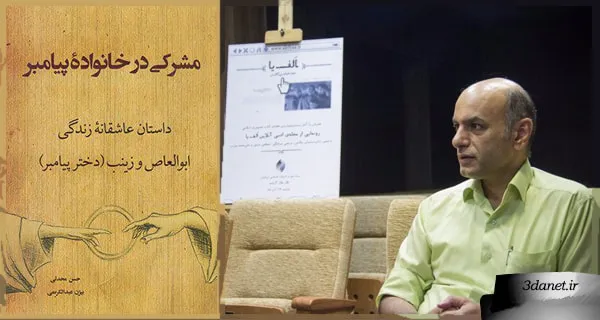
"A Polytheist in the Prophet's Family"; the title of the book tempts one to read it and answer the many questions that arise in the mind upon seeing this title; but this appeal intensifies when we see the names of two prominent professors of sociology and philosophy in the country as its authors: "Hassan Mohaddesi" and "Bijan Abdolkarimi," who seem to have embarked on a new literary venture, entering the realm of fiction—specifically, historical fiction—and have chosen a narrative from early Islam—as Dr. Mohaddesi puts it—to reveal to society aspects of Islam that have remained hidden from the view of historians. According to Dr. Mohaddesi, our religious intellectuals must step out of their classrooms, stop writing specialized articles and books, and connect with the common people on the streets; something religious intellectuals did before the revolution. Now, by writing this work, Dr. Mohaddesi has taken a new path. To become more familiar with the aims of writing this book and to learn about the author's views, we arranged a conversation with him.
Masoud Dayani: What is the story of "A Polytheist in the Prophet's Family"? Or could you give us an overview of this book for those who haven't read it yet, so they can be informed about the book and know what expectations to approach it with?
Dr. Mohaddesi: A very serious element here is the superiority of deeds and ethics over beliefs. That is, the perspective I had on this work, and with which Mr. Abdolkarimi also agreed, is that in fact, the superior criterion for evaluating human beings is not their beliefs, but their actions. And here we are faced with a character who does not hold much status in Islamic society; at least, he has no status in the existing Islamic society and custom. However, by examining the deeds that this person performs,
Masoud Dayani: A person like Abu al-As?
Dr. Mohaddesi: Yes! Yes! And then the Prophet's manner of dealing with him, the praise he bestows upon him, and the good relationship he has with him—all of this shows that we should not consider beliefs as the criterion, but rather we should consider deeds as the criterion. This is a kind of perspective different from the existing official view, which places beliefs above deeds. Another matter that was important to us is that there is an official, religious view that holds a very negative view towards non-believers, limiting or excluding them, and even treating them more harshly, depriving them of their rights, and possibly even endangering their lives. In fact, we wanted to show that this is not the case in Islam; even polytheists, who are the worst and most severe type of opponents of Islam, possess rights, and Muslims have a duty to observe those rights; let alone other spectrums and ideological opponents. We wanted to highlight this perspective. Especially, a view of religious reform that was in our minds is for this reason: in fact, we now have very powerful takfiri forces in the Islamic world who not only consider polytheists and infidels as having forfeited their blood, but also consider a portion of Muslims as infidels and believe they must be killed and their blood is lawful. Well, we want to see what relation this view has with early Islam; the Islam to which the Prophet was committed. We wanted to show that it is fundamentally very different; it differs from the fundamentalist takfiri view, from the official religion introduced by the government, and from the traditional religion presented by seminary scholars. In fact, early Islam and the Prophet's conduct and character are different from all of these, and tolerance, human freedom, and the rights of opponents exist much more seriously there. Of course, we did not want to modernize early Islam, meaning to extract something from it and present it in a modernized way; we emphasized that all content must be documented, meaning it must truly be in historical sources, and I don't know now! We tried to convey this to the audience; especially with the book's title, our intention was to engage the audience more seriously.
Mehdi Afkhami: According to statistics, your book is the best-selling book in the sociology section at Shahr-e Ketab Beheshti. Was the book intended to be fiction or history? Or neither of these, and was it meant to address the conduct and life of the Prophet; or even a love story with high dramatic potential? What is your opinion?
Dr. Mohaddesi: I would mostly place this book in the category of historical fiction. Although neither I nor Mr. Abdulkarimi are fiction writers, and we cannot define ourselves as such nor do we have such expertise, our intention was to choose this type of language and expression for, so to speak, the goals we have. Therefore, at the beginning, I was engaged in research and rewriting, and so to speak, repeated writing for two years, and this rewriting continued with Mr. Abdulkarimi, but in reality, this work had a process; initially, it had more of a historical and social aspect, and then, well, in the dialogue we had together, we tried to strengthen the fictional aspect of the work, because fiction has a particular power that can better realize our goals. Although this fictional format imposed something on us; the fact that we wanted to add a literary dimension and show the burden that narration carries in a story and the power it can exert more seriously in the work, created the concern that we might stray from history and historical documentation. Our effort was to create something in between the two; in reality, neither pure imagination nor pure history. To use, so to speak, fictional themes to engage the audience; to make them aware of truths in the history of Islam that, in reality, due to the type of historiography we have had in Iran and the Islamic world, they have remained unaware of. Secondly, it was very important for us to use the power of fiction and engage a wider audience so that the message we want to convey would, in reality, encompass a broader scope and have an impact. But it cannot be called sociology.
Mehdi Afkhami: How did your collaboration with Mr. Abdulkarimi take shape?
Dr. Mohaddesi: When you start a new task, especially one that is very unfamiliar and unconventional and inconsistent with official ideas and the official intellectual apparatus, you are repeatedly plagued by doubt as to whether the path I have chosen or the project I am spending time on is justified or not. Well, in this process and the path I was following, during the two years I was busy researching and rewriting, while I had a passion and enthusiasm because I had discovered a new element, and it was truly a discovery for me, I also had this concern: is this work I am doing justified or not? Naturally, I would enter into dialogue with the people around me to get help from them, see their reactions, and ask their opinion; so I sent this work to several people whom I considered trustworthy. Initially, my view was that I was writing for teenagers and young adults. I sent the work to "Dr. Iranmanesh" in Dezful so that he and his son could read it. When he read it, he told me this work has a general audience. I too could be the audience for this book. Well, this statement again gave us an idea that we do not necessarily need to think about a teenager or young adult. One of the people I trusted was Mr. Abdulkarimi. Mr. Abdulkarimi was more affected by this work than others and became completely engaged in the story, and he himself said, I started to tamper with the story and kept adding to it, and in the end, I saw it had become something new. Later, he called several times and said I am doing this. I also reassured him that he could revise whatever he wanted. Mr. Abdulkarimi had become so involved in the work that this story had also become his own story. This work had also become his own work. To this extent! When you become involved in a work, you develop an attachment to it; on the other hand, he had this concern about how I would react to him. When I saw Mr. Abdulkarimi's work and realized he had taken the work so seriously—while I had given the work to more than ten other people and no one had become so involved—for this reason, I accepted most of the changes he had made, and naturally, there are places where two minds might be discordant. People's standards are, well, not the same.
Mehdi Afkhami: Inside the book, when the point of view becomes omniscient, it takes on a sociological character and offers critique, opinion, and analysis. Mr. Abdulkarimi also mentioned in the introduction that the sociological part of the work was more extensive before editing.
Dr. Mohaddesi: Naturally, due to my specific field, this issue has been present and has played a greater role, and, so to speak, sociological themes have taken on an analytical aspect in the analyses. In repeated rewrites, we tried to reduce this. We moved some things to footnotes, and later we also removed a large portion of the footnotes so that the narrative aspect would actually prevail. But, well, naturally, our so-called expertise determines these things, meaning it is unintentional; besides, neither I nor Abdolkarimi are fiction writers, and naturally, we don't have much specialized knowledge of the subtleties that exist in fiction writing and this art, and the story was a tool for us to use to, so to speak, convey a message and achieve our goals. I don't know how successful it has been. It was very important to us that there be narrative appeal and that it engage the audience, but we haven't yet received enough feedback to know whether it has been so or not. Whether it is enjoyable for the audience or boring. Some of the audience said that they became engaged with the work and read it in one sitting; but it's still not enough to be able to judge it.
Masoud Diani: Well, didn't you think that if you collaborated with someone who has expertise in fiction or is a writer, you would get a better result?
Dr. Mohaddesi: The truth is that I was worried I wouldn't establish that connection with the person. I even sent the book to the Institute for the Intellectual Development of Children and Young Adults. They outright rejected the book and said we won't publish it. We were also facing this issue. I went to Ershad and spoke with the children's literature official, and they sent the work to the Institute, and they said we absolutely do not approve of this work and will not publish it, and well, this was the worry that the connection between me and a fiction writer wouldn't be established. Someone who understands my religious reformist concerns can help me better; therefore, we started the collaboration with Abdolkarimi. Abdolkarimi took the work very seriously; in the printing of the work and even its translation into other languages and its publication, my and Abdolkarimi's concerns were and are completely shared. Whereas I sent the book to many people and they didn't read it. So, collaborating with Mr. Abdolkarimi was a great opportunity for me.
Mehdi Afkhami: The illustrations that are in the book, where did the idea come from?
Dr. Mohaddesi: Actually, our idea was that painted images would help the audience associate with historical events and engage the audience. This idea was formed from the beginning when the book was supposed to be for teenagers, but it was not removed as the work continued, and again Mr. Abdolkarimi took it seriously. We don't have publishers who become this involved with the content of a work. Publishers look at a book as a commodity. I don't consider Mr. Abdolkarimi a publisher. He lives with the book. He doesn't see the book as a product he must sell, and he enjoys his life, and this is very different from, for example, a publisher who, for my sociology of religion book, which was the fruit of twenty years of my work, didn't design a single cover or even hold a single critique session for it. I saw no connection, no feeling, and no attachment. I have worked with various publishers, but he lives with the work. The same feeling that a translator and author has, spending their life and paying attention to every single word moment by moment; he is also a thinker and writer who has become engaged with the work. In fact, it was a great fortune for me.
Masoud Diani: Dr. Mohaddesi, do you think that if you receive positive feedback on the work, there is a possibility of changes to the book? For example, by an editor who is proficient in the techniques of fiction writing; or that when you gain a more precise understanding of the audience, you might do a deeper edit of the book; is that possible? Also, would you be interested?
Dr. Mohaddesi: Yes! Absolutely! We are waiting to see the feedback and critiques; whether those who critique from a literary perspective, those who delve into historical details, and also those who might critique the book's title from an intellectual and religious-thought-reform standpoint. These critiques could even be fundamental. The most important benefit we can derive is to learn something new. For us, this book is also a kind of birth, and now you want to see what fruit this creation bears. This work is a very good platform for learning; because most of my work has been specialized in the field of sociology. My experience was that it had a very limited circle of influence. At some point, we must choose for our audience to be the general public. It is very necessary to even translate a portion of specialized discussions for a general audience; meanwhile, I myself have a serious critique of post-revolution intellectuals. A pre-revolution religious intellectual like 'Dr. Shariati' both spoke about religion and spoke religiously, and could engage in discussion and dialogue with non-religious people and critique religion, and could also produce religious works that influenced and transformed religious people. I myself have been greatly influenced by him, and my religious thinking changed after reading his works. I then abandoned my father's religion. Successive generations have received this influence from him. Our post-revolution religious intellectuals have mostly spoken about religion but have not spoken religiously; consequently, they have not had a religious audience, and this is a very, very serious weakness. For us, this work is also speaking religiously. Both speaking to a general audience and speaking religiously.
Masoud Dayani: By general audience, you mean the public, right?
Dr. Mohaddesi: Yes! Meaning from a teenager to a ninety-year-old person can read your book. There is no need to know sociology. There is no need to know history. There is no need to know religion very well. But they read a story. They engage with the story. Amidst that story, you can also convey some of those points. I have another work, I am writing about Hajj; Hajj memoirs. I am writing with this view, to speak about Hajj considering today's conditions, and to speak religiously and socially, not to conduct a scientific and specialized discussion about Hajj. Ultimately, if I am a religious person, I must pay attention to speaking from the religious world, speaking from religious life. I cannot, on one hand, say I am religious, and on the other hand, not have religious speech. This is a serious flaw in the work of post-revolution intellectuals, and more work must be done in this area. To find its language.
Masoud Dayani: The late Shariati has a fictional book called 'Hasan and Mahbubeh'. At some point, Dr. Shariati felt that despite being among the people, he should still use storytelling. In the reformist division you made, which includes 'Mr. Motahhari', he wrote 'Dastan-e Rastan' (Stories of the Righteous) and paid great attention to art.
Dr. Mohaddesi: That's right! I was inspired both by Dr. Shariati's method and by Martyr Motahhari's Dastan-e Rastan. A great philosopher like Martyr Motahhari pays attention to the life stories of early Muslims and introduces them as role models. That is, he sees an element in these stories that is not present in philosophical discussion. One thing that is a weakness in religious education textbooks is that the life story of the Prophet and his companions is not in them. The teachings are there, but the life story is not. Children in elementary school connect more easily with stories. The education system must reconsider. Indeed, a heartfelt attachment should be created for children; just as the great philosopher Motahhari realized this point.
Afkhami: 'Islam in its essence has no flaw / Any flaw that exists, is from our Muslimness'; you apparently disagree with this proposition, but it seems the book says our Muslimness is flawed.
Dr. Mohaddesi: Here, my view is not that, and I do not have such an inference that Islam in itself has no problem; rather, we must also discuss what Islam is in our definition. My belief is that the system of religious belief emerges in a specific context, and some elements of that context enter that religion. In fact, some elements of religion are context-dependent, and consequently, when the world transforms and the context changes, then we must also think about those context-dependent elements. That view which says Islam has no flaw in its essence, in fact, considers a package of Islam that is always desirable and we must align ourselves with it, and that package should be preserved as it is. This view practically contradicts the reconstruction of religion; but our view is that no! Many elements of religion are context-dependent, and religion essentially grew in a context, and besides context-dependent elements, it has trans-contextual elements, but I cannot take the context-dependent elements of religion, which are for a tribal society, and use them in a modern society. This is where I say some constitutive elements of religion must be criticized and then reconstructed; but in that view, that package of religion is seen as completely without problem, whereas we see that all religions that emerged in traditional arenas have faced various crises, and in all of them, the necessity of religious reform and the necessity of reconstructing religion has been raised. Many elements of religion suffer from cultural lag and cannot respond to the needs of the time. That slogan wants to keep its package sealed and not touch it.
Afkhami: You said somewhere: "There is no pure religion. The ideal and pure religion is mostly imaginary, and fundamentally, we do not have something called pure religion or pure Islam; in any case, any intellectual and cultural system that wants to be implemented on earth becomes contaminated with the exigencies and possibilities of human life, and as a result, it takes elements from the social and cultural world and adapts itself to it." Well, this book is apparently about pure religion! Isn't it? This pure religion or early Islam, after all, started from some point, didn't it!
Dr. Mohaddesi: That early Islam, from my perspective, is also not pure or the true Islam. It too emerged in a context, and elements of that context exist within the religion. It is not the case that all those elements are applicable for all ages. The religion took shape within that setting. For example, "Allah" was the god of the Arabs, and this entered the Quran and Islam. Or the Hajj consisted of rituals that already existed and entered Islam in a more refined form. Just as when you speak of the Zoroastrian religion, Persian elements are present and exist within this religion. Now, Zoroaster comes along and demythologizes the elements that existed there and presents a new belief system. Therefore, the elements are contextual, and that too is real, and early Islam is also an Islam that appeared in history; it was not in the heavens and is not abstract; it emerges in a specific society and history and is influenced by the elements of that society; just as Marxism emerged in Europe and was influenced by the elements of that context. This same Marxism, when it entered other countries, the prominent thinkers of those countries who were Marxists were compelled to offer contextual interpretations. For instance, Peruvian Marxism has been forced to deviate from a series of Marx's statements and present new words, ideas, and interpretations, or Mao in China was compelled to revise Marxism because of the context he had, and he had to respond to the needs of that context and confront the reality he faced in that ground. In the history of Islam, we face the same issue. The Islam that went to Africa created a new version of Islam called African Islam. The Islam that went to East Asia created a new Islam called East Asian Islam. In Iran, we have Iranian Islam. In Europe, we have European Islam, and in Anatolia, we have Anatolian Islam; therefore, religion is influenced by its context, and the very place where it emerged was, in fact, influenced by that same context, and the myths and symbols that existed in that society entered this religion; for this reason, this religion is not pure. This too is influenced by context. Those who speak of pure religion and true religion have a package that they claim is without problem for all people and in all ages and times. That is, they consider it something extraterrestrial and supra-contextual. I do not believe in anything extraterrestrial and supra-contextual from religion at all. If it does exist, it is with God. If a true Islam or a pure Islam exists, it is with God and has nothing to do with us. That which has come to earth is contextual.
Dayani: This contradiction is still unresolved for me; the understanding we have of Islam differs from the understanding of early Islam. Do you want to challenge our historical understanding or our epistemological understanding? The fact that, ultimately, actions and ethics are more important than beliefs is an epistemological challenge for us, and we must consider it in our own time, and I think it is our problem today. The problem of the twenty-first-century human. To solve this problem, you refer us back to fourteen centuries ago to say, look, your Prophet also behaved this way with his family. Ultimately, you want to confront us with a challenge. This harsh stance regarding pure Islam and early Islam contradicts this book.
Dr. Mohaddesi: I don't think at all that by returning to the past and early Islam, all problems can be solved. Not at all. One can also have a critical view of early Islam. But the serious problem we face is the Islam that has taken shape in this historical process, and this Islam is even more backward than early Islam, and we are now facing these challenges; that is, the degree of tolerance we see in the Prophet's conduct, we do not see in the conduct of today's religious scholar, as someone who claims to be a follower of the Prophet, or in today's believing Muslim. Therefore, by referring to early Islam and the Prophet's sirah, we can critique part of the established religion. It gives us a possibility for critique, but my claim is not that all problems can be solved by referring to it. This is, in fact, one of our possibilities, and when these possibilities exist in Islamic history, why shouldn't we use them? It is reasonable that I, at the very least, not be more backward than the models the Prophet presented fourteen hundred years ago. At least elevate myself to that level. For example, students debate that women's rights in Islam are very backward; we cannot refer to Quranic rulings to solve women's issues and say we are solving the problems, but the Prophet's approach can help us explain to this audience that the Prophet lived in a society that gave him that extent of possibility for reform. The Prophet tried to carry out this extent of reform regarding women's rights. But that reformist approach of the Prophet did not continue in Islamic history; that is, I must explain to them that the possibilities of a historical actor like 'Muhammad ibn Abdullah' were limited to this extent, and we cannot carry out intellectual and social reforms by decree. If we compare the reforms the Prophet carried out with what came before, the Prophet's move is revolutionary. I want to say that there are possibilities in early Islam that we, as Muslims, are at least duty-bound to utilize, but that does not mean we can solve all problems with it; meanwhile, it now seems that we—if one can use this expression—see a kind of moral decline in religious societies like Muslims, and that is that if we are believers, it suffices; as if being a Muslim is defined by belief, and that if I am a Muslim but do not have righteous deeds, I am superior to someone who has righteous deeds but is not a Muslim! This has created a great affliction in Islamic society, and unfortunately, most Islamic scholars, whether Sunni or Shia, think that mere belief brings superiority for us Muslims—there have been great figures like Imam Musa Sadr who criticized this—or that if I perform worship, my worship is sufficient. Being a Muslim has been reduced to worship, and now, in order to confront these problems and fight moral decline, we naturally must emphasize righteous deeds. Essentially, worship is a prelude to righteous deeds. If it does not lead to that, worship is fruitless. I want to say we have fallen into decline; there is no emphasis on righteous deeds. This is a new perspective and reading that, in fact, wants to say that the main component of faith is not beliefs; nor even intentions and inner states, but rather the main component of faith is action, and the polytheist who possesses desirable and righteous action is, from this perspective we are looking at, superior to the believer who lacks righteous deeds, and we have dedicated a chapter to this superiority of action over belief; that is, we want to say this, and it is a potential, and we must use it. There is another point as well, and that is that I make a serious distinction between Quranic culture and Islamic culture, and I emphasize this greatly; by Quranic culture, I mean that which the Quran invites us to; that way of life the Quran invites us to, and that conduct the Prophet tries to realize in connection with the Quran and the instructions he receives. I call this totality Quranic culture. But with the death of the Prophet, Muslims continued to live, and a series of events occurred. Events happened that did not exist before. A series of knowledges and sciences entered Islamic culture. A collection of teachings, norms, and practical models that took shape over time and that we do not see in our Quranic culture. I call the totality of these Islamic culture, which includes Islamic mysticism, theology, ethics, jurisprudence, and exegesis that took shape over time and were influenced by the events of the age and by governments. All of these are Islamic culture. The elements of Islamic culture relate to Quranic culture in three ways.
Some elements of Islamic culture are compatible with Quranic culture. Some elements are distinct but not in opposition to one another; that is, new elements have arrived, such as the computer, which we use and which changes our lives, and it is not necessarily in opposition to ancient religious culture. However, a number of elements that have entered and played a role in the formation of Islamic culture and civilization are in clear and explicit opposition to Quranic culture. For example, the anthropology found in Islamic culture is an anthropology influenced by Greek culture, which stands in opposition to Quranic anthropology. In the Quran, the human being is not a dualistic, two-part entity. It is unified. It is not the case that one aspect of the human is base and another aspect is transcendent; that there is a bodily aspect and a spiritual aspect; a soul and a body. Both Islamic mysticism and Islamic philosophy see the human being as two-part. In the Quran, the human being is not two-part; it is two-possibility. That is, you are born and you may constantly move along the path of good or the path of evil. As long as you are alive and acting, you move along this line. Some actions take you in this direction and some choices take you in that direction. So the human being is two-possibility, yet unified. It is not that we have two parts; a divine part and a satanic part. Rather, we have a divine possibility and a satanic possibility. But in Islamic culture, the human being must strive to negate a part of their own existence; for instance, mystics have likened the self to a pig, a mouse, and a dog, which must always be guarded against. Philosophers, too, have deemed the body base and ultimately considered the body a mount that you must bring to a point where it can carry you; but in the Quran, this is fundamentally not the case. But what has happened? The Quran has spoken of the self three hundred times, but in Islamic culture, the self as defined by Aristotle has replaced the definition that the Quran gives of the self. This self is immaterial and has a hierarchy, yet none of this exists in the Quran. In terms of words, it is Quranic, but its content is Greek. The God of the Quran is entirely different from the God of the philosophers. The God of the Quran and the God of the mystics are entirely different, and Mr. Izutsu has demonstrated this well in his book 'God and Man in the Quran,' saying that Allah has one meaning in the semantic field of the Quran, another meaning in the semantic field of Islamic theology, and yet another meaning in the semantic field of Islamic mysticism. This is a distinction we can say exists between Quranic culture and Islamic culture; therefore, as a Muslim, we fundamentally have a duty to critique Islamic culture.Diyani: Dr. Mohaddesi, this effort to revisit and reinterpret early Islam has been undertaken by many religious intellectuals and reformers. These efforts have always been accused of ignoring certain evidence. That is, you see one aspect of history, but you do not see the violent or coercive aspects of this same Prophet; just as the opposing camp is always accused of the same. To what extent, in this work, did you try to take into account the evidence that goes against your theory or against your belief? Or did you focus only on a reading that reinforces your view?
Dr. Mohaddesi: In truth, we are not very worried about this. The understanding and interpretation of Islam, the Quranic verses, and the Prophet's conduct are highly diverse. Many of these individuals, in fact, present this understanding and interpretation based on the presuppositions they hold. I have an expression for this: I say that discussions about religion are based on two types of hermeneutics; one is the hermeneutics of hatred, and the other is the hermeneutics of fascination. That is, in fact, there is a hatred within the interpreter regarding religion, religious figures, or the performance of religion in a certain period of history, and then that hatred becomes the driving engine of interpretation. The interpreter goes after what they have presupposed beforehand and wants to highlight those things, viewing texts and historical events through that lens. On the other hand, among the believers themselves, the hermeneutics of fascination is very common; that is, you are fascinated by the figures, the history of Islam, the history of religion, and religion itself, and you are fundamentally unable to see the critiques and the destructive effects that have existed in religion and religious history, because you approach texts and historical events with that fascination. I, at least in my other works and various writings, have many works related to the critique of religion and the critique of Islamic history. I have previously narrated about black religion, red religion, and green religion, and those are available. Due to my familiarity with many of the critiques leveled against religion, I am thinking that we can respond to each of these in their proper place. For example, there is a common view that whenever you see a polytheist, you must kill them, citing a verse from the Quran. I have even seen a question asked in the virtual space: 'Must we kill every polytheist we see?' Then the respondent was forced to explain the Quranic verse, that it has a specific occasion of revelation, relates to the violation of the 'Treaty of Hudaybiyyah,' and came after that, and is fundamentally not a general ruling. Well, many interpretations of Islam and the Prophet's actions are like this. On the other hand, those with a fascinated view want to justify every event and every action. Well, in such cases where I cannot explain this intellectual apparatus, I hold a critical view. At the very least, I say it is not clear to me why a certain religious figure reacted in such a way. Ultimately, with this interpretation of that action, I cannot accept it as acceptable or Islamic; and there, I can even critique the action of that actor using the verses of the Quran. Because I hold this critical view, I know that I do not intend to justify, and my perspective is not justificatory. For instance, regarding some historical events in early Islam, such as the treatment of those three Jewish groups, 'Banu Nadir,' 'Qaynuqa,' and 'Banu Qurayza'; well, there I have serious questions and I delve until I find convincing answers, and as long as I have not found an answer, I do not consider it my duty to deem those actions justified. (For example, that seven or eight hundred people should be beheaded in one day!) Well, for me, this is one of those events about which I am not in a position of justification. Therefore, I have many questions about it and I do not justify such an event unless I find sources that explain to me that these actions are defensible or that such a thing did not happen at all and the reports given to us are not correct. Therefore, because I do not have a justificatory view, I am not worried about such an accusation being leveled at me. Besides, we are dealing here with a story and a cross-section of Islamic history, and we cannot start writing a book in which we justify and explain all events and all rulings. I want to say that unfortunately, I, who teach sociology of religion at the university, have very much realized that many of our students, even our colleagues, do not have a correct understanding of religious rulings and Islamic history and are very unfamiliar. Many of our students' awareness of Islam is what they have heard from pulpits, and often when we discuss with them in class, they use those pulpit-derived data to critique the information we give them from six sources, and we must make them aware that what you have heard from the pulpit is not a good standard for scholarly discussion, and you must start from a different perspective and look at historical sources. That is, we are faced with individuals for whom television and the films it produces are their sources of citation, and we must first teach them that these are not sources of citation at all; and similarly, other types of stances, many of which are fundamentally baseless and not based on research.
طبیعتا در این کار هم ما منتظر بودیم و منتظر هستیم با دو نوع مخالفت جدی مواجه شویم؛ یکی مخالفت از موضع بنیادگرایانه و ستنی، و یکی مخالفت از موضع متجددانه. آنها را انتظار میکشیم و آمادگی مواجهه با آنها را داریم؛ اما اینجا خوب در کار نمیشد توضیح داد؛ همانطور که گفتم، ناچار شدیم در خیلی جاها ارجاعتمان را هم حذف کنیم، چون مقاله و کتاب علمی نمینویسیم. آنجایی که خیلی حساس بود، ما ارجاع کوچکی دادیم که این حرف را از خودمان درنیاوردیم، این حرف منبع تاریخی دارد و منبعش مستند است. بسیاری از ارجاعات را حذف کردیم که اساساً مخاطب درگیر پانوشت و پینوشت و زیرنویس نشود و درگیر خود داستان باشد.Diyani: If we take Quranic culture as equivalent to the purism you yourself mentioned, this part of the statements and discussions constantly reminds me of the friends of the Tafkik (Separation) School. Our religion has been subjected to non-religious distortions by the philosophy that came from the West and the East, which is why they made opposition to philosophy the basis of their work. Do you see a boundary between yourself and the friends of the Tafkik School, or not?
Dr. Mohaddesi: In my discussion, there is no enmity with mysticism and philosophy. My discussion is more about eclecticism. Let us not combine ideas that have different philosophical and intellectual foundations and, in fact, cannot form an integrated system; and if we are to combine them, we must have valid syntheses. We can draw inspiration from and use mysticism, philosophy, and other ideas, but if we think the God of the Quran and the God of Aristotle are one and the same, we set the stage for misunderstanding the text. That is, if I want to interpret a text—whether it be the Quran or Hafez—I need rules to interpret it more validly. In order to have a valid interpretation, I must observe a method. I cannot now, based on existentialist assumptions, which are a modern philosophy, go to the Quran and say the Quran says this too. I can say that, but it is not valid. I can attribute any content I wish to Hafez, but is that a valid interpretation of Hafez? Therefore, the rules of interpretation and the rules of encountering a text have requirements that we must observe methodologically. Anything can be said about a text, but is it valid, and has it observed valid rules? Well, when I want to speak about Islam, I must separate the Islams of different periods from one another. The Islam of the early era differs from Umayyad Islam and Safavid Islam. If I say they are all one and the same, it is obvious that I fall into errors. Therefore, if I speak of, so to speak, early Islam, I want to say: as a Muslim, if I want to refer to a source, what is the most valid source? Who is our greatest role model? The Prophet of Islam. He is our role model. So naturally, instead of referring to 'Allameh Majlesi,' I refer to the Prophet, because he is the ultimate limit of my religious references.
Diyani: In fact, you want to provide us with a new possibility within Islamic history so that, using that possibility, we can carry out our ethical and religious life.
Dr. Mohaddesi: Yes! And if you want to move beyond Islam, you must first encounter it and then move beyond it. Many of the reactions that exist are without an encounter with Islam; they are, in fact, an encounter with what exists and with which one has a grievance or conflict, and based on these reactions and conflicts, one encounters, protests, or interprets. At the very least, we can have this expectation that you encounter it and critique it.
Afkhami: This discussion might be useful in the classroom, but the current reality in society is something else.
Dr. Mohaddesi: Yes! These discussions help one to, in fact, transcend the prison of one's own era. In the age we live in, we are inevitably trapped, but we can go beyond it; not only in religions but also if we have resources in Iranian culture, even, for example, ancient Iran, if there are humanistic resources, if there are resources in the Zoroastrian religion or in Persian literature, I think ignoring those resources is ingratitude. If we have cultural capital, we must liberate it in the direction of building a more humane world! So my perspective in this work, and my general view on religion, is truly not to preserve religion at any cost. I am at ease. Many years ago, when I was talking with 'Mr. Alijani,' one day he asked me: 'What is your main ideal?' My main ideal is not religion; my main ideal is humanity and human well-being; that is, to create conditions where humans suffer less, live better, and become more transcendent. If religion has resources that help with this, we must use them and not be ungrateful. If Persian literature or Islamic mysticism has resources that can help towards a better life for humans, not using them is ingratitude. So here, it makes no difference whether I am talking about religion or the Shahnameh; if there is cultural potential, we must actualize it and build a better world and confront the issues of our world. We are now facing the issues of Takfiri groups, we are facing fundamentalism, we are facing a very violent face of Islam; well! I think we should suffer from this matter more than others, that such inhumane products from our culture are being presented to the world. We must feel more responsible than others and use our own cultural reserves to confront these cases, and if early Islam helps us, well, why shouldn't we do this?! Now ISIS says that Shiites are infidels and must be killed; and likewise Christians, as Crusaders!
Dayani: The problem is that ISIS also speaks of early Islam!
Dr. Mohaddesi: That's fine! Then we can show that, sir! This is your Prophet, and this is his son-in-law, and he is also a polytheist. Then look at his relationship. Don't you call it Islam! Well, so this also exists; now you come and speak and respond. Instead of constantly saying, no, this is not Islam! We also say that, that too is Islam; it is one interpretation of Islam, but we have reserves. We present those reserves so that it becomes clear to everyone how authentic that is.
.
.
Alfiya in Conversation with Hassan Mohaddesi on the Book 'A Polytheist in the Prophet's Family'
Source: Alfiya
.
.

Discussion5 comments
استاد حسن محدثی سلام و هزار بار عرض ادب و احترام شما اندیشه برتر و فکر برتر هستی امیدوارم با مطالعه ای که شما دارید هر روز از شما بیشتر یاد بگیریم . خدا نگهدارتان
جعل داستان و نسبت دادن ان به پیامبر( ص) ارزش پاسخ دادن را هم ندارد. درضمن ، ایمان وعمل صالح از هم جدا نمی شوند و یکدیگر را تقویت مینمایند. در موارد متعدد در قران ، ایندو با هم امده اند.
برادر مسلمان، جای خالی کامنتها و پاسخهایتان، فضا را برای تجمع منحرفین و کفار گشوده بود. از حضور مجدد شما خجسته ایم. باشد اجرتان در آن دنیا با ولی حق :-D
سلام آقای شهبازی در تفسیر اشعار مولانا در برنامه تلویزیونی گنج حضور می گوید : مشرک کسی است که با عمل و رفتار خود و با ستیزه کردن و مخالفت کردن در مقابل اعمال و تصمیم گیری های خداوند می ایستد و تصمیمات خدا را که همان اتفاقاتی هستند که در زندگی روزمره روی میدهد نمی پذیرند و به خود اجازه میدهند به عنوان یک «من» جدا از خدا و در واقع شریک ، به اندازه او در ساماندهی زندگی و اوضاع و اتفاقات و پدیده ها مخالفت خود را عیان کند و در واقع تصمیم گیری های خداوند و صلاحدید های خدا را بر نمی تابند. مثلا کسی که عزیزش را از دست میدهد که در واقع جان آن عزیزش را خداوند گرفته ، در مقابل این اتفاق دست به شیون و زاری و اعتراض می زند و نمی تواند قبول کند که این اتفاق، اتفاقی است که بدست خداوند رقم خورده است و چون خود را برابر با خدا فرض میکند و در تعلق خاطر به عزیز از دست رفته اش خود را با خدا شریک میداند و خودآگاه یا ناخودآگاه دست به اعتراض بر میدارد و شیون راه می اندازد که چرا این اتفاق افتاد ، این چنین شخصی مشرک است، یعنی کسی که خود را برابر با خدا در روی دادن اتفاقات میداند و تصمیم گیری های خداوند را به تنهایی بر نمی تابد. چنین کسی حتا اگر به ظاهر مسلمان و دیندار هم باشد مشرک به حساب می آید.
بسیار عالی ، آرزوی توفیق برای مؤلفان دارم ۰