Philosophy
Ali Soltani's essay 'Corona's Catapult Showers Meetings with Arrows'
The proliferation of virtual meetings during the COVID era, while democratizing access to knowledge, exacerbated two flaws within the intellectual community: a preference for oral discourse over writing, and a diminished opportunity for critique and hearing the voice of the other among thinkers.
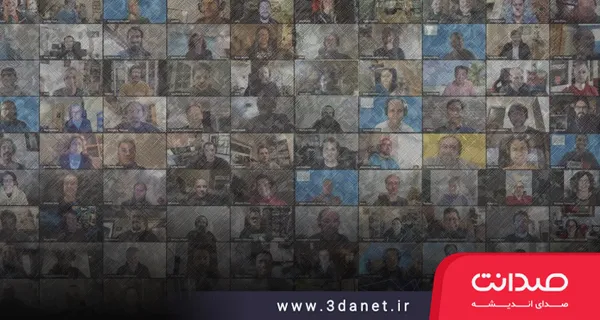
A Discourse on Two Years of Corona and the Epidemic of Online Scholarly Gatherings
From Corona's Catapult, Arrows of Gatherings Rain Down[1]
Ali Soltani, Researcher in Philosophy and Religion
In its two-year, suffering-increasing era, Corona has affected many dimensions of human life. This writing focuses on Corona's impact on the prohibition of in-person (scholarly) gatherings and the consequent expansion of webinars, and while honoring the benefits and blessings of this new possibility, it speaks of the epistemological consequences and harms arising from this expansion in the form of reinforcing or accelerating three defects.
The Corona pandemic had many consequences. The world before it will not resemble the world after it. One of the most evident traits of Corona and its era, one of its most biting results on the spirit and psyche of weary contemporary humans, was its opposition to human assemblies. Among these assemblies, scholarly gatherings, lecture sessions, and teaching courses also came into the line of fire. Thus, the teacher and speaker were left without an audience, and the audience without a speaker.
The early months of this era passed in the bewilderment of all of us at the impossibility of forming gatherings. But throughout history, humanity has always shown that, like a flowing stream of water, it seeks or creates a possible way through straits. This also happened in this era. The impossibility of listening and intellectual and verbal benefit was not absolutely closed. Those afflicted by Corona had previously accustomed themselves to some extent to non-in-person gatherings by holding live sessions and virtual meetings; when Corona struck, they brought forth that cultivated habit and, in diverse methods and numerous forms, held virtual sessions, roundtables, panels, conferences, and commemorations. Gradually, the harshness and roughness of gatherings that began with "Can you hear me?" lessened and lessened, and many domestic and international platforms and software became agents for holding ceremonies, arranging chairs and setting up microphones! Many speakers who refused to participate in virtual gatherings cast aside the cloak of refusal and entered the arena. We moved from roughness and difficulty to smoothness and ease, and gradually the sweetness and ease of forming a virtual gathering became palatable to us; webinars did not require the difficult logistical conditions of in-person gatherings and tempted us to form a virtual gathering with little resolve and a small poster.
Up to this point, my speech was about a general effect. That is, I did not have a specific domain in mind. The preceding points encompassed all scholarly and work gatherings, as well as recreational and occasional get-togethers. But my focus in this writing is on scholarly gatherings, university lectures, and specialized and epistemological subjects. Specialized gatherings, professors, and courses were not deprived of that generally eased situation. From Corona's catapult, arrows of gatherings rained down! These arrows were and are blessed. They helped and continue to help in the popularization of science, the distancing of scholars from ivory-tower seclusion, educational equality, and to some extent, the university's approach, in terms of language, subject, and approach, to the public sphere. Its blessings were and are not few. But my speech is about the harms; harms, some of which are along the lines of defects that existed before and have today added to the depth of those defects.
The first defect is that our intellectuals, academics, and thinkers in general, "write" less and "speak" more. In the university, if it were not for the "flimsy" and "corruption-increasing" quantitative requirements for promotion and rank, many professors and researchers would not turn to writing (original writing, of course, and not commissioning others, nor dictating opinions, and worst of all, not plagiarism!). The second defect is that our thinkers do not read each other's works, whether written or unwritten, and the result is the scarcity of critique and critical discourse.
Now bring these two traits to bear on the new situation. Regarding the first deficiency, the ease of virtual meetings and collective, serial gatherings has pushed us further toward non-writing and orality. A ready-made session, a ready-made audience, a ready-made speaker—why delay, then? Thus the wearisome difficulty of writing in a secluded corner gave way to the freshness and liveliness of spoken discourse. The result has been the reinforcement of the trait of non-writing and the inclination toward oral speech among us. Utterances, even if merely exposition and description, even if excessive and under-read. It would be redundant to elaborate on the characteristics of oral speech, especially when not attached to a written text. The least aspect of the predominance of oral speech over writing was, and is, the speaker's diminished responsibility for what they say, the drawn-out nature of the talk, the speaker's constant possibility of evasion, a greater likelihood of incoherence, verbosity, and so on. Let me add that orality in itself is not absolutely illegitimate. Many of the great books in the history of knowledge have been series of oral discourses. I will further elaborate on the desirable form of oral discourse from my perspective later; let me just add here that the issue is the dominant culture of oral expression over written expression in intellectual activity, which has deepened further in the new era.
The long queue of meetings and the multitude of topics have also inadvertently fueled the second trait: the deficiency of not reading others and, consequently, not critiquing them. The deficiency of not reading one another's works was, and is, a common shortcoming. Our thinkers usually content themselves with a simple and cursory familiarity with each other's works. This widespread unfamiliarity and failure to read others' works reveals itself on the rare occasions of critique. On the other hand, in the new Corona-stricken era, it was not only a limited few who noticed the ease of organizing gatherings. A great many saw this ease and decided accordingly. The result is that not a day passes without our encountering a meeting, a gathering, a symposium, a lecture series, or a live session. The multitude of these events, in our busy lives and with little time for reading, thinking, and benefiting, has pushed us into a corner of the ring of consumption. The meetings constantly throw punches, and before we have properly digested one, the next one arrives. The more serious problem I have in mind has occurred here. This "we" is not merely us, the bewildered and overwhelmed audience; the speakers themselves have also fallen into such a state in relation to other lectures.
Let me use an image to describe this situation. The story of our numerous virtual meetings is as if multiple lecterns have been set up before us, many chairs with many microphones. Numerous speakers are all seated side by side facing us. But a tall wall has been erected between these speakers themselves, and each speaker sits in their own booth, speaking without hearing the other's voice. "Without hearing the other's voice" is the focal point of this essay's analysis.
All these gatherings, all these courses, schools, and lecture series, among numerous researchers and speakers, are usually held—among the speakers themselves—without hearing another's voice. Evidence of this is that among the topics people address, there is rarely room for a critique of another's lecture, another's book, or another's views. This rarity is obvious. As was said, the scholar-speakers, in relation to others' lectures, were and are, like other listeners, in that corner-of-the-ring situation. They do not get around to, and cannot, benefit from the output of other gatherings. Perhaps they have even less time and opportunity. The combination of these circumstances has conspired so that its metaphorical rendering is a crowded place where many people are murmuring, no one's voice reaches another, and sounds, without being worked upon, simply go into the air, into the ear of time and earth. That is all. The speakers' satisfaction is also that we have spoken and laid down the burden of speech; what becomes of it, it seems, is not much of a concern to us. Moreover, the presupposition of our analysis in deepening these two defects is that all the current talk is sound and the result of hours of reading and hammering out, and not the rambling and verbosity that are the twin of oral speech. If we set aside this presupposition, it becomes time to speak of the intensification of a third cultural defect. The easy convening of virtual gatherings, alongside other new means of presentation, intensifies this trait in us of spending more than we take in. On the other hand, we spend on credit before any income is obtained! Every deep-rooted and profound epistemic offering is the result of hours of accumulation and patience in final expression. In Hafez's words, the honey and sugar of speech are the speaker's reward for patience. Hastiness in expressing what is not yet cooked and polished is an instance of serving food that has not yet had time to settle. Unfortunately, in some of the numerous virtual academic gatherings and the video and audio live streams of this era, we witness that the lust for expending speech, and perhaps the desire to be seen, riding on the ease of arranging a session, has overtaken the strength of expression and the speaker's maturity. If the rule were silence, succinctness, and solid expression, this overtaking should not occur.
In closing, let me add again that I do not at all claim that the above descriptions apply to all current gatherings. But if they encompass a significant number of these gatherings, such a situation is not desirable for the promotion of science, critical thinking, and the expansion of dialogue and mutual understanding. Its form is speaking and listening, but it is more monophony than dialogue, more monologue than dialogue, more speaking than listening, more recitation, repetition, and repair than thought, rebellion, and destruction; it is mist-like sounds released into the air rather than voices rooted and captive in the earth. With all this, as mentioned, the very expansion and multiplicity of academic gatherings is a blessing. However, in remedying the serious defects that are the twin of this blessing, the following suggestions, which usually transform the hardware difficulties of in-person gatherings into the software strictures of virtual ones, are worthy of attention:
1) It is better, or perhaps necessary, that lecture sessions, whether single sessions or serial lecture courses, be connected and oriented toward a continuous text. This means that either the speaker should present an abstract, note, or article on their topic beforehand, or, if it is a lecture course, it should be centered on a specific and accessible text or article. If, from this perspective, the speaker can read their presentation directly from a previously prepared written text, which would lead to greater coherence of speech and a shortening of their report time, then the best possible method has been implemented.
2) It is better for important sessions to be transcribed and their written text to be edited and published as the output of the meeting. When oral discourses are written down, they require more coherence, citation, and reasoning, and they increase the speaker's accountability. On the other hand, the reader of the written report will also be a better and more attentive audience for the speech.
3) It is better for sessions to be appended to another series of sessions of a critical and review nature. Such an appendix compels the speaker toward a firmer expression of opinions and more flawless viewpoints, and the listeners toward measured listening. This appendix remedies, to some extent, the second aforementioned defect, namely the absence of critique.
4) It is better that the session or sessions, especially in large webinars, be appended to a roadmap. That is, we should specify from which point to which point, for what purpose, and how we intend to move, and what role this single session and single speaker plays in this larger map. The facilitated convening of sessions that are haphazard and where the necessity, urgency, and appropriateness of their convening is in no way clear, realizes and reinforces the aforementioned shortcomings, particularly the second and third shortcomings.
5) Formulating a roadmap requires thoughtful collective work and a capable think tank. Hence, it is better that after individuals select their planning and executive collective through democratic mechanisms, they entrust the coherent and thoughtful convening of virtual sessions to them. A collective whose sole task is this laying of the track, and nothing more. Such an executive mechanism makes the realization of the roadmap possible and prevents the convening of weak sessions. Speakers and listeners, knowing that the session has passed through the filter of a purposeful collective review and evaluation, will participate in sessions more effectively and with greater motivation. It would be even better if the basis of that roadmap were restraint in convening sessions and strictness in holding meetings. I place great emphasis on a democratic, rotational, and minimal mechanism, because experience has shown that the formation of any institution can, after a time, itself become an obstacle to improvement.
6) The water of the ease of convening virtual meetings can also be channeled toward another ground. Toward holding pre-session or pre-sessions for public meetings, webinars with many speakers and large audiences, where speakers gauge the caliber of their speech, reasoning, opinions, and viewpoints in a smaller gathering. If this assessment is not satisfactory, the larger formal session should not be held. The great lust for speaking must be bridled; for what wisdoms arise from silence! (The third shortcoming). This suggestion can also be made possible under the elected executive collective of the previous proposal.
One could add to the list of these kinds of improving suggestions, but the reader of these few lines might think that these proposed dams built on the flowing river of numerous sessions cannot bring themselves to say: do not hold sessions; hence, they carve out obstacles whose end is simply not holding sessions. Both yes and no.
The truth is that the desirable foundation proposed by this discourse is based on silence, on speaking little and speaking selectively, like pearls. It is we who must have reason and necessity for speaking and for seating an audience before our speech, not the other way around. The affliction of the tongue is loquacity, and if the new space fans this affliction, we must become more sensitive. For the third time in these few lines, let me repeat that the expansion of the possibility of holding sessions, moving away from monologue, and practicing dialogue during the Corona era in online sessions is very, very blessed; especially for a society like ours, where it is vital that we practice dialogue more and more and increasingly find that in the current world, the healthy path of approaching truth is dialogue and exchange. But how much better it would be if this blessed well-being were linked to the blessedness of measured and considered speech, its skirt cleansed of the contamination of the lust for speech, and it resulted in an abundance of written and lasting texts.
[1] . This title is taken from a ghazal and a couplet attributed to Urfi Shirazi (963-999 AH):
From the catapult of the firmament, stones of sedition rain down / I foolishly flee to a glass fortress
But the calamity-contemplating theme of the poet in the couplet, as will be repeatedly stated in the text, is not my focus in the subject of this discourse.




Discussion1 comments
بسیار مفید و کاربردی. امید که پیشنهادها عملی شود.