Philosophy
Andisheh Eslah Interviews Masoud Sadeghi on Violence, Nonviolence, and Ethics
Violence is an enduring phenomenon, as old as the yearning for peace, and its root lies in the inability to tolerate the other in their entirety. Masoud Sadeghi examines the definition of violence, its moral justification, and the challenges of nonviolent struggle against violence-prone groups.
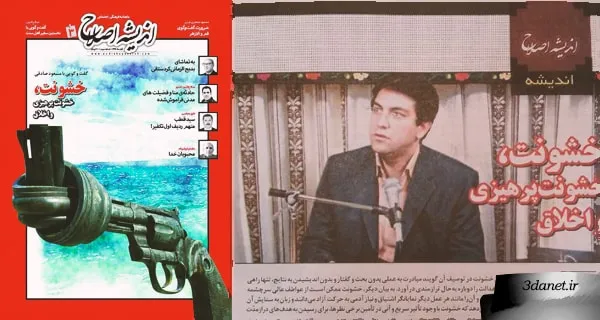
Masoud Sadeghi: Violence is as much an ancient and enduring human phenomenon as the concern and aspiration for peace or the negation of violence! The confrontation between Abel and Cain in religious literature may be an instance of two human phenomena arrayed against each other: the inclination toward violence and the inclination toward peace and the negation of violence. Two tendencies, both equally rooted in human history and nature...
.
Moloud Bahramian: To examine the phenomenon of violence and the strategy of nonviolence, we have posed questions in a conversation with "Masoud Sadeghi," PhD in moral philosophy and researcher in religion and ethics. We hope it will be well received.
-
What does violence mean, and what can we consider a violent act? If possible, could you explain the "philosophy of violence" and the philosophical and ethical status of violence? That is, whether violence is ethically permissible or impermissible?
In the name of God. I am very pleased to be in conversation with you and the esteemed journal Andisheh Eslah. You have posed a brief question that demands an answer as broad as the philosophy of violence. Definitions of violence are highly diverse and sometimes even irreconcilable. Nevertheless, some hold a very subtle and, of course, expansive definition of violence, believing that violence is any behavior contrary to nature and norms. This definition is so general that it encompasses everything from a mother-in-law's barbed sarcasm toward her daughter-in-law to the atomic bomb at Hiroshima! I consider this a general definition of violence and broadly agree with it. However, when we usually use the term violence, we have in mind a more specific form of behavior contrary to nature and norms; behavior that, in some way, involves our body and physical being. Violence in this sense is physical and bodily assault against the existence of another in a way that causes harm and injury.
-
In your view, can it be said that nonviolent struggle has always been a human concern, while we have philosophers who consider violence an entirely human matter? For example, one can name "Carl Schmitt" as a philosopher who justifies violence, or, in a sense, in our own Iran, those schooled in the thought of Fardid and others. Could you unpack this issue for our audience from the perspective of a philosopher who prescribes violence: with what outlook and angle of vision do such philosophers justify violence?
Depending on how we define "human" and "humane," we can offer a different answer to this question. In my opinion, violence is as much an ancient and enduring human phenomenon as the concern and aspiration for peace or the negation of violence! The confrontation between Abel and Cain in religious literature may be an instance of two human phenomena arrayed against each other: the inclination toward violence and the inclination toward peace and the negation of violence; two tendencies, both equally rooted in human history and nature.
But regarding the latter point in your question, I must say that not everyone who justifies violence is necessarily a promoter of violence. A philosopher's justification for the necessity or conditional acceptance of violence might be, for instance, that the absolute negation of violence may lead to absolute violence; suppose we, as a nation, ethnicity, or state, are confronted with a violence-centered and violence-worshipping group like ISIS. What is to be done? Dialogue? Tolerance?! If someone says that groups akin to or of the same ilk as ISIS must be suppressed immediately, their intention is in fact nothing other than ending violence, and this type of reaction cannot be called the justification and promotion of violence.
But the point I made in no way means that everyone who speaks of violence is an advocate of reasonable, sufficient, and logical violence; there truly have been and are people in the world and in Iran who are the theoretical instigators or supporters of violence; some are obscure, of course; some are obscure and some are well-known. I am not much inclined to name names and dispense praise or blame, and I also emphasize that I am neither a Fardidian nor have any interest in their practical approach. But the contribution of the spectrum opposing him in promoting violence is really not known to have been any less than that of others. I mean to say that although every thinker certainly has virtues and has rendered services, it is not clear that they have always acted in line with their slogans. Look at Dr. Davari Ardakani; according to the insinuations of his intellectual rivals, he ought to be an abusive and dogmatic individual. But is that really the case? I believe Davari's courtesy and composure, more than and prior to the appearances or lineage of his thoughts, indicate whether he is, hypothetically, a supporter of violence or not. Contrary to the relatively prevailing atmosphere, I absolutely do not believe that if violence has existed or exists in our society, it stems solely from the thoughts of the likes of Fardid and his students; even if that were the case, the opposing spectrum and individuals have also been in no way deficient in insults, harshness, defamation, and so on—which are among the sources of violence.
But in the global sphere; let me say briefly that in the global sphere, too, such instances roughly exist. That is, some thinkers, despite an anti-violence appearance, harbor violent thoughts or practices. Just as, for example, some liberal philosophers remained silent in the face of NATO or Western attacks on Afghanistan, Iraq, and so on, whereas according to appearances and slogans, this should not have happened.
-
On the subject of nonviolent struggles and their victories, much has been said. Don't you think that when violence is merged with an ideology, nonviolent struggle essentially becomes meaningless? In fact, the person standing against us is not only unconcerned about committing violence but considers it a religious duty and may even feel satisfaction?
This question is, in a way, a confirmation of my remarks. Is a nonviolent struggle against ISIS, for instance, feasible? When we say ISIS, we mean this very group with its current savage conduct. Of course, one could say that even the correct method for preventing the emergence or recurrence of ISIS depends on intellectual and peaceful confrontation with violence-inciting thoughts, but the point here is that history is not under our command and does not begin today. These thoughts have, in any case, taken shape and more or less taken root, and the unbridled violence of ISIS cannot be managed without a reasonable degree of violence.
-
If we take a psychological-sociological look at the phenomenon of violence, what, in your opinion, is the deep and hidden cause of violence in human beings; what is the cause of the human inclination toward hostility and aggression, and is it fundamentally possible for humans to be freed from violence and hostility?
You have posed a very difficult question. Truly, any answer to this question is provisional and ultimately one-sided. But in my humble opinion, the main cause of many violences can be analyzed as follows: the inability to tolerate the totality of the other. In simpler terms, violence usually begins where we cannot bear to see someone acting contrary to our desire or belief and yet remaining intact and still benefiting from all their abilities and capacities! Of course, this analysis and explanation cannot adequately account for sadistic or masochistic violences. But what I mean by the inability to tolerate the totality of the other pertains more to violences exerted by apparently healthy individuals or structures. That is, people who, if you align and fall in step with them, will no longer have any motive to harm you. But the violence of a sadistic or masochistic individual is not like this. That is, such an individual fundamentally does not engage in conflict with themselves or others due to a divergence of interests or opinions, but rather derives pleasure from being violent or does so compulsively.
I should also add that the inability to tolerate the other should not be viewed through a single factor. This inability can sometimes originate from envy, sometimes from arrogance, and sometimes from fear.
-
Some thinkers accept violence as an unavoidable evil. Under what conditions is the use of violence permissible? In other words, in what circumstances can one commit it?
I believe the criteria governing necessary, legitimate, or just violence should not be formulated so broadly and generally that they practically offer us no guiding or illuminating points. Perhaps in the present era, where a reasonably acceptable level of legalism prevails in the world, a simple answer to your question would be that violence is permissible when it is legal. Naturally, an inquiring mind will ask: what kind of violence should the law or the legislator permit? Without intending to enumerate all the elements as in a precise scholarly text, I briefly believe that violence should be permitted if it meets the following conditions; conditions which, naturally, can in one sense and from one perspective be subsumed under one another, and from another perspective, be separated:
First, violence is permissible only and exclusively when carried out against an oppressive act.
Second, it must be aimed at ending further violence, whether in the short term or the long term.
Third, it must either have a disciplinary effect or not be devoid of the potential for disciplinary and admonitory effects.
-
In some cases, using violence, even after employing convincing, motivating, and compelling mechanisms and forces for change, is unethical according to an "unjust law." Is the application of violence according to a "just law," considering the use of the three factors for principled change, permissible? What constitutes a just law? Who is the authority for adjudicating the justness or unjustness of a law in religious and extra-religious governments?
Your question, although it has an answer and it is necessary to answer it, is very general, and responding to it requires a very extensive discussion that does not fit within the scope of this conversation. However, briefly, it can be said that there is a difference between a law being legitimate and it being ethical or just. A specific law might be, in the common sense used in political science, completely legitimate and civil, yet be considered illegitimate and unjust in the common sense used in ethical or religious literature, or both. For example, a country's government might launch a military attack with the permission of its parliament. This attack is completely legal and legitimate from a legal standpoint. But it may be a reprehensible and undesirable act from an ethical perspective.
-
What is the relationship between violence and rationality? Is committing violence a rational behavior?
Sometimes, by "rational," we mean the same as "natural." In this sense, one might say that violence is part of human nature. But if we mean something else, it must be said that violence sometimes results from the suspension or weakening of rationality, such as violence stemming from a momentary anger. At other times, violence originates from a kind of rationality, such as a system of lawful punishment or discipline in a legitimate and popular government. Therefore, the relationship between violence and rationality must be divided and reduced to two types: direct and inverse. Some forms of violence are inherently anti-rational in nature and cannot be justified at all. But some forms of violence arise from a kind of rationality. Of course, let us not forget that not every act of violence that is summarily considered rational is necessarily and entirely reasonable, just, or permissible. For instance, not every act of violence that is legal and the product of a political structure's rationality is necessarily reasonable, legitimate, or ethical. Just as a mother's or teacher's punishment of a child might be based on a law and rule, and not stem from anger or vengeance. This punishment is in no way the result of the suspension or weakening of rationality, and might even be a sign of the existence of a kind of moral order. But the question here is whether this violence is also ethical or just. In my humble opinion, violence that does not result from the suspension of rationality can be acceptable and reasonable, but only on the condition that we also consider reasonableness to be contingent upon observing practical and ethical criteria.
-
Sometimes, to justify violence, recourse is made to matters found in jurisprudence, such as enjoining good and forbidding evil, prescribed punishments (hudud), retribution (qisas), and the ruling on apostasy. Do these matters truly justify the existence of violence in religion and that it is a permissible and legitimate act?
Let us not be coy! Violence exists in religion, and because its manifestations appear in the text of the Book and the Tradition, therefore, in the eyes of the faithful and believers, at least the principle of violence and a certain degree of it is permissible and licit. However, from the permissibility of the principle of violence, one cannot conclude the permissibility of every kind of violence; one cannot say that the more violence, the better, or the more religious, or the more pleasing to God. That is a fallacy and a wrong path. Islam has a legal system, and whether we consider this legal system intrinsic to the religion or extrinsic, punishment and violence are inevitably necessary within it. By this mere point, one cannot deem Islam a violent religion. Just as we cannot say that the legal system of the United States or Belgium is a violent system merely because it prescribes punishment. In fact, a legal system either does not and should not exist, or if it does exist, it certainly incorporates punishments within itself which, if they are not more or less violent and painful, are no longer punishments but rather instances of grace and consideration.
-
What is the best way to prove that the Prophet of Islam was not prone to violence? Is the exercise of violence by Muslims a right, an expediency, or neither?
The expression prone to violence is an ambiguous and equivocal expression. In any case, the Prophet of Islam (PBUH) fought wars, sometimes defended, and perhaps in a few rare instances attacked! But these events occurred within the context of historical happenings. Certainly, violence was not the habit or characteristic of our Prophet. The society contemporary with the Prophet (PBUH) saw him as a symbol of mercy rather than violence. Yet reality cannot and should not be concealed. The Prophet wielded the sword and was struck by the sword. We cannot portray the Prophet as a harmless monk fleeing from war or an absolute pacifist. But was he prone to violence? That is, did he consider war and bloodshed the first and primary solution to every phenomenon? No. History does not say so.
But regarding the second part of the question, I must say that the exercise of violence, not only by Muslims but by all human beings, is sometimes a right, sometimes an expediency, and sometimes a duty. However, in all three cases, violence should not be a priority. It should not be thought that being armed is preferable to being a peacemaker, or that litigation is preferable to mutual understanding. In most cases, violence must be the last resort. The very last resort!
-
What we see in the present day in Islamic countries, including Iran, are two phenomena that are interconnected: the "phenomenon of resorting to violence to defend sanctities" and the "phenomenon of resorting to sanctities to defend violence." This raises the question of how "sanctity" and "violence" have become so intimately linked.
I believe that the situation and nature of violence in Iran, Malaysia, Indonesia, and some other stable countries in the Islamic world is very different from that in Egypt, Yemen, Syria, and even Turkey. What some call sacred violence in Iran is, to a large extent, carried out and exercised based on the law and prevailing jurisprudential standards, and therefore it cannot be compared to the violence of ISIS or Jabhat al-Nusra! Yes, if we consider any type of forceful imposition carried out with the permission of religion, or by the official custodians of religion, or in the name of religion, as an instance of the amalgamation of violence and sanctity, then your question and statement would be correct, but this is truly not the case. There is a vast difference between the violence of ISIS and the exercise of force by an official and law-governed institution in Iran or, for example, the United Arab Emirates.
-
Ahmad Zeidabadi writes in an article: "Alas and alack, that extremism and violence in the Islamic world have become a virtue, and a modicum of intellectual and political maturity has acquired the status of the philosopher's stone!" This statement holds a considerable share of truth; for most countries in the region are embroiled in sectarian and religious turmoil. Of course, this matter has not only afflicted religious-Islamic currents. It can be said that, in addition, leftist and even nationalist parties have apparently also partaken of it and are, in their own way, experiencing intra-group violence. Here the question arises: what ultimately is the extreme degree of exercising violence for? If it is to achieve peace!—then the absence of ethically unjustified violence is peace itself. If it is to reach a desirable state!—as a rule, with the acceptance of the principle of the dynamism of time and the diversity of human desire, the desirable is never attained. Must we, therefore, always be at war?! Can intra-group or sectarian differences not be blended with a culture of accepting the other, and at least create a time for living together?
Of course it can and it must! But regardless of the practical difficulties, the theoretical problems and predicaments of this subject are not few. In my humble opinion, we have largely gone astray in justifying why and how the peaceful coexistence of Islamic sects should occur. By ‘we’ I mean governments as well as many Islamic intellectuals and new thinkers, both clerical and non-clerical. For example, Dr. Soroush considers the acceptance of epistemic pluralism to be the solution, and many politicians consider focusing on the idea of unity based on commonalities, especially a common enemy, to be the solution. But are these solutions really practical?! For now, I am not concerned with the theoretical validity or invalidity of these two solutions. Can we really hope, in the past or present climate of the Islamic world, that the majority of Muslims, from Sudan to Iran, will subscribe to epistemic pluralism and religious pluralism? Do you practically consider it probable that one day the overwhelming majority of Muslims will believe that the epistemic value and share of truth of frog-worship in Melanesia is equal to that of monotheism in Mecca and Mina?! Moreover, regarding political solutions, the practical problem is that, firstly, as much as there are commonalities, there are also differences and distinctions; secondly, the common enemy has a deeply political meaning and is consequently dependent on the situation of each Islamic country.
I recall that two years ago, in three consecutive lectures titled "The Ethics of Disagreement," I essentially made this very issue the subject of discussion. There I said that disagreement also has an ethics, and from my humble perspective, it must be based on three principles and elements: acceptance of the other, the golden rule, and the principle of ikrām. The first two components have been noted more or less by others, but my meaning of the latter principle, namely the principle of ikrām, is that we must not only respect one another but also practice ikrām. At least in contemporary Persian, ikrām is something beyond respect. Showing respect means observing formalities, considering the status and rank of the other, and so on... but I define ikrām as gracious regard for the other, even while believing in their wrongfulness and one's own rightfulness. When you respect someone, you are in fact fulfilling your duty. But ikrām is something beyond an obligation like respect and observing formalities. The art of the human being is to regard the other despite the assumption that they are not in the right or do not speak in accordance with the truth. This is ikrām. When we respect someone, we actually consider respect to be their right and our duty, but when we practice ikrām toward someone, we neither consider this respect and regard to be their right nor a duty upon our shoulders. But, as it happens, the art and importance of ethical living find their meaning precisely here. The merit and benefit of considering the principle of ikrām as the third pillar of the ethics of disagreement is that it frees the necessity and rationale for the coexistence of religious people from many theoretical bottlenecks. That is, based on the principle of ikrām, a Shia or Sunni does not necessarily have to consider truth and reality to be relative, or consider themselves to be in the wrong, or see the other as being in the right just like themselves, in order to be able to consider coexistence reasonable and legitimate.
-
History and social psychology have shown that violence cannot be stopped by violence. For if we resort to violence in the face of violence, we have increased violence. What is your opinion on this?
Perhaps one cannot issue a universal judgment. Because not all violence is on the same level or of the same type. Moreover, what you mean by stopping violence is not very clear. America's savage violence in Hiroshima truly ended Japan's violence and World War II in general. But was this form of ending an instance of ending well? It does not seem that one can always and everywhere conclude the justifiability of violence from "the stopping of violence by violence," or assume the unjustifiability and ineffectiveness of a violence like retribution from its failure to stop the continuation of the phenomenon of murder and homicide. The matter is more complex than to issue a final and universal verdict on violence based solely on one ambiguous criterion, namely the stopping of violence.
-
What is nonviolence? If possible, please briefly explain the theories of nonviolence and the types of nonviolence. Is the avoidance of violence a tactic or a strategy?
Allow me, in response to this question, not to carry coals to Newcastle and, without repeating what others have said about the definition and types of nonviolence for you and your learned readers, to draw your attention only to this point: I do not see nonviolence, in absolute terms, as a tactic, nor as a strategy, nor even as a disposition. For some people with particular and fragile temperaments, for instance, it is better for nonviolence to be a strategy and a disposition; perhaps there is fundamentally no alternative. But a government or a judge cannot adopt nonviolence as a permanent, universal method or an enduring disposition. My recommendation, and perhaps my wish, is that the primary tactic and method of all governments be based on the negation of violence, but truly, if we do not wish to merely sloganize or wander upon the clouds of illusion and wishful thinking, we must accept that this tactic can never become a strategy or a law. The standing of a citizen differs from the standing of a government and its agents.
-
Are conflict, hostility, and violence concomitant with ethnic and religious differences?
From whom and from what perspective are you seeking the answer to this question? History's answer is affirmative! Almost every difference has been concomitant with conflict. But ethics is not subordinate to history. The ethics of difference demands that we not equate or consider difference as concomitant with hostility.
-
What is the role of despotism and the legacy of colonialism in the accumulation of hatred, hostility, and the ignition of religious violence in the region?
It has certainly had a tremendous impact. I recall when Mr. Mujtahid Shabestari articulated his positions regarding the challenge of ISIS, I wrote the following in critique of part of his views: "What has provided the ground and pretext for the 'beheadings' of ISIS, more than practical and jurisprudential treatises, are the operations of Western 'unmanned' aircraft, and who does not know that if parts of Afghanistan and Pakistan are now, due to the existence of the Taliban, tantamount to a 'non-Pakistan,' it is because of the intervention of the modern Soviet government in Afghanistan and the support of the modern, liberal American government for its opponents!"... I want to say that we must not reduce the ground and causes of events to epistemic factors and ignore their political and historical dimensions. Of course, we must also not commit the opposite error!
-
A view holds that for nonviolence in society, one must benefit from the mechanisms of dialogue, belief in the necessity of critical thinking and creating change, commitment to the social contract, and emphasis on ethical teachings. In your opinion, against the application of non-peaceful and illegal methods for changing cultural, political, and social structures in society, what other mechanisms can be sought for Iranian society?
I believe the necessity and manner of changing the aforementioned structures cannot and should not be uniform. Truly, not merely due to professional and specialized interests but for numerous other reasons, I believe that our society suffers, above all, from ethical predicaments. Of course, one must not be simplistic and imagine that the cure for every ethical predicament is necessarily of an ethical nature and ethical counsel. An ethical problem may require a political or economic salve. The reverse is also true. Some political, social, and economic predicaments are also ameliorated only through the channel of ethics. For example, perhaps the remedy for this volume of lies in society is that, instead of merely emphasizing the ugliness of lying and the importance of honesty, we strengthen the structures of inquiry and verification so that citizens are less exposed to lies and their temptation. This is an instance of solving an ethical predicament through a scientific and political mechanism.
-
As Karl Popper says, whenever there is a conflict of interests, two paths exist for resolution; one is reasonable compromise and the other is the attempt to forcibly eliminate the opposing party. He believes a rationalist is someone who, instead of using violence, tries to reach a judgment or decision through reason, argument, or compromise. How can this method be applied at both the individual and social levels? In other words, how can a rational attitude be socialized?
We have a relatively familiar phenomenon called popularization of science. Popularization of science has methods whose analysis is not our topic of discussion here. But are there also ways for the popularization of reason? Apparently, the prevailing notion is that reason is equally distributed among all, and the only deficiency and difference among individuals stems from the scarcity or abundance of knowledge and information. However, reason should not be reduced to certain mental abilities or merely to theoretical reason. The prevalence of theoretical rationality may require the dominance of a kind of skepticism or critical thinking, but the prerequisite of "practical rationality" is the practice of ethics and virtue. Unfortunately, in our society, practical rationality is as weak as theoretical rationality, or perhaps even more so. I want to say that we should not assume that by changing common thought patterns or weakening traditions, we have necessarily achieved the popularization of reason or civility. Some ideas have a context, or require one, that is not necessarily inscribed within their texts. Part of these contexts has a completely ethical dimension, and we are oblivious to them.
In an interpretation that I have elaborated on in some of my writings, we are in need of both a sociology of ethics and a sociology-in-ethics. In fact, the latter is, in a way, my own proposal and coinage. We must know what society has done and is doing to ethics, and what becomes of a norm, rule, or ethical system within the heart of society; this is the sociology of ethics. On the other hand, we must know what meaning and place society holds within any intellectual/ethical system; this is what I consider and call sociology-in-ethics. Failing to see either of these two aspects leads to the privatization of reason for a certain group of intellectuals. That is, it may entrap us in theories or intellectual or practical models that are not suited to our society, or our society is not suited to them, whereas for a better and more ethical life, we are in dire need of the ever-greater popularization of reason; both with a theoretical and a practical approach!
.
.
Interview of Andisheh Eslah with Masoud Sadeghi on "Violence, Nonviolence, and Ethics"
Download from Server 1 | Download from Server 2
.
.
The Third Issue of the Cultural-Social Journal “Andisheh Eslah”
.
.


Discussion0 comments
No comments yet; let yours be the first voice.