Philosophy
Arash Ebrahimi: “The Case of a Metaphysical War: 2020, the Start of World War III”
World War III may have begun not with nuclear weapons, but through a transformation of human existence and virtual life—an invisible war concealed behind signs like the coronavirus, overturning the world without a single explosion. By Arash Ebrahimi.
The Case of a Metaphysical War
2020, the Start of World War III
Arash Ebrahimi[1] 98/12/20
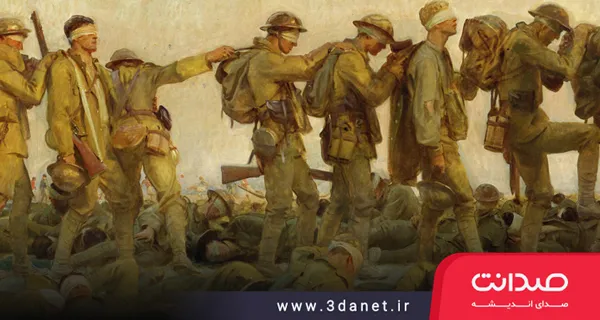
Albert Einstein is quoted as saying that he did not know what weapons would be used in World War III, but the weapons of World War IV would be sticks and stones. Now, several decades after this statement was made, we still do not know exactly what the weapons of World War III might be. Many assume that World War III must be a war centered on ultra-advanced atomic weapons, far more devastating than the two previous wars, to the point where the face of the earth is fundamentally disfigured. The issue is that in this conception, the upheaval of the earth's surface and catastrophic death and destruction are taken as the criteria for identifying a "great war"[2], whereas earthly life is only one form of human life; the lives of consciousness, meaning, language, and in our era, especially virtual life, are also dwellings in which human existence nests and is exposed to being overturned. Therefore, a world war is that war which, through the confrontation of global forces, places human existence in a different order and form. Pursuing previous assumptions about World War III recalls the simple-mindedness of one who digs all over the desert to find the money he had hidden under the ground; they saw him and asked, did you not leave a mark when you buried it? He said, yes; the shadow of a patch of cloud had fallen upon it. This is an allegory for our fantasy of searching for World War III beneath patches of blood. What was unknown to Einstein remains an unknown subject, and if we do not address this question, the world may find itself engaged in the fourth battle without having known when the third war occurred.
Slavoj Žižek[3], at the beginning of the 21st century, raises this question: ((What will war mean in the twenty-first century? If they are clearly neither states nor criminal groups, then who will they be?)) (Žižek, Slavoj; 2002, p.48) It is a subtle point that contemporary man does not exactly know who "they" are; those who have endangered and continue to endanger his existence, and stranger still, the rules of the twenty-first-century version of the game are so scrambled that man in this history cannot even recognize the threat. The method and the tool used in an event are the two fundamental principles by which we understand the nature of events. In a simple example, a hand reaches toward our chest; whether this hand holds a flower branch or a knife clarifies the meaning of the hand's movement. But the hand might gift us a flower branch that will poison us as soon as we smell it; this situation complicates epistemological equations, at least in the realm of communication, somewhat, and yet, what fear? This lesson of war was taught to us by the wooden horse of the Greeks at Troy, or in the guise of a fairy tale, the wicked queen, in the guise of a peddler, teaches children the same lesson with the poisoned apple she gives to Snow White. But now, there is no narrative commensurate with probable or ongoing wars to elevate our understanding of war to a new stage. Invisible wars slowly paralyze the frog in the slow-cooker in its warm and soft container, and the frog is suspended between leaping and passivity. The gambler only realizes he has been deceived when he loses. Troy had to fall for the lesson of the new war to emerge from this calamity and be taught through the language of story to take root in the human psyche.
At the beginning of the 1980s, when some people noticed cold-like symptoms or skin problems, they never imagined that behind these simple signs lay the greatest disease of the era, namely AIDS; it is entirely possible that behind signs of nothing, a great war is taking place. This resembles a paranoid notion, but in a dark cave, not taking every step cautiously and suspiciously is sheer ignorance. The war may, beyond its Trojan narrative, step forward from the very beginning as a ruthless invader and command all the attention and energy of the opposing side, while the real war is invisibly taking place behind it. It is possible that the outbreak of the coronavirus, which in its most defensive interpretation is assessed as a biological war, is merely a cover to conceal that other great war.

In the same article, Žižek also points to the subject of invisible war and considers it the first image of a twenty-first-century war, as opposed to bombings, terrorist attacks, and noisy actions of that sort; he writes: ((The explosion and collapse of the Twin Towers of the World Trade Center in September 2001 not only bore no resemblance to a twentieth-century war, but was the spectacular swan song of the twentieth century. What awaits us is something far more mysterious: the specter of an "immaterial" war in which the attack is invisible—viruses, poisons that can be everywhere and nowhere. At the level of visible material reality, nothing happens, no great explosion takes place; yet the familiar world collapses, life falls apart)) (ibid., p. 47)
If we consider this hypothesis of Žižek as the first answer to our Einsteinian riddle, we are obliged to strive to make the mysterious war of the twenty-first century visible. It is good, before anything else, to consult our feelings and intuition. The world feels the heat of a war, but sees no fire outside. The science of psychology teaches us the doctrine that when the limited and small consciousness is asleep or occupied with an appearance, the unconscious is attentive to everything. In the words of Carl Jung[4], the human unconscious is capable of perceiving things in a more sensitive and complete way than consciousness, but in most cases, consciousness is unable to understand its speech, because the language of the unconscious is symbolic, just as he himself, before the outbreak of the World War, had a dream of the world being covered in blood. For Jacques Lacan[5], this invisible war can be an instance of the Real that resists symbolization, and thus is not understood, except when the Real tears apart the symbolic order. Perhaps in some cases, one can neglect the unconscious's testimony of the concealed matter; but war is an event with eternal effects on the destiny of a nation, and if it occurs on a global scale, it will forever influence human history and overturn the world we knew. Therefore, conceptualizing what is silently underway in the human unconscious and the expanse of the world now becomes a critical matter.
Defense and military experts also hold that war is no longer valid in its old sense; the meaning of a weapon of war is no longer merely firearms and incendiaries, but includes anything that can weaken and incapacitate the opposing force. The space of war in the future will be more of a virtual, fluid, software-based space, beyond human senses (Heidari and Abdi; 1391, p. 56). This view on the course of wars beyond human senses aligns with Žižek's idea of the specter of war and is a confirmation of the path we have taken, that is, questioning the feelings that, below the threshold of consciousness, have drawn our unconscious to themselves.
Over the past two months (February and March 2020), following the news of the coronavirus outbreak, the world went on alert, and after its spread and transmission, governments and people, through the opportunity provided by social networks, engaged in disseminating preventive and protective campaigns, speculating about the agents of the virus's production and spread, news of the infected, citizens' reactions to the event, condemning groups, companies, political views, responsible countries, vendettas, and so on; to the point where it is now absolutely impossible to discern by which country, political group, and for what purposes this virus was produced.
Is the coronavirus a product of natural evolution or a mutated virus from a laboratory setting? Who is there to know? Among this multitude of economic, political, and social motives attributed to the production and the reaction of governments in creating a state of exception, which points to real instances and which is false? All of this has turned the mobile phone screen into a magic orb, open to a suspenseful film by Asghar Farhadi: Who is lying? This chaos is the result of which cover-up? When will the sun emerge from behind the clouds?
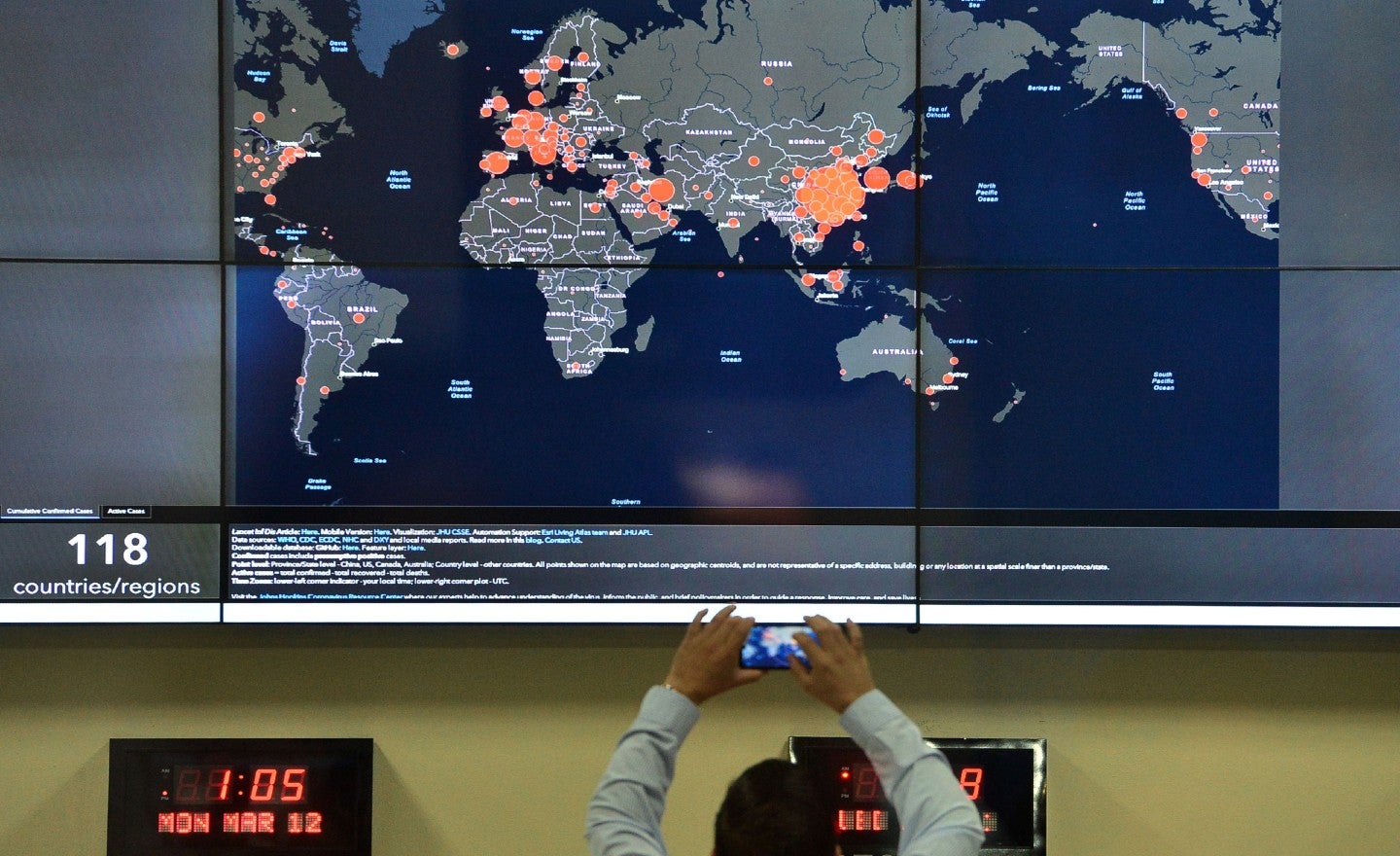
The coronavirus is the hero of thousands of twenty-four-hour virtual networks, in each of which it has preserved the constant essence of its anti-heroism while simultaneously exhibiting various and contradictory accidents and attributes. The Joker, as an anti-hero who can have a thousand contradictory narratives about his own past, is now placed as the star of the show in the global twenty-four-hour program of The Truman Show[6], with millions of screens open to him. Of course, with the difference that one cannot continue with normal life and now merely sit back and watch the "Corona Show." The Corona Show disrupted the game and pulled contemporary humanity out of the lethargy of its spectatorship, or, to put it another way, like a black hole, it dragged humanity into its own acute reality[7] to compress it, at the end of its cone, to the size of a datum[8].
But why is the coronavirus so powerful? Because it is deadly? Or are there other reasons at play?
Žižek considers contemporary humanity a Hollywood-struck being, which understands its existence and history through Hollywood images. The coronavirus has meaning and value as long as it makes living in an apocalyptic genre film possible. If the coronavirus were to step out of the world of the image, could it still remain a meaningful entity? Or, like Gil Shepherd in Woody Allen's 1985 film The Purple Rose of Cairo, who stepped out of the cinema screen to have a real experience of love and then realized he belonged to that world of images, the coronavirus will also return to the cybernetic world of our existence to ensnare the metaphysics of "reality" and "existence" with its distorted appearance in the trap of its event horizon[9].
Let us clarify this matter with an analogy. In 2014, it was announced that according to the latest statistics from the National Death Profile studies, heart attacks lead to the death of 93,000 Iranians annually, making it the leading cause of death among Iranians (Sayyari, Ali Akbar; 2014). This rate of mortality is higher than any contagious disease in history. Fast foods are one of the main causes of death from heart attacks and cancer; given these horrific statistics, why does no government declare a state of exception due to the presence of killer fast foods on the streets? Why is no one banned from going out on the street, from the time of contracting a cancerous sandwich from a fast-food outlet until the city is cleansed? Why, on the contrary, are fast-food outlets proliferating like mushrooms and infecting more people with fatal diseases every day? The main answer is that such concepts and images do not exist in our imaginary realm. But the coronavirus, with the background it has in twentieth-century fantasies, is a good vehicle for humanity to see the realization of its fantasy with its own eyes and to transport itself to another level of the imaginary, which we will address later.
In its psychological sense, the coronavirus is nothing but a hero that makes human fantasies possible—fantasies that have emerged from apocalyptic films, novels, and games to nurture the psyche of contemporary humanity in their own brine. If a child, by looking in the mirror, can recognize its body and its relation to the world, the human being in the age of simulacra recognizes and constructs itself in the mirror of cinema, digital games, and amidst the content of virtual space; and all these images that constitute the human imaginary have turned the coronavirus into a pristine vehicle for fantasy. A fantasy whose schemas had already been given in films such as Resident Evil[10], Contagion[11], and so on. Now this matter intersects with capitalist interests and power saturated within the masses, and an acute reality called the coronavirus is produced, which shatters all the relations of our existence.
The 2020 event is an image that cinema had not explained; in the moment, on social networks, it is emerging and constructing its own specific human being—and that is the emergence of a human quality we can call the “Cyber Gopat”[12]. The Gopat is a legendary creature in the ancient culture of the East, each part of whose body is taken from a disparate being; for example, a creature with the wings of an eagle, the torso of a bull, and the head of a human. The difference between a Gopat and Frankenstein is that Frankenstein is made from the dismembered parts of corpses from one social class, namely the destitute, but the Gopat, in the sense intended here, has a more chaotic and inexplicable identity; the human being emerging from the Cyber Gopat has come into being through an implosive explosion of every contradiction and every shattered distinction.
On an emotional and affective level, in the cinematic imagination, subjects like the coronavirus outbreak are often placed within a genre, usually the horror genre, and explicated in cinematic language. However, the generic event of the coronavirus in cyberspace ranges from comedy and farce to tragedy, from suspense and horror to melodrama, from realism to surrealism, and from the absurd to the musical, and so on, in its diversity. In simple terms, some of the human species have made the onslaught of this virus a subject of laughter, some weep over it, a group dances and plays music on its account, a faction is paralyzed by the terror of its existence, another faction considers the coronavirus a reminder of the futility of human life, and some introduce it as a golden opportunity to upgrade their business and life culture, staging a full-scale display of what they represent in cyberspace. This is the process that turns the human being emerging from the social network into a thousand-piece Gopat. The Cyber Gopat is an inwardly collapsed force, something helpless in thought and condemned to the inability to choose. The “Cyber Gopat” is a species of humanity that Sartre probably could not have predicted.
This event is unprecedented in the history of human life. The human being is currently faced with an entity called the coronavirus, about which, while still not knowing what it is based on actual data, in the state we have named the “Cyber Gopat,” it does not know what the existential meaning of this entity is, and on a psychological level, it does not even know how to regulate its emotions in relation to it. Philippe de Felice believes that psychological warfare causes mood cycles or psychosis in humans, and psychological warfare, by confronting the individual with different propaganda subjects, places the individual in an alternating state of excitement and depression. (Madahi, Mohammad Ebrahim; n.d.) The Cyber Gopat is a being born of epistemic and affective antagonisms. It has acquired the ability to live within the contradictoriness of affairs; whereas a human being is incapable of tolerating such states, and such a possibility can only occur when the human’s metaphysics has been ruptured. The transformation of the human being into the Cyber Gopat has been a gradual process, but the acute realities of the coronavirus completed this process.
Corona is a history, a history whose meaning for humanity is fading into obscurity. The 2020 event paralyzes human reason on two fronts: one, in the obscurity of the real — “What is the reality of this history?” — and the other, in the obscurity of meaning — “What is its existential meaning?”. It seems the coronavirus outbreak, which in its most defensive interpretation is the weaponry of a biological war — though it is unclear in service of which political structure and against which other political structure — is creating a history in 2020 that is pivotal not merely for political, biological, economic, and psychological reasons, but also wages battle on an ontological front. It is not far-fetched to say that the biological war that has brought the white-collar class to the front lines is, in fact, a cover for a metaphysical war that should bring thinkers to the front.
The problem of the real and meaning have been two perpetually open files in the modern and postmodern world. Problems for which, however many answers have been provided, the antithesis of non-answer has immediately reared its head from elsewhere. The metaphysical alienation of this era has not been resolved by philosophical and psychological answers, and over several centuries, the severity of this problem has continually increased, until in the postmodern era, talk arose of the death of meaning and the murder of the real. In Jean Baudrillard's terms, living in the age of the simulacrum[13] is the main factor in this situation. The “simulacrum” is a state in which signs dissolve into themselves and refer to no real principle. For example, in antiquity, reality was considered the referent for everything, and human fabrications were imitations of reality. The doctrine of the referentiality of reality from that age still remains. An example is the story of the boy who cried wolf, based on a tale by Aesop[14], the storyteller of ancient Greece, which is in our textbooks. In this story, the subject of reality is a vital matter and the axis of everything. The villagers, immediately upon encountering “reality,” realize the shepherd boy's lie and withdraw their trust from him, and on the other hand, this same “real,” in the form of a wolf, appears to the shepherd's flock and takes its revenge on him. But in the modern era, reality is not manifested in Marx's writings as Aesop describes, because the form and relation of humans to reality are transformed under the conditions of production; of course, although reality is hidden, its distorted version is accessible, and the thinker's task is to unveil the reality that has gone under the mask. But Baudrillard, with a bit of foresight, considers talking about reality laughable. For him, reality is like a whore that submits to any idea about itself.
Baudrillard describes our age as the age of simulacra. For him, the simulacrum is something that sits in the place of reality to conceal the absence of reality. In his own words, (“The simulacrum hides not the truth, but the non-existence of truth, or in other words, the extension of nothingness”) (Baudrillard, Jean; p.52). This differs from hiding reality, which was a dominant feature in the modern era. (“To dissimulate is to pretend not to have what one has. To simulate is to feign to have what one doesn't have. One implies a presence, the other an absence”) (Baudrillard, Jean; 1988, p.87). It is not without reason that in our era there are so many conspiracy theories, theories that consider humanity's greatest achievements, such as the moon landing, a historical simulacrum against what never actually occurred.
When we trace the assumption of the simulacrum in our own history, we affirm Baudrillard's idea, but it is unlikely that humanity has lost all its consciousness of reality, even though the cybernetic golem is passive toward the real; the reason that pursues reality is an archetype; that is, it has an eternal and everlasting psychological pattern that is inherited by humans beyond their control. Now, in whatever mode of existence, be it a cybernetic golem, zombie, vampire, or robot-human, the real is still the pivot of its reason and knowledge. Our rationality, religion, and metaphysics remain as devoted to reality as powerfully as in all eras. Reality is for us the center of gravity and the compass point of our existence. An attack on reality is an attack on being; just as if the queen bee is threatened, the death of the queen can lead to the end of life, and this is precisely the aim of the war that has targeted human metaphysics.
It should be noted that the simulacrum Baudrillard refers to mainly pertains to the period before the global proliferation of social networks. In the twentieth century, the media was in the hands of power; and one of Baudrillard's critiques of it was precisely its one-sidedness, which rendered communication, as a two-way affair, impossible. But now, every citizen of cyberspace is a medium, working in the service of disseminating simulacra. It resembles a honeybee adopting the behavior of a dung beetle, pouring everything it gathers into the hive each day. In the same vein, humans strive to share simulated content in this public space that has no reference to the real. Power and its interests are things lost amidst the simulated democracy of social networks. Now, every individual's mobile phone resembles a war radio, which, with the messages and content shared with others, enlarges the kite of hyperreality, like an atomic cloud, to the benefit of a structure it does not recognize.
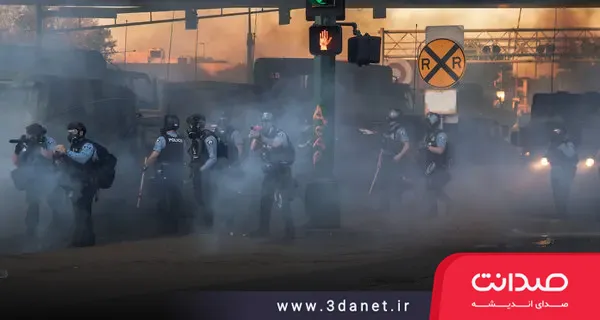
Power, through the implosion of signs, has become saturated, and every human is like a molecule exerting force in this conflict. Žižek had said that "we are entering a new period of paranoid warfare in which the greatest task will be to identify the enemy and his weapons." (Žižek, Slavoj; 2002, p.47) Now, eighteen years after this statement, we are precisely in the midst of this war, and identifying the enemy and the totality of his weaponry is, as he predicted and perhaps beyond his imagination, difficult; nevertheless, there is also no possibility of exiting this war. The world is a world of war, and whichever way you turn, you will find yourself on the front of the interests of a structure you do not know. This recalls the opening minutes of the film The Great Dictator, where Chaplin, as a Tomanian soldier, gets lost with a military unit in the dirt and smoke of war, to the point where, amidst a mass of smoke, we, the spectators, no longer see him and only hear his voice calling out "Commander, Commander" as he searches for his commander, and when the smoke clears, he finds himself having joined the enemy soldiers and advancing on his own territory; the first part of this episode resembles the state of the war we are engaged in; we advance in a veiled and concealed atmosphere, and it is by no means clear on which front our random choices have placed us, and in the other part, when Charlie looks at the soldiers, he realizes by following signs such as the soldiers' uniforms that he has fallen in with the enemy. But to what do the signs in the present war refer? In this war, not only the soldiers but also the commander has been decomposed in the play of signs. Today, power itself is also deeply under serious threat from simulation and simulacra, and this places two general ideas before power: one, a form of revolution against the simulated order, or the gamble of continuing this very order by producing another artificial-cybernetic social and political life, under extremely more complex conditions.
Baudrillard's prediction was the victory of the simulated over the real, and now this matter is observable in all our social, economic, and political relations. The capitalist system is a current whose life is deeply dependent on this dangerous order into which the boy who cried wolf has breathed life. Certainly, power will not refrain from any game for its survival. The survival of the age of simulation is now a matter of life and death for power.
We learned that the hyperreality of Corona has brought the cybernetic golem to an acceptable level for itself, but which idea will the cybernetic golem defend? Was power's entire gamble on Corona in the service of constructing this very type of human? If it is something other and more than this, what is it? The answer lies in this question: what is the only path remaining for power in producing an artificial condition? Certainly, the only way is to gamble on the ideals of the transhumanist movement[15], which will lead to a new post-capitalist order.
Transhumanism is a movement that aims to infinitely enhance human mental, physical, and psychological capacities through various technologies. The ideals of this movement roam in infinity, and all it believes in is that by transcending the human, it must transform the human into an advanced species. The Hegelian evolutionary-historical view, in its crudest form, lies at the center of this structure's ideology, and the subject of the struggle for survival in Darwinian evolution is the core principle that sanctions any crime. Of course, we are not opposed to or against the current and future achievements of this movement, but we have serious criticisms of its epistemological foundations; foundations that, contrary to their view, are not only not on the path of human progress, but, despite their appearance, are deeply backward and reactionary.
Vernor Vinge wrote in his 1993 article "The Technological Singularity" ((Within thirty years, we will have the technological means to create superhuman intelligence. Shortly after, the human era will be ended)) (Vinge, Vernor; 1993; cited in Bostrom, Nick 2005, p.9;) We are now exactly at the time Vinge pointed to. Predictions of this kind appear in numerous sources by thinkers of the transhumanist movement, and they have estimated the years of flourishing to be between 2030 and 2050. Fereidoun Esfandiary was another theorist of this movement, who adopted the name "F. M. 2030"; he says about choosing this name for himself: ((The name 2030 reflects my conviction that the years around 2030 will be a magical time. In 2030, no one will be old, and every human will have a great chance for eternal life. 2030 is a dream and a goal)) (F.M-2030, cited in Rose, David; 2014, p.117). The important thing is not agreeing on the prophecy of a specific date; the important thing is that the flourishing of this industry depends on public reception, which must occur in its most massive form. What this structure gives to humans is not like Apple products, where one can gain a broad market share using advertising strategies; rather, transhumanism is an event that, like vaccination, must occur in the most pervasive form; transhumanism will be a religion whose cultural-political structure tolerates nothing other than itself, and this justifies the necessity of designing precise, long-term, and ruthless strategies.
Although the promises of transhumanist theorists predict a future full of happiness, the imaginary arising from the simulacra of science fiction and apocalyptic genres also does not envision a happy ending for artificial intelligence, and this will cause problems for transhumanism in its rapid and immediate delivery. The imaginary arising from genre images is like the function of prophets such as Tiresias in Greek mythology, who promised a bad end to the hero and provided the means for his eternal avoidance and escape. Of course, the ideals of this order have had and will have the capacity to attract many followers, but clinging to it will not be possible initially except by discrediting the current lifeworld. The human must come to hate or fear their own body, their consciousness, and the material world around them to be willing to become a robot (however transcendent).
The most important strategy in this process is the initiation of a long period of biological and soft wars. In such a way that the human is severely reminded of the abjection and weakness of their physical body in the face of a hostile nature; it is then that the afflicted tribe of humanity will easily and eagerly accept the conditions for joining the power solution.
Global quarantine, the further destruction of non-online jobs, the dismantling of classical social capital and face-to-face interactions in favor of the online realm, and the hatred of the biological body in favor of the human-robot, will be among the minor outcomes of the designed biological wars. However, to achieve the “end of humanity,” the production of human-robot citizens, and ultimately the transformation of humans into cybernetic data, these systematic wars alone are not enough. The end of humanity will not be realized except through the instigation of wars in which human metaphysics is under assault—wars that ultimately target existence and truth. Therefore, in terms of subject matter, this series of wars needs to be distinguished from other forthcoming and probable wars under the name “Metaphysical War.” Thus, biological wars and the like are often pretexts for a concealed and grand metaphysical war that will continue until the realization of transhumanist ideals. In a sense, Corona and other global biological wars are like the golden apples dropped at the feet of Atalanta. Atalanta, a beautiful and agile young maiden in Greek legends, refused to marry because a prophecy had warned her that marriage would bring her misfortune. She set a footrace as a condition for all her suitors: if they won, they would take Atalanta as their bride, and if they lost, they had to die. With great agility, Atalanta triumphed in all these contests, and the suitors’ fate was nothing but death. Until Melanion, one of her admirers, sought help from Aphrodite, and at Aphrodite’s suggestion, dropped three golden apples at Atalanta’s feet during the race. Melanion’s goal in dropping the apples in Atalanta’s path was not victory for victory’s sake; his goal was to possess Atalanta, even though seizing her was only made possible by this act. Power, like Melanion, gambles on its own death, and plunging the world into this order is its entire purpose.
Post-capitalism also knows that it is through the subversion of human metaphysics that one can be made a consumer of the new artificial order, and this has led to the design of new wars that simultaneously corrupt all dimensions of human existence. The implosions that constantly collapse all boundaries in order to effectively overturn reason and knowledge, along with the cybernetic goop that renders humans dull and listless in their deepest emotions and feelings, will lead to a metaphysical despair that prepares schizoid life for the consumption of every simulacrum of descriptive and therapeutic theories; and this itself will be a new page in the history of madness.
Let us return to the riddle we borrowed from Einstein. What will the weapons of World War III be? We now know that these weapons must be something not for bringing down the enemy, but something for ending humanity; and what will make the end of humanity possible, except the subversion of its metaphysics? In this transition, the occurrence of any kind of war—whether biological, economic, psychological, cybernetic, etc.—is inevitable; and all of these will mark an era of violence that will be conceptualized under “World War III.” In the two previous world wars, there was a clear distinction and boundary between combatant and citizen, and therefore, when ordinary people were attacked by the enemy, they were referred to as innocent people. But in the third war, there is no distinction between soldier and citizen. Every spectator and every spectacle-maker in cyberspace who is busy swelling the mushroom cloud rising from the implosion of all affairs and signs is a soldier, or better put, a “war-people” who is engaged in the destruction of the metaphysics of their own world’s existence. This unaware warrior, who rushes headlong into obliterating their own being, recalls, in a more dreadful form, Voltaire’s saying that all people love freedom, yet employ a strange skill in annihilating it; now it must be added that people love their own existence, yet employ a strange skill in annihilating themselves. Nevertheless, in this world war, a grave duty now rests on the shoulders of thinkers. Today, more than ever in our world, precisely at this time when the end of philosophy is spoken of, if we take philosophy and thought in a single sense, it is upon the innovative philosopher to relate to their world in a new way and to rise up for “existence.”
.
.
References
Persian
1_ Baudrillard, Jean; The Dawn of Reality; translated by Arash Qorbani, in the monthly research journal Ettela'at-e Hekmat va Ma'refat, No. 3 (Serial 15), Second Year, Khordad 1386
2_ Baudrillard, Jean; (1988) Simulacra, translated by Mani Haghighi, in The Bewilderment of Signs (Examples of Postmodern Critique), Baudrillard and others, selection and editing: Haghighi, Mani, Tehran, Markaz, 1392
3_ Heydari, Kioumars and Abdi, Fereydoun (1391) Future wars and their characteristics with an analysis of the views of some Western military theorists. In the scientific-research quarterly Military Management, No. 48, Twelfth Year, Winter 1391
4_ Žižek, Slavoj; (2002) Welcome to the Desert of the Real; translated by Fattah Mohammadi, Zanjan: Hezare-ye Sevvom Publications, 1392
5_ Sayyari, Ali Akbar; (1393). Deutsche Welle Persian; Science and Technology (2017) taken from here
6_ Madahi, Mohammad Ebrahim; (n.d.). Psychological warfare and its psychological effects. In the Basij Quarterly
English
1_ Nic, bostrom (2005) A history of transhumanist thought , in journal of evolution and technology- vol. 14 Issue 1- april 2005
2_ Rose, david (2014) Enchanted Objects: Design, Human Desire, and the Internet of Things. New York, Division of simon & Schuster,inc,2014
.
.
[1] Master's degree in Clinical Psychology Ebrahimi.arash610@gmail.com
[2] The Great war
[3] Slavoj zizek
[4] Carl Jung
[5] Jacques Lacan
[6]The Truman show
[7] Hyper reality
[8] data
[9] Event horizon
[10] Resident Evil
[11] Contagion
[12] Cyber gupat
[13] simulacrum
[14] Aesop
[15] Transhumanism
.
.



Discussion0 comments
No comments yet; let yours be the first voice.