Philosophy
Arendt in the Darkness of Mehdi Khalaji’s Translation
A fluent translation is not necessarily an accurate one. In this essay, Hamidreza Saadat-Niaki compares the English text of Hannah Arendt's "Men in Dark Times" with Mehdi Khalaji's Persian translation and shows examples of errors that have at times inverted the meaning of Arendt's words, at times attributed her judgment to someone else, and at times dropped passages of the text. This documented critique raises a fundamental question: how can a reader without access to the original tell whether what he is reading is really the author's own voice?
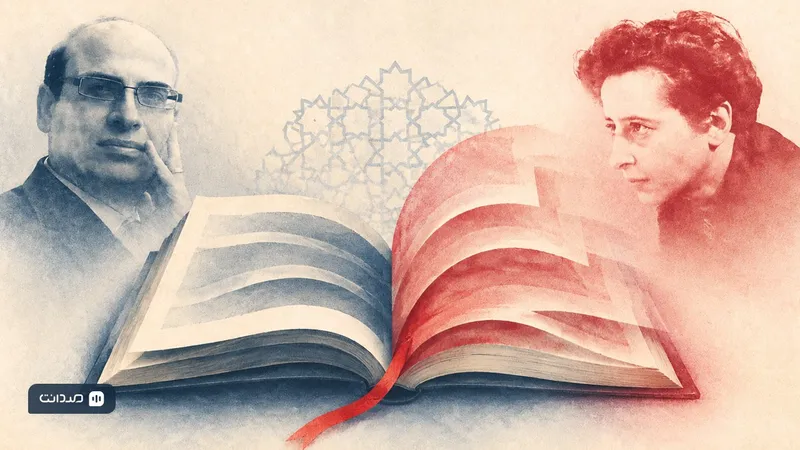

حمیدرضا سعادت نیاکی
نویسنده
Mehdi Khalaji
مترجم مورد بررسیWhen I began leafing through Men in Dark Times in Mehdi Khalaji's translation, I had no intention of writing a critique of it. Years had passed since the book was published by Tavaana in 2016, and its Persian prose aroused no suspicion. My doubts began with passages that I thought I had understood differently when reading the work in English. I compared a few places at random and gradually realised that the extent of the errors was far greater than I had first supposed. Here I examine only a selection of them. The criteria for choosing the evidence were that the error can be demonstrated by consulting the original and the context of the passage, and that it has a significant effect on the reader's understanding.
Differences of taste in the choice of equivalents, a preference for one mode of expression over another, and choices that are defensible on the basis of a legitimate approach to translation are not the subject of this critique. Likewise, wherever the original admits more than one legitimate reading, my disagreement with the translator's interpretation was not treated as grounds for calling his translation wrong. Minor errors that, despite being incorrect, have no significant effect on the understanding of the text or the accuracy of its information have also been left outside the scope of this critique.
The English text on which this critical essay is based is the same one that Khalaji translated:
Arendt, Hannah. Men in Dark Times. A Harvest Book. New York: Harcourt, Brace & World, Inc., 1968.
The electronic file of Khalaji's translation is available on the Tavaana website at the following address:
https://tavaana.org/wp-content/uploads/2022/12/Hannah-Arendt-Men-in-Dark-Times.pdf
The Inversion of Negation and Affirmation
In the essay "Rosa Luxemburg" we read:
“These were her real mistakes, and there was none she did not finally recognize and bitterly regret” (p. 47).
That is: "These were her real mistakes, and she finally recognised all of them and bitterly regretted them." But in Khalaji's translation we read: "These were her real mistakes. She never admitted these mistakes, nor did she regret them" (p. 96).
In the essay "Walter Benjamin" Arendt writes:
“greatly attracted not by religion but by theology” (p. 156).
That is, "He was greatly drawn to theology, not to religion." But Khalaji translates: "He was enamoured of religion, not theology" (p. 204).
To cover his living expenses Benjamin needed a monthly stipend. Arendt says he was willing, or thought he was willing, to accept the wishes of his financial backers in return for a stipend, that is, to take a stipend from the Zionists and learn Hebrew, or to accept financial support from the Marxists and think in the dialectical manner they favoured.
Arendt writes:
“The fact that despite being down and out he later did neither is worthy of admiration” (p. 180).
An accurate translation of this sentence would be: "That he later did neither of these things, despite his penury, is worthy of admiration." Khalaji has translated: "That, despite his bankruptcy, he later did this, is not worthy of admiration" (p. 229).
In the essay "On Humanity in Dark Times: Thoughts About Lessing," Arendt speaks of those who, in Lessing's phrase, take more trouble to make clouds than to scatter them:
“human society was in no way harmed by those “who take more trouble to make clouds than to scatter them” (p. 26).
That is, "Human society is in no way harmed by those who take more trouble to make clouds than to scatter them."
Khalaji's translation says that society "is harmed by those who go through fire and water to make clouds; a harm far greater than that caused by those who scatter those clouds" (p. 74).
In the essay "Angelo Giuseppe Roncalli: A Christian on St. Peter's Chair, 1958–1963," Arendt writes about accepting Christ's invitation:
“But the Church, being an institution and, especially since the Counter Reformation, more concerned with maintaining dogmatic beliefs than with the simplicity of faith, did not open the ecclesiastical career to men who had taken literally the invitation, ‘Follow me’” (p. 58).
A fairly accurate translation is: "But the Church, being an institution and, especially since the Counter-Reformation, more concerned with upholding dogmatic beliefs than with the simplicity of faith, did not open the path of advancement in the ecclesiastical ranks to those who had taken the invitation 'Follow me' literally."
The translator has rendered it thus: "But the Church as an institution, and especially since the Counter-Reformation, was more preoccupied with upholding its dogmatic beliefs and the simplicity of faith, and did not open ecclesiastical offices to those who had not taken the invitation 'Follow me' in the literal sense of the word" (p. 106).
In the original, the Church barred the path of advancement to those who had taken Christ's invitation literally, but in his translation Khalaji turns this group into those who had not taken the invitation literally.
In explaining Roncalli's rule for facing the future, Arendt writes:
“he now set down the “basic rule of conduct” for his new state—to “have no concern for the future,” to make no “human provision for it,” and to take care “not to speak of it confidently and casually to anyone” (pp. 65-66).
A fairly accurate translation: "and he now laid down the 'basic rule of conduct' for his new situation: to 'have no concern for the future,' to make no 'human provision for it,' and to take care 'not to speak of it confidently and casually to anyone.'"
The translator rendered this passage thus: "Roncalli laid down the 'basic law of conduct' for his new situation: 'to have no worry about the future,' 'to make the necessary human预见 and provisions for it,' and 'to care for everyone, not in word but in deed'" (p. 113).
Khalaji has turned the injunction not to make provision for the future into one to make provision for it.
The text continues:
“not even Rerum Novarum, the Encyclical of Leo XIII, “the great Pope of the working people,” had prevented the Vatican from paying starvation wages to its employees.” (pp. 65-66).
A fairly accurate translation: "Not even Rerum Novarum, the encyclical of Leo XIII, 'the great Pope of the working people,' had managed to prevent the Vatican from paying starvation wages to its employees."
The translator rendered it thus: "Even the circular issued by Leo XIII, 'the great Pope of the working class,' known as 'The Rights and Duties of Capital and Labour,' had stopped the Vatican from paying food money to its employees" (p. 114).
By dropping the negation, Khalaji has turned the encyclical's failure to prevent the payment of meagre wages into its having prevented the payment.
In the essay "Hermann Broch" we read:
“Within his horizon, however, Broch drew the most sweeping and radical conclusion from the experience of death. Not, to be sure, in the early value theory […]” (p.127).
That is: "Nevertheless, within his own horizon, Broch drew the most sweeping and radical conclusion from the experience of death. Not, to be sure, in his early value theory […]."
The translator rendered it thus: "Nevertheless, within this horizon Broch draws the most sweeping and radical conclusion from the experience of death. Undoubtedly, at the beginning of the value theory […]" (p. 177).
In fact, Arendt distinguishes between two phases of Broch's thought: the conclusion under discussion was not reached in his early value theory, but appeared in his epistemology. Khalaji has dropped 'Not' in his translation.
The Displacement of Roles and Referents in the Sentence
Khalaji sometimes errs in identifying the role of a sentence's components or the referent of a pronoun, and attributes Arendt's description or judgment to another person or subject. For example, in the essay "Karl Jaspers: A Laudatio," Arendt speaks of Jaspers's stance during the period of Nazi domination:
“It was self-evident that he would remain firm in the midst of catastrophe. But that the whole thing could never become even a temptation for him—this, which is less self-evident, was his inviolability, and to those who knew of him it meant far more than resistance and heroism” (p. 76).
That is: "It was self-evident that he would remain steadfast in the midst of catastrophe. But that the whole affair could never even become a temptation for him — this, which is less self-evident, was his inviolability, and for those who knew him it meant far more than resistance and heroism." In Khalaji's translation we read: "It was self-evident that Jaspers would remain steadfast in the midst of catastrophe, but what seemed far less self-evident was that his inviolability in such circumstances never even turned into an alluring temptation for him. For those who knew him, this was far beyond resistance and heroism" (p. 124).
In the original, 'the whole thing' is the subject of 'could … become a temptation': the whole business of Nazism could not even tempt Jaspers. Then 'this' refers to that very immunity to temptation, which Arendt calls "his inviolability." Khalaji has put "Jaspers's inviolability" in place of 'the whole thing.' As a result, in the Persian translation his inviolability itself is presented as something that was not tempting.
In the essay "Angelo Giuseppe Roncalli: A Christian on St. Peter's Chair, 1958–1963," after recounting anecdotes about the conduct of Pope John XXIII, Arendt examines the difference in how his faith appears in his life and in his writings. She writes:
“The single-mindedness of this faith, never troubled by doubt, never shaken by experience, never distorted by fanaticism—“which, even if innocent, is always harmful”—is splendid in deed and living word, but becomes monotonous and lame, a dead letter on the printed page” (p. 66).
That is: "The single-mindedness of this faith, never troubled by doubt, never shaken by experience, never distorted by fanaticism — a fanaticism 'which, even if innocent, is always harmful' — is splendid in deed and living word, but becomes monotonous and lame on the printed page, and turns into a dead letter."
Khalaji has translated the passage thus: "This steadfast faith was never agitated by doubt, never shaken by experience, and never marred by fanaticism. This faith, 'which was always harmful even in an innocent form,' appeared glorious and majestic in living deed and word, but on printed paper seems monotonous, crippled and a lifeless letter" (p. 115).
In the original, the relative pronoun 'which' refers back to 'fanaticism.' Roncalli's faith is likewise presented as a faith that fanaticism has not distorted. By opening the second sentence with "This faith 'which … was always harmful,'" the translator has attached the relative clause to "faith." As a result, a judgment that was originally about the harmfulness of fanaticism has been turned into one about the harmfulness of faith itself.
At the beginning of the essay "On Humanity in Dark Times: Thoughts About Lessing," speaking of what it means to accept the Lessing Prize, Arendt writes:
“we can do so only by ignoring ourselves and acting entirely within the framework of our attitude toward the world, toward a world and public to which we owe the space into which we speak and in which we are heard.” (p. 3)
A fairly accurate translation of this is: "We can do so only by setting ourselves aside and acting entirely within the framework of our attitude toward the world, that is, toward a world and a public to whom we owe the space in which we speak and are heard."
In Khalaji's translation we read: "Only by disregarding ourselves and acting within the framework of our approach to the world and the public do we accept the prize and give thanks. Accepting the prize means recognising the space in which we speak and the place where we are heard and to which we owe the prize" (p. 49).
In the English sentence the underlying structure is in fact this:
we owe the space to a world and public
In the English text, what we owe is "the space for speaking and being heard," and we owe this possibility to the world and to our audience. The relative pronoun 'which' in 'to which' refers back to 'a world and public.' But in Khalaji's translation, what we owe has become "the prize," and "space" has taken the place of the world and the audience. In this way, the relation between the common world and the possibility of speaking within it has been turned into a relation between prize and space.
In the same essay, while examining Lessing's view of art, Arendt turns to the position of the spectator and writes:
“the effect upon the spectator, who as it were represents the world” (p. 7).
That is, "the effect on the spectator, who as it were represents the world." Khalaji translates: "He cared about the effect that the work of art has on the spectator. The work of art represents the world" (p. 53). In the English text the relative pronoun 'who' refers back to 'spectator.' Arendt regards the spectator as the representative of the world, that is, of the common space that arises between the artist and other human beings. But by detaching the relative clause from its referent, Khalaji has attributed the quality of representing the world to the work of art. This displacement matters for understanding Arendt's argument, because it transfers the place she assigns to the spectator, in the relation between the work of art and the world, to the work itself.
Another example is from the essay "Isak Dinesen." In the English text we read:
“show yourself worthy of whatever it may be by recollecting and pondering over it” (p. 97).
That is, "By recollecting and pondering over what life has given you, show yourself worthy of it." Khalaji translates: "Show yourself the worth of whatever it may be" (p. 144). By changing the role of "yourself" in the sentence, Khalaji has turned this saying into advice to show the value of things to oneself.
In the essay "Hermann Broch" Arendt writes:
“since he was in fact one” (p. 113).
That is, "since he really was a poet and novelist." Khalaji has translated it as "since he was one person" (p. 163). The word 'one' in the English text stands in for the phrase "poet and novelist" in the preceding sentence. By taking this word as the numeral "one," the translator has turned a reference to Broch's professional identity into an irrelevant statement about his being a single person.
The Alteration of Logical and Comparative Relations
In some cases Khalaji has altered the logical relations between the parts of a sentence or between its propositions in the Persian rendering. Exception, condition, cause and comparison each play a part in determining the meaning of a statement, and changing them can convey to the reader a judgment different from what Arendt said.
The first example appears in the book's own preface. Writing about the persons to whom the pieces in this collection are devoted, Arendt says:
“with one exception, they hardly knew of each other” (p. vii).
That is, "with one exception, they hardly knew of each other's existence." Khalaji translates: "If there is any common feature, it is that they scarcely knew one another" (p. 39). The phrase 'with one exception' limits the claim that these persons were unaware of one another to a single exception. In the Persian translation this exception has been dropped and replaced by a condition about the persons' common feature.
In the Roncalli essay too, the relation between recognising a necessity and acting to establish equality has been altered. Describing the conduct of Roncalli, Pope John XXIII, Arendt explains that he treated people as equals regardless of their rank and position. She then writes:
“And he went to considerable lengths where he felt that this equality needed to be established” (p. 65).
That is, "And wherever he felt that this equality needed to be established, he went to considerable lengths to achieve it." Khalaji translates: "He went so far in this matter that he felt this kind of equality had to be established" (p. 114). In Arendt's text, the recognition that equality must be established is the basis of Roncalli's action in particular situations, but the construction "went so far that" in the Persian translation presents this recognition as the result of his action.
In the essay "Bertolt Brecht," Arendt describes the play Rise and Fall of the City of Mahagonny thus:
“Brecht’s only strictly nihilistic play” (p. 234).
That is, "the only play of Brecht's that is nihilistic in the strict sense of the word." Khalaji has translated it as "Brecht's most nihilistic play" (p. 293). In Arendt's phrase, 'only' signals that there is a single instance and 'strictly' specifies the exact sense of being nihilistic. But "most nihilistic" turns the restriction to a single instance into a comparison of degree among Brecht's plays.
In the same essay, examining the theme of a poem about Hitler's fame, Arendt writes:
“even if he made the earth unfit for habitation by conquering it” (p. 209).
That is, "even if, by conquering the earth, he made it unfit for habitation." Khalaji has translated: "Although, by his conquests, he made the earth wretched to live on" (p. 262). 'Even if' raises a hypothetical situation, whereas "although" takes the occurrence of that situation for granted. As a result, the earth's becoming unfit for habitation through Hitler's conquests, which Arendt put forward as a supposition, is stated in the Persian translation as an event that has taken place.
In the essay on Hermann Broch, Arendt explains that he became a poet against his own wishes, and then writes:
“by his reluctance gave personally valid and adequate expression” (p. 112).
That is, "by this very reluctance he gave a personally valid and adequate expression." Khalaji has translated 'by his reluctance,' that is, "by this very reluctance," as "despite his reluctance" (p. 162). In Arendt's text, reluctance is the means through which Broch expresses the fundamental trait of his nature and the central conflict of his life. But "despite" changes this relation to one of opposition and makes it appear that the expression of the conflict was achieved in spite of Broch's reluctance.
The Disruption of Relations and Temporal Order
In some cases Khalaji's translation reverses the sequence of events or erases the temporal relation between them.
In the essay "Bertolt Brecht," referring to the survivors of the cities bombed in the Second World War, Arendt recalls a poem that Brecht had written earlier:
“Brecht, decades before, had said in a poem” (p. 219).
That is, "Brecht, decades before, had said in a poem." Khalaji has translated: "Brecht, decades later, said in a poem" (p. 274). By changing "before" to "later," Khalaji has reversed the temporal order of the poem's composition and the destruction of the cities.
In the same essay, Arendt speaks of the time when Brecht, after joining the Communists, realised that in their logic, to change the world it is not enough to be good, one must oneself become bad. Arendt writes:
“He had scarcely joined the Communists before he found out” (p. 240).
That is, "No sooner had he joined the Communists than he discovered." Khalaji translates: "It is highly improbable that he joined the Communists with this awareness" (p. 299). The construction 'had scarcely … before' expresses a short interval between two events. In the Persian translation this temporal relation has been set aside and replaced by a speculative judgment about Brecht's awareness at the time he joined.
A Change in the Mood and Function of the Utterance
In some places Khalaji has changed the kind of statement Arendt makes, so that the reader of the translation meets an obligation or a report that has no such mood or function in the original.
For example, in the essay "Hermann Broch," while examining Broch's view of time and the possibility of converting the succession of events into simultaneity, Arendt writes:
“Man is bound to feel akin to this god because of the human ego’s alienation from world and time” (p. 133).
That is, "Because of the human ego's alienation from world and time, man is bound to feel akin to this god." Khalaji translates: "Man is obliged to feel himself akin to this god" (p. 182). In this context 'is bound to' expresses an inevitability arising from man's alienation from world and time; Khalaji has rendered it as "is obliged" and so turned the description of an inevitability into the statement of a duty.
In the essay "Bertolt Brecht," after pointing to the difficulty of talking about poets, Arendt writes:
“poets are there to be quoted, not to be talked about” (p. 210).
That is, "Poets should be quoted, not talked about." Khalaji writes: "There are poets whose words are quoted but who are not talked about" (p. 263). In this sentence Arendt states the proper way of approaching poets, preferring the quotation of their words to talk about them. Khalaji has turned this pronouncement into a report of what happens to certain poets.
Errors in Words, Terms and Expressions
Sometimes an error begins with the meaning of a single word or term and extends to a change in the subject of Arendt's remarks.
In the Lessing essay, Arendt speaks of ‘Nazi racial doctrine’, that is, "the racial doctrine of the Nazis," and then of ‘racial theories’, that is, "racial theories" (p. 29). Both times Khalaji translates ‘racial’ as "radical": "the radical doctrine of Nazism" and "radical theories" (pp. 76-77). In the continuation of the same paragraph Arendt supposes that the inferiority of a race could be proved by scientific evidence, and asks whether this would justify the annihilation of that race.
In the essay "Rosa Luxemburg," Arendt regards one of her most important political insights as the result of her encounter with ‘the revolutionary workers’ councils (the latter soviets)’ (p. 52), that is, "the revolutionary councils of workers (the later soviets)." In Khalaji's translation this phrase has become "the revolutionary director of the councils (later the unions)" (p. 100). Leaving aside "director," which may be a typesetting error, rendering ‘soviets’ as "unions" has erased the difference between revolutionary councils and trade unions.
In the essay "Jaspers: Citizen of the World?" Arendt raises the political responsibility of citizens independently of their personal fault:
“regardless of personal ‘guilt’” (p. 83), that is, "regardless of personal fault." Khalaji has translated it as "without personal 'pangs of conscience'" (p. 131). 'Guilt' in this context concerns personal blame or fault, whereas "pangs of conscience" are a feeling a person may have about his own wrongdoing. Arendt says that citizens bear political responsibility for the actions of their government even without being personally at fault, but Khalaji's translation has drawn the discussion toward the feeling of guilt.
In the essay "Hermann Broch," the phrase ‘mystic approaches of the Indian type’ (p. 131), meaning "mystical approaches of the Indian kind," has been translated as "Indian-style mythic approaches" (p. 180). 'Mystic' here relates to mysticism and differs from 'mythic,' meaning "mythical." This distinction matters in Broch's discussion, because on the same pages Arendt also speaks of the relation of philosophy to religion and myth.
In the same essay, describing Broch's conception of the world, Arendt uses the phrase “the world’s aboriginal ‘irrationality’” (p. 144), that is, "the world's primordial irrationality." Khalaji has translated it as "the irrationality of the world's natives" and, further on in the sentence, speaks of "their chaos and lawlessness" (p. 193). 'Aboriginal' in this phrase describes a primordial quality of the world itself. In the translation, the subject has shifted from a characteristic of the world to a description of a group of people who are not present in the text at all.
In the essay "Walter Benjamin," the expression ‘Through the good offices of a friend’ (p. 159) means "through the assistance and mediation of a friend." Khalaji has translated it as "through a friend's office" (p. 208).
'Good offices' is an expression for mediation and help and does not refer to an office or a workplace. Arendt explains that with a friend's help Benjamin was able to publish his study of Goethe's Elective Affinities in Hofmannsthal's journal.
In the same essay Arendt praises Scholem's patience in pursuing a stipend for Benjamin's study of Hebrew:
“and so is the infinite patience with which Scholem […] allowed himself to be put off for years” (p. 180).
That is: "and Scholem's infinite patience, with which he put up for years with Benjamin's putting him off, is also worthy of admiration." Khalaji translates: "and also the infinite patience that made Scholem dismiss the idea of helping him for several years" (p. 229). The expression ‘be put off’ here means being kept waiting because of another's procrastination. In Khalaji's translation, enduring this procrastination has become Scholem's being deterred from helping Benjamin.
In examining Benjamin's method, Arendt refers to ‘Baudelaire’s correspondances’ (p. 163). She speaks of the correspondence between a street scene, a stock-exchange transaction, a poem and a thought, which can be signs of a historical period. Khalaji translates ‘correspondances’ as "letters" ("mokātebāt") and in the next sentence speaks of "each of the letters" (p. 212).
Omissions in the Translation
In some places a sentence or phrase of Arendt's text that contributes to the understanding of her argument has been dropped from Khalaji's translation. In the Lessing essay, examining the flight from the public realm into private life in dark times, Arendt writes:
“They must remember that they are constantly on the run, and that the world’s reality is actually expressed by their escape” (p. 22).
That is, "They must remember that they are constantly on the run, and that the reality of the world is expressed in their very escape." This sentence has fallen out of the translation (p. 69). Before it, Arendt explains that taking refuge in private life can be justified, provided one does not forget the reality from which one is fleeing. The omitted sentence shows that even flight from the world bears witness to the reality of that world.
In the essay "Hermann Broch," Arendt connects freedom, in his conception, to his chaos-seeking desire to break away from others. She then explains that this rebellious, chaos-seeking side of the self was already present even in Broch's earliest writings:
“as one of the sources of radical evil” (p. 135).
That is, "as one of the sources of radical evil." In Khalaji's translation the discussion of this chaos-seeking side moves directly to its being overshadowed in Broch's early writings (p. 184). The indication that Broch regarded this tendency as one of the sources of radical evil has been dropped.
In the essay "Walter Benjamin," Arendt examines how the collector's attitude differs from tradition. According to her, against the authority of tradition the collector sets the authenticity and provenance of things. Arendt formulates this way of thinking as follows:
“he replaces content with pure originality or authenticity” (p. 199).
That is, "he replaces content with pure originality or authenticity." Khalaji translates the sentence before this phrase and then moves directly on to French existentialism (p. 249). Arendt's statement about authenticity replacing content has been dropped, and her subsequent explanation has been cut off from the theoretical formulation on which it rests.
In the essay "Bertolt Brecht," describing the fate of three generations of Europeans in the Second World War, Arendt mentions soldiers, refugees, exiles and members of resistance movements. Among them were also those who experienced the war:
“as inmates of concentration and extermination camps” (p. 219).
That is, "as inmates of concentration and extermination camps." This phrase does not appear in Khalaji's translation. The Persian list of members of resistance movements goes directly to the civilians who were under bombardment (p. 274). The earlier lines of the translation do refer to the Nazi camps, but the inmates of those camps have been dropped from the list that Arendt gives to show the common fate of those three generations.
In the examples examined, the meaning of Arendt's words has at times been changed, at times a judgment contrary to what she wrote has been attributed to her, and at times part of her argument has simply failed to reach Persian. The difficulty with this translation is that many of these errors occur in fluent, unobstructed prose. A reader who has only the Persian text often finds no sign that would prompt him to doubt. How can he know whether what he is reading is Arendt's own statement or the product of the translator's misunderstanding? Fluency of prose gives no assurance of a translation's accuracy. Therefore, citing Khalaji's translation, especially in reconstructing and criticising Arendt's thought, without comparing it against the original risks attributing to her words she never said.

Related articles
All articles Religion
Hannah Arendt's essay “Religion and the Intellectuals”
 Philosophy
Power Means the Presence of All: A Talk by Javad Kashi on Hannah Arendt and Her Thought
 Philosophy
Hannah Arendt in Plain Language, by Sahand Iranmehr
 Philosophy
Lectures on Hannah Arendt by Ramin Jahanbegloo (Agora Philosophical Association)
 Political Science

Discussion0 comments
No comments yet; let yours be the first voice.