Philosophy
Asghar Zare Kohanmoui’s Research Conversations on Ethics Published as “Ethics, the First Chapter of Reform”
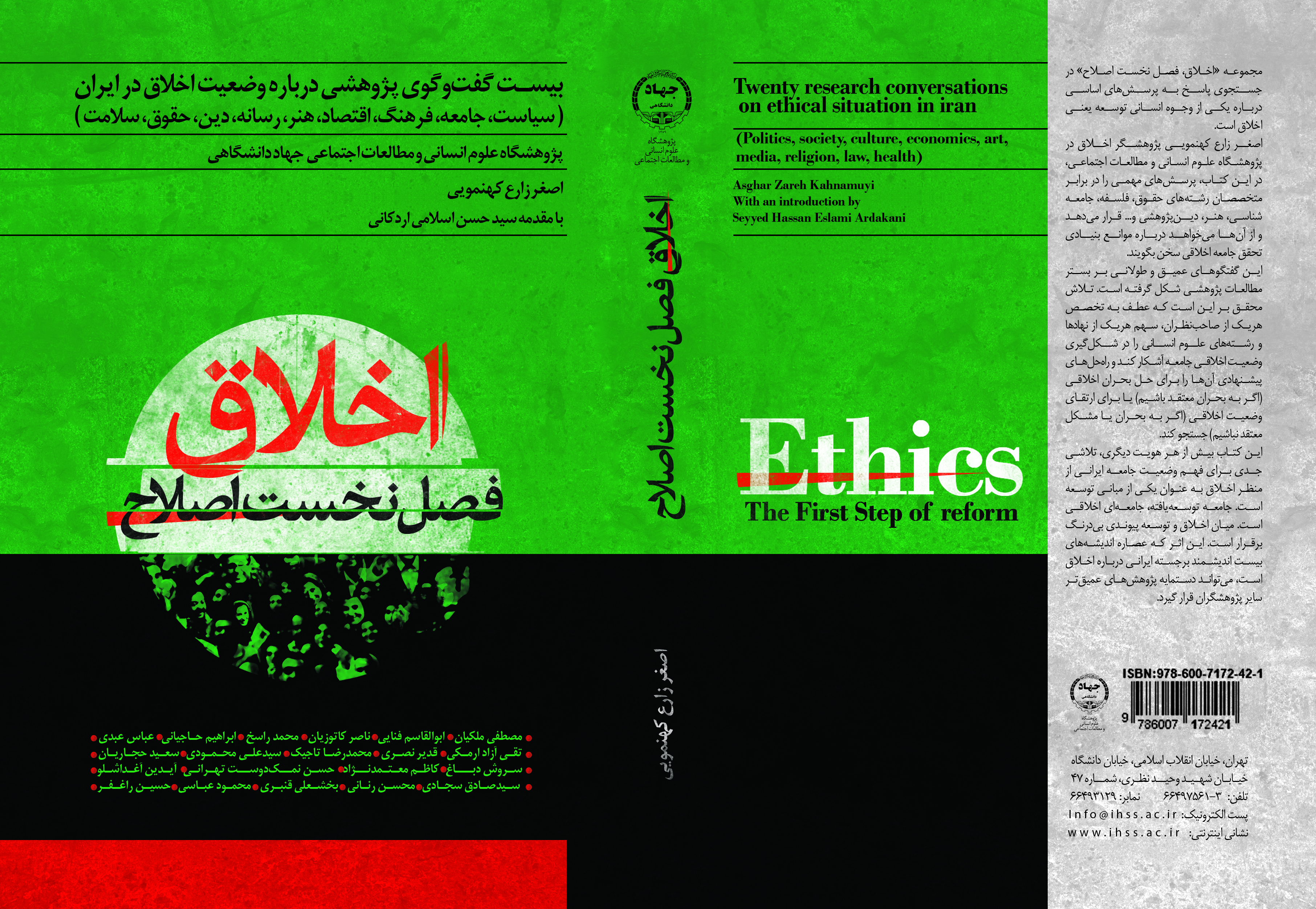
A collection of conversations by Asghar Zareʿ Kahnemuyi, titled Ethics, the First Chapter of Reform, has been published. The book examines the relationship between ethics and religion, politics, and economics, and through dialogues with experts, it seeks solutions for the moral betterment of society.
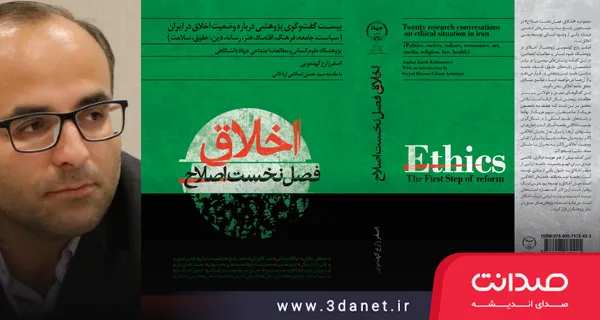
The Institute for Humanities and Social Studies has released a collection of research conversations by Asghar Zare Kohanmoui in the field of ethics.
According to ... , “Ethics, the First Chapter of Reform,” which features an introduction by Dr. Seyyed Hassan Eslami Ardakani and has been published as a research work following customary scholarly evaluations at a research center, is organized into five chapters, each of which deals with the specific relationship of a particular discipline to ethics.
In the first chapter, “The Relationship Between Ethics, Religion, and Law” is examined through four lengthy and highly significant conversations: Professor Mostafa Malekian, an influential philosopher of ethics and contemporary religious researcher; Dr. Abolghasem Fanaei, a prominent researcher in the ethics of religious studies; the late Dr. Nasser Katouzian, a distinguished professor of law; and Dr. Mohammad Rasekh, a professor of the philosophy of law.
In the second chapter, four academic figures discuss “The Ethical State of Iranian Society”: Dr. Taqi Azad Armaki, a professor of social sciences; Dr. Ebrahim Hajiani, a prolific sociologist of Iranian issues; Engineer Abbas Abdi, a sociological researcher; and Dr. Qadir Nasri, a young professor of political thought.
The third chapter is dedicated to “The Relationship Between Ethics, Politics, and Power” and includes four in-depth conversations, presented in the following order: Dr. Seyyed Ali Mahmoudi, one of the prolific writers on political thought in contemporary Iran; Dr. Mohammad Reza Tajik, a theorist of political discourses; Dr. Saeed Hajjarian, a theoretician of reform; and Dr. Soroush Dabbagh, a professor of moral philosophy.
In the fourth chapter, “The Importance and Manner of Ethical Conduct in the Realms of Media, Art, and History” is discussed with four distinguished professors of media, art, and history: the late Dr. Kazem Motamednejad, the late professor of communication science; Dr. Hassan Namakdoost, a distinctive researcher of media and democracy; Aydin Aghdashloo, a great contemporary painter; and Dr. Seyyed Sadegh Sajjadi, the former head of the History Department at the Center for the Great Islamic Encyclopedia.
The fifth chapter is devoted to examining the relationship between ethics and “Economics and the Guild System,” featuring conversations with Dr. Mohsen Renani, a professor of economics at the University of Isfahan; Dr. Bakhshali Ghanbari, a specialist in professional ethics; Dr. Mahmoud Abbasi, the former head of the Medical Ethics and Law Research Center; and Dr. Hossein Raghfar, an institutionalist professor of economics.
***
Dr. Seyyed Hassan Eslami Ardakani writes in his introduction to this book: Many factors make ethical conduct and moral agency difficult, yet they do not make it impossible. Always and in every situation, one can and must think about ethics and strive to act ethically. As stated at the outset, the foundation of ethical action is accepting responsibility and avoiding any kind of justification and self-deception. For this reason, part of practicing ethics, expanding ethics, and promoting the culture of living ethically and acting ethically is an invitation to accept one’s own responsibility and, instead of asking “Who did this?”, to raise the question “What is to be done?” The present collection is an effort to answer this fundamental question.
This distinguished professor of moral philosophy further writes: Mr. Asghar Zare Kohanmoui is a veteran journalist who has posed this responsible question to scholars from various disciplines, asking them, according to their expertise, to explain the role of different institutions in the current state of ethics and to say what must be done to move beyond the existing situation. In my belief, this valuable effort warrants much reflection and appreciation, especially because we have no path to understanding our society’s problems other than dialogue. Adopting the method of scholarly dialogue with various thinkers on a specific subject is a customary style in academic circles. This work requires special knowledge and skill, for it is impossible to engage in a specialized conversation with prominent experts without mastery of the subject under discussion, awareness of the interlocutor’s viewpoints, and possession of conversational skills.
***
In the foreword written for this book by the Institute for Humanities and Social Studies, it is stated: This book, more than any other identity, is a serious effort to understand the condition of Iranian society from the perspective of ethics as one of the foundations of development. A developed society is an ethical society. There is an immediate link between ethics and development. This work poses important questions to specialists in the fields of law, philosophy, sociology, art, religious studies, and so forth, and asks them to speak about the fundamental obstacles to the realization of an ethical society. These deep and lengthy conversations have been formed on the basis of research studies. The researcher's effort is to reveal, with reference to the expertise of each thinker, the contribution of each institution and humanities discipline to the formation of society's ethical condition, and to seek out their proposed solutions for resolving the ethical crisis (if we believe in a crisis) or for improving the ethical condition (if we do not believe in a crisis or problem).
***
In his lengthy introduction, which deals more with the necessities and difficulties of this journalistic-research project than the subject of the book, Zare Kohanmoui writes: One afternoon in the autumn of 2010, tired from news work, when I read the deplorable account of the brazen crime in Kāj Square in the news agencies, I was so astonished as if I had been struck dumb in my sleep. How is it possible, in broad daylight, in the middle of the street, for one human being to butcher another with a knife, and for others to merely suffice with filming the catastrophe? That night, after much sorrow, I concluded that I must migrate from the realm of politics to another place and, instead of contemplating power, attend to culture. This incident brought me to the realization that the glass palace of politics is not the first station where transformation must take shape. The first step of change is the ethical transformation of a society that seems to have forgotten that a street brawl is "bad" and that one must struggle against this "badness." If a journalist wishes to fulfill their social responsibility, they must, to the extent of their ability, make an effort to confront society's problems. The project "Ethics, the First Chapter of Reform" was sparked in my soul and mind that very night, but I did not know that this work would occupy five years of the best period of my life.
He writes: I consider dialogue the most ethical possible endeavor and the most necessary action that our society needs. The era of sitting in a corner of illusion and irresponsibly producing texts that assume the audience are "sheep" and the author a "goddess of wisdom" has come to an end. Challenging dialogue draws the audience into the text and prevents the author from dictatorship. For understanding the problems of our society, we have no path but dialogue.
***
"Asghar Zare Kohanmoui" is a journalist (a reporter in the fields of politics and thought, and former editor-in-chief of the Jamaran website and Bahar newspaper) and researcher (a scholar of the history of thought and philosophy of ethics, and a faculty member of the Department of Philosophy and Theology at the Academic Center for Education, Culture and Research's Institute for Humanities). He is currently studying for a doctorate in the History and Civilization of Islamic Nations at the University of Tehran. Zare Kohanmoui's first collection of conversations, titled "The Ethical Revolution," was published in June 2013 with a foreword by Seyyed Hassan Khomeini. In December 2015, the collection "Equality and the Elimination of Discrimination" was published with a foreword by Emadeddin Baghi, and in May 2016, the collection "The End of Monolingualism" was published with a foreword by Abdollah Ramezanzadeh. Now, in December 2019, "Ethics, the First Chapter of Reform" is being published with a foreword by Seyyed Hassan Eslami Ardakani by the Institute for Humanities and Social Studies.

Discussion0 comments
No comments yet; let yours be the first voice.