Religion
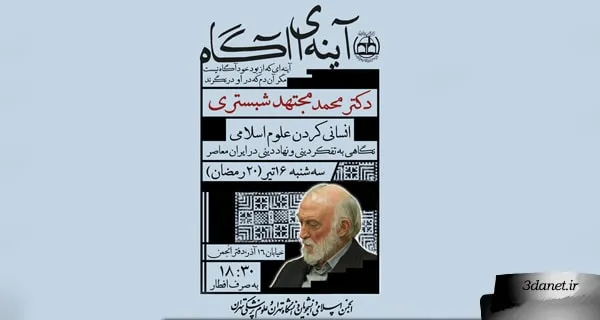
Audio Lecture by Mohammad Mojtahed Shabestari: Humanizing the Islamic Sciences
The project to Islamise the humanities has failed; instead, the Islamic sciences, the religious establishment, and the system of government have come to be seen as 'human' and fallible. Shabestari extends this loss of sanctity to the very sources of religion and insists on the necessity of a critical dialogue with the religious tradition.
۱- I believe we Iranians must continue serious discussions about the Islamic religious tradition—its analysis, critique, and nourishment—because building a better future than the present is only possible by traversing this path and the choices that follow. I do not deem it correct to call for abandoning critical dialogue with the Islamic religious tradition and beginning from a spirituality devoid of religion.
۲- After the victory of the 1979 revolution, the religious leaders claimed they wanted to govern the country with the sciences obtained from revelation (the Islamic sciences). Over several decades, they declared these sciences and their foundations sacred and absolute, and consequently sanctified the custodians of these sciences as well. They also called the governmental system derived from them a sacred system and said all of it is connected to divine revelation and beyond the reach of change or replacement. They endeavored to ensure that those sciences, their custodians, and the system arising from them would not be seen by the nation as fallible, susceptible to error and deviation, and open to criticism (human). They said that this triad, because it is connected to divine revelation, must be the arbiter of all knowledge, actions, behaviors, choices, and political decisions, including the arbiter of the human sciences, which play a major role especially in the realm of politics and governance. Those custodians, in a way, revived in Iran the single-source nature of human knowledge that we had moved beyond centuries ago. It was in the process of this very single-sourcing that, over the past several decades, extensive efforts were made under the title of the Islamization of the human sciences in universities, and vast material and spiritual resources were expended on it. Although all of this yielded no result. To date, not even a 50-page pamphlet that could be called an Islamized human science has been produced, because this was not possible.
۳- However, in these past four decades, if the human sciences have not become Islamic, another important event has gradually occurred and taken shape and consistency, which was not at all expected by the designers and agents of the Islamization of the human sciences. That event is that instead of the human sciences becoming Islamic, the "Islamic sciences have become humanized."
۴- The meaning of this claim is that in contemporary Iran, as a result of the historical unfolding of the revolution, social transformations, and the political events arising from it, the sanctity of those sciences, their custodians, and the system has been completely stripped away, the veils of illusion have been torn, and the naked, real nature of those sciences, their custodians, and the governmental system has been revealed. Those aforementioned phenomena are seen not as divine but all as "human"—that is, fallible, susceptible to error and deviation, captive to the evils of power, and open to criticism. The limits and boundaries of each of them have become known, their shortcomings and capabilities have come to light, and realities have been separated from illusions about them: ۱٫ It has become known and evident that over the past four decades, the country of Iran has not been governed by sciences derived from revelation (because this was not possible), but has practically been governed by the very human sciences they sought to eliminate (the formulation of several development plans, the twenty-year vision, and the like are clear examples of this reality). ۲٫ It has become known and evident that the custodians of the Islamic sciences (the institution of the clergy, the marja'iyya, and the seminaries) are also fallible, error-prone, influenced by the temptations of power and guild interests… and open to criticism. ۳٫ It has become known and evident that the term "sacred system of the Islamic Republic of Iran" is nothing but a propaganda slogan, and this system, like all other systems in the world, is unsacred. This system does the same good or bad things that other systems in the world do. The rulers of Iran, like all other rulers, are fallible, error-prone, and open to criticism. So what has happened is that those phenomena which, in the early years after the revolution's victory, were claimed to be divine and were surrounded by an aura of sanctity, are all seen today as human (insānī). And thus, it is the Islamic sciences that have become humanized, and not the other way around.
5- Today, in scholarly circles in Iran that possess sufficient precision and depth, this humanistic perspective has moved beyond the triad of Islamic sciences, religious institutions, and the governmental system, reaching the point of viewing the sources of the Islamic sciences—namely the Quran, the Prophetic tradition, consensus, and reason—in a humanistic light. Some have put forward the important proposition that the Quran, the Prophet, and the Prophetic tradition must also be seen in a humanistic way. The Quran and the Prophet possess humanity as well, and their language is a human language; the elaboration and detail of this proposition can be studied in writings such as the fifteen articles of A Prophetic Reading of the World and its appendices, and the supplementary writings.
.
.
Audio of Mojtahed Shabestari's Lecture Entitled Humanizing the Islamic Sciences
.
.
Lecture by Professor Mohammad Mojtahed Shabestari Entitled Humanizing the Islamic Sciences Islamic Association of Students, University of Tehran | 7 July 2015
.
.


Discussion0 comments
No comments yet; let yours be the first voice.