Philosophy
Dariush Shayegan Awarded France's Highest State Honour
Dariush Shayegan has been awarded the Legion of Honour; a philosopher whose works have become an inseparable part of French culture. In his acceptance speech, he reflected on the experience of living in 'two different times' and the influence of his childhood education on his thought.
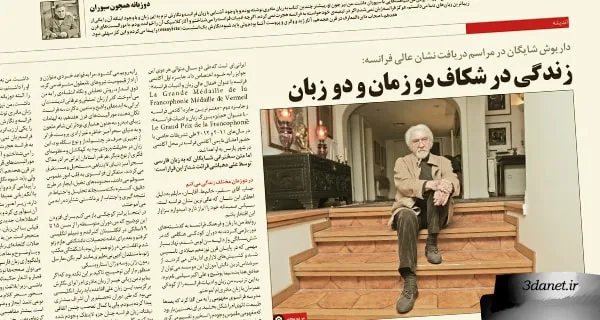
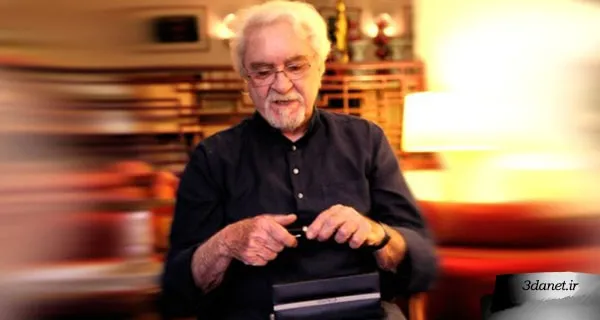
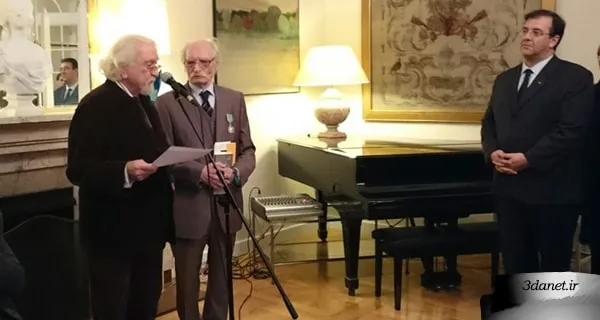
On the evening of Sunday, July 10, 2016, at the French Embassy, the highest state honour of France (Chevalier dans l’Ordre National de la Légion d’honneur) was awarded to Dr. Dariush Shayegan. The ceremony was held in the presence of the French Ambassador, Mr. Sénemaud, Cultural Counsellor Jamal Oubechou, a group of French Embassy staff, and Iranian and French cultural and academic figures. The Legion of Honour is the highest order of merit in France, graded into five levels comprising three ranks and two dignities, the lowest rank of which is Chevalier, the rank most recognized in Iran. Dr. Shayegan had received the Chevalier insignia in 2002, and this time received the highest state honour of France. Among other artists who have received the Legion of Honour are Mahmoud Dowlatabadi, Leila Hatami, Jalal Sattari, Reza Seyed-Hosseini, Mohammad-Reza Shajarian, Abbas Kiarostami, Pari Saberi, Mohammad-Ali Sepanlou, and others.
The name Dariush Shayegan is a familiar one to those in the fields of culture and thought. Hans Köchler considers his thought the epitome of a philosophy that lays the foundations for the ideals and aspirations of intercultural research and its application in an exemplary context. He sees Shayegan as embodying the implications of cultural diversity for understanding the world, standing ahead of his time and having established criteria for intercultural dialogue long before it became a fashionable title. As the speakers at this ceremony also acknowledged, Shayegan is among the rare Iranians whose works, more than being prominent in the Persian language, belong as an inseparable part of French-language culture and have found their Francophone audience. It is for these very activities that the French government decided to award this country's highest honour to this professor of philosophy from our country. On Sunday evening, the day Shayegan came from the farewell ceremony of his longtime friend Abbas Kiarostami to his eternal home.
Cultural and literary figures such as Dariush Mehrjui, Jaleh Amouzgar, Jahangir Naderzad, Dariush Talai, Mohammad Ehsaei, Nayer Tahoori, Maryam Asgari, Hamed Fouladvand, Ali Dehbashi, and a number of professors of French language and literature were present at the ceremony. At the beginning of the ceremony, the French Ambassador, in his speech, praised Dariush Shayegan's standing in French literature and culture and said: Shayegan has had the distinction of engaging in dialogue and cultural exchange with the greatest French thinkers over the past 50 years. Shayegan is perhaps one of the few Iranian writers to have found his primary audience in the French language. Then the highest state honour of France was awarded to Dariush Shayegan by the Ambassador, after which Dariush Shayegan took the podium and delivered his speech in French. After him, Ali Dehbashi read the Persian text of Shayegan's speech.
Then Hamed Fouladvand, in a speech, said: Shayegan is one of our rare thinkers whose works have gained international resonance. In his works, he has focused on free thought and the dialogue of cultures. Through his acquaintance with great thinkers such as Carl Gustav Jung, Henry Corbin, and other major Swiss and French thinkers, he has brought forth significant achievements. Shayegan has managed to preserve his Eastern roots and perpetuate Iran's cultural and historical heritage in the realm of thought.
It should be noted that previously, in 2002, the Officier de l’Ordre des Arts et des Lettres <
<
(Terre de mirages) in Paris. The third, the Global Dialogue Prize, known as <<Dialogue of Cultures and Civilizations>>, was awarded to him in 2010 at the Faculty of Humanities of Aarhus University in Denmark, accompanied by a lecture by Professor Hans Köhler. The fourth and fifth prizes were awarded by the Académie Française. This academy has two prizes in the field of French language and literature, and Dr. Dariush Shayegan is the first Iranian to have received both of these prizes in two consecutive years. The first prize from the Académie Française, entitled <<Grand Medal of French Language and Literature>>:
La Grande Médaille de la Francophonie Médaille de Vermeil and the second prize—the most prestigious prize of the Académie Française—entitled <<Grand Prize of French Language and Literature>>:
Le Grand Prix de la Francophonie
were awarded to him in 2011 and 2012 during special ceremonies attended by the permanent members of the Académie Française at the Academy's premises in Paris.
The text of Shayegan's speech, which was read in Persian by Ali Dehbashi, is as follows:
I live in two different times
Mr. Ambassador, ladies and gentlemen, I wish to express my sincere gratitude for the awarding of this medal, which is France's highest state honour. I hope I am worthy of this distinction.
My relationship with the French language and culture goes back to the distant past, to my childhood when, at the age of six, I entered the Lycée Saint-Louis, a very important institution founded at the end of the nineteenth century and run by the Lazarist priests. Among the most notable students of this institution were Sadegh Hedayat, Nima Yushij, and Ali-Akbar Siasi. In this way, I learned the French language and literature from childhood, simultaneously with my mother tongue.
The French school instilled in me a concept that later shaped my second nature. For the first time, a tangible concept seized and divided my being: <<the concept of history.>>
From childhood, I sensed that I lived in two different times: one, luminous in the past but ossified, adapting with difficulty to the modern world; the other, dynamic, changing, and deeply precarious. As much as the old masters nourished us with their eloquent speech and defined our mode of being, the Western masters, by contrast, spoke against one another, innovated, did not shy away from negating each other's ideas, and proposed audacious hypotheses.
Thus, I found myself at the intersection of two contradictory times, and the inevitable tensions and lightning contradictions originated from this, without my being able to separate these two times from one another. Now, as I review the past and reassess the tumultuous course of my life, I believe this was the first fissure that split my being in two.
The works I later wrote would undoubtedly never have come into being without this shattering experience. This fissure was, in a way, the driving force that overshadowed all my subsequent research, made me aware of my in-between situation, and made it possible, in the books I wrote in French—if we consider valid Gilles Deleuze's view that philosophy consists of <<creating concepts>>—then, without being aware of it, I was engaged in the work of philosophy in these writings.
Of course, at the start of my academic career I wrote in Persian, and if I had not voluntarily emigrated to France after the revolution—an emigration that lasted more than twelve years—I would never have become a French-language writer. The number of books I have written in French exceeds my Persian-language books. The French language opened the path of humanism to me, initiated me into the rules of a balanced reason free from the tutelage of irrational forces, and taught me a sense of measure, the analytical method, and the critical gaze. The passage from the allegorical and mystical language of Iranian thinkers to the clear and distinct ideas of Descartes, to the startling perspicacity of the seventeenth-century moralists, to the beautiful ambiguities of Diderot, to the lucid madness of Baudelaire, that accursed poet, and to the enchanted world of Proust's involuntary memory, was more than a mere change in perspective and outlook; this language was in truth an entry into a galaxy and an intellectual system of another kind. As much as Iranian masters dissolved and immersed me in the magical abyss of an infinite world, French thinkers drove me to the heart of tangible matters, teaching me the limits of imagination, concision in precise formulation, the nuanced scope of analysis, caution in drawing conclusions, and the avoidance of hasty judgment.
Here I open a small parenthesis to add the explanation that I spent my secondary school years from the age of 15 to 19 in England, obtained an English diploma, and then went to Geneva for my university studies. My stay in Geneva coincided with the flowering of the Geneva School, with incomparable literary critics such as Albert Béguin, Marcel Raymond, Jean Rousset, and Jean Starobinski.
My purpose in this explanation was to emphasize that if I were to choose a language other than my mother tongue for writing, that language should, by all accounts, have been English, over which I had gained greater mastery during my studies. Yet, to my great surprise, this did not happen; the French language had become such an inseparable part of my being that whenever the question of adopting a language other than Persian arose, the French language would immediately appear and impose itself entirely upon me. From this point began the issue of my bilingualism, which has both many advantages and inevitable disadvantages.
Perhaps it would not be amiss here to mention similar examples of bilingual writers: for Jorge Semprún, the Spanish-born French-language writer, "the French language is a new homeland, free from nationalist prejudices, a kind of taking root in universal values that transcends the bounds of a specific soil and opens toward the sky rather than toward the church steeple; a language that manifests the serenity of beauty at its highest." If Semprún wrote his first book not in Spanish but in French, he attributes the reason to a disinterested love, to sheer enchantment and pleasure. But for Emil Cioran, whom I knew personally and by whose being I was utterly captivated and fascinated by his cutting wit and euphoric pessimism, the matter was of a different kind. He had previously written several books in Romanian and now found the change of language painful. With this change, as he himself says, he traded in his past life all at once: "Even today I think I am writing in a language that is connected to nothing, has no roots, as if it were a hothouse language." In his notes on his own writing style, which some say cuts like a blade, Cioran writes: "If I spoke French like the natives of this land, I would never have thought of embellishment and would not have resorted to a coquettish style and the futile flirtations of language."
My situation differed from that of these two writers. I possessed neither the playful elegance of Cioran's style and his genius, nor the literary skill and talent of Semprun. Of course, my bilingualism bore some resemblance to Cioran's; like him, I too had previously written several books in my mother tongue, and despite my familiarity with the French language, having written my thesis in it, and despite considering it one of the most beautiful languages in the world, I would never have become a French-language writer had I not emigrated to France in a self-imposed exile. Although I knew French literature and had read its classical works, was familiar with the moralists of the seventeenth century, the Encyclopedists of the eighteenth century, the works of Gide, Valéry, and Proust, I still had to find the writing style of an essayist, and this was no easy task. The Persian language, while deeply poetic, possesses a flexible prose, for it has not yet crystallized; one can innovate within it and, due to the combinatory power of its words, coin new terms. Compared to this language, French has such a discipline that it seems almost petrified. I was accustomed to open spaces, not to the hothouse states of a language to which I had to submit and in which I had to express something with a clarity and obviousness that differed from the loose, wandering nature of Persian. In Persian, one can write pages brimming with the flavor of aphorisms and wise poetry without having said anything concrete, because the narrative eloquence dominating the text enchants the reader with the magic of words. French, conversely, is a kind of apprenticeship in concision, clarity, and precision in formulating ideas. Most of the concepts I have coined in French, I could hardly have formulated in my mother tongue, because these concepts had no cultural background whatsoever in Iran and, consequently, in the Persian language. On the other hand, to pass from one language to another, one must change one's mental tuning and adapt it to a new scale of sensibility and a new mode of writing.
After 30 years, I returned to writing in Persian, yet my emotional relationship with the French language still retains its force. I always wished to introduce Iranian readers to three French writers I have loved since my youth: Montaigne, Baudelaire, and Proust. The book on Baudelaire was published seven or eight months ago; if life permits, I may perhaps finish the other two as well. In any case, I have not shirked my duty as far as I was able; the future we leave in the hands of fate.
.
.
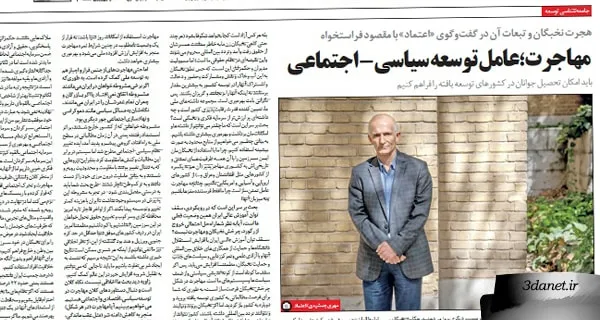
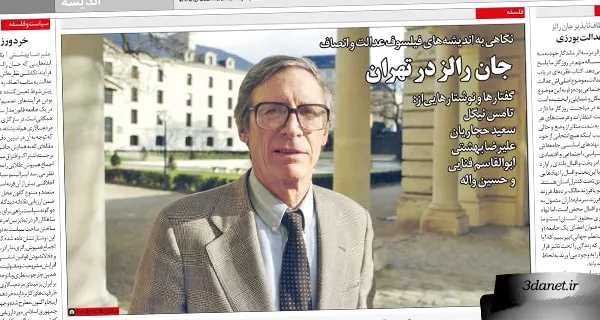
PDF file of the Etemad newspaper report on the awarding of France's highest state honour to Dariush Shayegan
.
.
On the evening of Sunday, July 10, 2016, at the French Embassy, France's highest state honour
Etemad Newspaper | Tuesday, July 12, 2016
.
.

Discussion0 comments
No comments yet; let yours be the first voice.