Sociology
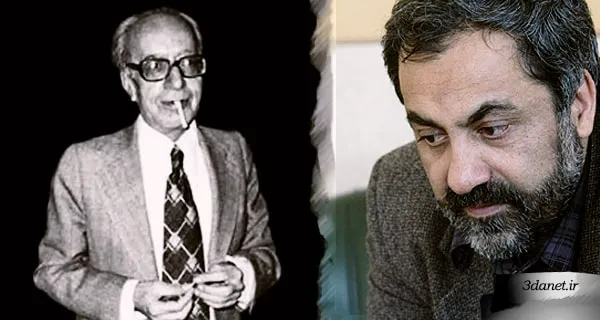
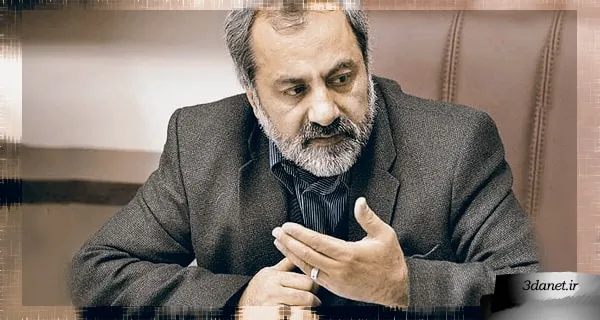
Emad Afroogh’s Analysis of the Recurrence of Violent Actions Two Years After Dey 96
Emad Afroogh considers a security-focused analysis of the protests insufficient and traces the roots of violence to the exclusion of the people from decision-making and to economic hardships. A sense of non-representation in the state is met with increasingly confrontational reactions.
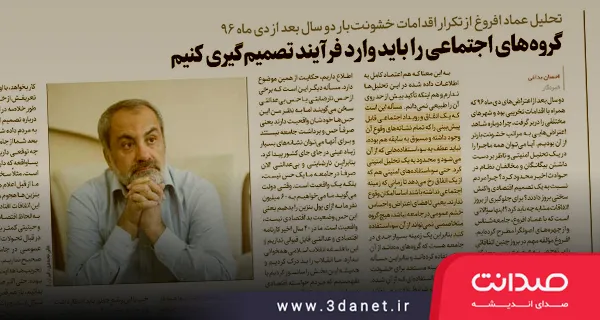
Emad Afroogh’s Analysis of the Recurrence of Violent Actions Two Years After Dey 96 We Must Bring Social Groups into the Decision-Making Process
Ehsan Badaghi (Reporter):
Two years after the Dey 96 protests, which were accompanied by destructive actions and engulfed various cities, why did we once again witness protests far more violent than before? Can the entire affair be confined to a security analysis focused on the involvement of foreigners and opponents of the regime in the recent events? Why did the people react so harshly to an economic decision? What must be done to prevent similar occurrences? These are the questions we posed to Emad Afroogh, a sociologist and a principlist figure. Afroogh considers the neglect of the public sphere and the people's standing to be a crucial factor in the emergence of such events, and he believes that the people feel they have no representative within the governing system. A noteworthy point in this sociologist's remarks is where he explains that the middle class, in the true sense of the term, has been destroyed or is in the process of being destroyed because it is not seen by the governing system.
In 2017, when the events of Dey occurred, the dominant official analysis and interpretation of those events was a security interpretation focused on the role-playing of foreign elements. For the events of recent days, we are again witnessing such analyses. Although this interpretation cannot be overlooked, in your opinion, can everything be confined to this security perspective?
No. A security perspective and analysis of a social incident and situation not only fails to lead us to the truth but also causes misguidance and is itself grounds for making wrong decisions. Let me say that I myself am even somewhat suspicious of these security analyses.
In what sense?
That is to say, I neither have complete trust in the information provided in these analyses, nor do I consider the excessive emphasis on them to be natural. The issue is that a predictable social event, for which all the signs of its occurrence existed and which had precedents, should not be reduced to the abuses made of it and confined to a security analysis. Even the security-related abuses that occur from an event are fundamentally impossible to realize as long as they lack a social context. That is, without an atmosphere of protest and a feeling of public anger in society, no hostile group can exploit it. Therefore, there is a very serious context in society that opposition groups have exploited, and thus our concern must be that context susceptible to violence, not the abuse made of it. Rioters cannot riot under normal conditions. The security analysis must be seen as a secondary issue, itself a consequence of conditions, not as a primary, original phenomenon and the cause of the matter. We witnessed this same event with many similarities in the year 96 [2017-2018]. At that time, many observers, citing data, came forward and said that this was a socio-economic phenomenon, not a security one. But the mistake of the establishment was that it viewed the entire issue as a security matter and then maneuvered on the people's gatherings against that event and assumed the issue was resolved. Whereas not only did the core issue remain, but statistics and the observable situation show that since then, social fissures and violence-prone substrates have not only persisted but are also on the rise. We are now facing a growing dissatisfaction in society regarding both social and economic issues. The statistics from the establishment's own surveys, of which we have some knowledge, also attest to this matter. Another issue is that some speak of a sense of dissatisfaction or a sense of injustice, but in my opinion, these feelings themselves are realities; that is, they are not merely society's perception or feeling, and one can find very many objective signs for them throughout the country. Therefore, dissatisfaction and injustice are now not just a feeling in our society, but a reality. When the government says it wants to give the equivalent of gasoline money to 60 million people, it means this is not a feeling of a bad economic situation; it is a reality. Over the past 40 years, we do not have an acceptable economic and justice record, and this is inconsistent with the philosophy of the Islamic Revolution. We misunderstood the revolution and have always censored this part or failed to understand that the people also have economic demands, and without their fulfillment, they exit the game and behave differently.
What does it mean that they exit the game? In fact, sociologically speaking, what state do they assume?
Precisely what we are seeing now. That is, first they become passive in their alignment with the system, and then confrontational approaches in society begin to increase. It is true that we consider the system and the revolution sacred in terms of its religious values, but this does not mean that whatever we do to society within this structure, nothing will happen. Society has its own system and rules, and it can withstand pressure, injustice, and an unfavorable situation only up to a point, after which it loses its tolerance. The sacredness of the system does not mean that the rules of society's reaction to inefficiencies differ. From the beginning of the revolution, we did not have a clear, formulated approach to economics and social justice. Step by step, our income gap in society has increased, and general purchasing power has decreased. All of this has placed a burden on society's shoulders over these 40 years, and it is clear that when such a decision is made without attention to the core of society, its situation, and its opinion, and society is not given an opportunity for self-expression, society's reaction will be negative and protest-oriented. That is, two things have happened here: the people have been sidelined from decision-making, and they have not had the possibility to express their opinions and criticisms.
Well, this roughly applies to all previous situations as well and is not specific to the recent gasoline decision. Do you mean that we were faced with an accumulation of problems in this area?
That is precisely the issue. We are constantly excluding various social groups from the decision-making and participation process. In the decisions that are made, the process of societal persuasion and public participation has no place whatsoever. Afterwards, there is also no possibility for expressing opinions, protests, criticisms, and the viewpoints of different segments of society. Well, under these circumstances, how can one expect society not to become angry and not to react sharply? These things had been piling up on society's shoulders, and the recent decision also carried a very heavy psychological burden, and at first glance, for every individual in society, it meant increased economic pressure without an increase in purchasing power. In my view, the recent decision on gasoline itself had enough major and glaring errors to provoke protests on its own. If we look at it fundamentally, this protest was the people's right; why? Because political power must be representative of social power, whereas society looks on and sees that not only is political power not its representative and spokesperson, but it is also interpreting civil institutions and the social sphere within a political and even security framework. That is, society thinks that from the perspective of political power, it is merely a malleable dough in the hands of power, and this power expects to do whatever it wants with it. While society's definition of itself is completely different. In short, within this framework, and especially regarding the recent decision, people were given neither the opportunity to participate nor the opportunity to protest. Then, what do you expect from a society that has no opportunity? The post-event analyses we are seeing now are also completely unacceptable. For example, the government spokesperson says that if we had announced it beforehand, people would have stormed the gas stations. Well, now that these events have occurred, was the loss and damage less in economic, social, political, and reputational terms? This means that we lack the ability to correctly calculate in the face of social developments and public reactions in society. Now they also say that the destruction was orchestrated and the work of counter-revolutionaries. Even if we consider this one hundred percent true, political power is still questioned here. Why did you not predict it? If you had predictions and it turned out this way, why did you make an error? This justification that it was the work of counter-revolutionaries is itself worse; well, what then becomes of our security authority? How did we allow parts of our country to suffer such horrific damage? Whichever angle we view and interpret this event from, we ultimately arrive at the mismanagement of political power in the country. All factions share a role in this. Whether we have a security interpretation of it or a social one. These events are a point where political power and the governing system, and most importantly the government, must engage in self-criticism and accept that whether these events were due to the interference of counter-revolutionaries, social mismanagement, or economic issues, the responsibility lies with the ruling power. These events have precedents, and the question that arises is: what wisdom does our decision-making system possess that it does not learn from these events?
As a sociologist, do you believe that the centrality of the protests should be attributed to the middle class or the marginalized? Or, from a social perspective, considering the issue of the right to participation and the right to protest, is the middle class itself considered marginalized?
It is said that in its final years, the Pahlavi regime made decisions that even the middle class, its supporting class, could no longer be persuaded by and became opposed to. Now, let me offer an economic analysis: our middle class is not the middle class of yesterday; it is falling toward the margins because its economic power is disintegrating. If the lower classes complain about their current situation, the middle class's protest, from an economic perspective, is directed at a future it does not have. But from a social and political perspective, we no longer have a middle class either. We have a ruling class that makes decisions and a vast underclass that must obey. That is, I want to say that even if we have a middle class economically, if this middle class is not given participation, if the elite is not taken into account, and if the expert has no effect on decisions, which middle class are we talking about? Even if our middle class had not collapsed economically—which it has—politically and socially, we no longer have a middle class. I even think the situation is more dire than this. Never mind ordinary people; right now, even a member of parliament, in terms of influence over this recent decision, is part of the underclass. When their words and opinions have no effect and they are forced to comply, we must consider them underclass. When you disregard the country's elite capacity, this is what happens. My point is not a critique of the decision about gasoline, whether the figure was correct or not. My point is the neglect of social domains in decision-making. My discussion on this matter involves several things: first, that these events were predictable; second, that this decision itself is problematic in terms of its content; and third, why did we not pursue a path of persuasion?
We have seen this type of incident repeated over the past two years. How do you see society's condition in terms of its susceptibility to such incidents?
We are becoming more susceptible to the occurrence of such violent incidents because we have not addressed the root of the matter. Just as these recent incidents were more violent than those in Dey 96, if we do not think about it, future incidents will be even more violent than today's. The reason is that we do not value the people and do not consider them as those we serve. Even liberals recognize the people's right to revolt because they believe governments are representatives of the people. We do not engage the public sphere and constantly deny its demands. We have no choice but to give the people the right to participate and, of course, to pay attention to their participation. This second part is very important. It is not that we say, for example, people have the right to protest, criticize, and express opinions, but ultimately we do as we please. We must both consider the people's right to participate and pay attention to their participation in our decision-making. That is, participation must be active and effective. We are under sanctions where pressure has increased, and we cannot tell the people to endure the pressure of sanctions, the pressure of our decisions, and the pressure of having their participation ignored. The truth of the matter is that I believe we have observed neither the ABCs of democracy nor the ABCs of religious governance. Is religion opposed to public participation, the right to livelihood, social justice, and a dignified life? Just as I warned in the year 96 that the events of that time had a root that needed to be addressed, today I also warn that this root has deepened, and ignoring it and relying on security analyses will not prevent the occurrence of more bitter events. Today, I am deeply worried about the future and believe that various parts of the government must quickly, in light of these events, conduct a critical review of their performance and their mode of operation toward society and accept certain undeniable realities that we have ignored for years.
.
.
Emad Afroogh's Analysis of the Recurrence of Violent Actions Two Years After Dey 96
We must bring social groups into the decision-making process
Source: Iran Newspaper / 23 Aban 1398
.
.
Discussion4 comments
تبلیغ الحاد، تلاش برای القاء باورهای جزمی دین ستیز و سانسور مواضع مستدل در صدا نت فریبکاری غیر اخلاقی است. ضعف شما در سانسور کامنت های مخالف با افراد مورد تکیه شما در تخریب متعصبانه برخی سنن فکری مغضوب شما بهتر است شما را به فکر وادارد.
اقای عماد افروغ بگویید چرانظام وانقلاب از نظر شما مقدس است ؟ایا این نظام وانقلاب توانست ارزشهای دینی را در جامعه نهادینه کند یا اینکه خود موجب دین گریزی ودین ستیزی مردم شد ؟ایا اصولا دین توان اداره جامعه رادارد ؟ برنامه ای برای اداره جامعه دارد ؟وقتیکه بجای رفاه عمومی ارمانهای دینی را بعنوان هدف جایگزین میکنید نتیجه اش همین میشود که مشاهده میکنید شما توان دفاع از تفکر خود را ندارید نه در میدان بحث ونظر ونه درمیدان عمل توان دفاع از تفکر خود را ندارید -----------
سلام و درود متاسفانه ادامه کامنت شما و کامنت بعدی شما را به خاطر قوانین کشور نمیتونیم منتشر کنیم.
سلام و احترام اتفاقا اغلب این تصمیم گیران توسط طبقه متوسط گرفته شده است و این مجلس و این دولت را طبقه متوسط با مشارکت و حرص و ولع انتخابذ کردند. چطور همین طبقه متوسط موقع انتخابات و موقع تصویب برجام چقدر شادی می کردند و می گفتند یا مرگ یا روحانی ..می گفتند یا مرگ یا جهانگیری..چرا همه چیز را گردن حاکمیت می اندازید.. جناب افروغ عزیز حضرتعالی و دوستانی که به این دولت و این مجلس رای دادید مقصرید.. مگر مجلس نماینده خود اقای علی لاریجانی را در این تصمیم مشارکت نداد.از مجلس چندین نفر در تتصمیمات بنزینی شرکت داشته اند و مشخص است از قبل در جریان بوده اند و حالا برای فرافکنی می خواهند نظام اسلامی و رهبری را مقصر جلوه دهند.. رهبری معظم هم اتفاقا به نظر و رای کارشناسان دولت و مجلسی که منتخب مردم هستند احترام گذاشتند و تایید کردند . فرض بفرمایید رهبری با تصمیمات بنزینی مخالفت می کرد ایا اقای روحانی استعفا نمی کرد؟ ایا احتمال شورش بزرگتر وجود نمی داشت؟ چرا همه جوانب را نمی بینید.. مگر دولت و حامیان برجام و طبقه متوسط نمی گفتند با برجام همه تحریمها برداشته می شود ولی نشد و در یک سال دوره اوباما هم برداشته نشد..پس فشار تحریمی و فشار اقتصادی به تصمیمات اشتباه طبقه متوسط هم بر می گردد.. چرا فکر می کنید طبقه متوسط تصمیم اشتباهی نگرفته است؟ ایا مردم درست و عقلانی و الهی انتخاب کردند و رای دادند؟ ایا هیچ مقصر نیستند..اینطور که شما می فرمایید تمام شورشیانی که علیه امام حسین و ام حسن ع شورش کردند برحق بودند چون مشکلاتشان در طی چندین سال انباشت شده بود ولی نمی گویید این مردم شورشی که در زمان امامان ع بودند چقدر از دستورات امامان تبعیت کردند؟ چقدر از حق حمایت کردند؟چقدر دستورات امامان را اجرا کردند..تقریبا هیچ تبعیت نکردند وفقط یا سکوت کردند یا طرف باطل و دنیا را گرفتند امروز هم همینطور است ملاک رای دادن مردم الهی نیست وانگیزه های مالی و قومی و غیر الهی در رایشان دخالت دارد. خیلی از افرادی که شورش کردند از طبقات ثروتمند و مرفه هستند و ربطی به فقر و بی عدالتی ندارد..باید نگاه تفکیکی داشت..بنده هم به تصمیمات بنزینی معترض هستم و راضی نیستم اما در ریشه یابی مشکلات و تحلیل این فشاره های اقتصادی علت یا علل اصلی را می بینم نه معلول را.. نظام اسلامی افتخارش این است که نوکر مردم و در خدمت مردم است . دولت و مجلس اگر ناکارامد هستند ربطی به نظام اسلامی ندارد کلیدش در دست خود مردم است.ارادت