Literature
From Zahhak’s Harem to Fereydun’s Iwan
This essay examines the transformation of women’s position through the story of Arnawaz and Shahrnaz in the Shahnameh, tracing their journey from captivity in Zahhak’s harem to their presence in Fereydun’s iwan and ultimately their emergence as narrators. Drawing on Bahram Beyzaie’s interpretation, the text explores the relationship between women, power, language, and narrative in Iran’s storytelling tradition.
Iraj Rezaei
AuthorIf we wish to follow the women of the Shahnameh in the very order in which the wise and inspired sage of Iran brought them onto the stage of his magnificent narrative, the first women we encounter are Arnawaz and Shahrnaz: the two sisters of Jamshid, who are abducted from Jamshid’s palace by Zahhak’s henchmen and taken to Zahhak’s harem. At first glance, the presence of these two women at the beginning of the Shahnameh may not seem particularly striking; yet if we pause for a moment, we see that Ferdowsi has placed their story at one of the most significant turning points of his narrative: in an age when Zahhak rules over the world and everything is being turned upside down to the benefit of demons and the mad:
The deeds of the wise have vanished from sight
The desires of demons have spread everywhere
Art has been disgraced, while sorcery is honored
Truth, once hidden, is openly harmed
The hands of demons have been stretched toward evil
A word of goodness is spoken only in secret
It is in such a world that the two pure women, trembling like willow branches, are taken from their home and delivered to Zahhak. Zahhak, who knows nothing but wrongdoing, naturally seeks to make everyone who associates with him resemble himself. The misery and misfortune of the two sisters deepen when they are forced by Zahhak’s corrupt instruction to practice sorcery and follow the path of falsehood, distortion, and wickedness. A power that is corrupt and vile seeks to turn everything into its own image.
Yet wickedness is not inherent in the nature or essence of these two women; it is the product of the upbringing and, indeed, the environment that Zahhak has created and rules over. The world of tyrants is a world in which evil does not merely govern, but also strives to reshape human beings and everything around them in its own likeness.
Years pass in hardship. Zahhak remains on the throne until, in the final forty years of his reign, he has a terrifying dream: a dream of Fereydun’s uprising and his own downfall. Terrified, he awakens with a cry so dreadful that the hundred pillars of his palace tremble. The beautiful women rise from their places at the sound of the king’s roar. Here, one of the most beautiful scenes of the Shahnameh unfolds through Arnawaz’s question and Zahhak’s reply:
Thus Arnawaz spoke to Zahhak:
“O king, what has happened? Tell us your secret,
You who slept peacefully within your own house,
Why have you become so fearful for your life?”
“The earth of the seven realms is under your command,
Beasts, demons, and men stand guard for you.”
This question and exchange, I believe, offers one of the clearest images in the Shahnameh of the psychology of power. Zahhak rules over the seven realms and has placed beasts, demons, and humans as his guardians; yet, astonishingly, he finds no peace in his own home and fears for his life. Power built upon oppression brings no security even to the one who possesses it. The bitter irony of the matter is this: the person who has plunged the world into fear ultimately lives himself in a world filled with fear. The tyrant, sooner or later, becomes trapped in the prison he has built for others.
At this point in the narrative, Arnawaz’s role becomes more prominent. Her voice is heard this time. It is as though, as the story progresses, she moves from being an object to becoming a subject, from complete submission and passivity toward agency. Arnawaz, as a resourceful woman, thinks and offers counsel. She suggests that Zahhak gather the nobles and priests to learn the meaning of his dream. She tells him: “Investigate and seek the truth.” Perhaps there is a hidden suggestion here that the truth of this nightmare should not be sought outside himself, but rather in his own actions and conduct.
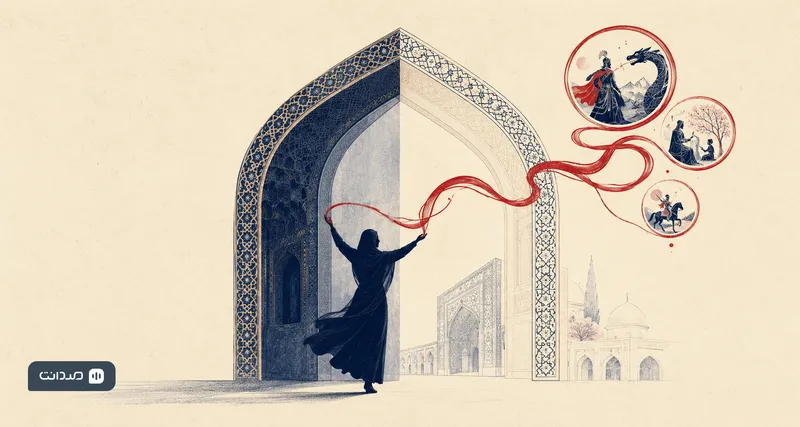
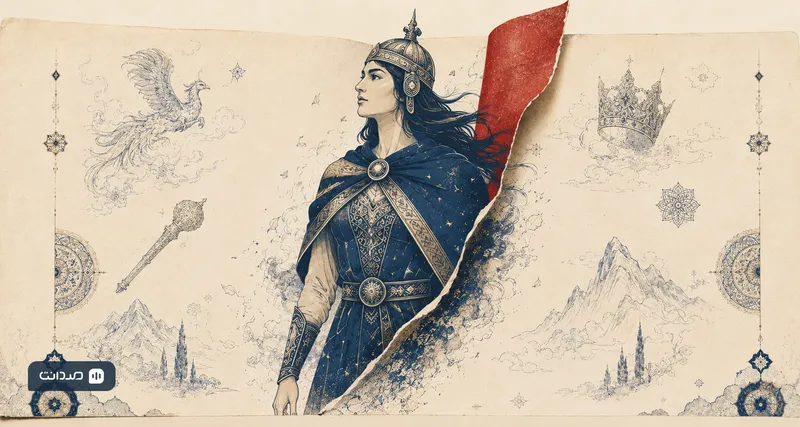
In the final part of the story, we see the sisters of Jamshid not in the harem this time, but in the iwan, beside Fereydun. This transition, in my view, can be understood as a meaningful indication of the transformation of women’s position in the Shahnameh. We had previously seen Arnawaz and Shahrnaz in Zahhak’s harem; now we see them standing beside Fereydun in the iwan. In the harem, woman occupied a confined and hidden space of power; she was like an object of desire and lust whose presence served the pleasure of its possessor. In the iwan, however, woman appears before the eyes of all: with a presence that is honored, constructive, joyful, and dignified.
This transition is not merely a change of place; it is a change of position. In the world of Fereydun the Fortunate, woman regains her dignity and respect. She has emerged from the narrow, enclosed space of the harem and now sits beside her companion in the iwan, witnessing the world alongside him.
What is remarkable is that when women move from the harem to the iwan, they also regain their language and their narrative. They become the narrators of their own suffering and joy; they speak of Zahhak, confront their past, and claim their future. Thus, Ferdowsi, without theorizing or delivering a speech on women’s freedom, takes a significant step in portraying women’s agency and describing human dignity through this movement from the harem to the iwan—a short distance in palace architecture.
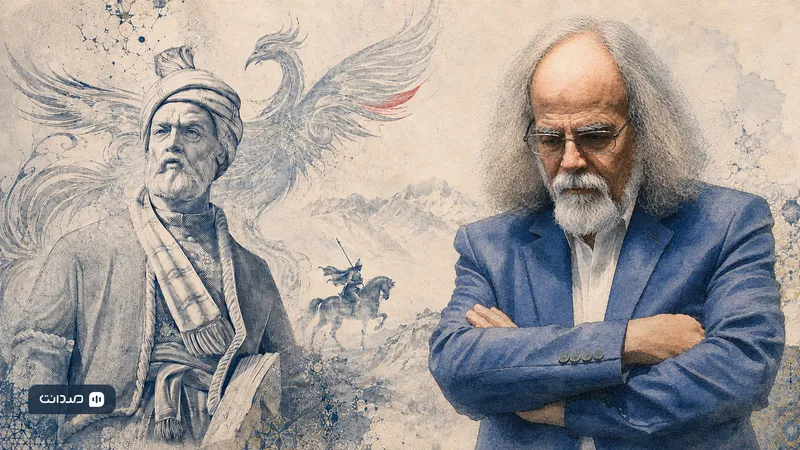
Now perhaps we can continue this path one step further with the help of Bahram Beyzaie’s creative reading; a reading that sees Arnawaz and Shahrnaz within a much longer historical trajectory of Ferdowsi’s narrative and seeks connections between these two women and their older and later counterparts, from Arnak and Sangahuk in the Avestan tradition to Scheherazade and Din-Azad in One Thousand and One Nights.
This theory, of course, should not be taken as a certain and indisputable historical fact. It is clear that Beyzaie is reconstructing and drawing parallels here, bringing before us, through scattered fragments of Iran’s narrative tradition, a lost story—one that he believes was called “Hazār Afsān” and whose fragments continued to live on in later tales. The importance of this reading for us lies less in proving or disproving this historical connection than in the question it places before us: if we continue the story of Arnawaz and Shahrnaz, which women stand at the end of this path? Beyzaie’s answer, remarkably, is Scheherazade.
In the Shahnameh, the two sisters of Jamshid are victims of Zahhak’s power. In One Thousand and One Nights, the king too, through his tyrannical power, sends women one after another to their deaths. But here woman is no longer merely a victim of power. Scheherazade enters the scene, and her instrument of resistance is neither sword nor army, but narrative. She tells stories; and in her hands, the story is not merely a story. Each night that the narrative continues, death is postponed by one more night and life gains another day. Scheherazade buys time with language, and with time, the possibility of change.
If we accept Beyzaie’s reading, we encounter an important transformation in the history of the image of woman. In this view, woman changes from the subject of narration into its owner. In the Shahnameh, after their liberation, Arnawaz and Shahrnaz recount to Fereydun what has happened to them. They speak of their suffering and captivity and reveal Zahhak’s deeds. This brief moment deserves attention: they are no longer merely those about whom others speak; they themselves speak. Beyzaie seems to take hold of this opening and carry it to its furthest point.
If a woman can speak of her suffering, if she can narrate her own experience, if she can begin and continue the story herself, then she is no longer merely the object of power and others’ narratives; she becomes one of the makers of the meaning of the world. From this perspective, women’s agency does not necessarily begin with taking up a sword; sometimes it begins at the moment when a woman finds her own voice. Fereydun goes to Zahhak with his mace; Scheherazade goes to the king with her tales. One breaks power in the battlefield, while the other, in the solitude of night, delays the mechanism of death through the power of language and imagination.
Accordingly, perhaps this path can be completed in the following way: from the harem to the iwan; from the iwan to language; and from language to narrative. The harem was the place where woman was trapped by power; the iwan was the place where woman, after liberation, appeared beside a newly established power; but narrative is the place where woman no longer sits beside power, but faces it and becomes the possessor of voice and meaning.
Perhaps this is why Beyzaie’s theory, even if not all its links can be historically proven with certainty, is so compelling and fruitful for reading the history of Iranian tales. He urges us to listen also to the silences of narrative; to what women have said, and to what they may have said but which has not reached us. In this perspective, the story is no longer mere entertainment. Sometimes storytelling is a way of preserving life; a way of delaying death; and a way of reclaiming the right of narration from power. And perhaps behind these ancient tales lies a simple and enduring truth: when woman becomes a narrator, she is no longer merely a part of the story; she herself becomes part of the force that changes the story—and perhaps changes the world.
Iraj Rezaei, September 1405

Discussion0 comments
No comments yet; let yours be the first voice.