Art
Lecture by Bahram Beyzai: “Myths in the Works of Bahram Beyzai”
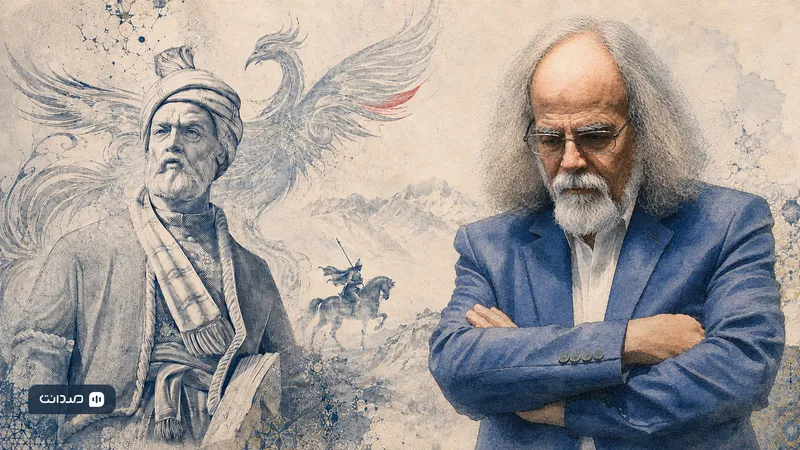
In a lecture at UCLA, Bahram Beyzai described myth in his work not as a deliberate device but as an unconscious emanation, and, critiquing hero-worship in his play Arash, stressed the persistence of myth in contemporary life.
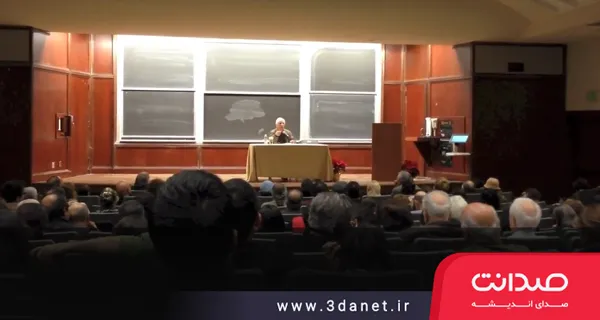
Bahram Beyzai is one of the greatest writers of plays and screenplays and one of the major directors of Iranian cinema, who, in addition to an Iranian perspective, possesses profound awareness and knowledge in the fields of literature, myth, history, culture, and art of Iran.
Bahram Beyzai has been teaching at Stanford University for over two years and recently received the university's “Heritage of Culture” award in recognition of a lifetime of striving for the elevation of Iranian culture and art. On Sunday, December 2, 2012, Bahram Beyzai, through the efforts of the Farhang Foundation and in collaboration with UCLA, delivered a lecture entitled “Myths in the Works of Bahram Beyzai” at DODD HALL. The event was held to the welcome of students and enthusiasts of theater and cinema in the city of Los Angeles.
.
Beyzai and Myth
Beyzai has previously said of myths in his works: “I do not imagine that I have deliberately addressed myths and rituals. These have seeped out of me; like a way of expressing perhaps expansive themes concisely, that is, humanity's concise expression of the nature of the world and its meaning.”
Beyzai considers myths a very important part of human life, whose influence can still be found in life today. All the thoughts and attitudes of modern humans are, in a way, a look at ancient beliefs and myths.
Beyzai knows Iranian myths, sees their traces and manifestations in the life and culture of the people, and displays them within the framework of film and theater.
“Beyzai's films are, in a sense, a visual translation of mythological texts. That is, instead of literature and even ancient languages, Beyzai — consciously or unconsciously — has found a new form for engaging with Iranian myths.”
In Beyzai's view, the age of myths never passes, and throughout history, humans have reshaped myths into newer forms suited to the evolution of their needs. And this perspective requires a tool like cinema and theater to show their manifestations in the life of modern humans. And thus it is that myths emerge in Beyzai's most social writings. Because “myth is a part of culture.”
Beyzai's interest in the presence of myths in his works is very clear; to the extent that in several of his works, he has essentially narrated myths. He even considers woman a mythological figure who appears in every era — sometimes as an unadorned woman and sometimes as a mother guarding children and family.
Beyzai's women are all unadorned faces of Anahita, whether “Nai” — in Bashu, the Little Stranger — who is the mother earth, or Shahrnaz — in The Night of a Thousand and One — who is an embodiment of Anahid. Beyzai knows myth and always expresses his thoughts inspired by mythological stories and figures. Some of these plays are essentially mythological narratives and stories, which this writer has transformed to advance his own goals and presents a new narrative of them, so as to create his impact on the readers of his works within that framework.
“One of Beyzai's techniques is to strip away the laudatory halos around people and show them to us very realistically; for example, in 'Arash' (which is, in fact, a response to Siavash Kasrai's Arash), the hero becomes a hero under the influence of the situation. Kasrai's sentimental hero-worship led him, under the influence of communist ideology in a silent, dead, and passive society, to make a hero out of Arash, but Beyzai says that small people can advance in specific circumstances.
The play Arash is a story whose hero the author cultivates as he wishes. Arash the stable-hand, who does not know how to shoot an arrow well (is not good at archery), yet under special circumstances becomes hope for all Iranians, and with the arrow he shoots, delivers many from the bonds of the Turanians and liberates the borders. This is one side of the narrative. The other side is Beyzai's protest—in the form of a character named Kashvad—against this point: hero-worship is not in the long-term interest of the people and the country.
A people who have grown accustomed to hero-worship and, in times of hardship, sit waiting for a hero to emerge from some corner and deliver them from that suffering. Beyzai opposes living passively and waiting in expectation. Opposes placing responsibility on another's shoulders. And it is interesting that Kashvad himself does not shoot the arrow; he tries to prevent Arash from doing so as well. Because he does not consider entrusting the fate of a country to an arrow to be proper or right. He believes that the maximum range of an arrow's flight is one league, and one league is a trifling thing compared to what part of the land of Iran is in the hands of the enemy: "Kashvad: With this arrow, nothing will change." (from the play Arash)
And: "The enemy has overrun a hundred thousand, you are on a path to liberate one, what a futile task!..." (from the play Arash)
Kashvad considers true liberation to be freedom from the bonds of servitude and tyranny. Not the liberation of one league of soil that is itself in the grip of its own domestic oppressors, who are not much different from the foreigners. He warns Arash of the outcome of this deed: "Beware lest he make himself a laughingstock. For he does not know how to shoot an arrow well" (from the play Arash)
Beyzai has chosen Arash from among the masses of the people. An oppressed and suffering people. Individuals who, in specific situations, can flourish and rise to the stature of a celestial and ideal hero. Yes, he wants to say that anyone else, like Arash, if placed in this situation, could also, in a difficult passage, become a hope for cleaving through impasses: "Hope that in every difficult passage, a man will come... O Arash! Impasses lie ahead; if you deliver them, you will become hope." (from the play Arash)
Text of Bahram Beyzai's Lecture at UCLA
Beyzai began his remarks thus: "I think the precise title of this session should be: 'Myth or Myths in the Works of Bahram Beyzai,' and well, naturally, with this definition, I do not want to first say what the meaning of myth is and where it came from and whether it is necessary or not, because presumably you all know everything and it would be redundant explanation, so I will go straight to the heart of the matter and speak about my own acquaintance with myth."
Beyzai noted that until he saw the book Mythology of Greece and Rome translated by Mr. Shojaeddin Shafa, he had no acquaintance whatsoever with myth, and continued: "Essentially, in the Iranian intellectual tradition, and especially in the progressive and leftist intellectual tradition, myth is considered something idle and nonsensical, that is, futile fables or things of that sort."
Beyzai continues: "When I was going to school, the first work I saw that was connected to Iranian mythology was the Arash of Siavash Kasrai, peace be upon him, because until that time, mythology did not exist in the leftist tradition."
Beyzai, in the continuation of his remarks, considers his acquaintance with myth to be older than this and believes that upon revisiting this acquaintance, he reached this conclusion: "The truth is that my acquaintance with myth began with a children's story that my grandmother told me, a story called 'Sultan Mar' (King Snake), based on which I later wrote a play and dedicated it to my grandmother."
Beyzai, continuing his lecture, recounted the story of Sultan Mar for the audience so that he could subsequently introduce his own signs and metaphors of myth within this story to the audience: "When I heard this story, I was enchanted by this strange world and captivated by the characters of this story, namely Sultan Mar, who had two personalities, and the strange, wondrous journeys of Khanom Negar."
Beyzai continued: “After reading the Book of Healing, I spent a year behind the University of Tehran entrance exam and in that time, I read Ferdowsi’s Shahnameh in a scattered way and realized things beyond whether we have myths in our culture or not. I became aware of history’s astonishing testimony to what we were, and the historical mistakes and the document of our own identity, and the mistakes we repeatedly make throughout history. I realized there is an unknown thing that was once compiled in its final form in the Shahnameh, and later I understood what the struggle over the Shahnameh throughout history was about—because an identity was supposed to replace this identity, just as when I was researching theater in Iran, I noticed a great dispute between the Shahnameh reciters of the fourth, fifth, and sixth centuries and those who recited the Iskandarnameh, Hamzehnameh, or Abu Muslimnameh instead of the Shahnameh. In these fifth and sixth centuries, two groups emerge: first, the group of Fazael reciters and the group of Manaqeb reciters. Some recited national epics, and in contrast, some recited religious epics, and in fact, a cultural dispute had occurred.”
Without wanting to or knowing it, I addressed myths in my first writings. In school, in the final years of high school, I wrote a play called Cain, fragments of which I still have, and it is about the myth of Cain, and the following year I wrote another play, of which I have nothing left. These two plays were my early experiments, but my first serious works were three plays: “Azhi Dahak,” a rereading of the story of Zahhak, and “Arash,” a rereading of the story of Arash, and “The Book of Bondar Bidakhsh,” the third of which was not finished at that stage, and I looked at it thirty years later and completed it. So my first serious works are about myths, but they are not the myths themselves. We know nothing about Arash except that he released an arrow to illuminate the border between Iran and Turan, and this is written in Kasravi’s poem and in the introduction by Beh’azin to Kasravi’s Arash—meaning that when necessary, a nation creates its own hero. In both of these writings, the hero is always born a hero from the beginning. At that time, when I read this, I thought about how someone could be born a hero. This is possible in the Shahnameh.”
Continuing his lecture, Beyzai recounted the story of “Azhi Dahak” for the audience and introduced and explained the myths within this story: “When I wrote Azhi Dahak, I was in fact rereading the myths and inverting them.”
Beyzai returns again to the story of the Serpent King to explain the symbols and signs of this story for his audience: “In the story of the Serpent King, the infertility of the king and the vizier signifies a cessation of fertility, which is one of the important themes in Iranian mythology. The greatest catastrophe for a society is non-production. Something I suspect we are currently on a downward slope towards. The apple tree in the Serpent King is linked to the theme of fertility. The demons guarding the apple trees are also a symbol of myth. Demons were those who halted and imprisoned fertility, and this existed in ancient Iranian culture. When water freezes, it means it is imprisoned, and when water warms with the light of Mehr, the water is freed, and heroes always free the water.
Also, in ancient agricultural culture, the cessation of human fertility is negated, and the one who frees fertility becomes a hero, and all grandmothers’ tales are, in truth, about this very matter. In all the stories where a dragon seizes a spring and a champion comes and kills the dragon, and the maidens the dragon has captured and the champion frees them, it is a symbol of fertility, and the sign of this theme is the marriages that happen at the end of the story.”
Key Points of Beyzai’s Lecture Titled Myths in the Works of Bahram Beyzai
In seemingly childish tales, we are dealing with a world of myth where every moment is laden with meaning. The emergence of myths in my works was initially spontaneous, not deliberate, except in instances where there has been an intellectual re-reading and reflection upon myth, such as in these three plays: Sultan Mar, Azhdahak, and Karname-ye Bondar-e Bidakhsh. The play Karname-ye Bondar-e Bidakhsh is about a myth that we do not have at all, and which I wrote; it is about the person who crafted the world-revealing cup. In all our myths, heroes are always born heroes. Throughout history, the hero has always been unwillingly placed in a heroic situation, and this is due to our excessive fondness for hero-making. Heroes are not necessarily special people; they are placed unwillingly in the position of a hero, without wanting or knowing it, like Arash. Demons are those who abduct, raid, and steal cattle. Look at the myth of Fereydun. Women and cattle in myths are symbols of fertility, like pregnant or marriageable women. The Nowruz festival is attributed to Jamshid because Nowruz is a sign of fertility, just as the story of Jamshid leads to fertility. The serpent in myth is both an allegory for medicine and a symbol of lethality. The serpent has both a good meaning and a bad meaning. The serpent associated with treasure and the serpent that is deadly. In the Torah, the serpent's punishment is to crawl on the ground forever because it made Eve aware.
The session continued with questions from the audience, and at the end of the talk, at the audience's request, Beyzai examined myth in his cinematic works, and for this purpose, he elucidated the symbols and signs of the film Sagkoshi for his audience. A number of cinema artists from before and after the revolution, such as Parviz Sayyad, Asghar Bichareh, and others, were also present at this session.
.
.
Lecture by Bahram Beyzai: “Myths in the Works of Bahram Beyzai”
Watch the film on Aparat | Watch the film on YouTube | Download the lecture audio
.
.
Lecture by Bahram Beyzai: Myths in the Works of Bahram Beyzai
At UCLA | Sunday, December 2, 2012
.
.

Discussion2 comments
سلام. فایل های تصویری پاک شده. لطفا دوباره آپلود کنید اگر مقدوره خیلی ممنون
سلام تمام لینکها مجددا آپلود شدند