Literature
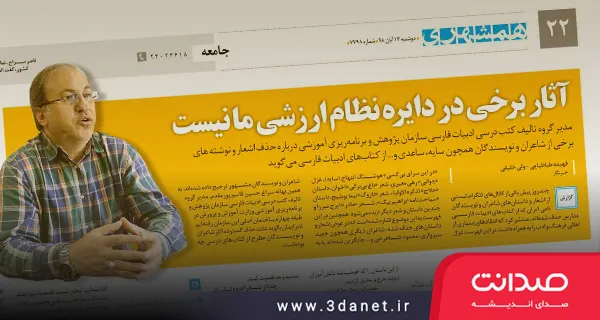
Head of Persian Literature Textbook Authorship Group: Some Authors’ Works Fall Outside Our Value System
The director of Persian literature textbooks says the changes are based on upstream policy documents; the works of some poets 'do not fall within our value system'; the new books have been authored with a focus on resistance literature and the Islamic Revolution.
A few days ago, one of the Telegram channels published a list of poems and stories by renowned Iranian poets and writers that have been removed from Persian literature textbooks, drawing widespread criticism from cultural and literary figures. The list includes Houshang Ebtehaj’s (Sayeh) ghazal “In This House of Loneliness,” Rahi Mo’ayyeri’s ghazal “Youth,” Akhavan’s poem “The Leafless Garden,” the story of “Hallaj” from Tazkirat al-Awliya, Nima Yushij’s poem “The Darug,” the story “The Travelogue of Ebrahim Beg,” Iraj Mirza’s poem “Mother,” and several other stories and poems. The list also notes that in place of the removed poems and stories, other poets such as Hamid Sabzevari, Mahmoud Shahrokhi, and others have been substituted or given preference over more celebrated poets and writers. On this pretext, we visited Hossein Ghasempour-Moghaddam, head of the Persian Literature Textbook Authorship Group at the Educational Research and Planning Organization of the Ministry of Education, on the fourth floor of the organization’s main building, to ask him about the reason for the extensive removal of works by prominent poets and writers from textbooks.
Mr. Ghasempour, it is natural for textbooks to undergo changes according to the exigencies of the time and day, and we understand that new educational approaches are incorporated into textbook content. However, there are issues to which society is sensitive; such as what has happened in high school Persian literature textbooks regarding the removal of poems and stories by some of the most important contemporary poets, like Houshang Ebtehaj (Sayeh). No one expects the works of renowned poets and writers, most of whom are contemporary, to be removed from textbooks or to have no place in the newly authored books. For example, a part of our cinematic literature is known through the story of the screenplay for The Cow, which is based on a story by Gholamhossein Sa’edi, and this was Sa’edi’s only story in all the textbooks, and now it has been removed. Why has this happened?
Textbooks are constantly undergoing revision, review, or new authorship based on the demands of upstream documents such as the Fundamental Transformation Document and the National Curriculum Document. On the other hand, extensive research is conducted in society over a long period, examining the needs, demands, and tastes of individuals and institutions, and these matters are taken into account in the authoring of new books. Since the alignment of textbooks with the National Curriculum Document was formally mandated in the early 2000s, by the late 2000s all programs, including language and literature, had to be revised according to this document, and because its principles and criteria cannot be deviated from in any way, the Persian literature textbooks for all grades were gradually re-planned and redesigned by the end of 2015. In the Educational Research and Planning Organization of the Ministry of Education, we have the Curriculum Planning Council, in which individuals with various specializations participate. In 2015, the structure of the new books was discussed, and ultimately the literature course topics were changed, which are now: Didactic Literature, Resistance Literature, Lyric Literature, Travel and Life, Islamic Revolution, Epic Literature, Fiction, and World Literature. These titles are repeated over the 3 years of upper secondary school, and each chapter must have 2 lessons; therefore, across the three grades of tenth, eleventh, and twelfth, we can have a total of 6 lessons in a chapter such as Epic Literature, 3 of which are from classical texts and the other 3 from contemporary texts. For this reason, in the new division, we were forced to set aside some texts; for example, among contemporary prose texts, the textbook authors ultimately preferred the story “The Roast Goose” by Mohammad-Ali Jamalzadeh.
Even from this very story, the name of “Sadegh Hedayat,” one of the most important pioneering writers in contemporary Persian literature, has been removed.
Sadegh Hedayat’s name was removed from the story 25 years ago, in 1996, and this has nothing to do with recent years. In recent years, we have abridged and modified parts of this story that were not pleasing to students.
Well, this process of omissions has occurred gradually over various years, and in each period, the works of some poets and writers have been removed, leading up to this period where we are witnessing the recent events?
No, that's not the case; in fact, in the new books, the number of refined classical literature texts has increased compared to the past. According to statistics, in the twelfth grade, there are 20 classical texts, and we actually have works from various poets and writers. Who said that Shafi'i Kadkani's poem has been removed? In fact, we have brought a much more suitable poem to replace the previous one (To Where Such Haste). (Referring to the poem...) Our whole point is that, firstly, the new books have been designed based on higher-level documents, and we explicitly state that nothing has been removed; rather, the books we taught for 10 years have now been set aside and become part of history, and we have authored new books; just as before us, the books of the 50s, 60s, and earlier were set aside. Secondly, we have reduced the volume of the books; previous literature books had 24 lessons, but now they have reached 16 lessons. In addition to this, we have added new topics such as Islamic Revolution literature and resistance literature to the literature books. For example, when the subject of martyrdom comes up, we cannot say that we will not include Martyr Hojaji in the lessons; rather, we are obliged and committed to incorporating value-based and revolutionary teachings. Of course, with all this, we have tried to maintain balance and give a share to other matters as well.
In your opinion, regarding the Persian literature course, is the share and role of resistance literature in the history of our country's literature greater, or the share of epic literature?
In my opinion, resistance literature has a longer history than epic literature. One must see resistance as meaning standing against oppression; for example, in which section of the Persian literature book would you place the epic of Imam Hussein (AS)? Is the event of Ashura anything other than an epic? If a poet or writer composed a poem or wrote a story about the epic of Karbala, it was much earlier than Ferdowsi's epic. Therefore, one must have a broad view of this subject; broader than the limited circle through which resistance literature is known today, which is the resistance of Lebanon, Palestine, etc.
With this new definition of resistance literature you offer, why have you included Mr. Sabzevari's poem You cannot disregard and remove a poet’s good poem simply because you claim it stems from personal taste. In the world literature chapter of the Persian literature textbooks for all three grades of upper secondary school, our approach was that while introducing the classical literature of other countries, we would also introduce the resistance literature of other countries in the same chapter, so that in the resistance literature chapter we could have lessons solely from the classical and contemporary texts of our own country’s literature. These matters were discussed extensively in the Persian textbook authorship council. Since we didn’t reach a conclusion on poetry, let’s talk about prose fiction. You said that in total, across the Persian literature textbook for the three years of upper secondary school, you could include six stories in the prose fiction chapter, three of which, according to you, were chosen from classical literature and three from contemporary literature. We see that in the classical literature section, you have removed the story of Mansur al-Hallaj from Tazkirat al-Awliya and the story of Hasanak the Vizier from Tarikh-i Bayhaqi. In the contemporary literature section of the current Persian literature textbooks, there is also no trace of Sadegh Hedayat, Gholamhossein Sa’edi, Mahmoud Dowlatabadi, Simin Daneshvar, or Bozorg Alavi; whatever was there has been removed, even though these individuals are among the most important contemporary writers of our country. You have even removed Simin Daneshvar’s story “Savushun” and Bozorg Alavi’s “Her Eyes.” On what logic were these decisions made in the authorship council? The current impression is that a specific group with a political outlook has authored the books. Our selection criterion is the national curriculum. I also do not accept that the outlook of a specific faction has been involved in authoring the books. Look, in the story chapter, there is a work by Mohammad Ali Jamalzadeh, who is the pioneer of contemporary Iranian prose fiction. There is also a story by Jamal Mirsadeghi. We have also included Rasul Parvizi’s story “My Glasses” in the textbook. It is not the case that all of these have been removed. When the volume of lessons has been reduced, we are forced to choose one from among Bozorg Alavi, Simin Daneshvar, and Jamalzadeh. As it happens, you kept the neutral stories and poems and removed those with critical and protest themes; for example, you have taken out Gholamhossein Sa’edi’s story, or the texts of Hasanak the Vizier and Mansur al-Hallaj, which are very impactful. Yes, they were impactful, but you cannot ask why one is present and another is not; for instance, the narrative of Mansur al-Hallaj was printed in the pre-university textbook, a grade that has been eliminated entirely. Nevertheless, we tried to use some texts like the “Neynameh,” but some texts did not fit the new chapter headings defined by the national curriculum; for example, the story of Hasanak the Vizier could not be placed in didactic literature. Our hands were tied. You cannot point to a specific work and ask why it was not included. Now, do you recognize the “Neynameh” more as a mystical text or the tale of Mansur al-Hallaj? There is a problem with the way you are judging. Then you tell me, where should an Iranian teenager or young adult get to know prominent and influential writers and poets like Bozorg Alavi, Sayeh, and the others I mentioned? Look, Iranian children do not become acquainted with literature solely through textbooks. You know better than I do that our young people have more awareness and information beyond the scope of the textbook; therefore, when our hands are tied and our capacity is limited, we cannot include an endless number of stories and poems. Naturally, teachers also introduce other writers. Let’s go back to the removed poems. All the poems that had a protest or critical theme have been removed from the Persian textbook; for example, Houshang Ebtehaj’s (Sayeh) poem “In This House of Desolation,” Akhavan-Sales’s poem “The Leafless Garden,” or Nima Yushij’s “Darug,” and so on. Because better alternatives have emerged, and we are not obligated to include works by the poets you mentioned. If those protest poems were removed, they were replaced by a poem by Seif Farghani, or we published a poem by Parvin E'tesami, which itself exemplifies protest poetry. How can you say this is not protest literature? I reiterate: when the volume of lessons and textbooks is reduced, we have no choice but to select, and we were compelled to omit the works of some poets and writers. Back when the Persian textbook was divided into classical and contemporary literature sections, many teachers messaged us saying that this chapter division betrayed contemporary literature, because you could only include works from a limited number of contemporary authors. But that is not the case now, and there are nearly 20 contemporary works in the textbooks. Now, you tell us which poem you replaced Sayeh's 'The House of Helplessness' with. We initially selected another poem by this poet, but it did not fit into our literary chapters; therefore, we removed that one as well and published a better poem by the late Salman Herati. So, the late Salman Herati holds a higher position in contemporary literature than Hushang Ebtehaj and Shamloo? The themes of Ebtehaj's poems were not suitable for textbooks. Let's also address the subject of the literary history book. Extensive censorship has occurred there as well, and the names of many prominent contemporary and even classical poets and writers have been removed. In this course, our duty is to teach what has occurred in the course of the country's literature; therefore, in the Literary Sciences and Techniques book, when we reach contemporary literature, we have introduced all writers and poets, even Forough Farrokhzad, Shamloo, and Sadegh Hedayat. But even in that book, our hands are tied, because the course title has changed and it is no longer literary history. In other words, the Literary Sciences and Techniques book has replaced the previous book, and in the new book, we have only dedicated 2 chapters to literary history. In these 2 lessons, we must introduce the poets and writers of the past hundred years, and for this reason, there is no opportunity to address all of them. Some time ago, the Ofogh network aired a detailed program about Forough Farrokhzad and her poems, where, incidentally, Morteza Amiri Esfandagheh—one of whose works has recently been included in the school Persian literature textbook—was the speaker for this program and spoke very supportively about Forough. How is it that producing a supportive program about Forough Farrokhzad is permitted on television, but in the literary history book, a student should not become acquainted with this literary figure? Literary history has had the highest rate of academic decline over the past 50 years and has been among the most difficult subjects on the university entrance exam, because it was solely based on the development of theoretical foundations and contained many details; therefore, we authored this course in the service of literary criticism and taught students how to critique poems. Does our youth community not need to know literary criticism, and must they always memorize the numerous names of poets and writers? Overall, your statements can be summarized in these two sentences: first, the content volume of the Persian literature textbook has been reduced, and for this reason, some lessons have been removed; and second, the National Curriculum Document, which was written during the previous administration by a specific intellectual faction, dictates to you what content should be included in textbooks, especially Persian literature—meaning a political perspective effectively dominates textbook authorship. We are obligated to do so. We are a state system and must operate within the framework of the National Curriculum Document; besides, no one has sworn that a literary work is suitable for all generations. For instance, regarding Gholamhossein Sa'edi's story "The Cow," one cannot say that students enjoy it as they did in the past, or concerning Akhavan-Sales's "The Leafless Garden," for years teachers wrote to the textbook authorship office that its theme is one of despair and hopelessness. I also do not accept that a specific ideology lies behind the non-repetition of certain poems and works in the newly authored textbook. The only issue is that when you live within a value system, to preserve its integrity you are obligated to choose between two texts the one that is closer to the system's convictions and beliefs, but I do not call this adherence to a specific ideology. It is precisely on this basis that I say we have some beautiful texts in literature that, because they belong to individuals who fall outside our value system, we cannot include a work by them. ـ When you live within a value system, to preserve its integrity you are obligated to choose between two texts the one that is closer to the system's convictions and beliefs, but I do not call this adherence to a specific ideology ـ The story of Hasanak the Vizier could not be included in didactic literature; our hands were tied ـ Akhavan-Sales's poem "The Leafless Garden" has a theme of despair and hopelessness, and for years teachers wrote to the textbook authorship office ـ I do not accept that the perspective of a specific faction has interfered in the authorship of the books ـ The themes of Ebtehaj's poems were not suitable for textbooks. We included one poem by this poet, but it did not fit into our literary chapters, so we removed even that and put in a better poem by the late Salman Herati ـ Sadegh Hedayat's name was removed from the story "Roast Goose" 25 years ago, in 1996, and this has nothing to do with recent years ـ When the subject of martyr and martyrdom arises, we cannot say that we will not include Martyr Hojaji in the lessons; rather, we are obligated and committed to incorporating value-based and revolutionary teachings . . . .
Head of Persian Literature Textbook Authorship Group: Some Authors' Works Fall Outside Our Value System
Source: Hamshahri | 13 Aban 98
Interviewing Journalists: Fahimeh Tabatabaei - Vali Khalili


Discussion8 comments
زماني كه مدير تأليف كتب درسي تعريف و معناي ادبيات حماسي را نمي داند و نمي فهمد و ادبيات عاشورايي و ادبيات پايداري فلسطين و لبنان را حماسه به حساب مي آورد انتظاري بيش از اين نمي توان داشت.
دوست عزیز انواع ادبی ریاضیات نیست! عدد نیست که اگر زوج بون مطلقاً فرد نباشد. بسیاری از آثار ادبی ویژگی های دو یا چند نوع ادبی را دارند. مثلاً مثنوی هم جنبه تعلیمی دارد و هم بُعد عرفانی و غنایی. حتّی برخی آن را حماسی هم می دانند. حماسه انسان در مقابله با دیو نفس و شیطان. اگر چیزی را قبول نداریم، رطب و یابس به هم نبافیم. منطقی و علمی سخن بگوییم.
لطفا معنای ادبیت حماسی را بفرمایید. بفرمایید معنای حماسه چیست. آیا تعصب نژادی دارید ؟
امان از نادانان آکاه
درود بر شما---خسته نباشید--زمانی که در جواب سئوال جنابعالی فرمودند ما در یک نظام ایدئولوژیک مجبوریم....دیگر نباید به مصاحبه ادامه میدادید.شاید شما هم در چهار چوب کار خودتان مثل این بنده خدا ناچاری هائی دارید.حیف از نام کلیه بزرگانی که در این مصاحبه درج شده...کاش به اعتراض از ادامه مصاحبه خودداری میشد
آقای سد محسن شما فرمودید که در نظامی ایدئولوژیک نیاید به مصاحبه ادامه داد. نظام ایدئولوزیک چیست؟ شما که در نظام غیر ایدئولوژیک فکر می کنید لطفا نام آن را بفرمایید. (سخنی غیر از پاسخ برای آقای سید محسن بصورت در گوشی: ایدئولوزیک خواندن یک نظام دشنام دادن و غیر عقلانی است. 2. مدعیان غیر ائوئو لوژیک بودن نگاهشان در بزرگترین ایدئولوژی و متافیزیک ممکنه غرق هستند. 3. تعصب ساینتیستم امروز خرافه قرن بیست یکم است چون این خرافه اکنون مورد ادعاست نه خرافه های دیگر. ) منتظر توضیح شما می مانم. احتمالا چون شما غیر ایدئولوژیک و امروزی فکر می کنید ناآگاهی ما را منطقی و عقلانی و علمی برطرف خواهید نمود. منتظریم.
یک ژانر خاص و رفتاری ویژه در میان برخی ایرانیان گاهی دیده می شود. از فردوسی پشت تریبون شعر خواندن و اشک ریختن. اساتیدی که دانشجویان از دستشان صدمه، تحقیر، و سرکوب فراوان تحمل کرده اند. اکنون بسیاری ایرانیان که زندگی در غرب و تلذذ را بر کار ترجیح دادهاند و در زمان جنگ در کشور شما ملیت خود را با بهانه های مختلف انکار کردند فردوسی خوانی و حافظ دوستی را بسیار خوش دارند. بخصوص که در جمع بزرگی باشد و بجز اشک ریختن هزینه دیگری نداشته باشد. اما روستایی جوان و تازه دادمادهای در نظر ما بیسواد سواد حیات و غیرت دفاع از ناموس را به هزینه نثار حیات از خود نشان دادند و اکنون نیز حماسه ساز به حساب نمی آیند. اگر آن جوانان حماسه به پا نکردند این حماسه است که بی ارزش است نه آن سرباز وطن و اشعار ساده و بی قافیه در رسای حماسه آنان. کمی به وجدان خود رجوع کنیم.
شاید فقط بتوان به معلمان بیدار امید بست...