Religion
Issue 150 of Ettela'at-e Hekmat va Ma'refat: 'Persian Mystical Literature in India'
Issue 150 of the quarterly Ettela'at-e Hekmat va Ma'refat, guest-edited by Masoud Faryamanesh, is devoted to 'Persian Mystical Literature in India.' This issue features a study of the malfuzat tradition, a conversation with Fathollah Mojtabai, and articles on Sufism and the Chishti Order.
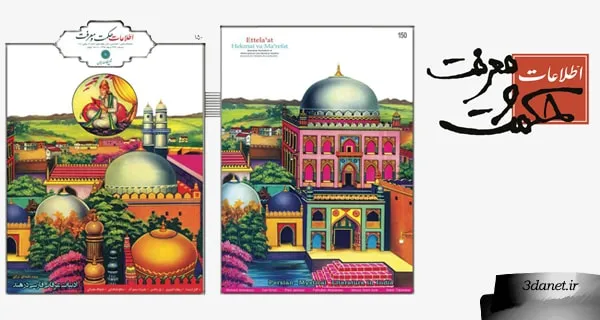
Persian mystical literature in India is the subject of the new issue of Ettela'at-e Hekmat va Ma'refat. The editing of this special issue was undertaken by Masoud Faryamanesh. In an essay published as the editor's note, he briefly surveys one of the most important genres in Persian literature of India, the malfuzat, and concisely introduces and analyzes malfuzat, both authentic and spurious.
Following the editor's note, in accordance with the journal's usual practice, the special issue begins with an interview. This issue features an interview with Dr. Fathollah Mojtabai, a distinguished Indologist and permanent member of the Academy of Persian Language and Literature, which contains useful information about the movement of translating Hindu religious texts from Sanskrit into Persian and the reasons and motivations behind the emergence of this movement within the Hindu-Iranian tradition. And now, the articles of this issue:
1_ "Interpreting the Tradition of Hagiography in India," written by Carl Ernst, translated by Masoud Faryamanesh. This article includes a readable discussion on the process of writing hagiographies during the Sultanate period, the Mughal era, and subsequent periods, and contains an examination of the general framework of some of the most important hagiographies.
2_ "Accounts of Chishti Mystics in the Sultanate Period," written by the late Mohammad Habibullah, professor at Aligarh Muslim University in India, translated by Sara Haji-Hosseini, which contains a detailed account of the process of the emergence and formation of early Chishti malfuzat and tazkiras.
3_ "A Re-examination of Khair al-Majalis," written by Paul Jackson, translated by Farzad Moraveji. In this article, the author engages in a thorough and detailed discussion of Hamid Qalandar's Khair al-Majalis.
4_ "The Resonance of the Master's Voice: The Malfuzat Style in South Asian Sufism," written by Amina Steinfels, translated by Mohammad Ehsan Mosahafi, contains an account of the formation and analysis of the structural patterns of malfuzat, focusing on the malfuzat of Sayyid Jalaluddin Bukhari.
5_ "A Review of Shattariyya Literature," written by Mohammad Reza Adli, contains a fresh account of the most important works of the Shattariyya order.
6_ "A Look at the Life, Thoughts, and Malfuzat of Zayn al-Din Shirazi Daulatabadi," written by Masoud Faryamanesh, is an account of the life events, thoughts, mystical disposition, and malfuzat of a lesser-known Iranian Sufi who was born in Shiraz between the death of Sa'di and the birth of Hafez, and after migrating to India, joined the circle of disciples of Burhan al-Din Gharib and ultimately succeeded him in his spiritual authority.
The other sections of this issue are:
Thought and Opinion: The article Henry Corbin and Traditionalism, translated by Inshallah Rahmati; Virtue Epistemology (The Formation of Ethics of Belief Without Evidence) by Richard Amesbury, translated by Ali Ghanbarian
and Perception from the Perspective of Ibn Arabi (The Manifestation of the Real in the Forms of Things) written by Sirus Ali Zargar, translated by Alireza Rezayat; Hinayana Texts in Persian History of the Fourteenth Century AD (A Note on Some Sources Used by Rashid al-Din) by Gregory Schopen, translated by Mohammad Montazeri.
Book Section: Review, Dialogue, and Book Introduction/ Monireh Panjtani; Design Based on Cognitive Neuroscience; The Relationship Between Cognitive Sciences and Art/ A Dialogue with Dr. Saleh Tabatabai;Questioning the Meaning of Contemporaneity in Iranian Art/ A Dialogue with Alireza Sami Azar; The Conceptual Revolution as a Consequence of Modernism. And finally, the Report section: The Crystallization of Shared Thinking and the Promotion of Rationality in the Iranian Philosophers' Assembly/ Sasan Yaghmai.
.
.
Editor's Note (Masoud Faryamanesh)
A Brief Look at the Tradition of Writing Malfuzat in the Subcontinent
Among the shared cultural aspects of Iran and India, which is the subject of this issue of the quarterly Hekmat va Ma'refat, one can mention the tradition of writing malfuzat (recorded sayings), which emerged in the circles of Persian-speaking Sufis of India, matured over centuries, and became one of the most important genres of mystical literature in Indian Sufism, particularly within the Chishti Order. It is worth noting that although the recording of the sayings of Sufi masters of Iran such as Bayazid, Abu al-Hasan Kharaqani, Abu Sa'id Abu al-Khayr, Shams Tabrizi, Mawlana Jalal al-Din Balkhi, and others had a precedent among Sufis, in India the malfuzat genre, given its specific characteristics (see the continuation of the article), soon became a prevalent literary form for transmitting the oral teachings of Chishti Sufis, such that most masters of this order saw no alternative but to render their discourses into this written form. In fact, the importance of this literary genre, which was itself deeply influenced by the ancient tradition of sira-writing and hadith transmission (see the continuation of the article), becomes more apparent when we consider that the early Chishti masters, due to their emphasis on oral instruction, did not write books; the emergence of the malfuzat genre allowed their path to suddenly find expression in a full-fledged literary tradition and paved the way for the transmission of their teachings to subsequent generations of the Chishtiyya. The initiator of this genre of mystical literature was Amir Hasan Ala Sijzi (fl. 727 AH/1327 CE), who recorded 188 assemblies of his master, Nizam al-Din Awliya, between 707/1307 CE and 722 AH/1322 CE in a book entitled Fawa'id al-Fu'ad.
He recorded these gatherings in the form of daily notes and memoirs, striving to present a pleasant account of the Sufi teachings of Nizamuddin Auliya in a smooth and flowing prose. Amir Hasan's mastery in composing this book, combined with the close bond between disciple and master, transformed Fawa'id al-Fu'ad into a remarkable presentation of the instructional relationship within the Chishti order. For this very reason, Amir Khusraw had wished: "Would that all the books upon which I have spent my life belonged to my brother Amir Hasan, and the discourses of the Sultan of Masters [Fawa'id al-Fu'ad] were mine, so that I might take pride and glory in them in this world and the next" (Mir Khurd Kirmani, Muhammad, Siyar al-Awliya, Lahore, 1978, p. 318). In any case, from the time of its composition, Fawa'id al-Fu'ad, alongside works such as Qut al-Qulub by Makki, Ihya' 'Ulum al-Din by Ghazali, Al-Risala al-Qushayriyya by Abu al-Qasim al-Qushayri, Mirsad al-'Ibad by Najm al-Din Razi, Maktubat by 'Ayn al-Qudat, and Lawa'ih and Lawami' by Hamid al-Din Nagauri, gained great acceptance among the khanaqah dwellers of India (see: Barani, Ziya' al-Din, Tarikh-i Firuz Shahi, ed. 'Abd al-Rashid, Aligarh, 1957, 2/177; Mir Khurd Kirmani, ibid.). Thereafter, especially within the circles of Nizamuddin Auliya's two principal disciples, Burhan al-Din Gharib and Nasir al-Din Mahmud Chiragh-i Dihli, works were composed in its imitation, which some scholars have termed "authentic malfuzat," such as Khayr al-Majalis by Hamid Qalandar (the malfuzat of Nasir al-Din Mahmud Chiragh-i Dihli), Nafa'is al-Anfas by Rukn al-Din Kashani (the malfuzat of Burhan al-Din Gharib), Ahsan al-Aqwal by Hammad al-Din Kashani (the malfuzat of Burhan al-Din Gharib), and Hidayat al-Qulub by Mir Hasan (the malfuzat of Zayn al-Din Shirazi) (for information on other examples of such works, see: Faryamanesh, Mas'ud, "Hasan Sijzi Dihlavi," Danishnama-yi Zaban va Adab-i Farsi dar Shibh-i Qarra, under the supervision of the Subcontinent Group, Tehran, 3/77), although none of these works attained the stature of Fawa'id al-Fu'ad. Furthermore, some other Sufi authors, such as Mir Khurd in Siyar al-Awliya, Ziya' al-Din Nakhshabi in Sulk al-Suluk, and 'Ali Jandar in Durar-i Nizami, also drew upon the style, approach, or content of Fawa'id al-Fu'ad (see: ibid.). The influence of Fawa'id al-Fu'ad on Sufi literature can be observed in various other instances as well. Curiously, from those ancient times, with the intention of continuing the tradition of the early Chishtis, several works were forged by plagiarizing Fawa'id al-Fu'ad and in reaction to it, as the most important and authoritative malfuzat text (for the view of Sayyid Muhammad Gisudaraz on the authenticity of Fawa'id al-Fu'ad, see: Muhammad Akbar Husayni, Jawami' al-Kalim, ed. Hafiz Muhammad Siddiqi, Gulbarga, 1352 AH, p. 134), attributed to the early Chishti masters, which contemporary scholars, from an academic perspective and not considering the influence they have had on the religious life of the general followers of the Chishti order, have called "forged malfuzat," including: 1. Anis al-Arwah (the apocryphal malfuzat of 'Uthman Harwani) attributed to Mu'in al-Din Chishti; 2. Dalil al-'Arifin (the apocryphal malfuzat of Mu'in al-Din Chishti) attributed to Qutb al-Din Bakhtiyar Kaki; 3. Fawa'id al-Salikin (the apocryphal malfuzat of Qutb al-Din Bakhtiyar Kaki) attributed to Farid al-Din Ganj-i Shakar; 4. Asrar al-Awliya (the apocryphal malfuzat of Farid al-Din Ganj-i Shakar) attributed to Badr al-Din Ishaq; 5. Rahat al-Qulub (the apocryphal malfuzat of Farid al-Din Ganj-i Shakar) attributed to Nizamuddin Auliya; 6. Afzal al-Fawa'id, together with Rahat al-Muhibbin (the apocryphal malfuzat of Nizamuddin Auliya) attributed to Amir Khusraw Dihlavi.
It is worth noting that these authentic and spurious malfūẓāt generally contained more or less pronounced features and characteristics, including: 1. Authentic malfūẓāt, under the influence of the hadith transmission model, aimed primarily at recording and preserving the teachings of the shaykh; hence, these malfūẓāt emphasize the themes of Sufi teachings, especially in terms of practice, whereas spurious malfūẓāt, like hagiographies, in most cases focused on the sainthood and authority of the shaykh; 2. Authentic malfūẓāt are replete throughout with questions and answers between the shaykh and the disciple, as well as the citation of couplets of poetry, but the texts of spurious malfūẓāt largely lack the oral character and that close personal contact between disciple and master which made Fawāʾid al-Fuʾād such a striking presentation of the teachings of Niẓām al-Dīn Awliyāʾ; these malfūẓāt often depict the Chishtī shaykhs delivering tedious sermons, a matter that caused the malfūẓāt in later Chishtī generations to lose their oral character to a great extent; in fact, authentic malfūẓāt contain lively, real conversations, and in them, the experience of being in the presence of the shaykh is somehow made possible for the audience, and the audience can imagine themselves in the shaykh's assembly, whereas the listeners in spurious malfūẓāt are silent witnesses to the shaykh's monologues; 3. Spurious malfūẓāt are, in fact, "retrospective" texts, meaning they narrate the states and stations of Sufis who had passed away by the time the work was composed; but the texts of authentic malfūẓāt were compiled during the lifetime of a shaykh and under his supervision, and thus contain the sayings of a contemporary shaykh; 4. Also, among the prominent characteristics of spurious malfūẓāt is the author's excessive inclination toward litanies and invocations – instead of an effort aimed at reviving the guiding presence of the shaykh in spiritual wayfaring, which is a feature of authentic malfūẓāt; 5. In authentic malfūẓāt, the miracles of the saints have a didactic function. In other words, miracles, in texts of this kind, are mentioned as part of the shaykh's teaching, whereas in spurious malfūẓāt, the author's primary concern is to add to the prestige and sacred status of the shaykh at every opportunity by mentioning numerous exaggerated miracles; 6. Authentic malfūẓāt are distinguished from spurious ones according to their audiences; the audience of authentic malfūẓāt were the elites of the Turkish noble and military classes ruling Delhi during the seventh and eighth centuries AH, but the audience of spurious malfūẓāt are the common people who, more than having an enthusiasm for Sufi methods and practices, are interested in the special powers and abilities of the Sufi shaykhs as intercessors before God; 7. Another feature of spurious malfūẓāt is the extensive plagiarism of these works from Amīr Ḥasan's Fawāʾid al-Fuʾād. Also, historical errors and mistakes sometimes find their way into spurious malfūẓāt, and in some cases, the teachings contained in them even conflict with authentic Chishtī teachings (for details, see: Ernst, Carl W., Eternal Garden, New York, 1992, pp. 62-85.). A comprehensive discussion introducing, reporting on, and analyzing this very important genre in Indian mystical literature is beyond the scope of this short essay, and the above points were brought up merely as an introduction to the subject and to lay the groundwork for the discussion. We refer the esteemed readers of the journal to Professor Carl Ernst's valuable book, Eternal Garden ([1]), and some of the articles in this issue.
As is customary, we have begun this issue with a conversation with Professor Dr. Fathollah Mojtabai about the shared ties between Iran and India. In this conversation, Professor Mojtabai, as a distinguished Indologist, introduces and examines the movement of translating Indian religious texts from Sanskrit into Persian, the reasons and motivations behind the emergence of this movement within the Hindu-Iranian tradition, and also introduces some of the most important works produced in this tradition. And now, the articles of this issue: an article by Mohammad Habibullah, the late professor at Aligarh Muslim University and a pioneering Indian scholar in the study of malfuzat (recorded sayings), titled “Accounts of Chishti Mystics in the Age of the Sultanate,” translated by Ms. Sara Haji-Hosseini, which comprises a detailed report on the process of the emergence and formation of early Chishti malfuzat and hagiographies; the article “A Re-examination of Khayr al-Majalis,” written by Paul Jackson, translated by Mr. Farzad Moraveji, containing a thorough and precise discussion of Hamid Qalandar’s Khayr al-Majalis; the article “Echoes of the Master’s Voice: The Style of Malfuzat in South Asian Sufism”, written by Amina Steinfels, translated by Mr. Mohammad Ehsan Mosahafi, comprises a report on the formation and analysis of the structural patterns of malfuzat, focusing on the malfuzat of Sayyid Jalal al-Din Bukhari; another discourse related to this subject appearing in this issue is an article by the present writer on the life of Zayn al-Din Shirazi and his thoughts and malfuzat, Hidayat al-Qulub wa ‘Inayat ‘Allam al-Ghuyub. This Zayn al-Din Shirazi, who was born in Shiraz between the death of Sa‘di and the birth of Hafiz and ultimately, after migrating to India, joined the circle of Burhan al-Din Gharib’s disciples in the Deccan, is one of the great Sufis of the Deccan, whose malfuzat contain subtle mystical content and are replete with the poetry of great Persian poets.
It is worth mentioning that the other articles in this issue are also each connected in some way to the subject of mystical literature in the Indian subcontinent. The article by Professor Carl Ernst, Distinguished Professor of Islamic Studies in the Department of Religious Studies at the University of North Carolina, titled “Interpreting the Tradition of Hagiography in India,” translated by the present writer, contains a fascinating discussion on the process of writing hagiographies during the Sultanate period, the Mughal era, and subsequent periods, and includes an examination of the general framework of some of the most important hagiographies. One of the noteworthy points in Ernst’s research is that hagiographies, especially in the Mughal era, were composed in a thoroughly political context and setting, and the increasing overlap of political aims and objectives is one of the main themes of such works; since the hagiographies of this era emerged during the expansion of the Mughal Empire, they defended the pan-Indian perspective of this empire, and in fact, it can be said that they came to serve the promotion of the slogans, goals, and expansionist objectives of that empire. For example, stories can be seen in these hagiographies concerning the activities of early Chishti masters in converting non-Muslims to Islam, a subject not seen in the writings of the seventh and eighth centuries AH. This subject linked the ruling power with the Sufi saints and also with the expansion of the foundations and principles of Islamic society, and caused Mughal-era writers to produce works in which the boundary between hagiography and dynastic history disappears. In fact, in these works, the historiographical approach blends hagiographical and courtly tendencies. In the hagiographies of the post-Mughal era and the period of Pakistan’s independence, the role of Sufis in the mass conversion of the non-Muslim populace to Islam is also re-envisioned and attributed to the miracles of the saints. According to the author, the hagiographies of the independence period reflect state-approved interpretations of the role of Sufi saints in the mass conversion of non-Muslims to Islam. ; the article “A Survey of Shattariyya Literature” by Mr. Mohammad Reza Adli contains a fresh report on the most important works of the Shattariyya order, such as Lata’if-i Ghaybiyya by Shah ‘Abdullah Shattari, Ma‘dan al-Asrar by Shaykh Qazan Shattari, Jawahir-i Khamsa by Shaykh Muhammad Ghawth Gwaliori, and others, using the manuscripts of these works. In closing, I hope that this issue will make a contribution, however small, to the introduction, identification, analysis, and critique of Indian mystical literature, especially the malfuzat genre. I also consider it my duty to sincerely thank my learned friends who kindly undertook the task of translating and writing these articles.
[1] . The translation of this book by the author of these lines has been completed, and if fortune favors the translator, the book will be published in the not-too-distant future.
.
.
Email Address: ehvm86gmail.com
Telegram Channel: t.me/Doostanehekmatmarefat
.
.

Discussion0 comments
No comments yet; let yours be the first voice.