Philosophy
Introducing Issue 140 of Ettela'at-e Hekmat va Ma'refat: 'The Virtue of Simplicity'
Issue 140 of Ettela'at-e Hekmat va Ma'refat, titled 'The Virtue of Simplicity,' explores the ethical and spiritual dimensions of simple living—from a conversation with Emrys Westacott to articles on consumerism, Gandhi, Thoreau, and a mystical perspective on simplicity.
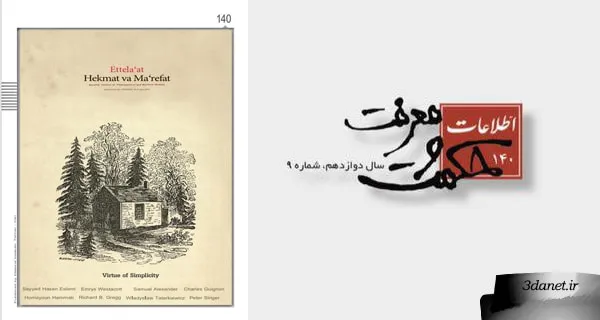
The Daftarmah section of this issue consists of 9 articles, and the other sections include Literature and Art, Thought and Opinion, and Books and Reports.
In an excerpt from the statement by the editor of Issue 140, penned by Naghmeh Parvan, it is stated: "The primary responsibility of discussions on simple living is to make us aware of conscious consumption and not to hand over the reins of life to this consumer culture, which is in no way incompatible with enjoying a moderate and normal level of well-being and security, because, as philosophers such as Aristotle also affirm, possessing a certain degree of external goods is necessary for attaining the inner desires of the soul and mind."
The first article in this issue's Daftarmah is an interview titled Under-Consumption, Happiness, and Everyday Ethics with Emrys Westacott, professor of philosophy and author of the book The Wisdom of Frugality, translated into Persian by Hossein Kermanshahi. Focusing on simple living, this interview seeks to clarify why philosophers have always advocated for frugality, yet such pronouncements are consistently ignored.
The second article, by Richard Gregg, is titled The Value of Voluntary Simplicity and has been translated into Persian by Ali Kalani Tehrani. In this article, "relying on the external and internal conditions of voluntary simplicity, he considers simple living a kind of relative self-restraint in some aspects of life for the purpose of securing more important benefits in life, and deems its attainment to require a kind of calculated organization in life."
In the third article, Day and Uusimaa, in their piece A Virtue-Based Approach to Consumption from the Perspective of MacIntyre and Beabout, translated by Alireza Rezayat, propose virtue ethics as a suitable theoretical framework for the ethical analysis of consumption due to its progressive dynamism in the field of consumption, and believe that pursuing inner desires and goods in consumption will bring about virtue for the consuming agent.
The fourth article is The Ethical and Spiritual Significance of Voluntary Simplicity by Jacob Garrett, translated by Yadollah Rostami. In this article, the author addresses the necessity of this way of life from the perspectives of ancient virtue ethics, Kantian deontology, and Foucault's aesthetics of existence, and by emphasizing the goodness of life and striving to reduce the pain and suffering of others, recommends that we live more simply.
The fifth article, titled The Voluntary Simplicity Movement, was written by Samuel Alexander and translated into Persian by Farnaz Tabrizi. "Alexander believes that the contemporary world's need for alternative lifestyles demands that a general outline of voluntary simplicity be presented. In this article, the author first provides a clear picture of this movement and its fundamental components by expressing the concepts, motivations, and practices of voluntary simplicity, and finally addresses the objections raised against voluntary simplicity as a movement and a lifestyle."
In the sixth article, titled Simple Living; Mahatma Gandhi and David Thoreau, Gholamali Keshani looks at simple living from the perspective of two thinkers who did not merely content themselves with opinion but, as much as possible, accompanied their simple-living beliefs with action. The author then enumerates the benefits that Gandhi and Thoreau identified as the consequences of "living simply."
In the seventh article, titled The Solution to World Poverty, Peter Singer outlines thought experiments for us to remind us that when spending money on luxurious and unnecessary items, we could have done something better with our money. He acknowledges that living an ethical life in today's world is very hard and difficult, but awareness of the tenets of such a life can be the first step toward setting us on the right path. This article has been translated into Persian by Hamed Merati.
The eighth article of this issue, written by Esmaeil Radpour and titled Embracing Simplicity, treats simplicity as one of the most fundamental meanings in metaphysical teachings and the mystical traditions of the Far East, describing the untouched, primordial, and innate state of beings in eternal perfection, which in such a path is generally alluded to through the allegory of the uncarved block of wood. Radpour's article can be considered a study of two references in the "Daodejing" or "The Sacred Book of the Way and Its Virtue" to the concept of simplicity and the commentaries of masters of the Daoist tradition in the oldest exegeses written on this book.
The ninth and final article of this issue's dossier is by Dr. Seyyed Hassan Eslami Ardakani, titled On the Virtue of Simplicity. In this article, the author considers simplicity in today's world to be simultaneously difficult and necessary, and holds the view that the expansion of human dependencies sometimes makes even the thought of simplifying life appear terrifying. He also introduces the initial steps toward being simple and five key concepts of simplicity from an Islamic perspective.
The second section of the monthly Ettela'at-e Hekmat va Ma'refat is called Literature and Art and comprises two articles. The first article is Aesthetics in the Year 1600 by Władysław Tatarkiewicz, translated by Seyyed Javad Fenderski and edited by Shadi Haddadpour Khiabani.
The second article, titled Qasem-e Anvar, is by Roger Mervyn Savory, and its translation and research were undertaken by Mahmoudreza Esfandiar and Jamshid Jalali Sheyjani.
Thought and Opinion is the title of the third section of the monthly, and it consists of two other writings. The first writing, titled Theology in the Contemporary World, is a conversation with Homayoun Hemmati. The second writing in this section, titled Being as Emergence: Recovering the Greek Experience of Physis, is by Charles Guignon, translated by Enshallah Rahmati.
The two final sections of the periodical are respectively titled Book and Dialogue. The Dialogue section begins with an article by Seyyed Masoud Razavi titled The Book of Sindbad. Following this is an article by Monireh Panjtani titled Story and Teaching Thinking. Then, in a conversation with Saeed Naji, she addresses the subject of the P4C criteria for stories. Subsequently, several books in the field of philosophy and the humanities are introduced. The last section of the periodical is dedicated to reporting the most important events in the realm of thought over the past month.
The 140th issue of Ettela'at-e Hekmat va Ma'refat, dated Azar 1396 (December 2017), titled "The Virtue of Simplicity," under the editorship and directorship of Enshallah Rahmati, was made available to enthusiasts at a price of 5,000 Tomans.
.
.
Editor's Note
By: Naghmeh Parvan
Simplicity is beautiful...
"Simplicity" seems to be one of those virtues that, at first glance, asks of us more of a "being nothing" than a being something. It wants us to be ourselves and to advance through life "authentically" with our true nature. Not to answer the call of every spread feast and table, not to blend in with every crowd, to know our own worth and, in the words of Shams Tabrizi, "not be captive to outward hypocrisy and not fall for every spectacle." To be free from everything borrowed and even free from knowledge, if it does not hasten to our aid in living well... That liberation which lightens the heavy burden of life so much that it elevates us to a point where we can sit and watch life from a loftier perspective.
"Simplicity," this simple yet stirring virtue, leans on its component of simple living, such that living simply becomes a support for the other components of this virtue. What this simple living demands of us is parsimony—in converting our soul and spirit into body and matter, and in becoming light of load and light of wing from everything that is not essential to our life. It warns us to consider as necessities of our lives only those things whose absence endangers our psyche, spirit, and body. It is by no means fitting to regard such a statement as merely abstract counsel and advice, for there is documented research indicating that money and material things only "succeed in making humans happy at low incomes," and beyond a certain point, their increase no longer has much effect on our happiness. Beyond that point, it is we humans who, when incapable of understanding our real needs—which are the attainment of spiritual and psychological attachments, peace of mind, and freedom and thought—or when we do not find within ourselves the talent and ability to achieve these real needs, mistakenly seek the remedy in immersion in the prevailing consumer culture, and we forget that: "True wealth is the all-around experience of life, and nothing more."
Therefore, the main responsibility of discussions on simple living is to make us alert to conscious consumption and not to hand over the reins of life to this consumer culture, which is in no way incompatible with enjoying a moderate and normal level of welfare and security, because, as philosophers such as Aristotle also affirm, possessing a certain degree of external wants is necessary for securing the internal wants of the soul and mind.
We begin the discussion with a conversation with Emrys Westacott, professor of philosophy and author of the book The Wisdom of Frugality, which, focusing on simple living—a topic that has recently become very popular—seeks to clarify why philosophers have always defended thriftiness, yet such statements are always ignored. Richard Gregg, in The Value of Voluntary Simplicity, relying on the external and internal conditions of voluntary simple living, considers simple living a kind of relative self-restraint in some aspects of life for the purpose of securing more important benefits in life, and deems its attainment to require a kind of calculated organization in life. Roos and Yousima, in A Virtue-Based Approach to Consumption, from the perspective of MacIntyre and Beabout, propose virtue ethics as a suitable theoretical framework for the ethical analysis of consumption due to its perfective dynamism in the domain of consumption, and believe that pursuing internal wants and goods in consumption will bring about virtue for the consuming agent.
In the article The Ethical and Spiritual Importance of Voluntary Simple Living, Jacob Gart, from the perspective of ancient virtue ethics, Kantian deontology, and Foucault's aesthetics of existence, addresses the necessity of this way of life and, emphasizing the goodness of life and striving to reduce the pain and suffering of others, recommends that we live more simply. Samuel Alexander's article The Voluntary Simplicity Movement, while presenting a clear picture of this movement and its fundamental components, discusses the concepts, motivations, and methods of action of voluntary simplicity. Alexander believes that the contemporary world's need for alternative lifestyles demands that a general outline of voluntary simplicity be presented, and at the end, he also mentions the objections that have been raised against voluntary simplicity as a movement and a lifestyle.
Gholamali Keshani, in the article Simple Living: Mahatma Gandhi and David Thoreau, looks at simple living from the perspective of two human beings who did not content themselves with mere opinion and, as much as possible, blended their simple-living beliefs with action. He goes on to remind us of the benefits that Gandhi and Thoreau introduced as the consequences of "living simply." Peter Singer, in the article The Solution to World Poverty, by depicting thought experiments, compels us to remember, when spending money on luxurious and unnecessary matters, that we could have done something better with our money. He acknowledges that living an ethical life in today's world is very hard and difficult, but awareness of the contents of such a life can place the first step on the right path before us.
Embracing Simplicity is an essay by Esmaeil Radpour that, by considering simplicity as one of the most fundamental meanings in metaphysical teachings and the mystical traditions of the Far East, describes the untouched, primordial, and innate state of beings in eternal perfection, which in such a path is generally alluded to through the analogy of the uncarved block of wood. His piece is an inquiry into two references in the Dao De Jing or the “Sacred Book of the Way and Its Virtue” to the concept of simplicity and the commentaries of masters of the Daoist tradition in the oldest exegeses written on this book.
And at the end of the issue, Dr. Seyyed Hassan Eslami Ardakani, in an article titled On the Virtue of Simplicity, considers simplicity in today’s world to be simultaneously difficult and necessary. Believing that the expansion of human dependencies sometimes makes even the thought of simplifying life seem terrifying, he introduces the initial steps of being simple and five key concepts of simplicity from an Islamic perspective; concepts such as not living in the past and not attaching one’s heart to possessions.
This “voluntary simplicity” under discussion, unlike “compulsory simplicity,” diminishes a person’s love for wealth and material things, and of course, one must very shrewdly and creatively pay attention to the many subtleties that make its correct implementation possible. The moral transcendentalists, who are considered among the founders of simplifying life in the last two centuries, remind us that discerning and sifting through what is necessary for life and obtaining these necessities through appropriate means requires very precise planning, and more importantly, attending to the preservation of our friendships and bonds in the depths of such simple living demands profound artistry.
With all of this, we wished to recall that embracing happiness is very difficult, but the obstacles to attaining it are not merely material. Certainly, with all the changes that have occurred in human life throughout the ages, the need to be simple and to live simply has always remained and will remain. Let us remember this saying of David Thoreau: “Our life is frittered away by detail… Simplify, simplify.”
.
.
.
.
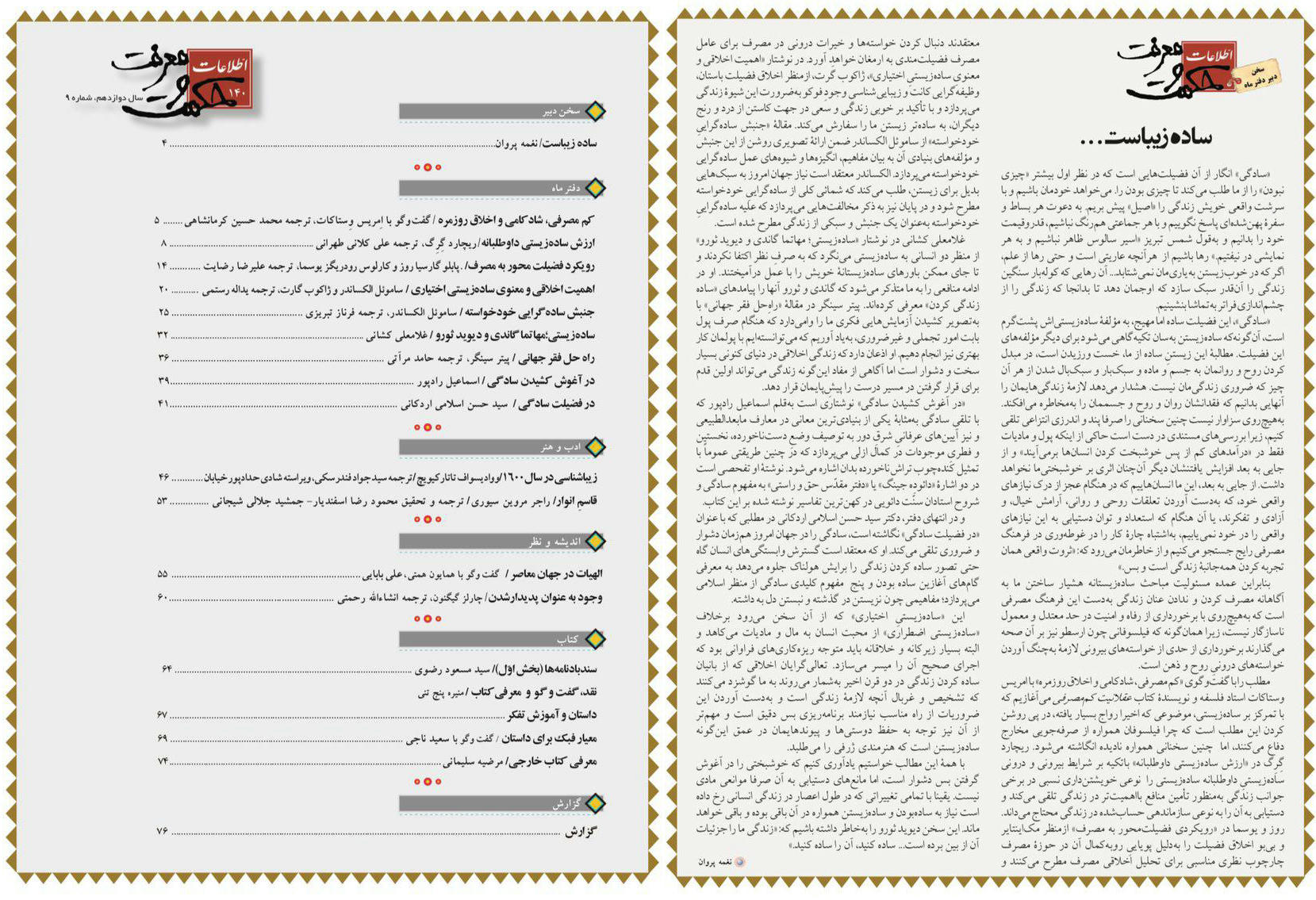
Table of Contents
Editorial
Simple is Beautiful/ Naghmeh Parvan
This Month’s Issue
Low Consumption, Happiness, and Everyday Ethics/ A Conversation with Emrys Westacott, translated by Mohammad Hossein Kermanshahi
The Value of Voluntary Simplicity/ Richard Gregg, translated by Ali Kalani Tehrani
A Virtue-Oriented Approach to Consumption/ Pablo García Ruiz and Carlos Rodríguez Lluesma, translated by Alireza Rezayat
The Moral and Spiritual Significance of Voluntary Simplicity/ Samuel Alexander and Jacob Garrett, translated by Yadollah Rostami
The Voluntary Simplicity Movement/ Samuel Alexander, translated by Farnaz Tabrizi
Simple Living; Mahatma Gandhi and David Thoreau/ Gholamali Keshani
The Solution to World Poverty/ Peter Singer, translated by Hamed Merati
Embracing Simplicity/ Esmaeil Radpour
On the Virtue of Simplicity/ Seyyed Hassan Eslami Ardakani
Literature and Art
1600/ Władysław Tatarkiewicz, translated by Seyyed Javad Fenderski, edited by Shadi Haddadpour Khiabani
Qasem-e Anvar/ Roger Mervyn Savory, translated and researched by Mahmoud Reza Esfandiar and Jamshid Jalali Sheijani
Thought and Opinion
Theology in the Contemporary World/ A Conversation with Homayoun Hemmati, Ali Babaei
Being as Manifestation: Recovering the Greek Experience of Physis / Charles Guignon, translated by Ensha'allah Rahmati
Book
Sindbad-Nameh (Part One) / Seyyed Masoud Razavi
Critique, Dialogue, and Book Introduction
Story and the Teaching of Thought / Monireh Panjtani
The P4C Criterion for Story / A Dialogue with Saeed Naji, Monireh Panjtani
Introduction to a Foreign Book / Marzieh Soleimani
Report
.
.
Email Address: ehvm86gmail.com
Telegram Channel: t.me/Doostanehekmatmarefat
.
.

Discussion0 comments
No comments yet; let yours be the first voice.