Philosophy
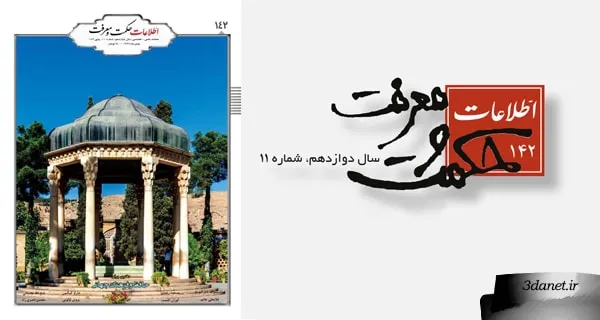
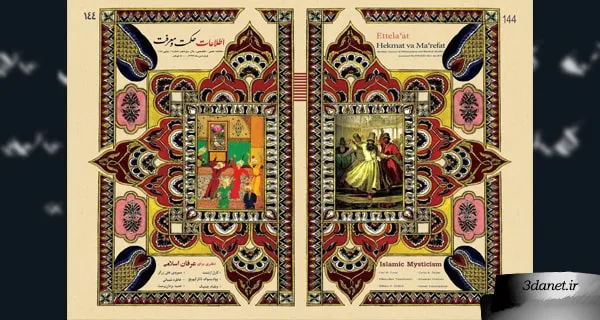
Introducing Issue 142 of Ettela'at-e Hekmat va Ma'refat: 'Hafez and World Culture'
“Hafez and World Culture” is the title of issue 142 of the journal Ettela'at-e Hekmat va Ma'refat, which examines Hafez’s influence on both Western and Eastern literature. The six articles in this dossier range from Iqbal Lahori’s encounter with Hafez to his impact on Western poets.
Introducing Issue 142 of Ettela'at-e Hekmat va Ma'refat: 'Hafez and World Culture'
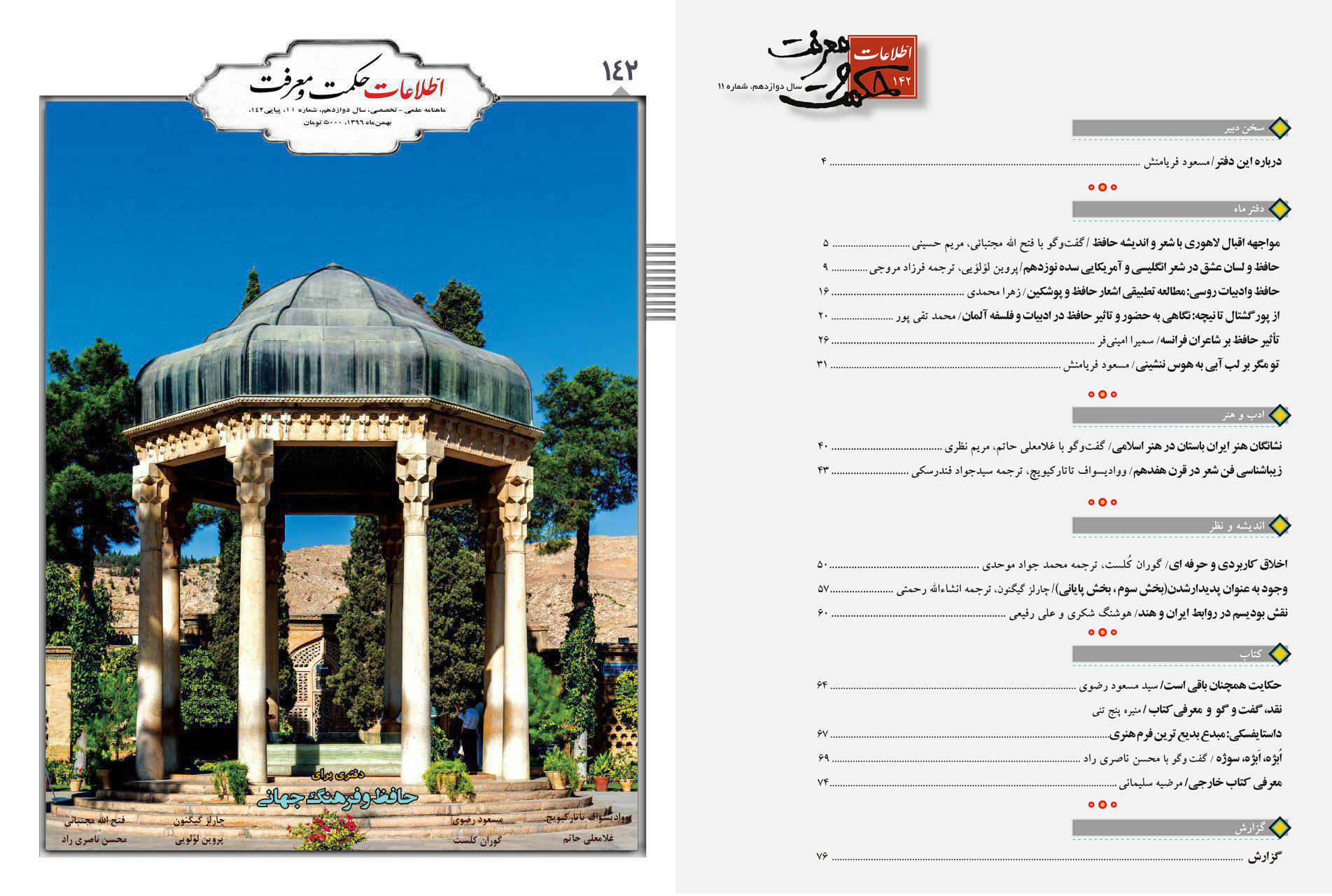
The dossier of this issue of the journal consists of 6 articles, and other pieces have also been published in the Literature and Art, Thought and Opinion, Books, and Reports sections.
In a portion of the editorial for Issue 142, Masoud Faryamanesh writes: "Given the worldwide renown of Hafez, that great prodigy of Iranian culture, in world culture, including in the monumental literary, philosophical, and artistic works of great Eastern and Western writers and poets, the articles in this dossier are dedicated to the subject of Hafez and world culture, and particularly his profound influence, major role, and trend-setting impact on Western literature."
The first article in this issue's dossier is a conversation with Professor Dr. Fathollah Mojtabaei, titled "Iqbal Lahori's Encounter with the Poetry and Thought of Hafez," which addresses the subject of Iqbal Lahori's intellectual evolution, his encounter with Iranian-Islamic mysticism and Persian poetry, and especially his encounter with Hafez.
The second article is by Parvin Loloi, titled "Hafez and the Language of Love in Nineteenth-Century English and American Poetry," translated by Farzad Moraveji. In this article, Loloi has attempted to examine the manner of Hafez's influence on English poetry and the Romantic poetry movement by identifying the linguistic tendencies of Hafez's translators.
The third piece in the dossier, "Hafez and Russian Literature: A Comparative Study of the Poems of Hafez and Pushkin," is by Zahra Mohammadi, dedicated to the subject of the influence of Hafez's poetry on Russian literature, particularly on the great Russian poet, Alexander Pushkin.
In the fourth article, titled "From Purgstall to Nietzsche," Mohammad Taqipour has attempted, by examining translations of Hafez's poetry into German, especially Purgstall's translation of Hafez's Divan, as well as works created based on Hafez's poetry in the vast expanse of this language, to address a corner of Hafez's literary influence on great German poets, writers, and philosophers, including Goethe, Rückert, Platen, Daumer, Bodenstedt, and Nietzsche, and the cultural presence of the sweet-tongued poet of Shiraz in the German-speaking world.
The fifth piece in this dossier, "The Influence of Hafez on French Poets," by Samira Aminifar, comprises a presentation of the history of French familiarity with Hafez's poetry and a report on Hafez's extraordinary influence and impact on French literature, stating that great French poets and writers such as Victor Hugo, Jean Caselli, Théophile Gautier, Armand Renaud, Tristan Klingsor, Mathieu de Noailles, Princess Bibesco, and especially André Gide, succeeded in creating immortal works in French literature inspired by the poems and thoughts of Hafez.
However, the sixth and final article of this dossier, "You Might Sit by a Stream for Pleasure," by Masoud Faryamanesh, deals not with the influence of Khwaja's poetry and thought on world culture, but, conversely, with his indirect influence from one of the famous products of world culture, namely the Greco-Roman myth of Narcissus.
In the Literature and Art section, we review two articles, which are: "Symptoms of Ancient Iranian Art in Islamic Art," a conversation by Maryam Nazari with Gholamali Hatam; and "The Aesthetics of Poetics in the Seventeenth Century" by Władysław Tatarkiewicz, translated by Seyyed Javad Fenderski.
The Thought and Opinion section of this issue contains three articles: "Applied and Professional Ethics," by Göran Collste, translated by Mohammad Javad Movahedi; "Being as Appearing" (Part Three, Final), by Charles Guignon, translated by Enshallah Rahmati; and "The Role of Buddhism in Iran-India Relations," authored by Houshang Shokri and Ali Rafiei.
The final two sections of this monthly are the Books and Reports sections, with the titles "The Tale Still Remains" by Seyyed Masoud Razavi; and a book review and introduction, and a conversation by Monireh Panjtani with Mohsen Naseri Rad...
The one hundred and forty-second issue of Ettela'at-e Hekmat va Ma'refat, dated Bahman 1396 (January/February 2018), titled "Hafez and World Culture," under the editorship and directorship of Enshallah Rahmati, was made available to enthusiasts at a price of 5,000 Tomans.
.
.
.
.
Email: ehvm86@gmail.com
Telegram Channel: t.me/Doostanehekmatmarefat
.
.

Discussion0 comments
No comments yet; let yours be the first voice.