Religion
Introducing and Reviewing the Book Religion and Rationality with Reza Babaei
The book Diyanat va Aqlaniyat (Religiosity and Rationality) comprises Reza Babaei's notes on intra-religious rationality, a pathology of traditional interpretations, and the necessity of changing textual understanding for cultural reform. This is a report on a book session with the author, aimed at reducing human suffering.
The book *Religion and Rationality* comprises notes and articles by Reza Babaei in the field of religious studies, bearing the hue of religious intellectualism and oriented toward pathology. Many of these notes and articles have previously been published in academic journals and virtual spaces; however, the author, taking into account critiques and feedback, has rewritten and edited all of them; as he writes in the book's introduction: “These notes and essays came into being over many long years; but all were revised and academically edited in the year 1396 [2017].”
The foundation of the book rests on “intra-religious rationality”; that is, the author presents the theoretical and ritual components attributed to religion to religious presuppositions, foundations, and accepted tenets to see whether logical and organic connections exist among them or not. He briefly accepts that some religious beliefs and recommendations elude self-sufficient rational assessments, but firstly, religion's red line is anti-rationalism, and secondly, beliefs and behaviors attributed to religion must be measured by intra-religious rationality. The logic of this measurement and evaluation is also formulated within religion itself, not outside it. Therefore, the book does not look at religion from the perspective of autonomous reason; rather, it has taken as its criterion of evaluation the rationality that can be learned from the general beliefs and teachings of religion through Coherentism.
The author's argument in the first chapter of the book is based on the premise that until the traditional understanding of the religious text changes, intra-religious reform is not possible, and cultural reform in society also faces severe obstacles, while the mission of these texts in the target society was cultural reform. In his view, although the train of social transformations does not wait for the understanding of religious scholars of the texts to change, without certain changes in the reading of the religious text, society must pay a higher cost for any transformation and change.
In the second chapter, he speaks of the fluidity and potentiality of religious understanding. All the notes in this section are critiques of the traditional and common reading of religion. Pathology, in the sense of discovering theoretical and practical inadequacies in the thought and conduct of the faithful, is the common thread of the notes in the third chapter of the book. To show his critiques in the three preceding chapters as justified, the author, in the fourth chapter, strives to demonstrate the share of history in the formation of certain traditions and dispositions, which is sometimes greater than the share of the texts and the conduct of the early leaders. An important part of this chapter concerns the truth of Ashura.
The fifth chapter of the book has a different hue; for it is more concerned with certain capacities and potentialities of religion in the domain of spirituality and mysticism. In this chapter, some mystical teachings are also reported, especially from the words of Rumi in the *Masnavi-ye Ma'navi*.
In this book, Babaei has striven greatly to speak in a simple and non-specialist language, and except for two or three notes in the book, it is entirely devoid of complex theological, philosophical, or jurisprudential discussions. From the book's dedication, one can also discern that the author's motivation for entering into religious-studies discussions is reforms aimed at the lives of human beings in this world and the path of reforming society toward greater coexistence, understanding, and ease. The author has dedicated his book to those who worship God in the altar of reason, and also to those who strive to lessen human suffering.
.
.
Audio of Reza Babaei's talk at this session
.
.
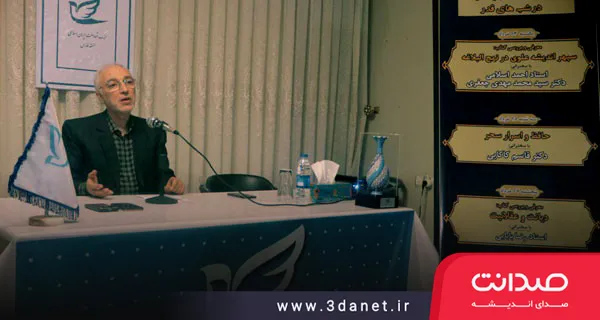
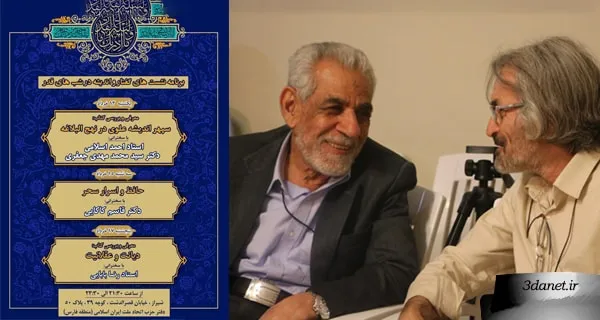
Introducing and Reviewing the Book *Religion and Rationality* with Reza Babaei
Speech and Thought Sessions , Session 24
The Twenty-Third Night of Ramadan, Khordad 1397 [June 2018]
.
.




Discussion0 comments
No comments yet; let yours be the first voice.