Literature
Introducing Issue 146 of Ettela'at-e Hekmat va Ma'refat
Issue 146 of the journal Ettela'at-e Hekmat va Ma'refat has been published, focusing on 'Wisdom in the Poetry and Thought of Nizami Ganjavi.' This volume features seven articles on the relationship between Nizami's thought and the philosophical schools and myths of ancient Iran, along with sections on literature, art, and thought.
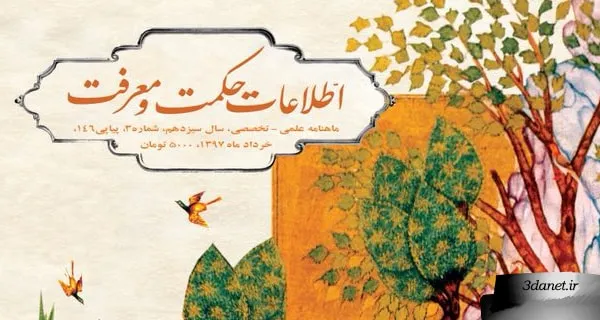
Introducing Issue 146 of the Journal Ettela'at-e Hekmat va Ma'refat
With a dossier on “Wisdom in the Poetry and Thought of Nizami Ganjavi”
This issue’s dossier comprises seven articles, and other pieces have been published in the Literature and Art, Thought and Opinion, and Book and Report sections.
In a portion of the editorial for Issue 146, Homa Shahram-Bakht writes: “Although Nizami can be considered one of the thinkers who was aware of all dimensions of the Islamic sciences, a close examination of his poetry reveals that he was not a follower of any particular philosophical or theological school. In Nizami’s era, Peripatetic philosophy was in decline in the eastern lands of Islam, and the Oriental philosophy, which harbored the Hermetic school within itself, found an opportunity to emerge. It was at this time that Nizami’s philosophical activity coincided with Suhrawardi’s school of Illuminationist philosophy. These two figures, who were contemporaries yet one was considered a sage (hakim) and the other a philosopher (faylasuf), employed common motifs in their works. Both Nizami and Suhrawardi held a deep attachment to the culture of ancient Iran and used Iranian myths abundantly in their works.”
The first article of this issue’s dossier is a conversation between Zahra Shahram-Bakht and Soheila Salahi Moqaddam titled “A Look at Haft Peykar with a Mystical and Symbolic Approach.”
The article “An Examination of Certain Mythological Motifs of Ancient Iranian Wisdom in Nizami’s Haft Peykar and Several Stories by Suhrawardi,” authored by Zahra Shahram-Bakht, is the second piece in this dossier, examining the influence of shared Iranian mythological motifs in some works of these two figures.
In the third article, “Nizami’s Worldview,” Zaker Mammadov addresses matters such as the why and how of creation. In his thoughts, Nizami always attempts to describe God from the perspective of reason and to explain the answers to questions of creation under the aegis of reason. This article has been translated into Persian by Roghayeh Rezaeifard and Mohammad Rezaeifard.
“Traces of the Hermetic School in a Story from the Eskandar-nameh” is the fourth piece in the present dossier, penned by Homa Shahram-Bakht. This article demonstrates how and with what depth Nizami’s simultaneous attention to Pythagorean and Hermetic philosophy is addressed in the Eskandar-nameh, and his familiarity with the figures of these two philosophies.

The fifth piece is an article by Maryam Bolouri titled “The Wisdom and Knowledge of Nizami Ganjavi,” which shows how Nizami engaged with the historical and cultural conditions of his time and, in this context, reflected his philosophical, ethical, political, and religious thoughts.
The sixth article is titled “Tanglusha in Nizami’s Haft Peykar,” by Jiva Vesel and translated by Farah Radnejad. In composing his book, Nizami benefited from the works of many sages, one of these books being attributed to Tanglusha, a Greek sage. This book concerns astronomy, zodiac signs, and constellations, and was initially translated from Greek into Middle Persian (Pahlavi) and from Middle Persian into Arabic. Although Nizami refers to astronomy throughout his book, this article seeks to demonstrate that Nizami’s reference to Tanglusha was limited to the domain of talismans.
The seventh and final piece of this month’s dossier is an article by Homa Shahram-Bakht titled “An Examination of the Fairy Element in the Saturday Poem of Haft Peykar,” which shows that Nizami used stories from various nations to compose his poetry. These stories have so deeply permeated the culture and beliefs of different peoples that traces of their culture and myths can be found in Nizami’s poems.
In this month’s Literature and Art section, we review four articles, which are: “Truth in Art” by Noël Carroll, translated by Enshallah Rahmati; “An Examination of Colloquial Words and Expressions in Nizami’s Poetry” by Fatemeh Elhami; “Elements of Thematic Composition in Makhzan al-Asrar” by Hamid Pouladi; and finally, “Philosophers and Aesthetics of the Seventeenth Century” by Władysław Tatarkiewicz, translated by Seyyed Javad Fenderski.
The Thought and Opinion section of this issue contains two articles: “Gems of Wisdom” by Ahmad Mahdavi Damghani and “The Innovative Thoughts of Allameh Tabatabai in Al-Mizan Commentary,” authored by Reza Yaghoubi.
The final two sections of this monthly are the Book and Report sections: Contemporary Iranian Ghazali Scholars (2)/ Seyyed Masoud Razavi. Book Review, Dialogue, and Introduction/ Monireh Panjtani and The Kyoto School: The Philosophy of Intercultural Dialogue/ A Conversation with Mohammad Asghari.
The 146th issue of Ettela'at-e Hekmat va Ma'refat was made available to enthusiasts in Khordad 1397 (May/June 2018) under the title “Wisdom in the Poetry and Thought of Nizami Ganjavi,” with Enshallah Rahmati as editor-in-chief and managing director, priced at 5,000 Tomans.
.
.
Email Address: ehvm86gmail.com
Telegram Channel: t.me/Doostanehekmatmarefat
.
.

Discussion0 comments
No comments yet; let yours be the first voice.