Art
Introducing The Rediscovered Hope: The Cinema of Andrei Tarkovsky by Babak Ahmadi
In Hope Regained, Tarkovsky’s cinema emerges as a new reality bound to an ethical ideal. The book includes a biography, his artistic views, and excerpts from his diaries on suffering and death.
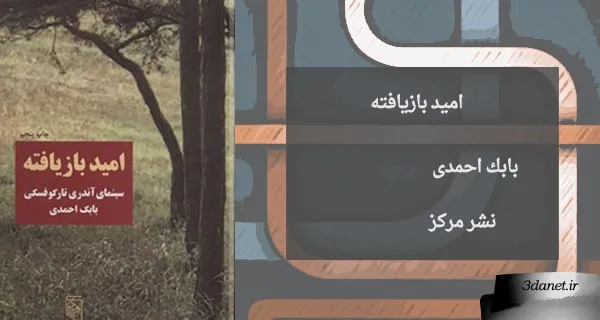
"At the beginning of the book The Rediscovered Hope, the author introduces 'Andrei Tarkovsky' as an artist who, in his works, created beauty accompanied by an ethical ritual. In his view, 'the closer Tarkovsky came to the end of his life, the more he emphasized the redemptive mission of the artist, and his words in his writings, conversations, and lectures also became more "prophetic."' The main discussions of the book are the presentation of viewpoints and the introduction of Tarkovsky's art in the realm of cinema, during which his films are also critiqued and examined from various aspects. It is stated in the book that 'realism from Tarkovsky's perspective is not a realist or naturalist effort in representing affairs as reflections of material and external reality. The tendency toward reality is a search for revealing what can emerge as the real. Revealing reality does not mean placing a mirror before it so that the same material existence is manifested once more, but rather it is the expression, or better yet, the construction of a new reality that has appeared in the artist's mind, grounded in his prior knowledge, which are themselves realities. Giving form to the second reality depends on the inner world and the spiritual and ethical life of the artist, and artistic beauty is only created in connection with an ethical ideal ... Tarkovsky's special view and belief in the creation of a second reality caused him to draw close to the tradition of poetic realism in French cinema ... In his films, there was no boundary between imagination and dream and "objective reality." He knew that in representing "real" moments, he could not suffice with recording objective events, and the representation of dreams, fancies, and wishes is the very revelation of reality ... For this reason, Tarkovsky taught: "Let us show dreams with complete precision. The most fascinating and terrifying dreams are those whose precise details of everything are remembered ..."'"
.
.
Excerpted from the text of the book The Rediscovered Hope:
Andrei Arsenievich Tarkovsky was born on April 4, 1932, in the village of Zavrazhye in the Ivanovo region near the town of Yuryevets, by the Volga River. He was born into a cultured family, a typical example of the Russian intelligentsia. His mother, Maria Ivanovna Vishnyakova, was passionate about literature and art. She was Andrei's true teacher, and she transmitted a love of culture and art to the boy, and years later encouraged him to turn to cinema.
In 1941, Tarkovsky entered elementary school in the town of Yuryevets. From 1943, they returned to Moscow, and there Andrei continued his studies. Tarkovsky was barely 14 years old when he was hospitalized for about a year due to cholera. According to a family friend, he was a rebellious teenager and tormented his mother. After finishing high school in 1951, he enrolled in the Faculty of Foreign Languages in Moscow, choosing Arabic language and literature. He was enamored with Eastern culture and sometimes called himself a follower of the Dao. In 1954, encouraged by his mother, Tarkovsky entered the State Institute of Cinematography, or VGIK. He did not believe in studying at film schools: "Based on my personal experience, I say that studying at film schools makes no one an artist. For artistic work, only professional and specialized training and learning various methods are not enough. It has been rightly said that to write correctly, one must forget the rules of grammar."
Tarkovsky's path was separate from the path of many who spoke of the crisis of modernity and the spiritual crisis of the modern world. He was neither the builder nor the defender of an ideology and a coherent system of beliefs. He was only sensitive to oppression, suppression, and the hardship of deprivation that people endure. The viewer of Tarkovsky's works, from the very first shots of each of his films, feels the presence of the "four primary elements." Rain and springs, perpetual winds, fire, and earth appear before their eyes in hundreds of forms, and even disrupt the familiar rules of everyday logic. He repeatedly called cinema the sculpting of time. Time is the main protagonist of his films. He was always fond of Thomas Mann's novel The Magic Mountain, and for a long time cherished the dream of making a film based on this novel.
The Rediscovered Hope: The Cinema of Andrei Tarkovsky / Babak Ahmadi / Ney Publishing / First Edition 1382 - Fourth Edition 1390 / 456 pp.
.
.
Excerpts from the Diary of Andrei Tarkovsky / The Rediscovered Hope / Babak Ahmadi:
.
One writes because one suffers, because one doubts. One writes to pretend to others and to oneself that one needs something... Humanity exists for the creation of its works of art.
.
Throughout his life, man knows that sooner or later he will die. But he does not know when his death will come. And to make it easier, he relegates that moment to a distant and uncertain future. But I know, and nothing will ever make life easier for me again. I suffer greatly. The difficulty is telling Larisa the story. How can I tell her?
.
Today we buried Mother. Now I am completely defenseless. No one in the world will ever love me like that. .
Andrusha laughs in the morning. What is truth? What is the concept of truth? Truth, in its depths, is something human that is not defined by a superhuman and absolute expression. The distance between man and the world is inconceivable. Truth is the same. Lao Tzu said: The most powerful things in this world cannot be seen, heard, or touched. Man must have an ideal to live without harming others. Morality is in our hearts, and if it is not there, we crumble. . Life is truly unbearable now. At the moment of parting from Mother, I picked some leaves from beside her grave. By the time I got home, I put them in water and they came back to life. I felt peace. Suddenly the phone rang. From Rome. It was Norman. He said the Italians would come on the twentieth of this month (for the Nostalghia contract). Of course, it was Mother's doing. I did not doubt it for a moment.
.
Blessed is he who lived the world in its fatal moments.
.
The recollection of the past must be such that it tears the heart from its place.
.
"Everything we obtain easily, we lose just as easily, and for everything we have striven hard for, we place greater value... Unaware that we have obtained life just as easily!
.
All day in bed. Pain deep in my body and in my back. Will my nerves hold out? I cannot move my legs. Leon does not understand the root of all this pain. If I did not have this pain in my arm, perhaps hope in chemotherapy would be justified. Now I have no strength left for anything. That is the issue. (This is Tarkovsky's last note)
.
.
The Rediscovered Hope Author: Babak Ahmadi Subject: Tarkovsky, Andrei Arsenyevich, 1932-1986. - Criticism and interpretation Publisher: Nashr-e Markaz Place of Publication: Tehran Format: Octavo Book Type: Authored Original Language: Persian Binding: Paperback Format: Octavo Print Run: 1000 Number of Pages: 464
.
.

Discussion0 comments
No comments yet; let yours be the first voice.