Art
Babak Ahmadi on Dialogue and Monologue
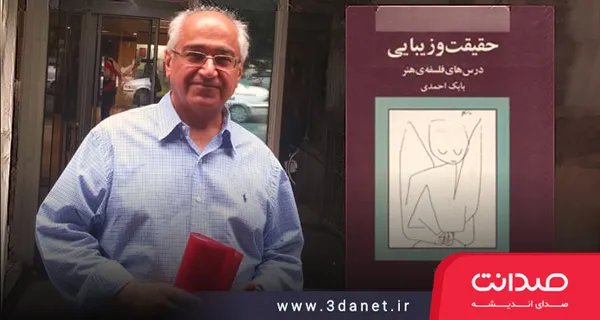
Following a performance of a play by Chرمshir, Babak Ahmadi examined the relationship between art and philosophy. He described dialogue as the division of reason in the pursuit of truth, argued that theatre is more successful than philosophy at revealing the conflict of legitimate forces, and noted that a monologue is addressed to us all.
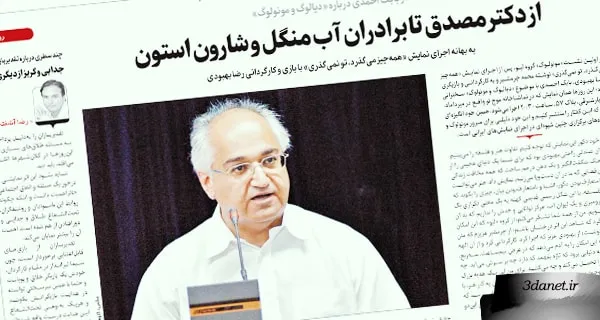
At the first “Monologue” session of the Liu Group, following the performance of the play Everything Passes, You Do Not Pass written by Mohammad Charmshir and directed and performed by Reza Behboudi, Babak Ahmadi delivered a lecture on the subject of “Dialogue and Monologue”; these days, that same play is being staged at the Wave Now Theater, located at No. 57, Rudbar-e Sharghi, Mirdamad, at 8:30 PM. This itself provided the impetus to publish this talk, and this in turn is a reason to review the monologue and the motivations for adopting such a method in the staging of Iranian plays.
If we pay attention to the very décor of this performance, we see the difference between art and philosophy. Art was that comfortable armchair of Behboudi, which constructed for you a strange world from a wondrous culture and a tangled mind, displaying all the absurdity of life in this space in which we flounder. Art, with its unconventional décor, objects, and unconventional expression, could say something that we, people of philosophy, with this old, worn-out formal style—in a sense, the repetitive cliché of a table, a tablecloth, and a glass of water—never have the capacity or the scope to even approach. I thank you all: the "Liū" group, who made it possible for me to witness this brilliant work; my dear Chirmshir, who wrote the text; my dear Behboudi, who performed and directed it; and that goddess of performance, who allows one, in the space of half an hour or three-quarters of an hour, to depart from this world into a world where one only then understands what is happening to them, what things they are enduring, and what they are killing. For me, this was a great gift. Yet, despite underestimating my own work and esteeming the work of art, despite belittling philosophical discussion—when it wants to reach the place that art passes through so easily—I still cannot set aside the comparison between the two.
Perhaps the art closest to philosophy, historically, thematically, and in terms of the similarity of form and expression, is theater; the most important text we find in the history of theorizing, in the theory of art and the philosophy of art, is Aristotle's Poetics, which is about theater—about tragedy, whose comedy section has unfortunately been lost. In theater, we see all those elements that philosophy, in the most flourishing period of the history of philosophy, namely in ancient Greece, in the era before Plato and Aristotle, up to the two paths of this great individual, advanced. One can easily see the influence of the theater of that era in all their philosophical thoughts. Many years after Aristotle and his discussion of the art of tragedy, Hegel returned to that discussion, and in his Phenomenology of Spirit, referring to Sophocles' play Antigone, he raised the question of what tragedy means and felt that nothing helped him illuminate the meaning of tragedy more profoundly than that very play by Sophocles. When two equal forces fight each other, both are justified, both are legitimate, and whichever you choose is the right choice.
Antigone's choice was right, for she was faithful to the law of the earth. She loved her brother and could not abandon his corpse. But she had betrayed the other law of the earth: the decree of the king; the decree of Creon, who was, in fact, carrying out divine law. These two great conflicts, two equal forces, created tragedy. Whenever philosophy tries to show this conflict of forces that are both legitimate, or appear legitimate according to a "discursive" logic, it inevitably returns to art. We have no way to show this in the form of abstract philosophical expression. Look at the Renaissance and the important plays of that period, especially the works of Shakespeare. For example, in Shakespeare's The Tempest, you can easily see that everything the philosophers of the Renaissance wanted to say, and was not practicable, the artist said in a play: this belief that the world is a stage, that life is a stage; this true belief that can be proven for a thousand and one reasons. And this continues in the same way, up to Racine, up to Chekhov, up to Beckett, up to the theater of today, and up to you writers who now, under all this pressure and hardship, carry on your work and use every opening to make us understand where we are floundering, why we live this way, and why there is no room for hope. In fact, this is the main point that binds theater and philosophy together. My work is philosophy. When I was asked to speak about monologue and dialogue, with trepidation, I immediately said that I am not a theater person and have nothing in this field to teach anyone, but I can, from a philosophical perspective, within the realm of my own work, as far as I am able, advance my point more briefly and directly.
The term dialogue, which we usually translate as conversation and talk, is a rational exchange of thought, speech, and expression—in the general sense of the word, since sometimes it turns out to be irrational!—between two or more people or two or more groups. Dialogue comes from the division of "logos" into two parts, or in Greek, meaning a splitting in two; the same thing that in "dialectic" is the splitting in two of logos or reason, in dialogue is the splitting in two of the self, and for this reason, in Socratic conversations, dialectic assumes the central role.
The assumption is that what constitutes "knowledge" is divided among people, and they have no way but to engage in dialogue with one another, no way but to pass truth to each other through this dialogue, no way to discover truth or approach it except through dialogue with one another. For the Greeks, thought itself also meant the fragmentation of thought and its division among different people, and theater performs this division well. These people [in theater] exchange things with one another; a truth of the era, sometimes clearly [like] a Chekhov play. Many people are on stage, and you see a division of thought among them. Sometimes it is not like this. There is one person who sits in the darkness and speaks words that are divided among countless people. Like the play we just saw. He expresses all the ignorances present in his culture, in a way, between the lines. In this strange and wondrous world, from the late "Dr. Mosaddegh" to the "Ab-e-Mangel brothers" to "Sharon Stone" find a place; this astonishing world that we all carry with us every day, and which constructs for us multiple identities, various instincts, the conflict of these instincts, and our own psychological warfare. This important person speaks of those very people, and his address is to all of us. For this reason, it is very difficult to say that a monologue in theater is a "soliloquy." It is very difficult to say that in this art, people on stage speak words that only they themselves understand, or that are addressed to themselves, or that they speak of an inner truth they have discovered themselves. If I return to philosophy, we began precisely with dialogue. "Socrates" spoke in dialogue. [But] according to another philosopher I am very fond of—Hegel—Socratic dialogues are not the discovery of truth. Because one party knows the truth and only wants to, as they say, "trip up" the other. He asks him a question so that he answers, and when his answers turn out to be contradictory, he tells him: "You see, you were wrong. I was right." Hegel says: Such a thing is not, and cannot be, the discovery of truth. The discovery of truth is the very division of reason. Something of reason must have also been with Socrates' interlocutor, and something of truth must have been discoverable in his words. A real dialogue does not begin on the basis that I know and want to convince the other. A real dialogue is one where I and the other do not know, and through talking with each other, we come to know more, we understand something more. Soliloquy and Monologue The real form of philosophy, in the strict sense of the word, is soliloquy. The real form of philosophy is that a philosopher writes a treatise, or [delivers] a lecture, or [presents] a discourse in which he states his opinions, the things he has understood. However, a good philosopher is one who knows that what he says is relatively correct and full of errors that others must criticize. Philosophy, if it has any importance, lies in the fact that it opens the way to critical thought. But if we return to theater, I want to make this claim that in theater, we do not have something called a monologue. Every kind of monologue is a kind of dialogue with others. I refer to my dear playwrights. We can arrive at two or three classifications. One type is where a person talks to himself, but another person is present, though the first person does not know it, like "Juliet" when she speaks to herself on the balcony, in front of her room, not knowing that "Romeo" is hidden among the trees in the garden and is listening to her words. One of Shakespeare's most beautiful and profound writings is there. Another type is where the listener is not hidden, but does not listen. Like at the end of "Uncle Vanya" when "Sonya" speaks. It is one of the most beautiful and strange moments in the history of theater: at the end of the play, when "Vanya," despairing and alone, his mistakes having reached their peak, having fired a gun, the love he thought was the true love of his life gone, now understanding it was not, sits in despair and has almost nothing left in this world... In this absolute decline, Sonya delivers a soliloquy saying, Uncle Vanya, do not grieve. Whatever suffering we endured in this world, there is another place where these will be compensated. There, they will caress us. There, they will be like the beauty of a mother's embrace. There, we will have refuge. This is the voice of a wretched nation, which is very understandable to us. The voice of a nation without refuge, which in this world no longer has happiness, and in total despair—while from afar the sound of one of the actors' "balalaika" is heard, and he too does not listen to Sonya—[is spoken]. This monologue of Sonya is addressed to us. No one in this play is listening. Uncle Vanya is not listening. He is crying and is almost destroyed. He is finished. He is a finished man, and these words no longer hold anything for him. At this point in the play, you are dealing with a monologue that is addressed only to us. So it is not a monologue; in a way, it takes each and every spectator along with it—across different generations, across different cultures—and in this way, it proves to us beautifully that we always have listeners. Theater always needs people sitting opposite. The difference between reading a dramatic text and seeing it lies right here; the difference between this very text by Mr. Chirmshir and this same text that we just heard performed, the difference between the tone of voice, the person sitting there, this person whose tone of voice changes, this person who knows how, who is skilled, experienced, and insightful, who knows the craft of theater acting well and can assume any state for you. The chapter divisions that the actor, in fact, creates in this text: the first chapter that introduces us to a strange and wondrous world in a garden where the father, mother, Dr. Mosaddegh, and others are present; the chapter of the dinosaurs; the chapter of returning; the chapter of the administrative letter; the chapter of suffocation; the chapter of the end of happiness; and the chapter of death. He can bring each and every one of these to life for us through his performance in a way that we, as readers of a text, can never access. We always say theater consists of two things: one is the written text, which is read as a book or booklet, and the other is the performance. But when you see the first, you become certain that [theater] is the second. The first is, in fact, lifeless. It is as if it has no soul. The second creates its soul. That scene, the position of the light, the position of the place, the position of every single object there, and the voice of a person who is there. A person who speaks to you. Who asks you to listen to him. Who asks you to enter his world. Who asks you, even as he mocks you. Perhaps the things he was saying were, for me as well—at least some of them—among the values of my life. But this is another person. He is fighting with these values and challenging these values. In fact, he is telling me: "I am not like you." I have experienced the world in a different way, and you can only converse with me [when] you accept my human right, and we can discover something together. Well, so where is the monologue in this? Where is the soliloquy? This is a social address to all audiences. Because art is only art within the circuit of social communication, within the circuit of human connection. Otherwise, in its closed state, it absolutely does not exist. If a text is not read, it is not a text; just as if a stone is not seen, it is not a stone, and if a tree is experienced but no name is placed upon it, it is not a tree. Therefore, the main lesson we derive is that this type of monologue—even if it is a dramatic device in, say, Renaissance-era plays to acquaint us with points that the author could hardly convey to us in another way, and through which we hear words that express his inner self—opens up another world before you. We have the same thing in the twentieth-century novel. With monologues that, especially in the twentieth-century novel, we call "stream of consciousness," a term borrowed from "William James," the American psychologist and philosopher, and it is when you want to express the functioning of a brain, the functioning of a mind, the articulation of a consciousness. When you do this and listen and move forward in this way, you accept that it does not align with the logic of everyday life. Because you yourself, when you think, when you think constantly throughout the day, when you return to your real instincts, in fact to your Freudian "ID," as long as you are no longer a "superego" wanting to play a role in front of others, this stream of consciousness of yours is not logical. It jumps from one branch to another. Therefore, it delves into that world. You recall memories that are left half-finished, memories that trigger the recollection of other memories. A complex surfaces, resentments are revealed. This lone individual does not want to express this. He does not want to, and logically, for a thousand and one moral or social reasons, he is also incapable of expressing it. This is an inner part of each of our lives. Each and every one of us carries it with us, and it has no window to others. Art opens this window. Art tells us that this stream of consciousness, these everyday memories that form a monologue in our minds, is in fact a dialogue. It can be conveyed to others in some way. Changed. Moved. And compelled to think differently.From this brief discussion on the art of theater and the references made to other arts, I conclude that monologue, even better than dialogue, expresses the logic of conversation. Conversation in the sense of "logic," a logic that is divided among people, among consciousnesses, and between parties. We see this a great deal in twentieth-century philosophy. Two giants of twentieth-century philosophical thought, one "Mikhail Bakhtin" and the other "Hans-Georg Gadamer," each in their own way raised this discussion. The discussion that dialogue always exists within the work itself; both within itself—in its constituent parts, in the structure of the story, novel, or play—and in the dialogue of the characters in, say, Dostoevsky's works and the works of a playwright, and also insofar as the text cannot remain without an audience, because if it were to remain without an audience, it would no longer be a work, no longer art. It would be something on the level of that internal monologue which has no window onto the world. When this window opens—in whatever way it opens—you are transported to another world. Well, from all this, we arrive at only one logical point, and that is that there is no way for these windows to remain open to one another unless the ways of closing these windows are minimized. If this state comes about, these windows usually open, people are congruent with one another; they can reach understanding. They can both discover and, on the spot, construct their shared existential truth. Freedom of expression is the ultimate opening of this window. For us, the ideal form of cinema is a free cinema, the ideal form of theater is a free theater. They may criticize small student groups—who, of course, draw upon the theatrical experiences of past generations to be able to speak their piece—but they must be able to build their world and tell us of their experiences, to cast a light into my heart. The very point I made at the beginning; to give me a gift, a gift with which I can better know my own world and better live my life. This is the property of art. The performance we just saw had this in excess. I congratulate those involved and think it is a brilliant idea to take us into the Beckettian tradition, into a monologic world in fact, and through that teach us how to engage in dialogue with one another. I am absolutely certain that in art we do not encounter something called monologue. Finding a path to truth, to human dignity, to living humanly in this world, and to understanding why we are, and understanding how we are and how we will die—this is the work of art, and it is a great work that you have gifted me an art that—with many thanks to my dear Charmashir and with many thanks to each and every one of you—does this to a person..
.
pdf of Babak Ahmadi's talk on "Dialogue and Monologue" in Shargh newspaper
.
.
Babak Ahmadi | Dialogue and Monologue | Shargh newspaper | 9 May 2015
.
.

Discussion0 comments
No comments yet; let yours be the first voice.