Philosophy
A Critique of Babak Ahmadi's Text Structure and Interpretation by Farhadpour and Abazari
Yousef Abazari and Morad Farhadpour consider Babak Ahmadi's book Structure and Interpretation of the Text an incoherent concoction whose explanations of concepts are superficial and whose author lacks a clear grasp of the source material; this piece examines the pathology of a common approach to Western culture.
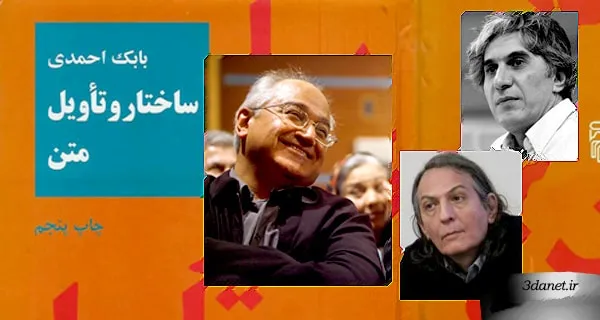
The present text is a joint critique by Yousef Abazari and Morad Farhadpour of the first edition of Babak Ahmadi's book Text Structure and Interpretation.
Text Structure and Interpretation has not only no structure and meaning, but indeed no definite or specific subject either; the book is in fact a strange concoction in which a bit of everything can be found: some semiotics (Peirce, Morris), a little philosophical structuralism (Foucault), some structuralist literary criticism plus a bit of Eco's literary semiotics. The inadequacy and superficiality of many of the author's explanations and commentaries, and more importantly, the very composition of the book, testify that the author himself has no clear understanding of the raw ingredients of his concoction.
.
Yousef Abazari, Morad Farhadpour: The aim of this writing is a pathology of a certain common approach to Western culture and an examination of the factors and causes of such an approach; hence we have not addressed other discussions, particularly the issue of the prose and Persian writing of the author of Text Structure and Interpretation, although this issue is of fundamental importance. Another point is that the authors of this article in no way deny the value of authored works and in fact believe that until the door to the interpretation of philosophical works is opened in Persian, we will not find a language befitting modern philosophy; therefore, our objections to the authorship of this book are objections to this kind of authorship, not to authorship in the general sense.
This writing consists of two parts. In the first part, we have dealt with the overall structure of the book and fundamental discussions concerning it, and in the second part, while introducing Dilthey, we have provided an example of the author's introductions of philosophical figures and the methods he has adopted for this task. The importance of this discussion lies in the fact that the book is in reality a collection of such introductions.
1) A book has recently been published entitled Text Structure and Interpretation (written by Babak Ahmadi, Markaz Publishing, Tehran, 1371 [1992]). The author notes in the book's preface [p. 2] that "in explaining the ideas of the thinkers presented in this book, I have made it a principle to use their own works directly and without mediation, and as far as possible, I have referred less to secondary sources, that is, works written about them" [emphasis ours]. We, too, had better not forget this note and keep it in mind throughout our reading of the book.
We proceed to read the section on Saussure:
An elementary and clichéd explanation of famous and well-known categories such as "signifier" and "signified," "langue" and "parole," "diachrony" and "synchrony," which is neither complete nor very clear, or the same familiar explanations and examples like the famous example of the "8:45 Geneva-Paris train" that is present in every second-hand, third-hand, and tenth-hand text on Saussure [including this very text]. We also pass through the sections on Peirce, Bakhtin, Propp, and so on. At the end of the section on Barthes, an impossible reading presents itself, and the question that has been present from the beginning and has gradually become more and more prominent becomes so heavy and pervasive that evading its formulation is no longer possible: What kind of book is this? What is its subject? Fundamentally, why and for whom and from what perspective and with what method was it written? A book in which almost everything and everyone, from Frege and Virginia Woolf to Abu Sa'id Abu'l-Khayr and Dilthey, are present in one way or another, and in various forms, from the photograph on the cover to the countless multitude of quotations, allusions, and short, long, and medium-length commentaries, bombard the reader's mind.
We somehow manage to finish listening to the broadcast about Barthes and, in order to grasp the book's main subject, return to its beginning. In the first sentence of the preface we read: "This book has two main aims; the first is to introduce three new doctrines of literary theory, namely structuralism, deconstruction, and hermeneutics." [p. 1] But when we turn to the book itself, we find nothing but chapters of 20 to 30 pages on some of the prominent figures of these theoretical schools;¹ chapters that not only have no connection with one another, but also, as independent sections, lack any internal logic or consistency. There is no sign of explaining and elaborating fundamental concepts, comparing or interpreting specific cases based on a particular outlook or perspective, let alone critical review and examination. The author occasionally selects a famous figure and becomes fascinated with them for a while; when dealing with Barthes, he is fascinated by Barthes; when he turns to Foucault, he praises him; Peirce, Dilthey, and Freud are all lauded in the same tone. This organized confusion and chaos can also be seen within each section: a mixture of chic and irrelevant quotations, philosophical and literary allusions, biographical explanations, names of books, articles, and persons, along with fragments that describe the content of this or that theorist's works in one or two pages in the most elementary and inadequate way possible, and fragments taken from "secondary texts" that are montaged together in utter disarray. For those familiar with these texts and discussions, a brief look at the notes section of each chapter clarifies several facts. Most of the quotations—as we shall see—are taken from those same "secondary texts," but the author cites them as direct references to the primary texts. Perhaps the best proof of this point is the reference to the English, French, and German texts of a single work; for instance, one can point to Gadamer's *Truth and Method*, from which the author has quoted in all three languages. The author has not even taken the trouble to compare the German and French quotations with the text and refer all of them to a single text.
Another point is the juxtaposition of quotations from individuals and schools of thought that have opposing identities and natures; for example, using a quotation from Adorno to confirm Gadamer's position.
The confusion and disarray are such that the author himself is forced to confess and tries to justify it somehow. In the introduction to the second book [p. 180] we read: "In this book, a chapter on the origins, roots, and history of structuralism has not been written; the reason is not that I have considered such a discussion unimportant; quite the contrary, it is a very important discussion, but it creates countless and complex theoretical points whose examination must be the subject of a separate book" [emphasis ours]. It is strange that the author shies away from confronting "countless and complex theoretical points," but the real reason is something else. Discussing structuralism as a school of thought and examining it conceptually requires a certain outlook and a minimum of intellectual coherence. At the same time, this method leaves little room for playing with chic quotations. A relatively old but classic example of this type of conceptual examination is Jean Piaget's book *Structuralism*, which the author never mentions, perhaps because old Piaget has become "outmoded." The author's evasion of conceptual discussion is an important issue to which we will return later, but for now, let us address the book's second aim.
In the preface we read: "The second aim is to prove the point that the three doctrines, despite their many distinctions and dissonances, have ultimately drawn closer to one another. Expressing this convergence might also be useful for a reader who has previously become acquainted with these discussions" [p. 1]. It seems that here, at least, we are dealing with a subject and content worthy of discussion, but the author does nothing but repeat his claim and point to the proximity of structuralism to "modern hermeneutics"—whatever that is supposed to mean. Everywhere, we are again faced only with a mass of quotations, and the author has nothing to say. His occasional interventions do not go beyond paternalistic advice to inexperienced youth and bringing quotations from Shams Tabrizi and Ayn al-Quzat. Incidentally, it is precisely these interventions and quotations that cause the "reader familiar with these discussions" to doubt the author's knowledge and understanding of structuralism and hermeneutics.
The author considers the three schools he discusses to be approaches that “have determined the background and method of research in artistic and especially literary essays over the past decade” [p. 1]. But this view is only true of the second school, namely deconstruction, or as the author calls it, shāludeh-shekani. Structuralism replaced Sartrean existentialism in France from the late 1960s, and its transfer to Europe and America also occurred in the 1970s. Hermeneutics, too, regardless of its traditional roots in biblical exegesis and the interpretation of literary works of the ancient world, entered the scene from the early 18th century (Schleiermacher), found a new manifestation in the late 19th and early 20th centuries (Dilthey), and its main debates in the present century (such as the Gadamer-Betti debate or the Gadamer-Habermas debate) were all raised before the 1980s. Even the order of the material and the manner of introducing the schools indicate intellectual confusion. Building bridges between alien and even opposing traditions—which always faces the danger of superficial eclecticism and playing with quotations—is itself one of the valuable philosophical and theoretical traditions, and undoubtedly if a prominent philosopher and creative thinker like Paul Ricoeur introduces bridging between structuralism and hermeneutics as the main goal of his intellectual life and philosophical project, he must be taken seriously and his writings and intellectual development followed. But when this same claim is made in this text by resorting to ultra-modern gestures, it is a matter for reflection [similar to the case of a writer who hides his inability to write even a short realist story by imitating Joyce and Virginia Woolf].
The aim of criticizing this book is to clarify two main issues:
1) Clarifying its confusion, meaninglessness, and hollowness in terms of content; that is, recognizing that this collection of quotations and fragments taken from “second-hand texts,” which have been translated into Persian by the method of “authorial translation”—that is, by omitting difficult parts and distorting and vulgarizing the material—not only does not introduce structuralism and hermeneutics, but its only result is the bewilderment of readers. Nevertheless, even astute readers, even if they “are not familiar with these discussions,” cannot realize the hollowness of the book, provided they have not already been intimidated by the author’s “breadth of knowledge.”
2) Clarifying the unity and inner meaning of the book as a cultural and social phenomenon; that is, specifying that Text Structure and Interpretation, despite the author’s praise of structuralist criticism, has a direct connection with his “inner intention” and the psychological structure of “interested readers,” and can only be understood by being placed within its own specific social and cultural context. The sociological and psychological critique of the work shows that the unifying principle of this confused and meaningless collection is a kind of “touristic attitude” toward philosophy and culture, which fully corresponds with its social and ideological background.
In the continuation of the critique, we will examine these two issues in two separate sections.
Let us return to the preface; after the main remark about using “second-hand sources,” the author adds: “Sometimes in the notes I have referred the reader to a number of second-hand books and articles, and these are texts that I believe are necessary to read” [p. 2]. As far as can be discerned from the book, the utilization—if not the reading—of all these “second-hand sources” has been necessary for the author, for otherwise writing the book would not have been possible at all. But truly, which are the texts that are not necessary for the reader to read? Those whose traces are seen throughout the author’s work and whose reading might lead the reader to comparison and Gadamerian reflection? Or those whose logical rigor, intellectual richness, and authors’ humility reveal the disarray and theoretical poverty of the author’s work? It seems the best course of action is for us to undertake this comparison ourselves. For this purpose, we have selected the following 4 books:
۱. Structuralism and Since: from Lovi Strauss to Derrida, ed. John Sturrock, O.U.P,۱۹۷۹.
۲. Jonathan Culler, The Pursuit of Signs; Semiotics, Litcrature, Dcconstruction, R.K.P, London, ۱۹۸۷.
۳. Jonathan Culler, Structuralist Poctics: Structuralism, Linguistics and the study of Literature, R.K.P, London, ۱۹۷۵.
۴. Robet Scholes. Stucturalisn in Literature an introduction. Yale University Press, ۱۹۷۵.
از میان این ۴ کتاب، دوتای آنها بهطورقطع و یکی به احتمال قوی مورد «بهرهبرداری» مؤلف قرار گرفته است. مسلماً «منابع درجه دوم» که کتاب از تکهپارههای آنها ساخته و پرداخته شده است به اینها محدود نمیشود. برای مثال میتوان به ردپای کتاب The Criticalنوشتهی دیوید هوی در بخش مربوط به هرمنوتیک [بهویژه فصل گادامر] یا کتاب The Order Of Mimesis اثر کریستوفر برندرگاست اشاره کرد {تقریباً تمامی بخش اول فصل دوازدهم ساختار تأویل متن که به تفسیر افلاطون از مفهوم تقلید Mimesis در رسالات «جمهوری» و «کراتیلوس» (Cratylus)، «واسازی» این متون توسط دریدا و تفسیر وی از نظریهی تقلید افلاطون میپردازد، از این کتاب گرفته شده است} رجوع کنید به
(C.Prendergast, The Order of Mimesis, Cambridge University Press, ۱۹۸۶, pp. ۹-۱۲)
ردیابی «منبع درجه دوم» فرانسوی به علت عدم آشنایی ما با زبان فرانسه مقدور نیست. ۴ کتاب فوق اساساً با توجه به مطالب جلد اول و حضور کموبیش آشکار آنها در متن مؤلف و بدون جستوجوی بسیار انتخاب شدهاند. قصد ما صرفاً ارائهی چند نمونه است و فکر میکنیم آنچه در بخش دو نمونه معرفی خواهد آمد، ما را در اینجا از پرداختن به چگونگی اقتباسات مؤلف معاف کند.
برای اینکه ببینیم این مؤلفان چگونه و با چه روشی در این مباحث کتاب نوشتهاند، به معرفی کوتاهی از هر یک میپردازیم. کتاب نخست، مجموعهای از ۶ مقاله است؛ ریشههای تاریخی و مفاهیم بنیانی ساختگرایی در مقدمهی کتاب معرفی شده است و ۵ مقالهی بعدی به بررسی انتقادی آرای لوی استروس، بارت، فوکو، لاکان و دریدا اختصاص دارند که توسط مترجمان و ناقدان آثار آنها نوشته شدهاند [مثلاً مؤلف مقالهی دریدا، جاناتان کولر است که خود چندین مقاله و کتاب دربارهی دریدا و واسازی نوشته است]. هدف اصلی مقالات، ارائهی تصویری کلی و انتقادی از نگرش فلسفی این چهرههای برجسته به ساختگرایی است، نه شرح زندگی و آثار آنها؛ برای نمونه مقالهی مربوط به فوکو یا بحثی دربارهی ماهیت و ملاک مشروعیت گفتار خود فوکو و رابطهی دوگانهی آن با گفتار عصیانگر ساده نیچه و آرتور آغاز میشود، سپس به تحلیل مفصل تعریف خود فوکو از گفتار و رابطهی آن با قدرت پرداخته و تفسیر او از معرفت و ادوار تاریخی آن را مورد بحث قرار میدهد و آنگاه ردپا و چگونگی تحول این نگرش را در آثار فوکو دنبال میکند. در این کتاب از باختین، موریس، تودوروف، ژنت، اکو و کریستوا هیچ خبری نیست.
سه کتاب دیگر همانطور که از نامشان پیداست، بیشتر با تجلیات ساختگرایی در قلمرو نقد ادبی و تأویل متون سروکار دارند، ولی علیرغم این شباهت موضوعی، دیدگاه و روش نگارش نویسندگان آنها کاملاً متفاوت است. کتاب شولس، همانطور که از نامش برمیآید، جنبهی مقدماتی دارد و ازاینرو بیشتر مطالب و فصول آن با نام اشخاص مشخص شده است و معرفی و بسط مفاهیم ساختگرایی ادبی و تحول تاریخی و مفهومی آن از طریق بحث دربارهی افراد انجام میگیرد. این روش مسلماً برای خوانندهی ناآشنا ملموستر و مفیدتر است. در مقابل کولر، مطالب هر دو کتاب خود را بر اساس بسط مفاهیم کلی تهیه و تنظیم کرده است، آثار او از لحاظ نکات فنی مربوط به نقد ساختگرا بسیار دقیقتر، پیچیدهتر و غنیتر است. کولر در کتاب تعقیب نشانهها The Parsuit of Singsنشانهشناسی را بهمنزلهی نوعی «نظریهی قرائت» آثار ادبی مورد بررسی قرار میدهد و عمدتاً به نقد نشانهشناسی شعر و ادبیات میپردازد. در این کتاب نیز از موریس، باختین و موکاروفسکی خبری نیست. مؤلف قصد اطالهی کلام ندارد، ازاینرو در مورد پیرس و سوسور به اشارهای کوتاه اکتفا میکند. علیرغم اختصاص یکسوم کتاب به واسازی یا شالودهشکنی، دریدا فقط چند صفحهای را به خود اختصاص داده است و از فوکو نیز فقط یک بار نام برده میشود. در واقع تنها کسانی که فصلی مجزا را به خود اختصاص دادهاند، میکل ریفاتر و استانلی فیش میباشند که اتفاقاً در ساختار و تأویل متن نشان چندانی از حضور آنها دیده نمیشود.
Culler's other book has a similar structure and content, but its subject area is more general and deals with the classic concepts and figures of structuralist criticism [Jakobson, Lévi-Strauss, Greimas, the Russian Formalists, Frye, and others]. On page 188 of Text Structure and Interpretation, a phrase from Lévi-Strauss is quoted, marked with the number 26. In the notes section, under number 26, we read:
"۲۶.C Levi-strauss, Structuralist Poetlce, London ۱۹۷۵.PP.۴۰-۵۳."
If a curious reader wishes to benefit from this "illuminating discussion" using the author's guidance, at the beginning of page 44 of Culler's book, they encounter this quotation from Lévi-Strauss: "Thus the [interpretive] context of each myth is increasingly constructed by other myths" (Du micl aux cendres, P۳۰۵); this is the very quotation that the author must have taken through "direct and unmediated use" of Lévi-Strauss's original book, but with a little attention, we realize that the entire passage ending with this "direct" quotation is nothing but a "free translation" of the material on page 43 of Culler's book, with the difference that the author has exercised "creativity" and mentions Milton and Rilke instead of Shakespeare. This is one of the author's main techniques: quoting from secondary texts, but employing a tactic that makes the reader think he has used the original texts.
The philosophy behind the arrangement and the manner of classifying the four aforementioned books clarifies an important point: Text Structure and Interpretation not only lacks structure and meaning but also lacks a definite and specific subject. The book is, in fact, a strange concoction in which a bit of everything can be found: some semiotics (Peirce, Morris), a little philosophical structuralism (Foucault), some structuralist literary criticism plus a bit of Eco's literary semiotics. The inadequacy and superficiality of many of the author's explanations and commentaries, and more importantly, the very composition of the book, testify that the author himself lacks a clear understanding of the raw materials of his concoction.
Among the four books above, the author only refers to one, which was mentioned earlier, but the more important point is the complete absence of the fourth book. The importance and meaning of this absence become clear when we compare the table of contents of Scholes's book with the author's work, because, as we said, the material and chapters of this book are also divided and arranged according to individuals. Given the extraordinary similarity of the structure and chapter headings of this book to the material in the first volume of Text Structure and Interpretation, one can propose the hypothesis that the book Structuralism in literature "was in fact the primary secondary source," the primary model for the author, and this very fact explains the absence of any mention or reference to it.۲ Therefore, it is worth examining Scholes's book with greater care and detail.
Setting aside the first two chapters, which have a general and conceptual aspect, and the third chapter, which deals with older, unofficial, and less well-known figures of structuralist literary criticism (André Jolles and Étienne Souriau), the titles of some sections are as follows: "The Mythographers Mythographers, Propp and Lévi-Strauss," "The Russian Formalists," "Semantics and the Logic and Grammar of Propp's Ethics," "System and System-Builders," "Tzvetan Todorov's Theory of Reading," "Roland Barthes's Codes," "Gérard Genette's Figures." The important point is that this division based on individuals is not devoid of a certain conceptual logic. Jolles and Souriau are linked based on the simple concept of "simplifying form"; Lévi-Strauss, Propp, and the Russian Formalists are united by "the movement toward a structuralist poetics"; and Todorov, Propp, and Genette are placed within a general space through "the structural analysis of literary texts."
In the first chapter of his book, Scholes discusses structuralism as a philosophical movement and also as a kind of method, and in the second chapter he deals with the transformation of structuralism from a linguistic theory into a kind of poetics (Poetics) and explains the manner of its expansion and change of form in the works of Saussure, Jakobson, Lévi-Strauss, and Riffaterre. These two chapters form the theoretical foundation of the book and introduce the key concepts and distinctions specific to structuralism. Reference to certain aspects of the theoretical outlook of figures such as Chomsky, Cassirer, Wittgenstein, and Gestalt psychology illuminates some of the roots and theoretical foundations of structuralism, and its comparison with the literary criticism of Georges Poulet, which has a phenomenological nature, highlights the methodological characteristics of structuralist criticism. The introduction of the fundamental concepts of Saussurean linguistics and the literary criticism of Jakobson and Lévi-Strauss, followed by the explanation of Riffaterre's devastating critique of the abstract character of their famous interpretation of Baudelaire's poem, places the reader in a position to understand the similarities, differences, and disagreements, as well as the meaning and significance of subsequent developments.
There is no doubt that these two chapters do not "define" structuralism, nor do they even provide a comprehensive description of the application of the structuralist method in the realm of literary criticism; nevertheless, within this limited space, Scholes has been able to delineate his own perspective on structuralism and its conceptual and logical atmosphere, a task that the author of Text Structure and Interpretation has failed to accomplish, resorting instead to the familiar pretext that this "should be the subject of a separate book." In a book devoid of any conceptual discussion, the author's main goal, namely "introducing structuralism as a literary theory," also remains merely a claim.
Scholes's book certainly does not say "everything" about structuralism, nor about literary criticism, nor even about the connection between the two, but it places a collection of concepts, perspectives, and theories alongside one another in a logical manner, and through this, acquaints the reader with a body of texts and the intellectual atmosphere governing them. The introduction of individuals is also carried out on this basis, and therefore Scholes, for instance, does not say everything about Barthes either, and does not bury the reader's mind under an avalanche of quotations, names of books and articles, and subsidiary explanations that have a merely decorative function.
2)
With the confusion and meaninglessness of Text Structure and Interpretation having been clarified, we can now turn to the second question and discuss its real meaning and unity. To do this, it might be better for us to also resort to the method of the "deconstructionists" and examine the text according to its own discussions and topics; that is, according to the concepts of structuralism and semiotics.
The arbitrariness of the signifier and the signified and the conventional nature of the link between them is the central principle of Saussurean linguistics, and the spirit governing structuralism and post-structuralism also originates from this very principle of the "conventionality of the sign," such that the philosophical project of someone like Derrida can be summarized as the extension of this principle to traditional subjects of philosophy—such as truth, mind, and meaning. In this sense, it must be said that Text Structure and Interpretation is pure signifier; everything about it is arbitrary and changeable, from the title of the work and its contents to the order and volume of the chapters. Sections can be deleted and new sections added to it, chapters can be rearranged, instead of Peirce and Morris, a chapter on Frege and Wittgenstein could be written, or Northrop Frye could replace Greimas and Bremond, but what is the signified of this arbitrary signifier? In Saussure's theory, the signified, like the signifier, is arbitrary and conventional, and Derrida, emphasizing this very aspect, has critiqued metaphysics and dissolves everything in the reason-defying play of signs; with all signifieds becoming arbitrary, discussion about truth and falsehood and their critique also becomes meaningless, or better to say, "arbitrary." This matter also encompasses the cultural system itself and the customs and conventions based upon it. If we accept this view, then the critique of the author's work truly becomes impossible, and this very matter explains the author's intense interest in this French postmodern innovation. But are all signifieds, meanings, and truths truly arbitrary? We do not submit to this theory of arbitrariness, and therefore we repeat our question once more: What is the real signified of the author's work?
It is precisely here that a sociological and psychological critique of the structure and interpretation of the text becomes necessary. Contrary to the author’s repeated emphasis on the autonomy of the text and its meaning from the author’s intention, on the autonomy of the text and its meaning from the author’s intention, the book is entirely under the sway of its author’s intention. The real signified of this work, which gives it meaning and unity, is nothing other than the author’s actual attitude; that is, the touristic attitude.
The concept of the touristic attitude is the true key to this book, and once it is grasped, all the previous points become clearer: the mass of quotations also become clearer, the mass of often irrelevant quotations, the lack of clarity regarding the book’s subject, in which a little of everything can be found, the emphasis on well-known figures and personalities chosen at will, with no theoretical discussion or argument connecting them, the avoidance of any descriptive or critical discussion of fundamental concepts and categories, the absence of any overarching or comprehensive view even in introducing individuals, and the use of fragments taken from “secondary sources” that the author has cobbled together to write chapters on Foucault, Gadamer, Todorov, and others, the complete disregard for the substantive distinctions and differences between individuals and schools of thought, and the remaining issues that need not be repeated. As we said, this book is rooted in the “author’s intention,” which is itself constructed by that same touristic attitude.
Thus we have answered our two main questions and clarified, as far as possible, the confusion and meaninglessness of the text in terms of its own subject and claims, and its real meaning and unity in terms of its cultural context. Now what remains is an examination of the mediations that the text itself provides for linking these two levels and transitioning from the first to the second. An immanent (immanent) critique of the author’s work and its deconstruction must be carried out with the help of these very mediations. These mediations are in fact the nodal points of the text through which the real structure and meaning of this book are manifested in its apparent structure and meaning. Finding these nodal points is very easy, given the author’s technique of montaging fragments and quotations; wherever the author leaves the shelter of “secondary sources” and quotations and steps forward himself, we encounter one of these nodal points. In these instances, even the author’s tone suddenly changes, taking on a didactic hue, and we find ourselves facing a wise sage who seeks to guide naive and inexperienced youth with his counsels. It is interesting that even in these few cases, the author does not entirely set aside his protective shield, and his direct interventions are also realized with the aid of quotations; that is, with the help of phrases taken from our own mystical and literary tradition, which have nothing to do with the schools the author has in mind (structuralism, deconstruction, and hermeneutics).
Now, at the end of this section, we will examine one example of these mediations or nodal points in detail and attempt, using the content of the work itself, namely those three schools, to provide a semantic context for them, so that through this, the meaninglessness and irrelevance of it, and the true nature of the author’s understanding of his work’s subject, become clear.
At the end of the section on Foucault, something curious happens: the author suddenly forgets his subject, Michel Foucault, entirely and turns to another topic. He devotes the whole of page 201 to examining several quotations from Barthes in connection with Proust and Mallarmé, and in the remaining page and a half, he expounds, criticizes, and rejects Sartre’s theory [Text Structure and Interpretation, pp. 202 and 203], perhaps because he found it impossible to forgo a few “beautiful” quotations from Sartre. That is, after his profound one-and-a-half-page analysis of four famous books by Sartre [Baudelaire, Saint Genet, The Words, and The Family Idiot], the author says: I do not deny the importance of these four books, and I know how useful Sartre’s outstanding works are in finding answers to that philosophical question, but for one who aspires to understand literary texts, I do not recommend following Sartre, and I do not believe that researching the biographies of authors is a sound basis or starting point [Text Structure and Interpretation, p. 203]. Truly, we must thank the author on Sartre’s behalf; alas, Sartre is dead and cannot himself witness this great discovery. In his one-and-a-half-page analysis, the author has solved the enigma of Sartre’s works. We now know that his works on Baudelaire, Flaubert, Genet, and himself were nothing more than biographies, and that Sartre himself was a biographer who “did not aspire to understand literary texts,” and therefore, starting from a “false starting point” and for the sake of “researching the biographies of authors,” wrote 700 pages on Baudelaire and several thousand pages on Flaubert.6
(Keep in mind this leap from Foucault to Barthes, and from Barthes to Sartre, and this Sartre-bashing, as we move on to the next point.) Immediately after his remarks on Sartre, the author writes:
“A thousand years ago, Ayn al-Quzat Hamadani wrote: O noble one! Consider these poems as a mirror! For you know that a mirror has no form in itself; but whoever looks into it can see their own form. Likewise, know that poetry has no meaning in itself; but each person can see in it that which is the currency of their time and the perfection of their work. And if you say that the meaning of poetry is what its speaker intended, and others impose other meanings from themselves, this is just as if someone were to say that the form of the mirror is the form of the polisher’s face that first appeared in it” [Text Structure and Interpretation, p. 203]. What does this mean? Presumably, the author has found a resemblance between this saying of Ayn al-Quzat and the three approaches he intends to introduce. Now, let us provide a semantic context for this passage from within the discussions and subjects of the book, so that it becomes clear how meaningless and irrelevant the above quotation is within the context of these discussions and subjects.
In his examination of Roland Barthes’s theories, David Hoy enumerates the commonalities between structuralism and the hermeneutic tradition.7 He points to three main ones: 1) A comprehensive critique of objectivism in interpretation and an emphasis on the point that the context of interpretation, or the context within which the meaning of the text must be determined, does not arise solely from the text itself, but the critic also participates in creating it. 2) The rejection of psychologism and opposition to reducing the meaning of the text to the subjective, inner intentions of the author. 3) The rejection of the philological method, which limits the task of literary history and literary criticism merely to recreating the text’s original horizon and attempts to read the text only in the way that was prevalent at its first emergence and was its initial form of reading.
At first glance, these commonalities—especially the third—seem related and compatible with Ayn al-Quzat’s statement, but with a little more reflection and precision, the incompatibilities and, ultimately, the irrelevance of the statement become apparent. Realizing this requires raising some points about the three traditions of hermeneutics, structuralism, and deconstruction.
We first turn to Gadamer and his hermeneutic theory; this theory contains a devastating critique of objectivism in interpretation—that is, the view that the text possesses an objective meaning independent of the reader and that the goal of interpretation is to clarify this very meaning. Based on his philosophical interpretation of the historicity of understanding and interpretation, Gadamer attempts to offer an alternative theory in which the meaning of the text arises from within a kind of dialogue or conversation between the text and the reader. For this purpose, Gadamer introduces the concept of the "fusion of horizons." According to Gadamer, understanding always takes place within a situation and therefore entails a kind of tradition or prejudice and possesses a specific historical horizon. In the text, this horizon is the perspective through which the object [Objekt] becomes present to consciousness or mind [Subjekt]. Thus, understanding the object only occurs on the basis of a pre-predicative structure. This structure is the fore-conception of understanding, a set of pre-understandings that make understanding possible. According to Gadamer, any understanding or mutual comprehension requires a relative fusion of horizons. The reading, understanding, and interpretation of texts also occur in this manner. "Every encounter with tradition that takes place within historical consciousness involves the experience of a tension between the text and the present. The hermeneutic task consists in ... consciously bringing out this tension."⁸ The historical horizon of the text is distinguished from the interpreter's horizon, but since the interpreter's horizon is itself a product of tradition, this distinction is simultaneously established and effaced, and thus, in Gadamer's words, a genuine fusion of horizons occurs, which makes the understanding and interpretation of the text's meaning possible, although this cannot be considered the final, absolute, or sole true meaning of the text. The concept of dialogue or conversation with the text carries the risk that the text might be construed as a mind and once again reduced to the subjectivity or intention of the author. Gadamer strongly opposes this interpretation, and for this reason, immediately after introducing the concept of the "fusion of horizons," he states: "We described this conscious act of fusing horizons as the goal and task of the historically effected consciousness" [ibid., pp. 273-274]. Consciousness of the history of effects is another fundamental concept of Gadamer's hermeneutic theory. The historical horizon of the text is summed up neither in the author's intention nor in the first reading of the text; this horizon is, in fact, the totality of readings that have occurred in the historical interval between the text's emergence and its interpretation in the present. The effects that the text has left in this interval are considered part of its historical identity and the basis of its historicity. As Gadamer says, our reading and interpretation of Plato can never ignore or be unrelated to the interpretations of Plato by Kant and Hegel; our historical situation and Kant's presence in the historical interval between us and Plato automatically means that we read Plato's dialogues as a set of readings [including Kant's reading] and historical effects; thus, the fusion of horizons and the interpretation of Plato's works is nothing other than consciousness of the history of these effects. The result of this interpretation is a specific understanding of Plato that, compared to Kant's understanding of Plato and his own understanding of his works, is neither better nor worse, but simply a different understanding.
The incompatibility of Gadamer's theory with Ayn al-Quzat's phrase is quite clear; the text is not a mirror in which the reader merely sees their own image; the historicity of interpretation does not mean it is arbitrary, and therefore one can judge various interpretations and their adequacy or inadequacy. Moreover, in Gadamer's words, the reader approaches the text with a kind of "fore-conception and anticipation of completeness," and the text, through its history of effects, actively participates in the formation of meaning and dialogue with the reader.
The phrase of ʿAyn al-Quḍāt refers to a particular kind of text (poetic texts). In literary criticism, there is a tradition influenced by Nietzsche’s theories that consistently sets the immanence of poetic texts against the historicity of interpretation. Poetic texts are their own semantic field; they have no external referent and do not use time as a means of reference and signification. Their meaning is internal and intrinsic to them, and for this reason they are called immanent texts immanent texts. Despite belonging to a particular history and course, poetic texts are in a sense considered “timeless” and “eternal.” In fact, this “timelessness” is itself one of the principal themes of poetic action and a prime example of the reflexive character of poetic texts, because these texts are their own referent. This plays an important role in Gadamer’s interpretation of immanent poetic texts. Poetic texts refer not to something outside the realm of language, but to the essence of language, or what Gadamer calls linguisticality. Their primary reference is the historical bond and unity of language and experience, to a part of concrete experience; thus the true referent of poetic texts is nothing other than poetry itself. But this reference to linguisticality is in fact the other side of the historicity of understanding and interpretation. By virtue of their resistance to multiple historical interpretations, poetic texts compel the reader to become aware of the historical character of their own reading. Poetic texts reveal the truth that “only through time can time be overcome” and “timelessness” attained.
According to Gadamer, every act of understanding entails a kind of self-understanding, because it is only in the process of understanding the other that the prejudices and the traditional historical identity of the self are revealed. Understanding a text, too, leads to self-understanding only as an encounter with the other. Staring into a mirror never leads to self-knowledge, because the formation of the individual self and awareness of its distinction from the world and others only begins after this mirror-relation is broken and this initial stage is left behind.
In his theory of literary criticism, Roland Barthes held that the reading and interpretation of texts depends on the provision of a semantic field. In his ahistorical outlook, there was no place for concepts such as the “fusion of horizons” and “history of effects.” Uncovering the structure of a text and decoding it undoubtedly requires a semantic field, but now this field had to be supplied entirely by the reader and critic, and this very fact turned criticism and interpretation into a subjectivist act. The superficial resemblance of this view to the phrase of ʿAyn al-Quḍāt raises the question: Did Barthes consider literary texts to be mirrors in which the reader can (or must) see their own image? Without any doubt, the answer must be negative. In fact, if we wish to point to the most important, most fundamental, and most enduring theoretical theme in Barthes’s intellectual life, we must immediately refer to his hatred of realism, imitation [mimesis mimesis], and the theory of “literature as a reflection of reality.” For Barthes, imitation was the generic name for a collection of vices; the stupidity, repetition, monotony, deception, false consciousness, and sterility, the corruption and rottenness of imitation, nauseated Barthes, and for this reason Christopher Prendergast9 considers his theory of “imitation as nausea” to be the polar opposite of Plato’s theory of “imitation as poison.” Plato regarded works of art as reflections of reflections, the lowest degree and the polar opposite of the Forms or philosophical truth. In his view, the proliferation and multiplication of these images was a deadly poison that endangered the health of society. Barthes, conversely, considered the reflection of the “real world” in the “mirror of art” and the imitation of social reality by realist literary texts to be an important ideological tool for preserving “order and law,” naturalizing social relations, erasing critical perspective, and stupefying and passivizing the reader; hence, the use of the mirror metaphor in relation to literature could only provoke his nausea and hatred. The evolution of Barthes’s position and his break from traditional structuralism—an evolution as a result of which the prodigal son of the family, namely structuralist literary criticism, rose up against its own kin and tribe, and ultimately stood tall in the guise of deconstruction theory against the scientific claims of the discipline of semiology.10
A brief reference to M. H. Abrams's famous book, The Mirror and the Lamp: Romantic Theory and the Critical Tradition, raises new points. This book, which is now considered a classic text of literary criticism, can, in a particular sense, be regarded as one of the first examples of deconstruction. Abrams's aim is to demonstrate that many of the concepts and attitudes of New Criticism and the new anti-Romantic movements were in fact the achievement of Romantic artists such as Coleridge. As a result of Abrams's work, it became clear that the anti-Romantics were far more Romantic than they themselves supposed, and that Romantic theory, contrary to the assumptions of its critics, contains elements and presuppositions that disrupt its stability and coherence from within, such that one can deconstruct Romantic theory by relying on the works of the Romantics themselves.11
Abrams took the title of his book from this phrase by Yeats: "It must go further still: that soul must become its own betrayer, its own deliverer, the one activity, the mirror turn lamp." Abrams uses the metaphor of the mirror to refer to pre-Romantic aesthetics, in which the task of art is the imitation of reality, and the artwork is a mirror the artist holds up to nature to reveal and eternalize its inherent truth. In contrast, the metaphor of the "lamp" expresses the central principle of Romantic aesthetics, which considers the artwork a manifestation of the artist's genius. This type of aesthetics foregrounds the relationship between the work and the artist and places it at the center of the artistic experience. However, a brief look at the history of philosophical and aesthetic ideas reveals that the matter is not so simple, and the division made by Abrams and Yeats—which, according to Culler, also has an evaluative aspect12—is largely arbitrary. The Enlightenment's [17th century] conception of the "mirror" metaphor was not always abstract and mechanical, and in many cases, the "mirror" metaphor referred to the active, creative mind, which was in no way inferior to the "lamp." With the revival of the category of imitation (mimesis) in the Realist tradition [19th century], the "mirror" once again replaced the "lamp," but the anti-Realist "novel" favored by Barthes, which emerged after the decline of Realism, had nothing to do with the Romantic "lamp." In fact, the arbitrary aspect of Abrams's division is a consequence of the ambiguous and dual nature of the "mirror and lamp" itself.
In explaining the fascination of the "mirror stage,"13 Jacques Lacan points out that at this stage, the ego appears and becomes visible as a unified totality, and for this reason, the child never completely leaves this stage behind and always seeks to identify itself with images representing totality. But the love of totality and the hatred of fragmentation, whether in the self or in the world, was the main characteristic of the Romantic movement. The Romantic mind was always eager to unite and make one the inner and outer worlds, a childish longing that made maturity impossible and resulted in being imprisoned in a "mirror-world," a world in which the self saw only its own images and nothing more.
The mysterious link between the Romantic mentality and the "mirror" reflects the ambiguity latent in this metaphor, but it is an ambiguity that darkens even the "lamp." In a passage that must be considered an outstanding example of the application of deconstructive techniques, Culler elaborates on this ambiguity: "The mind or poet as lamp: what is the power of this figure? A lamp is an instrument that illuminates a scene in darkness or when light is lacking. The light of the lamp is a substitute for or an imitation of natural light and has a determinate relation to it. The meaning of the lamp depends on a system that makes it a source of light or a substitute for the sun; its significance and meaning are established by a mimetic relation. There is certainly a difference between the poet as lamp—who, by divine grace, emits a light like divine lights—and the poet as mirror—who reflects divine light—but both place us before a system based on visibility, presence, and representation, where the mind, as author, sheds light on what it perceives and represents. To put it bluntly, without light, a mirror is useless, and illuminating a scene is a futile and pointless act unless there is something to record or reflect what is there."14 Thus, every lamp needs a mirror (mimesis) and every mirror needs a lamp (creativity).
The various theories of literary criticism are full of lamps and mirrors, and we can continue our effort to provide a semantic context indefinitely! And in fact, it is this very boundlessness of context that makes it impossible to arrive at a definitive, final interpretation and the “ultimate truth” of the text, but this much suffices for our purpose. Attending to the marginal points of the text [examples, similes, metaphors, etc.]; that is, those vulnerable and unprotected parts where the text’s presuppositions, gaps, and contradictions, as well as the author’s slips of the pen, manifest themselves, is one of the most effective techniques of deconstruction. This technique is usually employed to illuminate the implicit and hidden meanings of the text—which stand in direct opposition to its explicit and manifest aims and meanings—not to expose the text’s meaninglessness and irrelevance. But Text Structure and Interpretation is assembled in such a way that almost everything is equally marginal (or central), and its meaninglessness is also a fundamental component of the book’s content, the secret of its appeal, and probably its only “true meaning.” Where there is no mirror, any wickless candle can call itself a lamp. In conclusion, it must be said that Text Structure and Interpretation is truly an injustice the author has perpetrated upon himself, his readers, and the subject of his book.
Introducing Dilthey
The author writes in the preface to the first volume: “In this book, I have inevitably crossed the boundaries of aesthetic discourse many times and delved into the exposition of philosophical inquiries. I have tried to be concise in these ‘digressions’ and to explain only those points that are directly relevant to artistic matters and without which a number of the main discussions would remain unknown. I wrote this so that the reader knows that only a corner of the intellectual world of thinkers such as Jakobson, Bakhtin ... has been revealed to him ... and not to mistake this book for an introduction to modern aesthetic thought” (Text Structure and Interpretation, Vol. 1, p. 1).
For a more precise examination of the author’s claims, we have specifically chosen the section on Dilthey to demonstrate to what extent the author has been truthful in his claim. Of the 10 pages devoted to Dilthey, the author spends 8 pages elaborating on Dilthey’s philosophical principles and only attempts in 2 pages, as he puts it, to clarify and specify Dilthey’s aesthetic principles. This section begins with the sentence, “We can now move to the aesthetic dimension of Dilthey’s hermeneutics.” In the first part, the author digresses so much that he even brings up Engels’s discussion in Anti-Dühring about the dialectics of nature, without any relevance to the subject. Our view is that in this section, due to a lack of access to secondary texts that could guide him in opening a discussion about Dilthey, the author has resorted to recounting hearsay about his philosophy and has consequently neither clarified his philosophy in 8 pages nor said anything about his aesthetics in 2 pages. But if we glance at the notes for chapter seventeen, we are horrified by the abundance of references to Dilthey’s texts and texts about Dilthey.
In note number 40, the author refers to the following book and encourages the reader to read it, a book he most likely has not read himself; because if he had, the content of these 10 pages would have been precise material about Dilthey instead of digressions:
K.Muller Vollmer. Towards a Phenomenological Theory of Lilerture, ?study of Wilhelm Dillthey's poelik, the ???,۱۹۶۳.
Here, for two important purposes that will become clear at the end, we will briefly explain and state the theoretical principles of Dilthey’s philosophy and its fundamental categories, matters the author has entirely omitted and instead staged the play of the Prince of Denmark without Hamlet:
The principles of Dilthey’s philosophy were, in the first instance, dedicated to establishing an appropriate methodology for understanding human social and artistic expressions (Expression), and for this purpose, he believed we must go beyond the reductionist and mechanistic methodology of the natural sciences. It is for this reason that Muller-Vollmer has called Dilthey’s efforts phenomenological, an interpretation with which other commentators, including Makkreel, Hodges, and Palmer, disagree. Achieving such a purpose requires understanding these three issues:
1- To address the particulars of this methodology is an epistemological matter.
2- This method must deepen our understanding of historical consciousness.
3- This method enables us to understand manifestations from "life" itself.
If these three issues are understood, the distinction between the human sciences Geisteswissen schaften and the natural sciences Naturwissen Schafen will be understood. Dilthey introduces two types of metaphysical foundation for describing human creations; his opposition to Hegel stems from this very matter, although late in life he sought to free himself from the contradictions of his philosophy by resorting to Hegel's concept of "objective spirit," and could not.15 Dilthey asks, what is the nature of the understanding that is the foundation of the study of humanity? In other words, he considers addressing this matter to be within the domain of epistemology. In a sense, Dilthey is a continuer of Kant's critical philosophy, but he can in no way be considered a neo-Kantian.16 Dilthey believed that Kant, in the *Critique of Pure Reason*, laid the epistemological foundations of the sciences, but Dilthey saw his own mission as writing a "Critique of Historical Reason," which was to lay the epistemological foundation for the "human sciences." For him, the validity of Kantian categories regarding the natural sciences was indisputable, but he thought the a priori categories of time and space were ineffective for understanding the inner life of the human being. It is because of his rejection of any kind of a priori category that Hodges calls Dilthey an empiricist who is, at the same time, also a romantic.17 However, the experience of which Dilthey speaks is a specific experience, which we will discuss.
Dilthey's Hermeneutic Formula
Dilthey writes: "That science belongs to the human sciences whose subject matter is obtained through a method based on the systematic relationship among life, manifestation, and understanding Verdtchen."18
These three categories form the foundation of Dilthey's hermeneutics, and any discussion of Dilthey without reference to them is meaningless, and all of Dilthey's commentators engage in explaining and describing these categories.
1. Experience
In German, there are two words for experience, first Erfahrung, and second a specific word coined in recent times: Erlebnis.
Erfahrung refers to experience in general, as when we wish to refer to "life experience," but Dilthey uses the word Erlebnis, which is derived from the verb Erlebneu (meaning more individual experience). It should be noted that the singular verb Erlebnis had not been used by anyone in Germany before Dilthey, and its plural form Erlebnisse can be found in Goethe's writings; it is thought that Dilthey borrowed this word from Goethe. Dilthey writes: "That which in the flow of time constitutes a unity in the present—because it possesses a single meaning—is the smallest unit we can consider as a kind of 'analysis'."19 In other words, the experience of meaning from a painting, even if it occurs at different times, can be called an experience or Erlebnis. What is the characteristic of this unit of meaning? Dilthey explains this matter in detail; for understanding Erlebnis, which can be translated as "lived experience," is very important in Dilthey's hermeneutics. Lived experience is not the reflected-upon content of consciousness; for in that case, it would be something of which we were aware. Lived experience is this act itself, and it is something with which and through which we live. Lived experience can become an object of reflection, at which point it will no longer be immediate, lived experience. "Lived experience should not be considered something above which consciousness stands and perceives it."20
This means that experience cannot grasp itself directly; for otherwise it would itself have to be the reflected-upon act of consciousness; therefore, there is a lived experience prior to the separation of subject and object. Lived experience is the direct encounter with life and its unmediated experience.
Dilthey writes: "The way in which lived experience presents itself to me [i.e., its being-there-for-me] is entirely different from the way in which images images appear before me. The consciousness of experience and the constitution Constitution of it are one; there is no separation between what is there-for-me and what, in experience, is there-for-me, but rather, in fact, its mere being for me is inseparable from its whatness Whatness that is present there for me."21
But it is a mistake to consider lived experience as pointing to a kind of purely subjective reality; for lived experience is the reality of that which is there-for-me, before experience becomes an object. Dilthey wants to show that lived experience is a realm prior to subject and object, a realm where the world and our experience of it are given together. Another matter for Dilthey is the emphasis on the temporality (Temporality) of the "psychic nexus" that is given to us in lived experience. Lived experience is not something static, but rather, in its meaningful unity, goes beyond it and encompasses both the memory of the past and the anticipation of the future within the overall meaningful nexus. Meaning cannot be conceived except in the context of what is expected from the future and what has happened in the past. Dilthey takes great pains to prove that the temporality of experience is not something imposed in a reflected-upon manner by consciousness, a position Kant held, considering the mind an active agent that imposes unity on perception. For Dilthey, temporality is implicitly embedded in the experience that is given to us.
Thus, by emphasizing the temporality of experience, Dilthey wants to underscore the historicality of the human world. Historicality (Geschich Geschich) does not mean that human beings are prisoners of the past, but rather it is an acknowledgment of the temporality of the lived experience we wish to describe, and it means that we can only view the present within the horizon of the past and the future. This has nothing to do with the activity of consciousness, but is embedded in the structure of lived experience. For Dilthey, the temporality of lived experience has profound hermeneutic consequences; for it makes clear that investigating the human world with scientific categories is impossible.
2. Expression
The second term in Dilthey's formula is Ausdruck, which can be translated as expression. For Dilthey, expression is not the embodiment of human feelings, but rather the "expression of life." Expression can be applied to an idea, a law, a time, and to anything that bears the reflection and stamp of the inner life of a human being. Expression can also be interpreted as the objectification (Objectification) of the human mind, feeling, and will. The hermeneutic importance of objectification lies in the fact that "understanding" can focus on the "objective" expression of lived experience and need not resort to introspection (Introspection). For Dilthey, introspection cannot serve as the foundation of the human sciences and is also an unstable foundation for self-knowledge; therefore, the human sciences must necessarily rely on "expressions of life." Relying on the objectifications of life is fundamentally hermeneutic. He writes: "Everything in which the human spirit has objectified itself falls within the domain of the human sciences."22
The Work of Art as Objectifications of Lived Experience
The domain of human studies is very broad. The question now is: how is the understanding of the work of art, and more precisely, the understanding of literary works, made possible, and where does it stand? Dilthey classifies the manifold expressions of life into 3 important categories:
a. Ideas (Ideas); that is, concepts (Concepts) and judgments (judgments) which exist only in the "contents of thought" and are independent of space, time, and the person who issues them, and for this reason can be easily communicated.
b. Actions (Actions); actions are difficult to interpret and construe because every action conceals a purpose, but we can hardly clarify the factors that led us to decide upon an action.
c. Expressions of Lived Experience (Expressions of Lived Exprience); the scope of this category ranges from spontaneous manifestations of inner life, such as a gesture, to conscious works, such as works of art.
Dilthey calls the first two categories "manifestations of life" (Lebensausserungen) and the third category "expressions of lived experience" (Erlebnisausdrucke). It is in the third category that the inner experience of life crystallizes and manifests itself well, and understanding and interpretation face the most difficult obstacles and, consequently, the most difficult tasks. According to Dilthey: "How different the expression of lived experience is from actions and ideas! There is a special relationship between the expression of lived experience, as the expression of life itself, and the understanding that realizes it. The expression can contain a share of the nexus of inner life (see lischen zusammenhang), a share far greater than what introspection is capable of grasping; for the expression arises from depths that consciousness is unable to illuminate."23
The work of art is far deeper than a gesture; for a gesture can be deceptive, but art expresses experience itself, and deception has no place in it. Dilthey writes: "Great works of art create an insight independent of the poet, artist, writer, and its creator ... and we enter a realm where the creator no longer deceives ... Truly, this work does not seek to say anything about its creator; the work of art, which contains its own truth, stands there, fixed and visible, enduring ..."; 24 because the work of art refers to life itself, and for this reason, the work of art is a reliable and solid foundation for the human sciences. The work of art, which is fixed and objective, provides the artistic understanding of expressions. According to Dilthey: "Thus, within the boundary between knowledge and action, a circle or realm comes into being in which life reveals itself at such a depth that observation, reflection, and theory cannot reach it."25 Among all works of art, written works have the greatest power to disclose the inner life of human beings, and for this reason, hermeneutics has an important task ahead.
Dilthey emphasizes that the principles of hermeneutics can pave the way to a general theory of understanding; because "above all ... the understanding of the structure of inner life is based on the interpretation of works in which the fabric of inner life is fully manifested."26 Therefore, for Dilthey, hermeneutics takes on a newer and broader importance; for its task is not only the interpretation of the text but also how life is disclosed and manifested in works of art.
3. Understanding (Verstchen)
Understanding, like the other two categories, is used by Dilthey in a specific sense; for instance, "understanding" does not refer to the rational comprehension of something like a mathematical problem. Understanding is used for grasping the mind or spirit (Geisit) of another human being. This is fundamentally not related to the act of knowing the mind, but is a specific moment when one life understands another life. "In explanation, we only use intellectual processes, but we understand with the aid of the combined activity of the mind's perceptual powers."27
Dilthey, in another passage, defines understanding more clearly: “We explain (Explain) nature, whereas we must understand the human being.”28 Thus, understanding is a mental process through which we grasp the lived experience of humanity; “understanding,” like the category of lived experience, possesses a totality that eludes rational theorization.
Through understanding the world and human individuals, we reveal the possibilities of our own nature. Understanding is not merely a cessation of action, but a re-experiencing of the world that another encounters in their lived experience. Understanding is not the reflected-upon, conscious science of analogy, but the still act of thought by which the individual “rediscovers himself in the other.”29
We will forgo elaborating on Dilthey’s other categories and refrain from tracing the development of his views;30 we ask the eager, searching reader who, like us and the author, cannot access Dilthey’s Gesammelte Schriften due to unfamiliarity with the German language or other limitations, to look at chapters 2, 3, and 4 of Makkreel’s book,31 which span nearly 350 pages, for an introduction to Dilthey’s aesthetics. Among these, one can point to “The Three Tasks of Literary Criticism,” “The Laws of Imaginative Transformation,” “Imagination and the Understanding of Style,” “The Seven Realms of Feeling,” and “Poetic Imagination,” for which Dilthey posits five characteristics and two types, among other things.
It is clear that this examination is not the place to present Dilthey’s philosophy, but we have done this for one reason: to show that explaining a philosopher’s ideas in a way that most readers can understand is not a difficult task, and that ambiguity in presenting these matters indicates the commentator’s weakness in comprehending them. Another important point is that we, like the author, are unfamiliar with the German language, yet how have we managed, in this brief space, to refer so extensively to Dilthey’s collected works? The matter is very simple: we have taken the present text from the chapter dedicated to Dilthey in Richard Palmer’s book, Hermeneutics.32 We could have interspersed our writing with further quotations from Ayn al-Quzat, Kafka, Abu Shakur Balkhi, and Agatha Christie, but we did not.
.
.
Notes:
1. Nietzsche, Husserl, Heidegger, and Freud all together in 28 pages. Saussure, Peirce, and Morris in 27 pages, Foucault in about 9 pages.
2. For example, one can refer to pages 584 and 585 of the book. In this section, the author quotes passages from Escarpit and honestly acknowledges that the source is David Hoy’s book [footnote 69], but forgets to add that the following paragraph and the quotation from Gadamer are both translations of material from pages 106 and 107 of Hoy’s book.
3. To see an example of the “influences” of Scholes’s book on the author’s work, compare the second part of the section on Barthes (pp. 219-220) with the material on pages 149-150 of Structuralism in Literature.
4. Pointing to instances such as the complete absence of Northrop Frye—a prominent figure in structuralist criticism—in Text Structure and Interpretation will likely be taken as nitpicking, but this is a pit the author has dug for himself. Assembling illustrious names naturally raises the question of why so-and-so was not mentioned. Completing the author’s method would also necessarily lead to the compilation of an encyclopedia, a practice unfortunately widespread today. The author’s work, as an incomplete encyclopedia, responds to this universal passion for unifying culture or vocabulary; the main point is that this very passion is a symptom of cultural crisis and poverty.
5. For example, the word “عمو” (uncle) has no particular essence, and there is nothing in its sound, visual form, or anything else that intrinsically links it to its external referent, namely the father’s brother. The identity of this word, which is pronounced in various ways, arises solely from its difference from other words within the context of a specific system, that is, the Persian language, and therefore it could easily have had a different form. The word uncle in English also has the same meaning and referent, even though there is no resemblance between these two phonic signs. But according to Saussure, the signified of these two arbitrary signifiers is also a conventional and non-essential matter. In English, both the maternal uncle and the paternal uncle are expressed with a single word, and fundamentally, there is no category that separates “father’s brother” (paternal uncle) from “mother’s brother” (maternal uncle). This shows that not only the word but also the categories and concepts that these words express are conventional and arbitrary matters. The categories that are the basis of experience and knowledge of the world are part of a specific cultural system and are entirely changeable.
6. There is no doubt that Sartre gathers the various dimensions of Genet’s and Flaubert’s lives into a totality. “Life as a whole” was one of the theoretical achievements of the Romantic movement, which became intertwined with the philosophy of Idealism in Hegel’s thought and was later introduced as the foundation of interpretation and meaning in the works of Dilthey and others. According to this concept, the totality of life is present in every single part, or at least in its significant events, and conversely, these parts and events also recover their true meaning only within the context of that totality. It is worth mentioning that the concept of totality, along with totalization Totalization, is one of the fundamental concepts of Sartre’s last work, Critique of Dialectical Reason, which has a direct link to his book on Flaubert. For Hegel, “life as a whole” was more an expression of an ideal than an idea, an ideal that man must attain. Sartre, too, based on his interpretation of existential psychoanalysis, considered life a project Project with an overall choice that inherently signifies freedom and responsibility; this overall project and the manner of its evolution is the very totality that makes a whole out of life and its events. Sartre’s interpretation of this category transforms the dialectic of self and other, which he and Hegel believed to be the foundation of the formation of the self and individual subjectivity, into the arena of the realization of freedom, choice, and responsibility; because every person can integrate the destiny imposed by the world and life’s events into their personal project; that is, by their own choice and responsibility, be that which they are in the eyes of others, or conversely, through bad faith, separate themselves from what they are and take refuge in “I wish” and “if only.”
7. D.C.Hoy, The critidal circle, university of California Press. 1982, P144.
8. H.G, Gadamer. Truth and Method. P373.
9. Christopher Prendergast. The order of Mimesis. Cambridge u.p.1986, ch.1.
10. This movement between event (action) and structure, which holds deconstruction at the border of semiology with a kind of love-hate feeling toward it, shapes the internal dynamism of Derrida's thought. Derrida points to numerous examples of this opposition, including the opposition between signifier and signified and, most importantly, the opposition between writing and spoken word, which holds fundamental importance for him. In all these cases, metaphysical thought, based on what Derrida calls the "Logic of Supplementarity," attempts to take one of the two poles as the original and introduce the other as its supplement, complement, or second-hand copy. In all these cases, Derrida reverses the relationship and shows that, contrary to common perception, speech can be considered a byproduct of writing and the signified a supplement of the signifier, but his intention is not merely to reverse and repeat metaphysical thought; he tries to create a space, espacement, in which each of the two perspectives is "destroyed" and deconstructed by the other. Metaphysical thought cannot endure in this space, which is the product of difference and absence; because this thought explains existence and perception based on the concept of presence and is itself fundamentally nothing but a kind of "metaphysics of presence." This thought is compelled to always turn one of the two poles into the origin or center and consider that center as the source and ultimate truth, or the "creative word" logos, and hence Derrida calls it Logocentrism. This thought requires a foundation or origin that is always present and makes the realization of meaning possible, but the difference and opposition between event (action) and structure (linguistic signs), which creates the space of reading, understanding, and meaning, is precisely what makes access to an ultimate foundation, truth, understanding, and interpretation impossible. Derrida designates this movement with the new term Differance. In the space of Differance, action and structure, innovation and passivity (tradition), and difference and identity are intertwined. Signs are different from one another (differing), and this very difference makes meaning possible, yet at the same time, they defer one another and postpone the arrival at an ultimate origin or foundation (deferring). Thus, it can be said that Differance is the knowledge of two things: a passive difference that pre-exists as an objective structure and condition of signification and meaning, and an active action that, through differing (differing) and deferring (deferring), creates differences. Derrida's thought represents a movement in philosophical thinking that shifts the center of gravity of this thought from logic (Logic) to rhetoric (rhetoric). Derrida transforms the relationship between words and things, and language and reality, into a relationship among words themselves, an intra-textual relationship. Disregarding the difference and opposition between these two types of relationships and reducing the former to the latter is itself an example of the "Logic of Supplementarity" and the main boundary of Derrida's thought, a boundary with the help of which one can deconstruct Derrida himself and illuminate its ideological functions. Derrida reduces the critique of reality or ideological critique to literary criticism. There is no doubt that Flaubert's simple-heartedness can be read in two different and contradictory ways [in rejection or justification of the use of cliché in thought and life], but real life is not a literary text, and history cannot be reduced to the endless play of signs. At the end of the "play" of Derrida and his followers, the dry, serious, and grim face of reality remains untouched.
11. For example, see Abrams's analysis of the concept of "organic analysis" in the works of Coleridge
M.H.Abrams, The Mirror and the Lamp, o,u,p,1977,p173.
12. The Pursuit of Signs, p.163
13. The mirror stage refers to a period of infancy in which the child does not distinguish between the world and its own self. In this stage, the child still lacks a name, position, and specific identity within the framework of familial relations, and it is only after submitting to language and accepting the discontinuity of the self and the distinction of the body from objects that the child enters the "symbolic stage" and the Oedipal and painful battle for identity [see the above book, p. 165].
14. Ibid, p.163
۱۵. Andrew Arato, The Neo. Idealist defese of subjectivity in Telas No:۲۱. Fall۱۹۷۴, pp۱۰۸-۱۶۱.
۱۶. Regarding Dilthey's relationship with the Neo-Kantians, refer to chapters two and three of the following book:
H.A. Hagdes, The Phliosophy of Wilhelm Dilthey, Koutldge & Kegan Paual, London,۱۹۵۲.
۱۷. Regarding the synthesis of these two perspectives in Dilthey, refer to Hodges' book, chapter one.
۱۸. See
Dilthey. Gesammelte schriften
VII,P,۸۶
and also
Hadges,P,۲۴۹
۱۹. Dilthey.G.S,VII ۱۹۴
۲۰. ibid, P.۱۳۹.
۲۱. ibid.
۲۲. G.S.VII.۱۴۸
۲۳. ibid. P. ۲۰۷
۲۴. ibid
۲۵. ibid
۲۶. ibid. P.۳۲۲
۲۷. G.SV.P۱۷۲
۲۸. ibid. P.۱۴۴
۲۹. G.S.VII.P۱۹۱
۳۰. For a critique of Dilthey's works, refer to the following 2 books:
۱. Jurgen Habrimas. Knowledge and Human interests.
Bcacon Press, Boston, ۱۹۷۱, PP۱۴۰-۱۶۰.
۲. Georg Lukacs, The Destraction of Reason. Merlin Press London ۱۹۸۰,PP ۴۱۷-۴۴۲.
۳۱. Rudolf A. Makreel. Dilthey. Philosopher of the Haman studies, Princcton, ۱۹۷۵.
۳۲. Richard. E.Palmer, Hermeneutics, North western university Press, ۱۹۶۹.
.
.
Source: A Critique of the Book Text Structure and Interpretation | Kian Magazine | No. 8
.
.
Related Content:
Introducing the book Text Structure and Interpretation, by Babak Ahmadi
.
.




Discussion6 comments
با نوع نگاه این نقد، می توان خود نویسنده ها را متهم کرد به حسادت و غرض ورزی! من نقد خاصی در این نوشتار ندیدم که روشنگر باشد.
کتاب آقای احمدی را خواندم و نقدهایی بر آن وارد است. نه این کتاب بلکه هر کتابی با دیدگاه انتقادی قابل نقد است. انتقاد موثر آداب خود را دارد و مجموعه از اصول اخلاقی در آن توصیه می شود. نیروی نقد اگر مهار نشود منجر به تهاجمات ویرانگری می شود کما اینکه قبل از هر کس و هر موضوع، نقادان (فرهاد پور و اباذری) را مورد عنایت قرار می دهد. آقای بابک احمدی موظف است با توجه به بازخوردی که از کتاب دریافت کردند اصلاحات لازم را به عمل آورند. برای برادران فرهادپور و اباذری نیز خوانش کتاب اصول و فنون نقادی نوشته دکتر غلامرضا خاکی را توصیه می کنم. به امید اصلاح و آبادانی وطن
در ایران معاصر نیاز مبرم داریم که دو مقوله بصورت کاملا طبقهبندی شده و دقیق آموزش داده شود، یکی نقد و دیگری نقدِنقد. متن بالا را خواندم که خود نقد است و نقدِنقد و خالی از شاخصههای نقد، انواع مغالطه و مغلطه را در آن میتوان نشان داد، هیچ تعمید مقدمهای ندارد و نتیجهگیری عالمانه ای نیز ندارد، نتایجی که گرفته است از مقدمه چینیهای آن اتخاذ نمیشود و سرتاسر آن پیشنتایجی است که قبل از تحلیل درنظر گرفته شدهاند و... علیرغم این که نام آشنایانی چون اباذری و فرهادپور با هم مولف این متن بودهاند باید گفت مثل نوشتههای زرد و در حد تحلیلهای کودکانه فراستی بر سینما بود. این نکته را نیندازم که بر کتاب مذکور نقدهای فراوانی وارد است، اما برای آن نقدها شیوه درست باید اتخاذ کرد
از کثرت وجود کلمات توصیفی از جمله"ضعیف"، "مبهم"، "پرداخت کلیشه ای" و از این قبیل بر میاید که هدف نقدی فنی نبوده بل نوعی غرض ورزی یا حمله به مولف بوده است. در اغلب جملات این به اصطلاح نقد به نادانی مولف اشارت رفته و ظاهرا هدف بررسی خود کتاب نبوده است.
بیشتر مچ گیری بابت دزدی ادبی و علمی بود تا نقد :-D
این نوشته نسبت ناچیزی با نقد حرفه ای دارد.