Philosophy
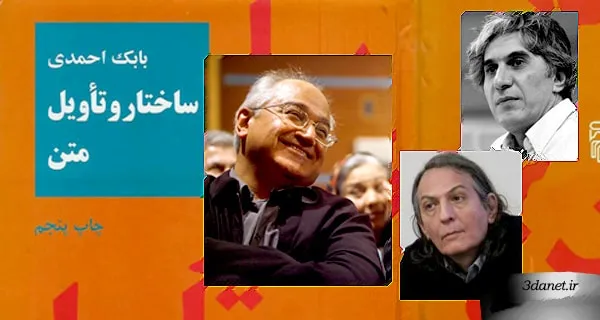
Introducing The Structure and Interpretation of the Text by Babak Ahmadi
Babak Ahmadi's Structure and Interpretation of the Text introduced concepts such as hermeneutics and structuralism to Persian readers on the cusp of the 1990s. Reviewing the ideas of thinkers like Derrida and Foucault, the work serves as a primer for beginners on these topics.
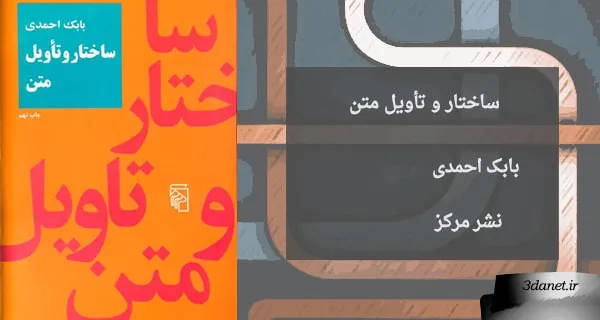
The Structure and Interpretation of the Text was the title of a book published precisely on the threshold of the 1990s; a work by Babak Ahmadi in which new concepts and themes were introduced together, in the form of a single book, in the Persian language: hermeneutics, Russian Formalism, deconstruction, and so on. In this book, names were presciently mentioned that would appear frequently in works, articles, writings, and books in the years to come: Michel Foucault, Jacques Derrida, Gilles Deleuze, Jürgen Habermas, Hans-Georg Gadamer, Paul Ricœur, Tzvetan Todorov, Umberto Eco, Roman Jakobson, Wilhelm Dilthey, Georges Bataille, Roland Barthes, Julia Kristeva, and others. The discussion of the text and its readings soon transcended the boundaries of literary criticism and even philosophical debates, and religious intellectuals also wrote books and articles on the subject, but the discussions in the aforementioned book had already done their work, and a large number of enthusiasts and young writers turned to serious, primary texts.
A decade later, the author of that book, Babak Ahmadi—now a well-known name to all those involved in philosophy and culture, who had published other works during this decade such as Modernity and Critical Thought (1993), The Book of Doubt (1995), Truth and Beauty (1995), Four Reports on Attar's Tazkirat al-Awliya (1997), and others—published a small book titled Structure and Hermeneutics with Gam-e No Publishing in 2001. The book was the product of lectures at the Polytechnic University (Amirkabir). During the summers of those years, students at the Polytechnic University organized sessions and invited Iranian intellectuals and thinkers to present lectures to students in their fields of interest. Structure and Hermeneutics was also the product of one of these classes. Babak Ahmadi himself, in the introduction he wrote to this small book, explained its content: "The subject of the lectures was two important schools of thought that emerged, developed, and became the source of numerous influences in the realm of philosophical discourse and the human sciences in the second half of the twentieth century. The first school is structuralism, which took shape mainly in France from the 1950s and gained considerable prestige among European and American researchers and academics for two decades, proving pioneering in anthropology, philosophy, aesthetics, art criticism, psychoanalysis, and even political studies.
A number of the main themes and theoretical problems of structuralism are still discussed among researchers in the human sciences and philosophy, especially where it encountered the famous critiques of post-structuralist criticism. The second school is hermeneutics, which, in the words of Gianni Vattimo, is today's common discourse in various disciplines of philosophy and the human sciences. In one sense, this school has a long history in the history of human culture, but it can be said that in its contemporary form, as it emerged in the last two decades of the twentieth century, it has offered new ideas and become the basis for unparalleled methods." Structure and Hermeneutics can, in one sense, be read as a summary of the first book, The Structure and Interpretation of the Text; a simplified text, particularly for students in technical fields who were not sufficiently familiar with the specialized terminology and background of these discussions. Now, after numerous reprints and a relatively long interval, this book has been reprinted with its fifth edition. In the interim, of course, numerous works by the thinkers mentioned have been translated and published, or various writings have been presented explaining their thought. Yet Ahmadi's book can still be useful for novice readers and acquaint them with the important terms and main intellectual lines of these two schools of thought.
.
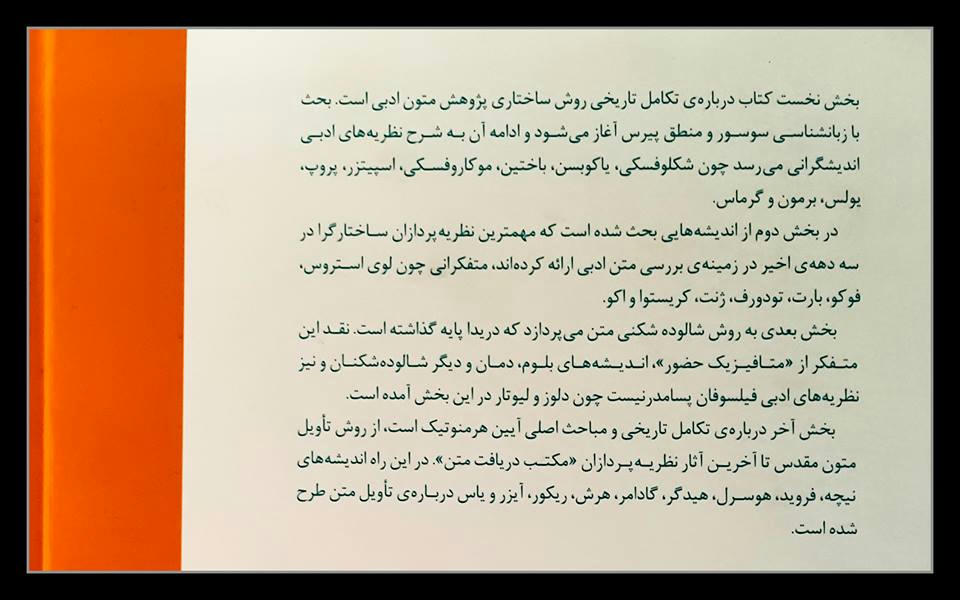
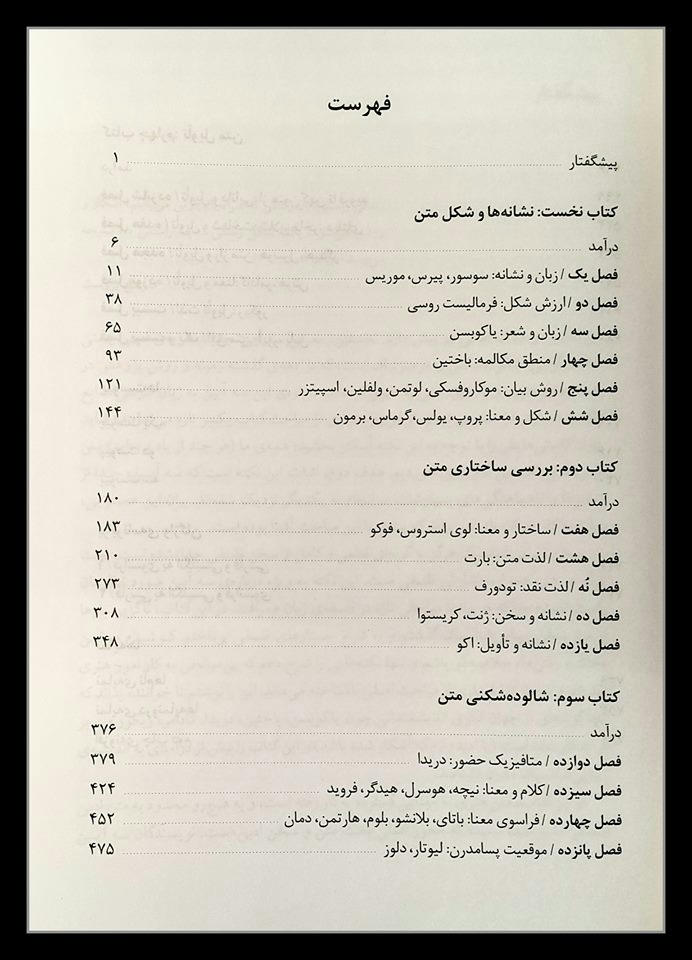
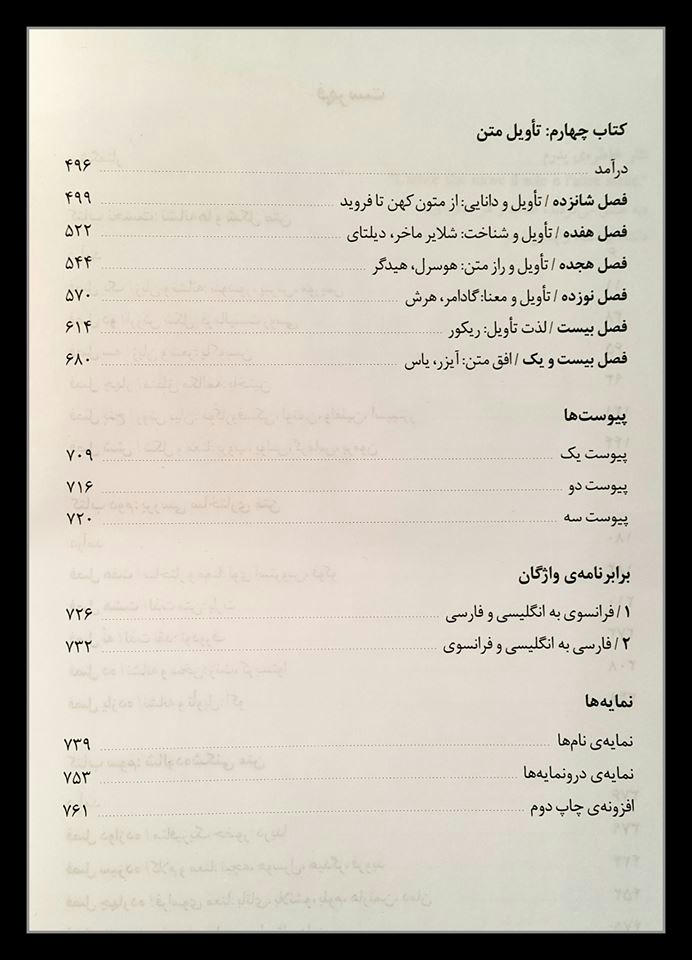
The first part of the book The Structure and Interpretation of the Text concerns the historical evolution of the structural method of researching literary texts. The discussion begins with Saussurean linguistics and Peirce's logic and continues with an exposition of the literary theories of thinkers such as Shklovsky, Jakobson, Bakhtin, Mukarovsky, Spitzer, Propp, Jules, Bremond, and Greimas.
The second part discusses the ideas that the most important structuralist theorists of the last three decades have presented in the field of literary text analysis, thinkers such as Lévi-Strauss, Foucault, Barthes, Genette, Kristeva, and Eco. The next section addresses the method of deconstructing the text, founded by Derrida.
This thinker's critique of the "metaphysics of presence," the ideas of Bloom, de Man, and other deconstructionists, as well as the literary theories of postmodern philosophers such as Deleuze and Lyotard, are presented in this section.
The final section concerns the historical evolution and main topics of the hermeneutic tradition. From the method of interpreting sacred texts to the latest works of the theorists of the "reception theory school." Along this path, the ideas of Nietzsche, Freud, Husserl, Heidegger, Gadamer, Hirsch, Ricoeur, Iser, and Jauss on textual interpretation are outlined.
.
.
The book The Structure and Interpretation of the Text by Babak Ahmadi was reprinted for the sixteenth time in 1393 (2014-2015) by Nashr-e Markaz.
.
.
Related Content:
A Critique of the Book “The Structure and Interpretation of the Text” by Babak Ahmadi, by Farhadpour and Abazari
.
.


Discussion2 comments
سلام بر بزرگواران، اول از همه باید ستایش کنم از این کارتون. خدا برکت به زندگی شما بدهد.. امکان داره کتاب های بیشتری در باب هرمنوتیک ادبیات ذکر کنید و یا درسگفتار در این باب پخش کنید ؟ یک دنیا تشکر.
ممنون