Philosophy
Lectures on Medieval Philosophy by Ahmad Rajabi
Ahmad Rajabi's lectures on medieval philosophy examine the intersection of Greek, Islamic, and Christian traditions, focusing on ontology and metaphysics—from Augustine and Thomas Aquinas to the collapse of medieval rationality and the groundwork for modern philosophy.
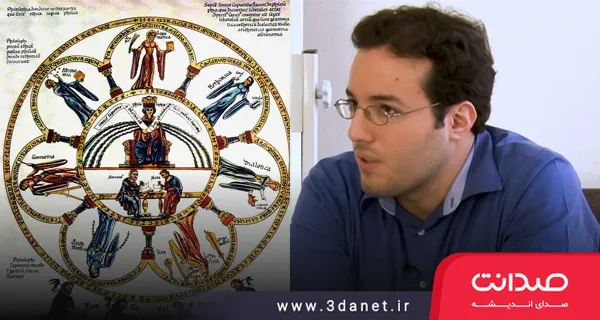
The history of medieval philosophy constitutes a vast field in the history of thought, both in terms of its temporal span and the breadth and interweaving of diverse intellectual traditions arising from ancient Greek, Hellenistic, and Roman philosophy, and especially the influence of Christianity and revealed religion, as well as in that medieval philosophy is the point of convergence and intersection between Greek philosophy, theology and mysticism, and Islamic, Jewish, and Christian philosophy, and also the ground in which modern thought germinated and philosophy distanced itself from its Greek origins. Addressing all of these aspects in a single four-credit course is impossible and undesirable, and one must necessarily make a selection; in this course, an attempt is made to select and discuss the continuity of several major philosophical problems, focusing on a few prominent philosophers, with attention both to their texts and to their reception of ancient philosophy as well as their influence on modern philosophy. The main focus throughout all discussions will be on ontology and the possibility of founding philosophy as metaphysics. The general headings of the discussions, in terms of problems, figures, and works, will be as follows:
1- An introductory discussion on the place and meaning of philosophy in relation to revealed religion and Judeo-Christian revealed theology: In this section, attention is given to passages from the texts of the Old Testament and the New Testament, through the discussion of which and the interpretations of the Church Fathers, the possibility of philosophy in the Middle Ages takes shape.
2- The problem of absolute skepticism and overcoming it, and the novel revival of philosophy through a new definition of the relationship between knowledge and being, truth and God: In this section, the focus will be, above all, on the discussions and texts of Augustine, and the connection of the new foundation of philosophy in his thought with epistemology, ontology, theology, and especially the discussion of eternity and time will be pursued.
3- The problem of universals: In this section, with a relatively detailed reference to the thought of Aristotle and his interpretation of the universal and the common in the philosophy of Plato, the philosophical dispute over this issue in the works of Boethius, Abelard, and the medieval realists will be addressed.
4- The problem of the existence of God and its proof: This discussion will be pursued with reference to the text of Anselm and the statement of his argument, and the place of this discussion in relation to the foundation of philosophy and its critique and influence up to modern philosophy.
5- The ontology of Thomas Aquinas: This discussion will be the most detailed section and, with reference to the texts of Thomas and references to Aristotle, Avicenna, and Averroes, the following topics will be set forth: the self-evidence of existence, the univocity and analogy of being, the transcendental determinations of being, the distinction between existence and essence, the act of being.
6- The problem of individuation and theological voluntarism, the collapse of the possibility of philosophical rationality with nominalism: This discussion will be our final section and, with reference to connected discussions from Duns Scotus and Ockham, will pursue how attention to the problem of individuation and the disappearance of the universal and the Platonic idea under the dominance of nominalism, and in connection with that, the emergence of theological voluntarism, came about, and the discussion of how, from the heart of highlighting Aristotelian individuation and the divine will, the rational system of medieval philosophy collapses and the skepticism that prepares the ground for modern philosophy arises.
These lectures were delivered virtually in the fall semester of 1400 (2021) as a four-credit undergraduate philosophy course at the University of Tehran.
.
.
Audio of Session One
Audio of Session Two
Audio of Session Three
Audio of Session Four
Audio of Session Five
Audio of Session Six
Audio of Session Seven
Audio of Session Eight
Audio of Session Nine
Audio of Session Ten
Audio of Session Eleven
Audio of Session Twelve
Audio of Session Thirteen
Audio of Session Fourteen
Audio of Session Fifteen
Audio of Session Sixteen
Audio of Session Seventeen
Audio of Session Eighteen
Audio of Session Nineteen
Audio of Session Twenty
Audio of Session Twenty-One
Audio of Session Twenty-Two
Audio of Session Twenty-Three
Audio of Session Twenty-Four
Audio of Session Twenty-Five
Audio of Session Twenty-Six
Audio of Session Twenty-Seven
Audio of Session Twenty-Eight
Audio of Session Twenty-Nine
Audio of Session Thirty
.
.

Discussion3 comments
با سلام ممکن هست راهنمایی کنید که کدام جلسه یا جلسات از ابلار بحث شده؟
سلام صوت جلسه بيست و چهارم فقط تا دقيقه ٢١ قابل شنيده شدن است. لطفا در صورت امكان فايل سالم را جايگزين كنيد. سپاسگزارم
سلام و ادب. اصلاح شد