Philosophy
Mahmoud Morvarid's essay 'Analytic Philosophy and the Muslim Tradition of Rational Sciences'
Analytic philosophy is a general approach grounded in precision and argumentation, not a specific school. An analysis of its components and evolution serves as a prelude to examining its relationship with the Muslim tradition of rational sciences.
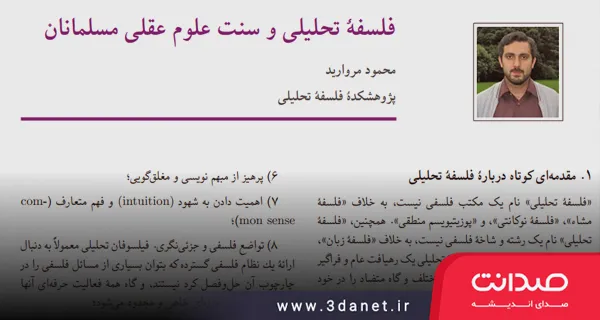

Mahmoud Morvarid
AuthorAnalytic Philosophy and the Muslim Tradition of Rational Sciences[1]
Published in Akhbar Journal, Vol. 26, No. 2, Summer 2019, Serial No. 93
1- A Brief Introduction to Analytic Philosophy
“Analytic philosophy” is not the name of a philosophical school, unlike “Peripatetic philosophy,” “Neo-Kantian philosophy,” and “Logical Positivism.” Likewise, “analytic philosophy” is not the name of a philosophical discipline or branch, unlike “philosophy of language,” “philosophy of mind,” and “metaphysics.” Analytic philosophy is a general and overarching approach that encompasses various disciplines and different, sometimes conflicting, schools. Historically, the movement known as analytic philosophy took shape in the late nineteenth and early twentieth centuries with the influential works of Gottlob Frege, and subsequently Bertrand Russell and G. E. Moore. In the twentieth century, this movement has been the dominant philosophical approach in English-speaking countries, and, of course, it gradually found its way to other parts of the world as well.
Setting aside the historical-geographical scope of the analytic philosophy movement, there are differing opinions regarding what analytic philosophy is and what distinguishes it from other types of philosophizing, which this brief space does not permit us to address. In a very rough and approximate summary, it can be said that the analytic method of philosophizing is that style of philosophizing which is based on precision, analysis, and argumentation. If we wish to elaborate on this summary slightly, we can enumerate the following components for the analytic method of philosophizing:
1_ Breaking down large-scale philosophical problems into smaller problems and meticulously examining each of the more detailed problems.
2_ Precise analysis of the words and concepts used in philosophical problems.
3_ Clarifying definitions, presuppositions, arguments, and claims, and distinguishing them from one another in each philosophical problem.
4_ Distinguishing the different stages of an argument and examining the reasons offered for or against each stage.
5_ The extensive use of logic and logical tools. Analytic philosophers make considerable use not only of classical mathematical logic but also of non-classical logics, especially modal logic.
6_ Avoidance of obscure writing and convoluted speech.
7_ Giving importance to intuition and common sense.
8_ Philosophical humility and particularism. Analytic philosophers are usually not seeking to present a broad philosophical system within which many philosophical problems can be resolved, and sometimes their entire professional activity is devoted to research in a specific and limited area.
9_ Attention to the empirical sciences and mathematics. Analytic philosophy stands in a two-way interaction with mathematics and the empirical sciences. On the one hand, analytic philosophers engage in philosophical reflection on empirical science and mathematics, the result of which is the disciplines of philosophy of science and philosophy of mathematics, and on the other hand, they utilize the achievements of the empirical sciences and mathematics in their own theorizing.
Of course, it should be noted that the above components are not meant to completely delineate the boundaries of analytic philosophy. It is quite possible that in some of the views and theories put forth within analytic philosophy, some of these components have a more prominent presence, while others are absent. However, it can be said approximately that in any theory falling under the analytic philosophy movement, at least some of the above components can be found. Many of the elements above, such as the emphasis on precision, analysis, and argumentation (components 1 to 7), also existed in past philosophers, and in a sense, it can even be said that philosophy is fundamentally nothing but precision, analysis, and argumentation. The difference between analytic philosophers and their predecessors is that analytic philosophers strive to apply the analytic method with greater precision and care in all areas of philosophy. Setting aside this difference, and also putting aside historical considerations, perhaps it can be said that in this broad sense of the word, the title “analytic philosopher” applies as much to Avicenna and Hume as it does to Russell, Wittgenstein, and Quine.
Now, when various philosophical topics are addressed using this same method of philosophizing introduced approximately above, the diverse branches of analytic philosophy emerge. For example, in the philosophy of language, the phenomena of meaning, reference, and linguistic communication are addressed through the analytic method of philosophizing. In metaphysics, we approach the universal principles of beings with this same method. In the philosophy of mind, we again reflect on the phenomenon of the mind and mental states in this same way. And the same analogy applies to other branches of analytic philosophy, such as epistemology, moral philosophy, and so on.
Analytic philosophy has passed through various periods from its inception to the present day. In some of its early and middle periods, the issue of language and meaning (and consequently the philosophy of language) held dominance within the analytic philosophy milieu. For instance, the logical positivists, the later Wittgenstein, and his followers more or less believed that the task of philosophy is to focus on the problem of language and meaning. In their view, by analyzing the sentences of language or reflecting on the uses of language, the traditional problems of philosophy dissolve on their own. In the words of the later Wittgenstein, the traditional problems of philosophy arise from the incorrect use of language, and by correcting its use, those problems will vanish. For this reason, this group of analytic philosophers fundamentally did not recognize metaphysical problems (at least in their traditional form). However, from around the mid-twentieth century onward, the dominant approach in analytic philosophy changed. Today, while most analytic philosophers fully acknowledge the importance of linguistic analysis, they do not believe that the sole task of philosophy is the analysis of language sentences or reflection on the uses of language. From their perspective, linguistic analyses, the application of logical tools, the distinction between the surface form and the logical form of sentences, and the like can clarify philosophical problems and consequently assist us in solving those problems, without necessarily dissolving them. For this reason, in recent periods of analytic philosophy, metaphysics has returned to the scene with renewed vigor and is now considered one of the advanced and fundamental branches of analytic philosophy. The story regarding disciplines such as the philosophy of religion is more or less the same. Today, one can no longer speak of the dominance of a specific branch (like the philosophy of language) over the analytic philosophy milieu; rather, various branches coexist and continue on their own paths.[2]
I now repeat the opening statement of this section: analytic philosophy is not a school or a philosophical discipline; it is a general current that encompasses diverse disciplines such as the philosophy of language, metaphysics, the philosophy of mind, epistemology, moral philosophy, the philosophy of religion, the philosophy of science, and so on. In each of these disciplines, conflicting theories have been presented within the framework of analytic philosophy, for and against which extensive arguments are offered. For example, in the philosophy of mind, two rival views, physicalism and anti-physicalism, are present, or in moral philosophy, two competing theories, cognitivism and non-cognitivism, have been presented, each having its proponents, and the same holds true for other parts of analytic philosophy.[3]
2- The Muslim Tradition of Rational Sciences and Its Relation to Analytic Philosophy
Some of the sciences that took shape within Islamic civilization have a distinctly "rational" character (as opposed to empirical and transmitted sciences). Logic, philosophy, rational theology, parts of legal theory (uṣūl al-fiqh), parts of theoretical mysticism, and portions of the rhetorical sciences can be counted among the rational sciences of Muslims. This rational tradition has continued for over a thousand years, with its ups and downs. Parts of these sciences still exist as a living and influential tradition in Iranian academic circles, both in the seminary and the university. It goes without saying that after centuries, the views of Avicenna, Suhrawardī, Mullā Ṣadrā, Ibn ʿArabī, and the theories of theologians are still taught in the seminaries of Iran. Likewise, legal theory is one of the most important axes of teaching and research in the seminaries. In the same vein, corresponding disciplines have been established in universities for teaching and researching these sciences. An interesting point is that, especially in the seminaries, the aforementioned sciences are viewed not as parts of the history of thought, but as living discussions and problems. In such an atmosphere, a very natural question arises for practitioners of analytic philosophy in Iran: what is the relationship between analytic philosophy, as a rational science, and the Muslim tradition of rational sciences? When the sapling of analytic philosophy is to be planted in a ground that is the inheritor of a rational sciences tradition spanning over a thousand years, an analysis of the relationship between this new approach and that historical tradition is a perfectly reasonable expectation. It is obvious that the question of the relationship between the Muslim rational sciences and analytic philosophy is too vast to do justice to in this writing. Here, I will merely point out that it seems there is a kinship and affinity between analytic philosophy and the Muslim tradition of rational sciences. This closeness has at least four main reasons (or four main aspects).
The first reason is historical. Analytic philosophy is, in truth, one of the continuations of the course of philosophical thought in the West, whose origins must be sought in ancient Greece. An important part of the Muslim tradition of rational sciences was also influenced by the ideas of ancient Greece. Therefore, it is not out of place if we say that analytic philosophy and the Muslim rational sciences share a common ancestor.
The second reason is the predominance of a "realist" approach in both intellectual traditions. According to the common perspective in both traditions, truths are established independently of the human mind and language, and human rational faculties can have limited access to these truths. Of course, it should not be overlooked that in analytic philosophy, there is a much more modest view (compared to the Muslim tradition of rational sciences) regarding the ability of human rational faculties. Nevertheless, it can generally be said that the dominant tendency in analytic philosophy, like the Islamic rational sciences tradition, distances itself from relativistic and skeptical approaches (I emphasize again that the discussion is about the dominant tendency in analytic philosophy; otherwise, rival theories also exist within analytic philosophy). In connection with this same point, in both intellectual traditions, philosophical problems themselves are important, and philosophical research is not reduced to research in the history of philosophy.
The third reason for the closeness between these two intellectual traditions is the similarity in the method of philosophizing. The most important components of the method of analytic philosophy were mentioned earlier. A set of these components can (albeit to varying degrees) also be observed in the Muslim tradition of rational sciences. In particular, in the Peripatetic tendencies and the rational parts of legal theory, the similarity in the methods of posing and examining problems is striking and noteworthy. Reliance on argumentation, the use of the method of objection and response (which is sometimes presented within the framework of the well-known format "in qulta... qultu..." [if you say... I say...]), the analysis of concepts and the refinement of definitions based on counterexamples, appeal to intuitions, etc., are clearly seen in these parts of the Islamic rational sciences tradition. Now that the discussion of "appeal to intuition" has come up, it is appropriate to mention that what is meant by "intuition" in analytic philosophy is neither mystical intuition nor intuition in the sense discussed in Kant's philosophy. The concept of "intuition" in analytic philosophy roughly (and not exactly) corresponds to the concept of "badāha" (self-evidence) or "irtikāz" (tacit presumption) in the Muslim tradition of rational sciences. Therefore, "intuitive propositions" in analytic philosophy are more or less equivalent to "self-evident propositions" or "propositions based on irtikāz" in the Muslim tradition of rational sciences, and it is clear that in this tradition, special attention is paid to self-evidence and irtikāz.
In any case, the third argument merely claims a similarity and closeness in method between analytic philosophy and the Muslim tradition of rational sciences. At the same time, one should not overlook the significant differences in the method of philosophizing between these two traditions. Among these differences, one can point out that the use of logical tools and linguistic analysis is far more prominent in analytic philosophy, and these tools themselves have, of course, undergone remarkable growth and development within the analytic philosophy milieu. Furthermore, although both analytic philosophers and Muslim philosophers often rely on intuition, these two groups have different conceptions of the epistemological status of intuition. Those analytic philosophers who accept the validity of intuition emphasize that intuition is, at most, a fallible piece of evidence or basis. However, the prevailing conception in Islamic philosophy seems to be that self-evident propositions are infallible.
Finally, the fourth reason or aspect of the closeness between analytic philosophy and the Muslim rational sciences is similarity in content; or, more precisely, similarity in the issues raised in these two intellectual traditions. Providing a summary list of the shared issues between these two domains is very difficult. Nevertheless, in what follows (Sections 3 and 4), I will very briefly touch upon some of the shared issues that exist between Islamic philosophy and legal theory (uṣūl al-fiqh) on the one hand, and various branches of analytic philosophy on the other.
3- A Brief Look at Some Shared Issues Between Islamic Philosophy and Analytic Philosophy
In the Peripatetic tradition, what was called "philosophical sciences" or "wisdom" (ḥikma) in this tradition has two main parts: theoretical wisdom and practical wisdom. Theoretical wisdom itself has three major parts: physics, mathematics, and theology. Theology, in turn, is divided into two parts. Theology in the broader sense (also called "first philosophy") deals with the general attributes of existents insofar as they exist. Theology in the narrower sense is dedicated to examining the attributes of the Necessarily Existent by Essence and immaterial beings. The term "philosophy" or "wisdom" was initially applied to the totality of these discussions, but over time, it became restricted solely to the theological part (in both the broader and narrower senses). In any case, the issues raised in Islamic philosophy share significant commonalities with at least three branches of analytic philosophy: metaphysics, philosophy of mind, and philosophy of religion. In what follows, only a very incomplete and general list of these shared issues is mentioned[4]:
A- Metaphysics: existence and its attributes, essence and its attributes, categories, substance and accident, the structure of material objects, the composition of matter and form, the indivisible particle, modalities (necessity, possibility, and impossibility), causality and its types, causal necessity, the impossibility of circularity and infinite regress in causes, space, time, the identity of material objects over time, the change of material objects, types of change (accidental motion and substantial motion), determinism and free will, truth and correspondence to reality, the fact of the matter (nafs al-amr), etc.
B- Philosophy of Mind: the problem of the nature of the soul, the soul's relation to the body, the immateriality or materiality of the soul, the nature of knowledge and its types, the problem of mental existence (these last two discussions are closely related to the problem of intentionality in contemporary philosophy of mind), the nature of mental states such as pleasure, pain, and will, the problem of knowledge by presence (this issue can have connections to the problem of phenomenal states), etc.
C- Philosophy of Religion: proofs for the existence of God, such as the argument from design, the argument from contingency and necessity, the proofs of the veracious (burhān al-ṣiddīqīn), the attributes of God, the simplicity of God, the relation of God's knowledge to human free will, the relation of God's power to human free will, God's relation to moral truths, the problem of evil, resurrection and the survival of the soul, etc.
The topics listed above are some of the issues raised in Islamic philosophy that analytic philosophers have also addressed in detail within metaphysics, philosophy of mind, and philosophy of religion. Of course, one should not overlook the very fundamental and important differences between these two traditions here either. Among the differences, it can be pointed out that both Islamic philosophy and analytic metaphysics (as well as analytic philosophy of mind and philosophy of religion) have their own specific issues; issues that have not been prominently raised in the other tradition. Furthermore, although the issues mentioned are in some respects common to both traditions, these very points of commonality are usually interwoven within a network of distinct theories and frameworks, such that establishing a correspondence between the two traditions is not so simple and requires extra care. Also, despite the aforementioned commonalities in issues, the manner of examining shared problems and even their formulation in these two intellectual traditions is completely distinct, and more importantly, the views adopted in response to the said issues sometimes have fundamental differences. It should also be added that analytic philosophers, partly due to their utilization of the advanced tools of modern logic, the use of techniques provided by the philosophy of language, and a systematic focus on problems, have achieved unprecedented levels of philosophical subtlety and complexity.
4- A Brief Look at Some Shared Issues between Principles of Jurisprudence and Analytic Philosophy
The discipline of Principles of Jurisprudence (Uṣūl al-Fiqh) is concerned with presenting and examining the methods of deriving legal rulings. This science is considered one of the foundational sciences in Islamic civilization; because, unlike Islamic philosophy, no significant precedent for it can be found in Greek civilization or other pre-Islamic intellectual traditions. The science of Uṣūl has passed through various periods over more than a thousand years. In the Shia tradition, the most fundamental recent transformation of this science occurred with the influential works of Shaykh Ansari (1214-1281 AH, 1799-1864 CE), and to this day, Principles of Jurisprudence has maintained its dynamism in Shia seminaries.
One of the interesting points in the science of Principles of Jurisprudence, especially in the later Shia Uṣūl, is the prominence and diversity of rational discussions in its various sections. Traditionally, the main focus of Muslim philosophers has been ontology. Hence, in the formal literature of Islamic philosophy, other branches of philosophy (such as philosophy of language, ethics, and epistemology) were not addressed comprehensively and systematically; although occasionally, insights into these topics can be gleaned from the discussions of Muslim philosophers. But what is interesting here is that the Uṣūlīs have tried to somewhat fill this gap and have addressed non-metaphysical philosophical issues in various discussions. Of course, the primary aim of the Uṣūlīs was not to deal with such topics; rather, they raised them as needed. For instance, in the discussions on words (alfāẓ) in Principles of Jurisprudence, the Uṣūlīs encountered the problem of the nature of meaning and how a word relates to meaning, and since such an issue had not been fully and precisely addressed in our philosophical tradition, they themselves engaged in philosophizing and theorizing, and thus, considerable discussions in the fields of philosophy of language, ethics, etc., emerged within the problems of the science of Uṣūl.
It seems that commonalities can be observed between the issues of Principles of Jurisprudence and at least five different branches of analytic philosophy: philosophy of language, philosophy of mind, ethics, epistemology, and the theory of rationality. In what follows, some of these cases are pointed out in a very general and cursory manner:
A- Philosophy of Language: The reality of coinage (waḍʿ), types of coinage, the reality of meaning, the reality of usage (istiʿmāl), literal and figurative usage, signs of literal truth, informative (khabar) and performative (inshāʾ) utterances, types of verbal implications (conceptual implication, primary assertive implication, secondary assertive implication), layers of the speaker's will (usage will, communicative will, serious will), the meaning of demonstrative pronouns (like "this" and "that"), the meaning of pronouns, the meaning of the form of declarative and performative sentences, the meaning of verb forms, the analysis of conditional sentences, and so on.
B- Philosophy of Mind: The problem of desire's attachment to a nature or an individual (this issue is in fact the problem of the structure and object of propositional attitudes), the analysis of conditional desire and conditional obligation (this issue corresponds to the discussion of conditional desire), the analysis of voluntary actions, the stages of the formation of a voluntary action, the nature of will, and so on.
C- Moral Philosophy: the nature of good and evil and moral obligation, the reality or conventionality of good and evil, the rationality or religious nature of good, the essentiality of good and evil, the rule of concomitance between the judgment of reason regarding good and evil and the judgment of the Lawgiver, the goodness of justice, the obligation of gratitude to the Benefactor, the goodness of obedience, the goodness of precaution, the evil of injustice, the evil of sin, the evil of insolence, the evil of imposing a duty on the incapable, the evil of punishment without explanation, the path of rational exemption (barāʾa ʿaqliyya) and the path of the right of obedience (ḥaqq al-ṭāʿa), etc.
D- Epistemology: the concept of authoritativeness (ḥujjiyya), the authoritativeness of certainty (qaṭʿ), the authoritativeness or non-authoritativeness of the certainty of the excessively certain (qaṭʿ al-qaṭṭāʿ), the authoritativeness or non-authoritativeness of certainty obtained through rational means, the authoritativeness of widely transmitted reports (khabar mutawātir) and solitary reports (khabar wāḥid), the authoritativeness of consensus (ijmāʿ) and widespread reputation (shuhra), etc.
E- Theory of Rationality: the nature of apparent ruling (ḥukm ẓāhirī), the reconciliation between real ruling (ḥukm wāqiʿī) and apparent ruling, the difference between an indicator (amāra) and a practical principle (aṣl ʿamalī), the rational practical principle, rational exemption and the right of obedience, the actualizing effect of indeterminate knowledge (ʿilm ijmālī), the argument from the closure of access (dalīl al-insidād), the rule of the requisite and the impediment (qāʿidat al-muqtaḍī wa-l-māniʿ), the problem of the opposite (masʾalat al-ḍidd), the problem of conflict (tazāḥum), etc.
The titles in the above list are mentioned according to the common terminology in the science of uṣūl al-fiqh, and analytic philosophers have also addressed similar or closely related issues in the aforementioned disciplines. Of course, here too, in the same manner as was stated at the end of the third section, there are fundamental distinctions between uṣūl al-fiqh and analytic philosophy in theorizing about and examining these very shared issues. Among them is that the mentioned issues are sometimes presented within distinct theoretical frameworks, and therefore, even the formulation of these issues in analytic philosophy and uṣūl al-fiqh is distinct. Also, the method of examining the issues and especially the adopted opinions sometimes have serious differences. Here too, analytic philosophers, aided by techniques of linguistic analysis and systematic focus on issues, have achieved considerable depth and precision.
5- Concluding Remarks
In the preceding sections, the proximity of the Muslim tradition of rational sciences to analytic philosophy was discussed from various aspects. Based on this, it is not far-fetched to say that the affinity of the Muslim tradition of rational sciences with analytic philosophy is far greater and more fundamental than with so-called continental philosophies (this statement is merely descriptive and in no way implies a value judgment about the mentioned intellectual traditions). Of course, this statement may seem strange to some, but I believe this strangeness can arise from a twofold neglect: neglect of the nature of analytic philosophy, especially in its later periods, and neglect of the discursive and argumentative nature of the Muslim rational sciences. If these two are removed, the proximity between analytic philosophy and the Muslim rational sciences will become more apparent.
The affinity between analytic philosophy and Islamic rational sciences provides a very favorable ground for comparative research between them.[5] It goes without saying, of course, that comparative-contrastive research has its own specific difficulties. Especially since, as was mentioned, we sometimes encounter distinct theoretical and conceptual frameworks. This difficulty is perhaps even greater in comparative research between uṣūl al-fiqh and analytic philosophy. One reason for this is that, as was mentioned, uṣūl al-fiqh, unlike Islamic philosophy, is considered a foundational science within the Islamic civilizational tradition. Many of the issues and concepts raised in Islamic philosophy are derived from the Greek tradition, and therefore, those same issues and concepts have historically been transmitted to contemporary analytic metaphysics as well. Hence, in a comparison between Islamic philosophy and analytic metaphysics, the very titles of the issues can to some extent indicate common points. For example, both in Islamic philosophy and in analytic metaphysics, issues related to "causality," "time," "space," "necessity," "substance," "motion/change," etc., are raised under these same titles (despite all the differences observed between these two traditions). But the story is different in many parts of uṣūl al-fiqh (especially the issues referred to under C, D, and E in the third section of this writing). In these parts, that historical chain established through the mediation of Greece is not prominently present, and therefore, at the very first step, finding common points and formulating them is difficult and complex.
In any case, through comparative research between analytic philosophy and the Islamic rational sciences, a two-way interaction can be established between them. On the one hand, by utilizing the frameworks and theories of analytic philosophy, the possibility of reconstructing, refining, precisifying, and developing the rational sciences of Muslims in various areas is provided, and on the other hand, the insights found in the rational sciences of Muslims may well create fertile ground for theorizing within the sphere of analytic philosophy. Various examples can be cited for this two-way interaction, the details of which require another occasion. In short, for those whose hearts are devoted to the rational sciences of Muslims and who seek the flourishing and modernization of these sciences, serious and comprehensive attention to analytic philosophy is an unavoidable necessity.[6]
.
[1] - The present writing is by no means a philosophical article. For many of its claims, no evidence or argument has been provided, and fundamentally, there is no room for such a thing in this short piece.
[2] - It is appropriate here to mention two interrelated misunderstandings about analytic philosophy in the Iranian context. The first misunderstanding is that analytic philosophy lacks metaphysics. This statement can only stem from ignorance of the developments in analytic philosophy in recent decades. If metaphysics is the same activity that Aristotle, Avicenna, Aquinas, and others engaged in, it must certainly be said that metaphysics, in an advanced and precise style, has a prominent and significant presence in analytic philosophy. The other misunderstanding is that analytic philosophy is nothing but the philosophy of language. This statement may hold some truth only regarding some of the early or middle periods of analytic philosophy.
[3] - For a useful article on analytic philosophy, see Hamid Vahid's essay entitled "Analytic Philosophy: History, Method, and Nature" in this same issue.
[4] - In the lists that will appear in this section and the next, the titles mentioned are based on the terminology common in Islamic philosophy and the principles of jurisprudence (usul al-fiqh). In some cases, the corresponding issues in analytic philosophy are noted in parentheses.
[5] It is worth mentioning that one of the goals of the Comparative Studies Core, formed at the Research Center for Analytic Philosophy of the Institute for Research in Fundamental Sciences (IPM), is precisely this: conducting comparative research between analytic philosophy and the rational sciences of Muslims.
[6] - I am grateful to Mohsen Zamani for reading this piece and suggesting useful points.
.






Discussion2 comments
احسنتم! از نگاه من، در روشن شدن پاره ای از مفاهیم و حوزه های فلسفی و درک اجمالی مفهوم فلسفه ی تحلیلی خیلی عالی بود!درود بر نویسنده و نشر دهنده!
حضور آقای محمود مروارید نقطه روشن جامعه فلسفی ایران و منبع طرح مسائل واقعی و بدیع فلسفی است. روحیه ای الهام بخش که توسل به اعتبار دیگران را بعنوان تنها رفتار فلسفی کنار گذاشته است.اگر که اگر نیک بنگریم، در حالی که افراد شناخته شده جامعه فلسفی به نحوی اعتباری ارتقاء یافته اند، آقای محمود مروارید اندیشه، روحیه پرسش گری و اجتهاد بدیع را به جامعه فکری عطا می کند.