اندیشهفلسفهخردگفتگوحکمتمعناپرسشفرهنگ
Philosophy
Misunderstanding the Logic of Politics
Morad Farhadpour drew on cultural Marxism to critique capitalism, but his reliance on a closed lexicon and fallacious analogies has distorted his analysis of economic and political crises.
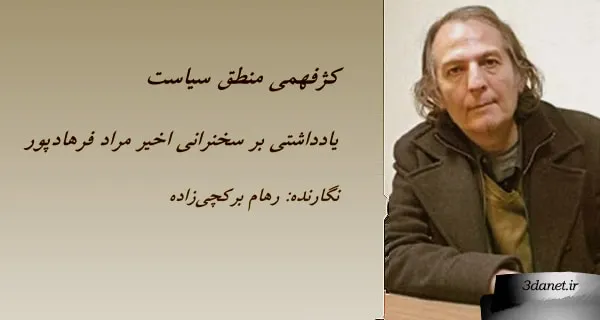
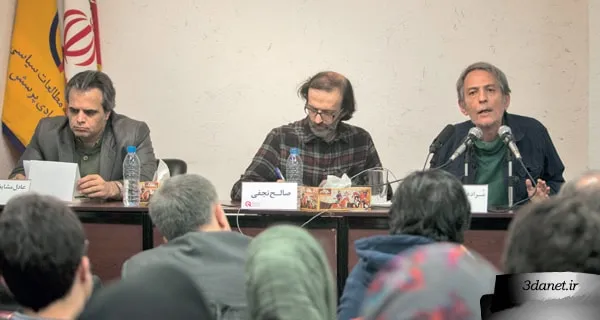
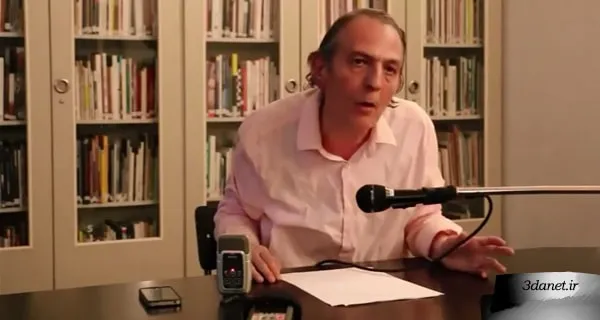
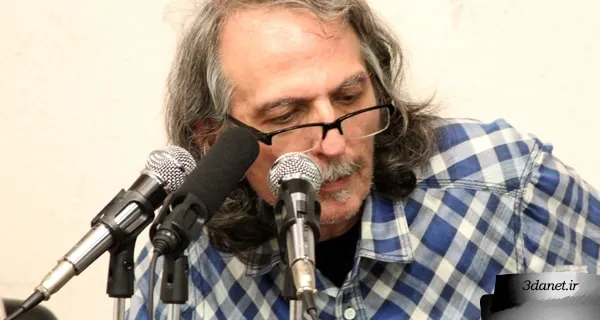
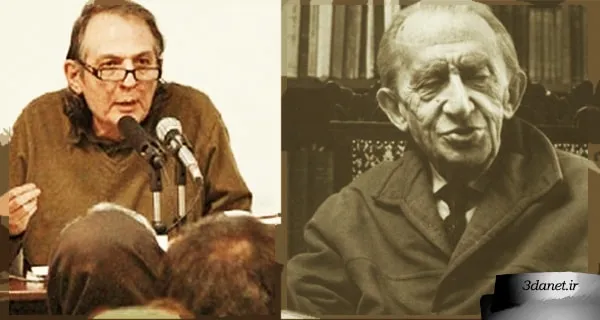
On Thursday, December 9th, many people came to the well-known Porsesh Institute to witness a lecture by the prominent New Left intellectual, Morad Farhadpour, and two other intellectuals close to him, on the subject of the link between “Philosophy and Politics.” Despite the program’s executive director emphasizing that the speakers belong to a current “ostracized” from academic and media circles, and that “Porsesh” has been neglected by active philosophical circles nationwide, Morad Farhadpour, as the most prominent figure active at Porsesh, has always (including for this lecture) been the subject of increasing attention from the media, as well as from students and those interested in philosophy and the humanities. Yet this fame has not prevented Farhadpour from always taking serious pride in not being an academic figure, nor from striving to discredit the university and academic intellectuals. As if, in his and his like-minded peers’ opinion, if academic activity in the field of philosophy is not so dynamic and progressive, extra-academic intellectual circles are very dynamic and influential, and new ideas constantly emerge from them. He and his circle of students and associates have drawn attention particularly through introducing a range of radical French and Italian thinkers and philosophers; but in addition, Farhadpour is also famous for his passionate and fierce lectures against globalization, capitalism, the culture industry, and the Enlightenment project. What is evident in the framework and content of Farhadpour’s lectures is his clear borrowing from the major current of European cultural Marxism; something he himself has repeatedly affirmed and acknowledged. In this lecture too, which bore the title “Philosophy and the Truth of Today’s World” and dealt with everything except the act of illuminating the—in the author’s words—special role of philosophy in confronting the crises of the present world, just as he himself emphasized at the beginning of the lecture, we heard no new, thought-provoking, or noteworthy point.
Misunderstanding the Logic of Politics
A Note on Morad Farhadpour’s Recent Lecture
Author: Roham Barkchizadeh
Introduction:
On Thursday, December 9th, many people came to the well-known Porsesh Institute to witness a lecture by the prominent New Left intellectual, Morad Farhadpour, and two other intellectuals close to him, on the subject of the link between “Philosophy and Politics.” Despite the program’s executive director emphasizing that the speakers belong to a current “ostracized” from academic and media circles, and that “Porsesh” has been neglected by active philosophical circles nationwide, Morad Farhadpour, as the most prominent figure active at Porsesh, has always (including for this lecture) been the subject of increasing attention from the media, as well as from students and those interested in philosophy and the humanities. Yet this fame has not prevented Farhadpour from always taking serious pride in not being an academic figure, nor from striving to discredit the university and academic intellectuals. As if, in his and his like-minded peers’ opinion, if academic activity in the field of philosophy is not so dynamic and progressive, extra-academic intellectual circles are very dynamic and influential, and new ideas constantly emerge from them. He and his circle of students and associates have drawn attention particularly through introducing a range of radical French and Italian thinkers and philosophers; but in addition, Farhadpour is also famous for his passionate and fierce lectures against globalization, capitalism, the culture industry, and the Enlightenment project. What is evident in the framework and content of Farhadpour’s lectures is his clear borrowing from the major current of European cultural Marxism; something he himself has repeatedly affirmed and acknowledged. In this lecture too, which bore the title “Philosophy and the Truth of Today’s World” and dealt with everything except the act of illuminating the—in the author’s words—special role of philosophy in confronting the crises of the present world, just as he himself emphasized at the beginning of the lecture, we heard no new, thought-provoking, or noteworthy point.
It should be noted that all quotations that follow are referenced from the transcript of the speech published by the Etemad newspaper. Although, like other transcribed speeches, it has been edited and refined, with a very limited number of references corrected, it nonetheless encompasses the vast majority of the points raised by Mr. Farhadpour.
Farhadpour is a thinker who, with a limited vocabulary of terms such as globalization, fascism, neoliberalism, and the like, recklessly describes and explains events large and small from every corner of the world. Many readers of the present text have read or heard about his extreme and radical interpretation of cinema in the book Paris-Tehran; an entirely irrelevant and unfaithful reading of Kiarostami's cinema that only the book's dialogic structure allowed to assert itself. This same narrow-minded use of a limited circle of words and meanings has caused Farhadpour to repeatedly fall into the trap of fallacious analogies; such as when he views financial embezzlement and administrative corruption—in this very recent speech—as being of the same nature as the common monetary and tax policies of crisis-stricken governments to repair bankrupt sectors of the economy, and says:
"This situation and what we have experienced is by no means exceptional or unique to us. This is another one of the false notions that, incidentally, some opponents of capitalism have fueled—that the backward, irrational, corrupt capitalism of the Third World is different from the clean, tidy capitalism of Europe and the West, whereas we have witnessed the outbreak of crisis everywhere."
Here, Farhadpour simply disregards the importance of transparency and the health of countries' economic systems and imagines the financial and economic crises of countries like Iran to be of the same kind as the global financial crisis of 2008, whereas not only were the foundations of their formation fundamentally different, but they also yielded different consequences. The 2008 global crisis was not caused by administrative corruption and a lack of transparency in budget spending, nor by an untimely and disproportionate increase in government spending and the creation of an inflationary wave due to oil price fluctuations. Therefore, speaking of these two crises (Iran's inflation and recession crisis of recent years and the 2008 global crisis that led to massive bailouts) as if they are of the same kind can only originate from ignorance and imprecise analysis.
Or elsewhere, he imagines the deliberate bombardment of a multitude of hospitals and densely populated areas by the Syrian and Russian air forces to be of the same nature as the accidental bombing of a hospital in Kunduz, Afghanistan, around which Taliban forces were building fortifications and starting fires. Although Mr. Farhadpour, surprisingly, instead of referring to the bombed hospital in Kunduz, points to the bombing of hospitals in Yemen by the United States Air Force; something that has not happened to date! He says: "Today we are witnessing that America and Russia are bombing hospitals in Syria and Yemen, and no protest takes place." Whereas we know that in both cases (Syria and Kunduz), widespread international protests occurred. Although these may not have been very fruitful in the case of the bombings in Syria (in the case of the Kunduz hospital bombing, the United States government was forced to issue a formal apology and promised to pursue the matter legally), they were effective in slowing down and reducing the intensity of military operations; while in the not-so-distant past, such an effect clearly did not exist (for example, in the Persian Gulf War and Vietnam). Today, the vast and extensive coverage of mass media and social networks across the globe has created a situation where covering up crimes that were previously hidden, or whose dimensions could only be understood much later than when public pressure and international human rights institutions could be used to stop or reduce their intensity, is no longer possible. If Mr. Farhadpour believes that these pressures are still not as effective as they should be, he is undoubtedly right, and others agree with him; but comparing the existing situation with an ideal state is based on counterfactual expectations. The pressure of public opinion and international institutions in today's world must only be compared with the world of a few decades ago, and in that case, speaking of the total "rottenness" of the world today will become meaningless.
In all these instances, what has led Farhadpour to a mistaken understanding of the origin of events is ideological narrow-mindedness and clinging to the framework of a closed lexical system in which he has been trapped for years and from which he is unable to escape. This same dogmatic tendency has caused Farhadpour, in this lecture, with astonishing disregard, to label “all” the governments established in the Islamic Republic of Iran as “neoliberal” and to say: “As far as the economy is concerned, all governments were neoliberal, and in all of them, Iran was economically integrated into the global market, and in this very postmodernism, which ultimately can produce nothing but corruption and decay, apart from that same opiate of art.” Acknowledging such a statement is impossible without the misplaced and sloppy application of terminology common in the literature of cultural Marxism. This sloppiness is so blatant and obvious that even he himself, at the beginning of this lecture, tried to cover it up with a humorous tone: “Philosophy has always dealt with the universal, and I am exploiting this aspect of it, making statements that may be generalizations, with no room for proving them.” Truly, even if we wish to be “generalizers” and avoid technical details, how can we characterize Iran’s economy as neoliberal or “integrated into the neoliberal world system”? How can one call the economy of a country where markets, as well as large enterprises, are monopolistic and completely controlled, and where prices are determined not around their equilibrium points in the arena of supply and demand, but by state pressure and security control, neoliberal, without having a profound misunderstanding of the meaning of neoliberalism and its foundations?! An economy in which almost all major production and service projects are state-owned or quasi-state-owned, and whose most important industries have been under sanctions for years, in what sense can it be considered neoliberal? Even if we consider the removal of energy carrier subsidies—which was promoted and encouraged by the World Bank throughout the region and pursued as a purely scientific economic policy in other countries with oil-based economies, such as Saudi Arabia—as a form of compliance with the neoliberal world system, this can ultimately only be considered a small, initial step towards liberalization, and nothing more!
In what follows, I will proceed to analyze the main points and passages of Farhadpour’s lecture from its beginning, demonstrating the fallacious nature of some of his claims on the one hand, and the inadequacy of his other claims on the other.
The Mission of Philosophy:
Farhadpour begins his lecture with a definition of philosophy, considering it as the “search for truths” or “love of knowledge” in a way that can be articulated in relation to the duality of “crisis/critique.” Thus, philosophy deals with a “crisis-ridden” society confronted with critique. He claims that philosophy, “in its specific form,” despite its “universality,” manifests itself in the “particular” and specific. Hence, philosophy, despite its “universality,” is rooted in ancient Greece; a society which, in Farhadpour’s view, resembles our society today due to its “formal democracy” and in “certain other respects.”
Considering the research of recent decades in the history of world philosophy, emphasizing a specific geography for the beginning of philosophical thought is misleading. We know that forms of political thought existed, for example, in Confucianism and the Legalist school[1] of Han Feizi—which can be considered two interpretations of conservative Platonism in Chinese wisdom—manifestations of which we still witness in the extensive bureaucracy of China’s socio-political system today. The diverse metaphysical forms that emerged and flourished in the various branches of Indian philosophy, although they cannot be considered a type of political philosophy in the modern sense, can be regarded as a kind of “trans-political” or anti-political metaphysics; a kind of radical metaphysics that seeks to transform reality in a more fundamental way by suspending the political and social praxis. Therefore, all these schools of thought are also based on methods for critiquing the existing state of affairs and striving to overcome it, or to fundamentally change it.
اما برخلاف آنچه فرهادپور میگوید تحولاتی که جامعۀ انسانی در گذر تاریخ تجربه کرده، نه تحولاتی صوری، که تحولاتی واقعی بوده و پیامدها و دستاوردهای واقعی به ارمغان آورده است. امروزه دیگر خبری از نظامهای آپارتاید جهان باستان نیست. هر چند شاید بتوان بر این انگارۀ چپگرایانه صحه نهاد که دموکراسی پارلمانی امروز، دموکراسی کاملی نیست (زیرا شهروندان از توانایی یکسان و برابری برای اثرگذاری بر مناسبات اجتماعی و سیاسی برخوردار نیستند) اما اگر برابری «عملی» وجود ندارد، دستکم شکلی از برابری «حقوقی» وجود دارد که در آتن باستان وجود نداشت. (که این برابری حقوقی هم بیتأثیر نیست.) همین برابری حقوقی، نژادی، جنسیتی و قومی مدیون مبارزات مستمر و خستگیناپذیری بوده است.
در نگاه فرهادپور چه چیزی در پیشِ روی جامعۀ بحرانزده و مواجه با نقد قرار دارد؟ یا رجعت به اسطوره و امر مطلق - که فرهادپور دموکراتهای آتنی را به سبب محاکمۀ سقراط در حال گام برداشتن در این مسیر قلمداد میکند – و یا مبارزه با سفسطه به مثابۀ نوعی «نسبیگرایی».
اما «سفسطه» در نظر فرهادپور به معنای گرایش به این ایده است که «هیچ حقیقتی وجود ندارد و آنچه هست تنها رتوریک یا خطابه است، مشابه آنچه امروزه رسانه و فرهنگ و زبان و همۀ آنچه برای مداخله در افکار عمومی هست، خوانده میشود.» بنابراین در اندیشۀ افراطی فرهادپور، رسانه و فرهنگ، زبان و هر آنچه برای اثرگذاری بر افکار عمومی به کار میرود، شکلی از خطابه و خالی از حقیقت است. به عبارت دیگر به زعم او، رسانه و فرهنگ عامیانه به کلی عاری از هر عنصری از «حقیقت» بوده و صرفاً با استفاده از شکلی روزآمد از فنون خطابه، برای فریب دادن شهروندان به کار میرود. این سخن یادآور جملۀ بسیار مشهور بودریار است که در آن مدعی شده بود «جنگ خلیج فارس اتفاق نیفتاده است.» به این معنای استعاری که آنطور که رسانهها گفتند و نشان دادند اتفاق نیفتاده است. فارغ از اینکه این تعبیر تا چه حد صادقانه و مطابق با واقع است، میتوان پرسید اگر رسانه و به عبارت کلیتر تمامی عناصر فرهنگ، شکلی از حجاب حقیقت هستند، چگونه ایشان و دوستانشان با اعتماد به همین رسانهها بر بمباران بیمارستانها توسط روسیه، یا به کار بردن سپردههای شهروندان برای بازفعالسازی بنگاههای ورشکستۀ مالی و تولیدی آمریکایی صحه گذاردند؟! لابد شخص ایشان به شکلی مستقیم در جریان تمام این اتفاقات بودهاند و حقیقت به طور بلاواسطه بر ایشان مکشوف شده! بنابراین با وجود آنکه نطفهای از حقیقت در کلام فرهادپور وجود دارد و به راستی وظیفۀ خطیر نقد فرهنگ عامه و مظاهر آن بر دوش فیلسوفان است، اما این نطفۀ صادقانه، در زیر بار بیان افراطی فرهادپور له شده است. نقد رسانههای عمومی و سازوکارهای ژورنالیستی از دیرباز متداول بوده و حتی متفکران و ادیبان قرن نوزدهمی همچون گوته هم بسیار دربارۀ آن سخن گفتهاند، اما شکل رادیکالی که این نقد در مارکسیسم فرهنگی به خود گرفته و در زبان تند فرهادپور متجلی میشود، درونمایهای خیالی مییابد. در واقع اگر امثال فرهادپور دستاویزهایی برای نقد در اختیار دارند، آنها را همین رسانههای به تعبیر او «سوفسطایی» در اختیارشان قرار دادهاند؛ و این تضاد «منافع شخصی» یا گروهی که فرهادپور آن را سرچمشۀ شر و حجاب حقیقت میپندارد، همان عاملی است که موجب میشود هر کدام از جریانهای فرهنگی و رسانهای به فراخور سوگیریهای متفاوتشان، گوشههای متفاوتی از حقیقت را عرضه کنند و با ارائۀ خوانشهای متنوع از حقیقت، چشمانداز واقعیتری از جهان و رویدادها به نمایش بگذارند. اگر امثال فرهادپور میتوانند مناسبات اجتماعی و سیاسی جهانی را نقد کنند، این کار را تنها در فضایی لیبرالی و مبتنی بر تضاد منافع گروهی میتوانند عملی کنند و خوراک نقدشان را تفاوت و گاهاً تضاد سوگیریِ رسانههای رقیب تأمین میکند؛ چه اگر این تضاد منافع و سوگیریها نبود، آنها نه از بمباران بیمارستانهای سوریه خبردار میشدند و نه مناسبات جهانیسازی که مدام از آنها به انتقاد یاد میکنند. بنابراین اگر فرهادپور به مثابۀ روشنفکری «رسانهای» و نه مطرود وجود دارد، آن را مدیون فضای رقابتی رسانهها و فرهنگها در جهانی لیبرالی و مبتنی بر تضاد منافع است و نه آرمانشهر «کمونیستی» که خود از آن سخن میگوید. تجربۀ تاریخی به روشنی نشان داده است که اضمحلال نهادها و برنهادهای اجتماعی و فرهنگی در قالب سنتزهای انقلابیِ انجسمگرا و فراگیرنده، به اشکال نامنعطفتر و ایستاتر طبقات و گروههای متباین و ناهمگون اجتماعی و ایدئولوژیک منجر شده است. این نشاندهندۀ آن است که تضاد منافع فردی و گروهی همواره وجود داشته و خواهد داشت و امر سیاسی به تعبیر کارل اشمیت در همین تضاد منافع، تعبیر و تعریف میشود و هرگونه تعلیق موقت تقابلهای فردی و گروهی، به بازآرایی سیاسی جدیدی منجر میشود.
بنابراین همانطور که دیدیم فرهادپور فلسفه را شکلی از کنش سیاسی میداند که وظیفۀ نقد جامعۀ بحرانزاده را بر دوش میکشد و در میانۀ دوگانگی سفسطه و اسطوره، میکوشد راه سومی باز کند. بنابراین در نگاه او فلسفه در عرصۀ پراکسیس است که ظهور میکند و نه صرفاً در تبیین واقعیت، بلکه در تغییر واقعیت نمود پیدا میکند. اما به زعم فرهادپور تاریخ فلسفه، تاریخ شکست خوردن در تحقق این غایت است:
«اما چنان که دیدیم، فلسفه این توانایی را نداشت. این هم در مورد افلاطون مشهود است و هم در رابطۀ اسکندر و ارسطو؛ یعنی شاهدیم حرکت به سمت قدرت و ایدههایی چون پادشاه-فیلسوف اجازۀ اینکه واقعیت تغییر کند و در نتیجه راه سومی گشوده شود را نداد.»
Therefore, Farhadpour argues that the idea of aristocracy or elite rule, which resulted from the proximity of philosophers to the center of power and the effort to structurally transform it from within, has failed and has even become an obstacle to change. Farhadpour makes this claim in a context where Plato's utopian idea has not only failed to find an opportunity to emerge and manifest, but has also been lost and buried in a corner of history. Nevertheless, while Farhadpour emphatically declares its failure, he refuses to accept the failure of communism and the continuous experience of catastrophe with the emergence of the dictatorship of the proletariat across the corners of human history and geography, and still tirelessly clings to Marx's revolutionary theses. But if, in the words of Saleh Najafi (another speaker at this event), the philosopher's sole and only task is the "repetition" of the experience of revolution through the reinterpretation of its "creative shock," why should one not commit to the redefinition and revolutionary rebirth of the Platonic kind; a revolution for the creation of a severely class-based system, in opposition to the class-dismantling communist revolution? Najafi seeks help from Beckett and Benjamin to defend the ideal of the "repetition of failure," provided that the subsequent failure is a "better" failure. But if, in Benjamin's terms, the Russian October Revolution was a renewal of the French Revolution to "compensate" for it, in practice it was not only not compensatory, but a far more terrible failure and a much greater loss. If, in Benjamin's terms, the Russian Revolution stepped forward seeking the mirage of extracting the buried creative shock of the failed French Revolution from under the rubble of history, in practice it left behind a more ruined wasteland. Najafi, speaking in agreement with Farhadpour about the necessity of the "repetition of failure" in the combined realm of practice and theory, philosophy and politics, ignores the destructive potential of repetition and considers the other creative embryos that have been trampled during the "repetition of failure" as nothing. They do not pay attention to the fact that in the realm of practice, if the October Revolution had not triumphed with the weapons of the Bolsheviks, and if Lenin, after the defeat in the Constituent Assembly elections, had not ordered its dissolution, the coalition of centrist socialist forces with the liberals on one hand, and the coalition of the new assembly's political currents with former military personnel on the other, might have ushered Russia into a new historical era from which it was practically prevented. Thus, such an ill-considered and untimely "repetition," instead of compensating for the failure of the Great French Revolution, turned out to be a far more terrible failure that strangled the truly generative force of the revolution in its infancy. The repeated experience of inconclusive repetitions should free us from one-sidedness and direct attention to the "economy of life"; to what the opportunity cost of such a repetition might be. In other words, the emergence of any generative force is accompanied not only by the collapse of pre-existing structures, but also by the suppression and repression of other generative forces and ideas. To understand such a perspective on the economy of life, one must abandon the conventional Hegelian conception of the unidirectionality and perpetual progress of history toward the Absolute and arrive at a more flexible understanding of the openness of possibilities in historical moments. Therefore, the initial question when confronting the category of the repeatability of experience and its consequences is: what form is the repetition supposed to take? Although the idea of revolution is completed during revolutionary action, in order to be compatible with considerations related to the economy of life, it must be based in advance on theoretical schemas that outline, however vaguely, its outcome. When it comes to such a situation, the thinkers and intellectuals of the New Left fall silent and only intensify the sting of their critique against the "free market" and the "miserable existing state of affairs." Thus, the more fiery the language of Farhadpour and his like-minded colleagues becomes in criticizing the capitalist and liberal system, the less their fervor becomes in presenting an alternative model. When facing any economic or social crisis, they consider the efforts of governments to contain the situation and reactivate stagnant economic sectors as an attempt to "preserve existing conditions" or "prevent the eruption of revolutionary potentials"; as if, in the absence of a clear theoretical perspective on the future of the crisis, failing to contain it with existing economic tools (such as borrowing from other governments, issuing bonds, or borrowing from the central bank) might not have irreparable consequences and, with the relentless spread of recession and unemployment, provide the ground for the emergence of a kind of full-blown anarchy leading to the dominance of populist political groups or totalitarian governments.
In that case, restoring this situation to its original state requires spending far more time and money than the effort needed to resolve the crisis at the very beginning of its formation; and its cost is paid by the middle and lower classes, who become unemployed during the bankruptcy of large manufacturing firms. If the United States government had sat on its hands during the 2008 crisis and allowed large firms such as “General Motors” to go bankrupt, replacing them with smaller firms would not have been feasible in the short term; and at least in the short term, we would have faced a massive wave of unemployment and a sharp decline in exports, which, especially given the complexity of today’s global economic system, could have inflicted longer-term damage on the United States economy as well. Therefore, the Obama administration rightly sought an immediate solution to the crisis and tried to revive large manufacturing and service firms in a way that would entail the least damage to the national economy.Three Features of Today's World:
Farhadpour then says something strange: “I have repeatedly emphasized that in the era we live in, the economic paradigm is neoliberalism, the political paradigm is securitization and the war on terror, and culturally, a kind of postmodern aesthetics prevails. As a result, this era confronts us with a dilemma that I have tried to refer to through the Bush–Bin Laden binary. Although when I first raised this issue, I did not know that reality could be so rich as to combine Bush and Bin Laden in the form of Trump or Putin.”
All three features that Farhadpour attributes to “today's world” are exaggerated and exemplify fallacious overgeneralization. The claim that the economic order of today's world is a neoliberal order cannot be substantiated merely by relying on the fact that major global financial and economic institutions such as the “World Bank” and the “International Monetary Fund” have adopted a neoliberal conception of economics and promote it worldwide. If by neoliberalism we mean the conception of the principles of economics held by members of the Austrian School in the post-World War II world, and subsequently the achievements of the Chicago School in the 1970s, it can rightly be said that a large part of the world economy still follows a pre-liberal logic. Numerous countries in Latin America such as Venezuela, Bolivia, Ecuador, etc., numerous countries in Africa and the Middle East, as well as those states that have adopted a “state capitalist” economic structure (such as China), should not be called neoliberal; for the simple reason that a large part of their economies, namely their domestic economies, does not follow liberal principles such as the free market, extensive privatization, and the restriction of the state's role to the distribution of public goods and the legal regulation of the market. However, the notion that the neoliberal paradigm is expanding in the global economy is correct, and the reason for this must be sought in the efficiency and historical success of this economic logic in reducing poverty, unemployment, and inflation, and maximizing per capita production. In Latin America, governments that followed the so-called neoliberal logic in the post-war decades, such as Chile and Argentina, experienced the highest rates of economic growth. Governments that relied heavily on socialist logic—the most important of which are Cuba and the oil-rich Venezuela—have in recent years faced widespread political and economic crises, among which one can point to the energy crisis in Venezuela last year, which led to massive demonstrations by Venezuelan students and youth and forced the government of the time to concede.
Regarding Mr. Farhadpour’s characterization of the political logic governing the world as a “security” logic based on “terror,” one must ask: has there ever been a time in world history when such a logic did not prevail? Has the scale and scope of terror and security control increased in recent decades, which he considers the “era of neoliberalism”? Clearly, the security environment, repression, and violence in the last four decades—which Farhadpour calls the decade of “pure rot”—have diminished compared to all previous historical periods. Even the dimensions of social violence and crime at the level of nations worldwide have, according to statistics, continuously declined, and we owe this to the very liberal logic and the—in Farhadpour’s view—false and illusory democracy; because the reduction of poverty levels and consequently crime is possible not through the controlling methods of communist states, but only through increasing the general level of wealth and incomes, which in turn requires sustained and stable economic growth. Farhadpour simply claims: “Today, this very security paradigm, the fear of terrorism, and the war on terror are just as determining as the Cold War and the struggle against the evil Soviet empire were 50 years ago.” But these two are not only not issues of the same kind, they are also incomparable in terms of scale. If today, in the domestic politics of Western governments, the limited wiretapping and surveillance of citizens’ conversations is a fundamental subject of critique and its removal a basic human rights demand, during the Cold War, the violent and systematic suppression of leftist and rightist social movements was the subject of critique and protest. If in the present era, the torture of individuals suspected of collaborating with terrorist organizations is abolished under public pressure, during the Cold War it appeared an established and unchallengeable matter. If today an international military coalition is formed against ISIS, during the Cold War a coalition of all states around a regional policy was impossible. The reason for this must be understood in the fundamental difference between the ideological atmosphere governing the Cold War and the ideological atmosphere governing the war on terror; the difference between the global fear of radical Islamism as the violent “resistance” of a minority and declining movement against the formation of a modern and secular Middle East, and the mirage of communism as a progressive, supposedly “redemptive” idea and the greatest political religion of the twentieth century. In practice, this difference can also be observed in the foreign policy pivot of Obama and likewise his successor Trump, from the seemingly intractable conflicts of the Middle East toward East Asia and the Red Sea. If the issue of the war on terror were, in Farhadpour’s terms, a paradigm-creating category, such a pivot would have seemed impossible.
But I do not understand what Mr. Farhadpour means by the culture of our era being based on a kind of postmodern aesthetics. Elsewhere in his speech, he says:
“Where capital has advanced alone and what it has built is a cultural and aesthetic logic; a kind of aesthetic practice that has spread everywhere as global culture and today, in the form of culture and art, plays the role of ideology; not as something false, but as reality itself.”
Despite the addition of these sentences, Farhadpour’s meaning is still not entirely clear; because pointing to the role of capital in shaping art does not define its specific characteristic or distinguishing factor, for the flow of capital itself in what Adorno and Horkheimer called the culture industry or industrialized art is a function of public taste and demand. Although one can rightly claim that while being influenced, it also shapes public taste or disposition, its receptivity is more pervasive and intense. This is something most leftist cultural critics pay little attention to: that more than Hollywood directs the public taste of citizens, it has itself been preemptively aligned with it. In other words, more than imposing its clichés on audiences, it has been preemptively aligned with the audiences’ clichés. Nevertheless, beyond saying that “postmodern” art is a kind of popular art, what other distinguishing feature can we enumerate for it? And fundamentally, beyond that, is there any art today that is not, on the whole, supported and backed by the flow of capital?
Likewise, I will not engage in any way with Mr. Farhadpour's simplistic notion that explains our "era" through the allegory of the "Bush/Bin Laden" duality, and I can only say that this claim is exceedingly simplistic and hollow. Even less intelligent is Mr. Farhadpour's view that Trump is the product of a synthesis of Bush and Bin Laden. It is unclear what meaning lies behind these metaphors.
The Issue of Immigrants and the Rise of the Right Wing:
Nevertheless, it is necessary to speak a little about the issue of the rise and expanding influence of right-wingers in the Western world, which Mr. Farhadpour simplistically labels "quasi-fascism" or "populism." Farhadpour says: "Therefore, what has been realized in the contemporary era under the banner of the praise of the state must have the courage to accept its ultimate result, namely the emergence of fascism and quasi-fascism, and not hide behind general Hegelian-style talk about the praise of monarchy and so on." And elsewhere he says: "Since one cannot predict, and what lies before us is not a third way through changing reality, but a combination of bad and worse in the form of a quasi-fascist assemblage ..."
But when Farhadpour uses the label “right-wing populism” or “quasi-fascism,” he is in effect implicitly treating the newly resurgent right wing in Europe and America as a projection of real crises onto fabricated pretexts. In fact, in the view of Farhadpour and his like-minded colleagues, the rise of the right wing stems from a kind of profound misunderstanding of the crisis-generating mechanism of capitalism, which is then projected onto minority demographic groups such as immigrants. Now we must see to what extent the issue of immigrants is in itself crisis-generating, and to what extent it has been used as a pretext; to what extent the European right wing can be granted legitimacy, and to what extent it should be reproached for demagoguery. I think that although the issue of immigrants and blaming them for the formation of security, economic, and cultural challenges has to some degree been used as a pretext and exaggerated, it is also to some degree real and supported by more or less solid evidence. It is enough to examine the economic and cultural performance of immigrants across Europe. In the security domain, since the large-scale arrival of Syrian immigrants in Germany, almost every week we have witnessed reports of various offenses committed by immigrants that occur less frequently in the German social space and cause tension; offenses such as sexual assault, whose occurrence by Syrian and Afghan immigrants has been reported more or less continuously. In one instance, on Christmas Eve, we witnessed a large-scale, dispersed group sexual assault in several German cities. The occurrence of such an event on this scale reveals the fact that such behaviors cannot simply be dismissed as singular, exceptional cases; rather, by simply comparing them with prevalent sexual behaviors in the Middle East (for example, Egypt and Turkey, where assault has become a common and established behavior), one can speak of the infiltration of previously taboo behaviors into the public sphere of life, whose manifestations, with the arrival of immigrants in Europe, have displayed and reproduced themselves in the new social space as well. Nevertheless, the cultural differences between the immigrant population and the native population are not limited to universal taboos; they also include, for instance, immigrants’ views on the status, position, and rights of women. In other words, upon entering Europe, immigrants bring not only their bodies but also a package of visions, dispositions, and socio-cultural behavioral patterns that are in many respects incompatible with the native culture and its social norms; and the notion that this compatibility will necessarily occur over time is a simplistic one. Just as, for example, during the large-scale migration of Turks to West Germany during the post-World War II economic reconstruction, we witnessed the formation of Turkish neighborhoods and subsequently even intra-ethnic administrative and occupational relations; so much so that ultimately, the strengthening of these intra-group relations made cultural and social integration into the native majority impossible. Therefore, to the extent that this integration is incomplete (and it will always be incomplete), the likelihood of social tensions and security challenges will be greater. On the other hand, we witnessed the expansion of Muslim neighborhoods in France and Belgium, on the margins of which, and in mosques that, with extensive financial aid from the governments of Saudi Arabia and Turkey, had acquired vast propaganda tools and ideological influence potential, the spread of extremist Islamism was also facilitated, organizing numerous attacks in Western Europe. Although serious legal and legislative measures have recently been taken by European governments to limit the possibility of foreign government funding for mosques, the cultural divide is still deeper than to simply expect it to be resolved. Now we must ask: for what expediency should the people of Europe endure these cultural, social, and security tensions, when by reducing the influx of immigrants and tightening the space for illegal immigrants—who generally come from Africa and have the least cultural commonality with native Europeans—they could reduce the level of tensions? Of course, human rights considerations have their place in European ideals and values, and supporting war-stricken immigrants is a praiseworthy action by governments such as Germany’s; but this cannot cause the legitimacy of the right wing’s demands, in invoking national interests and prioritizing them, to be entirely called into question.
In the economic sphere, conditions are not much in favor of immigrants either. Evidence shows that the unemployment rate and per capita output among immigrants are lower than the European native average. This indicates that under current conditions, immigrants are more of a burden on European governments and native taxpayers than a driver of economic growth and development. Of course, one can concede that immigrants are justified in having lower employment and production rates, given the linguistic and cultural gaps on the one hand and the relative lack of specialized training opportunities for immigrants compared to native citizens on the other; but this justification is not a reason for the state to insist on accepting more immigrants, because the cost must be borne by native taxpayers. Therefore, the decision on this matter rests with native citizens, and their inclination toward right-wing politics and reducing the number of immigrants is, on the grounds stated, reasonable and legitimate. Moreover, it must be considered that a portion of the immigrant workforce may eventually return to their home country, while during their stay they have benefited from free or nearly free European education and healthcare. This has led, for example, the French National Front to take a stance against free education and healthcare for immigrants, though it is unclear to what extent this would help reduce illegal immigration or further fuel and exacerbate social problems.
Thus, by way of conclusion, it can be said that despite Farhadpour and his like-minded colleagues speaking of the rise of "quasi-fascist populism" in the Western world, the ascendancy of the right-wing faction in Europe signifies neither the emergence of fascism nor does it fully possess the characteristics of populist movements, because although it has committed excesses and radicalisms, it also has roots in reality; it is not fascist, because it neither employs violence as a tool of domination and repression, nor promotes mechanisms of mass mobilization and interventionist expansionism, nor is it totalitarian. It is not entirely populist because a large part of its slogans and ideals are based on objective realities. The newly emerged right-wing in the West can be called a form of nationalism that has, in some instances—mainly through rhetoric and not practical action—engaged in radicalisms. The origin of this nationalism must be sought in the suppression and disregard of longstanding elements of identity formation, which had been hidden for decades under the ashes of policies that promoted broad unification and integration without regard for existing deep differences. Nevertheless, the newly emerged European nationalism is still far removed from fascism and is unlikely to even come close to having a fascist semblance, which is a promise for the preservation of the European Union. However, it must be noted that the financial, legal, and even territorial integration of lands as different as Greece and Britain or Bulgaria and France was a grave undertaking that was bound to exhibit tremors and shocks one day.
The Logic of Capital and the State:
Farhadpour goes on to consider the task of philosophy in relation to the current situation as the explication of the logic of "capital" and the logic of the "state"; the logic of capital, which Farhadpour believes was founded in its most fundamental form by Marx in the shape of political economy, and the logic of the state, which was the unrealized prospect of Marx's philosophical project in explicating the human world; two logics that, in Farhadpour's view, cannot be reduced to one another or explained in terms of one another, nor can one be contained and the crisis overcome by relying on the other; rather, they must be confronted separately and yet in an integrated and simultaneous manner. Regardless of Farhadpour making a ludicrous comparison between Marx's discovery of the logic of capital and the discovery of Newtonian mechanics and general relativity, and deeming Marx's discovery "historically" superior, he subsequently admits that Marxism not only has no idea of how to transcend capitalism, but does not even have an understanding of the origin and nature of capitalism!
He continues: “Under Marx’s conceptualization of formal to real subsumption, we encounter a situation where capital, as a global force, uses everything and not only creates its own contradictions, conflicts, and catastrophes—such that its production of wealth is accompanied by the production of poverty—but also uses the contradictions, repressive institutions, ruptures, and catastrophes of the past for its own reproduction. ... We have seen time and again how capital has been able to preserve, reaffirm, and utilize even the most traditional and reactionary institutions alongside itself.”
In this very passage of his remarks, Farhadpour commits two serious fallacies that are very common in New Left discourse: the first mistake is imagining that the capital system leads to the systematic reproduction of poverty, whereas this fallacy stems from a failure to distinguish between the concepts of “relative” poverty and “absolute” poverty. Not only capitalism as a comprehensive system of production and distribution, but also the growth of science and technology alone leads to relative (and not absolute) poverty, because with the emergence of a new technology, since the limitation of resources means that not everyone can benefit from that technology at the outset, the majority who lack access to that newly emerged technology are considered “relatively poor” compared to its owners. But it must be noted that this relative poverty is a requisite of economic development. As far as new systems and tools of production are concerned, the transformation in the mode of production takes place in a gradual and continuous process (due to the limitation of resources), and consequently, one cannot expect development, while taking shape, to benefit everyone equally. For this reason, the uninterrupted continuation of development necessitates the formation of a level of inequality that fuels relative poverty. But regardless of the disproportionate benefit of citizens from new systems of production, should not everyone benefit equally from its gifts and advantages? The evidence explicitly shows that if all citizens, regardless of whether they produce with old methods and tools or with new ones, were to benefit equally from the gifts and advantages of production (something that happens in communist societies), the citizens’ incentive to abandon the old mode of production and acquire the expertise and training to use new tools would decrease, and the pace of development would slow down drastically. This is the very experience that eight decades of communist rule in various corners of the world demonstrated to the economist. The reason for this decrease in incentive and the slowing of development is simply that citizens have little inclination to strive for the increase of the public good when this does not tangibly improve their personal good. In “The German Ideology,” Marx simply denied this undeniable truth with the label of “egoism” or “self-centeredness,” which, following Hegel, he saw as secondary and accidental to human essence and the product of a kind of deviation in social relations and “alienation.” This imaginary conception is the very notion that compels Farhadpour to close his eyes to the repeated and successive failures of “redemptive” communist revolutions and to remain in anticipation of his imaginary utopia.
Nevertheless, in any modern economic system today, a kind of tax system and public welfare fund has been defined, the existence of which guarantees the public benefit from any development in which a multitude of citizens do not have the capacity to share. In other words, in a healthy capitalist economic system, all citizens benefit from the gifts of development, but not equally and symmetrically, rather in an unbalanced way; and this imbalance is necessary for accelerating development and for the new system and order of production to become widespread.
His second mistake is to regard the reproduction of extremist ideologies “belonging to the past” as an inherent feature of capitalism. His fallacy is that capital does not choose which ideology and which forces to mobilize; rather, the existing space dictates to capital in which direction to surge. If the United States supported radical Islamists such as the Taliban and al-Qaeda in order to cripple the Red Army in Afghanistan, it was simply because these forces had the greatest influence in the political climate of Afghanistan, just as the Shia clergy had the greatest popularity and clout among political groups during the Iranian Revolution. On the other hand, global concern over the Soviet Union’s militaristic policy cannot be reduced to the logic of capital. The cost that the United States later paid for the establishment of a national government after the fall of the Taliban exceeds the profit from any investment, large or small, made in Afghanistan. It is therefore exceedingly simplistic to reduce the idea of the war on terror (as a security challenge) or creating an obstacle to the Soviet Union’s militaristic policy to the flow of capital. The idea of supporting the Afghan Mujahideen stemmed more from a kind of ideological fear and resistance than from a desire for investment or market creation in Afghanistan. Likewise, the idea of fighting to overthrow the Taliban was primarily a security challenge for the U.S. government; and this can easily be seen in the enormous financial loss the U.S. government incurred in its efforts to maintain and sustain the Afghan government from its formation to the present day. (In the case of Iraq, given the existence of a vast and profitable oil market for investment, Farhadpour’s view might be defensible to some extent; although it requires more careful examination and more solid evidence.) Regarding the issue of ISIS’s formation, the matter is far more complex than to speak of a conspiracy by the U.S. government or any other government or capital flow. Although it is a detailed discussion that does not fit in this essay, it can be emphatically stated that the formation of ISIS was also largely the result of a kind of ideological resistance rooted in the indigenous political and cultural climate of the Middle East; and the major role in its expansion and strengthening was played by Middle Eastern governments rather than any Western government, which, through passivity in the face of the Syrian war, merely watched the ascendancy of extremist Islamists; and imagined that with diplomatic pressure and the limited, localized arming of certain small secular groups, they could influence the course of the war and secure their future interests.
Farhadpour then contrasts Marx’s dialectical logic with the non-dialectical view of Hardt and Negri and concludes that against the globalization of capital, which leads to the formation of a kind of global bourgeoisie and proletariat, stands the pluralistic logic of the state, which, relying on cultural, linguistic, and racial identities on the one hand, and the requisites of its power such as the judicial, legal, and security systems on the other, rises up against the globalization of capital and limits it. And modernity, in Farhadpour’s view, is the product of the interaction of these two global logics, one of which constructs a “national” totality and the other a “transnational” one:
“This duality can be seen in the situation of the European Union and the conflict between Brussels’ economic holism and the pluralistic nationalism pursued by various European states, which is now emerging everywhere in the form of various right-wing populisms.” Farhadpour believes this duality prevents the complete dominance of the globalization of capital. He says: “The globalizing dreams of capital have not been and will not be realized. We saw this in the 2008 crisis and the return of most nations to populism; that is, economies like Turkey, Brazil, China, and Russia, which were supposed to become very global, have all retreated into realms where we encounter a specific kind of despotism; like Putin, Erdoğan, etc. That is, everywhere it is the state that has come forward, stood against globalization, and obstructed it.”
Since there is no precise and agreed-upon interpretation of the concept of “globalization,” one cannot speak about it with certainty. However, if we take globalization in its minimal sense—that is, the interconnectedness of the world’s economic system within the framework of bilateral and multilateral trade relations and mutual dependencies—it can be said that this process is still expanding, and the limited obstacles created by the severance or deterioration of states’ diplomatic relations should not be considered permanent. In fact, this mutual economic interdependence has caused states to strive more actively to maintain balance in their diplomatic relations, an example of which we saw in the recent dispute between Turkey and Russia over the downing of a Russian fighter jet by the Turkish military; a dispute that was immediately resolved due to extensive trade relations. Moreover, it should be noted that relations within regional unions (such as the European Union) should not be mistaken for globalization, and their fluctuations should not be regarded as a fundamental weakening of globalization. Even if the financial and legal cohesion of nation-states within unions diminishes and is disrupted, it does not necessarily lead to a reduction in their trade balance or a decrease in cooperation among nations within multinational corporations, nor does it negate the mutual dependence of economies. (Of course, the dispute taking shape between the United States under Trump and China, given the ambiguity surrounding its nature, must be considered an exception to this rule.) Nevertheless, if we take globalization in a more radical sense than economic interdependence, the growing complexity of multilateral trade relations, and the expansion of multinational corporations, and speak of cultural and social interconnectedness and entanglement, one can imagine that Farhadpour’s perception is correct and that the world, at least in the short-term future, will move toward a kind of social rupture and a return to, and renewed emphasis on, the concept of nationality; but one can truly doubt its long-term continuation, because globalization is a process that will benefit everyone and, contrary to what many imagine, is not economically detrimental to any nation.
The 2008 Financial Crisis and the Future of Capitalism:
At the end of the lecture, Farhadpour draws on an analysis of the 2008 global crisis to paint a bleak outlook for the future of the world; an outlook from which he himself admits there is no way out and which will grip the world until the “end of the century”:
“This is another one of those false notions that, incidentally, some opponents of capitalism have fueled—that the corrupt, irrational, backward capitalism of the Third World is different from the more rational, cleaner capitalism of Europe and the West. Yet we have witnessed the outbreak of crisis everywhere. How did 2008 come to an end in America? Wasn’t it precisely the case that they bailed out the banks with people’s money, and Mr. Obama did not allow any changes to be made, and the same methods and foreclosures continued? It is not only our banks where it is unclear to whom they are lending. The banks of America and Europe are all bankrupt as well.”
Farhadpour’s mistaken notions about the mechanism of the capitalist system are clearly revealed in his analysis of the 2008 financial crisis. Like many other leftists, Farhadpour, elated by the outbreak of the 2008 global crisis, presents it as a manifestation of the failure of the capitalist system without a meticulous investigation into the causes of this event. He fails to notice that a disruption in the healthy functioning of a system is not sufficient grounds for discarding the entire system; for if this were the case, none of the great scientific theories would have lasted long before being discarded from the moment of their inception. Farhadpour hastily expects that with the occurrence of a crisis, even a major one, the entire capitalist system should be fundamentally called into question and discarded; whereas any intelligent economist would resist such a radical view. In the preceding pages, I explained why it was necessary for the then US government, as well as other governments, to intervene immediately to contain the crisis. The government’s tool—in cooperation and coordination with the central bank—for controlling and containing financial crises is nothing other than manipulation of monetary and fiscal policies. Consequently, what Farhadpour calls sacrificing the middle and lower classes to save Wall Street was a necessity pursued by the Obama administration to save those very citizens. I think it is necessary to explain a little about the 2008 financial crisis to audiences who may not be familiar with it, so that it becomes clear why this crisis should not be considered the failure of the capitalist system in its entirety.
The root of the 2008 financial crisis goes back to the 1990s and the Clinton administration. One of the Clinton administration’s measures to increase the percentage of homeowners was to enable and facilitate the provision of mortgage loans with low interest rates and minimal guarantees to citizens. Facilitating the provision of high-risk loans led to an increase in demand for housing and a significant boom in the housing market. This market boom and the continuous rise in housing prices led to increased investment and purchasing by investors in the housing market, with the aim of making the best use of the created conditions to increase profitability. About a decade after the start of the Clinton administration’s policies, the price bubble in the housing market had grown considerably. However, from around 2006, with a gradual decrease in demand, the housing market stagnated and prices gradually began to fall. As a result, investment and purchasing gradually decreased in the market, to the point where, with certainty about the onset of a premature housing market recession, the demand for selling increased instantly, the price bubble burst, and consequently, housing prices collapsed instantly. Following this event, a large portion of buyers who had become homeowners through incentivized, often adjustable-rate mortgage loans defaulted on their loans so that the bank would seize the mortgaged houses, which had suffered a price collapse and were worth less compared to the loan paid, thereby incurring less loss. Also, demand for mortgage loans to purchase housing increased. As a result, banks began foreclosing on homes, but since they were unable to sell them immediately at a high rate in the market, they faced a severe liquidity shortage, and then-President George Bush officially declared the beginning of the major financial crisis. Following this event and the shock to the financial markets and the sudden crash of the stock market, many companies and enterprises that had lost access to their capital went bankrupt, and the scope of the crisis spread to other countries around the world, turning into a global financial crisis.
The fundamental question is: where is the source of this crisis? This issue is very complex economically, and many reasons have been proposed by various economists for this crisis, but all of them revolve around a few main axes: the hasty policies of the Clinton and Bush administrations in booming the housing market, high-risk, low-interest, and highly flexible mortgage loans, the weakness of the US central bank’s supervisory system, and the lack of control over the securities market. In other words, a combination of uncontrolled risks, working in concert, was able to create this crisis; matters such as inattention to bubbles and the lack of effort to contain them by the central bank, as well as the decline in supervision over loan repayments after their sale to other investors through securities.
پس از رفع نسبی اثرات بحران مالی، قانونگذاران اقدام به ارائۀ اصلاحیههایی برای کاهش ضریب ریسک وامها و افزایش کنترل و نظارت بر بازاهای مالی کردند. باید توجه داشت که بحرانی مالی با این ابعاد از دهۀ سوم قرن بیستم به این سو بیسابقه بوده است و اینکه نظامی اقتصادی در هر قرن، یک یا دو بار دچار بحرانهای کلان شود، نشاندهندۀ ناکامی تمامعیار آن نیست. در نظام اقتصادی فئودالی این قحطیها بودند که هر از چندی پهنهای را در مینوردیدند و زندگیهای بیشماری را تباه میساختند؛ اما در نظام سرمایهداری قحطیها مهار شدهاند و این بحرانهای مالی هستند که هر چند دهه یک بار گریبانگیر اقتصاد میشوند. با این حال در مقام مقایسه نباید فراموش کرد که نظامهای سوسیالیستی در اثنای همین قرن بیستم، بارها دچار رکودهای کمرشکن و حتی در مواردی قحطی میشدند. گاهی کمبود مواد غذایی حتی گریبان کشور پیشرفتهای چون اتحاد جماهیر شوروی را نیز میگرفت و تاریخ، این حقیقت را در قالب تصاویری از فروشگاههای خالی و صف جمعیت در حال انتظار ثبت کرده است.
اما آنچه فرهادپور و همفکرانش را در درک ریشۀ بحران به اشتباه میاندازد، عدم درک پیچیدگی اقتصاد جهانی و لزوم وجود این پیچیدگی برای بیشینه کردن مطلوبیت است. طبیعی است که پیچیده شدن نظام اقتصاد جهانی و گسترش نامحدود مناسبات دو و چند جانبه در قالب تجارت جهانی و همینطور شرکتهای مشترکالمنافع، زمینه را برای گسترش سریع بحرانِ ایجاد شده در طول شبکۀ روابط فراهم میکند. به عبارت دیگر برای آنکه منافع همگانی تضمین شده و سود عمومی بیشینه شود، لازم است که شبکۀ روابطِ متقابل پیچیدهتر شود و وقتی این اتفاق بیفتد، در صورت وقوع بحران، گسترش و سرایت آن در طول شبکۀ جهانی نیز اجتنابناپذیر خواهد بود؛ چیزی که میتوان آن را به درستی «اثر پروانهای» در اقتصاد نامید. در نتیجه برای اینکه احتمال وقوع بحران مالی جهانی به کمترین مقدار برسد، لازم است که سطح مناسبات به حداقل کاهش یافته و به همان نسبت، از ثروت و رفاه عمومی نیز به شدت کاسته شود. اما اگر چنین پیامدی مطلوب نیست، لازم است که مخاطرۀ بحران را به جان بخریم و بکوشیم با پیچیدهتر کردن مدلهای توصیفی و توان پیشبینی خود، از احتمال آن بکاهیم. بنابراین آنطور که فرهادپور تصور میکند، هیچ فرمول جادوییای برای مهار بحران وجود ندارد و بحران همیشه در کمین ماست. با انقلاب یا هر فرمول جادویی دیگری هم صرفاً اوضاع بغرنجتر و خطرناکتر میشود.
بحران در بهار عربی:
در ادامه تندروی را به اوج رسانده و مدعی میشود:
«مسلم است که برخی صحنههای این بحران به جهان سوم نزدیکتر است. اینکه چگونه تودههای میلیونی فقیر عرب، علیه مفتخورهای شورای خلیج قیام میکنند، به کمک غرب انقلابهایشان به روزی میافتد که الان شاهدش هستیم. همین وضعیت را در آفریقا با خشکسالی و دستکاری از زیر ساختن انواع گروههای بنیادگرا شاهد هستیم.»
پرسش ابتدایی این است که در کدام کشور عضو شورای همکاری خلیج فارس، قیامی میلیونی علیه آن دولتها شکل گرفت؟ تنها مورد بحرین است که اکثریت شیعۀ آن علیه حاکمیت سلطنتی و به قصد اصلاحات قیام کردند و تقریباً به سرعت سرکوب شدند. با اولین تکانههای شورش، عربستان سعودی در حمایت از حاکمیت بحرین، نیروهایی را به این کشور اعزام کرد که به نیروی سرکوبگر این دولت ابتکار عمل بیشتری بدهد. دولت ایالات متحده نیز همگام با سازمان ملل و سازمانهای حقوق بشری این اقدام را محکوم کردند. نهایت انتقادی که میتوان از غرب در این زمینه کرد – که آن هم به زعم من با توجه به شرایط خاص جغرافیای سیاسی خاورمیانه وارد نیست – این است که چرا بر انتقادات خود اصرار نورزید و آن را بدل به اقدامات عملی علیه دولت بحرین نکرد. در سایر کشورهای شورای خلیج هم شورشهای پراکنده و کوچکی شکل گرفت که بیش از چند روز یا هفته نپایید.
The uprisings that took shape under the name of the "Arab Spring" in the Middle East and North Africa were all initially reformist uprisings that arose with the demand for increased civil liberties. Incidentally, contrary to Farhadpour's view, the revolutions in Egypt, Tunisia, and Libya would not have succeeded without the help and support of the United States and the West (particularly France). Western support for the Tunisian revolution played a role in neutralizing the army and allowed the revolution to come to fruition peacefully, establishing a limited and nascent form of democracy in Tunisia. In Egypt, despite this same beneficial role of the West, the revolution was derailed due to endogenous reasons and suffered regression as a result of a coup d'état and the provocative actions of the Muslim Brotherhood. Nevertheless, the West initially condemned the coup in Egypt with a loud voice and took a stance against it; but given the coup's consolidation with the support of a large segment of the Egyptian people, secular political currents, and the massive financial backing of members of the Gulf Cooperation Council, the West was ultimately forced to back down from its position. But Libya is the best example that reveals the leftists' misunderstanding of the mechanism of Western political and military intervention. While Farhadpour and his like-minded peers firmly imagine that Western military operations are carried out solely with the motives of creating new markets and centers for investment, the case of Libya demonstrates the contrary; because the Gaddafi government had purposefully entered into systematic negotiations and cooperation with the West since 2001. In 2003, in addition to abandoning its weapons of mass destruction program, it cooperated with the West in suppressing Islamist insurgents and opened the door to Western intelligence agencies in Libya. Nevertheless, Libya's relations with the West were not limited to security issues and quickly entered the commercial sphere, which had been made possible by the lifting of economic sanctions on Libya. European Union investment in Libya's agricultural and oil industries is among the achievements of this period of Libya's relations with the West. Furthermore, in exchange for receiving a sum of financial aid from the European Union, Libya became a solid barrier against African migration to Europe. Therefore, the claim that assistance in overthrowing the Gaddafi government was motivated by economic reasons is a manifestly false claim, because economic opening and the flow of Western capital into Libya had begun years earlier and had even accelerated. Today, too, given the existence of military conflicts and security problems in Libya and the presence of three separate centers of power in the country, Western investment in Libyan industries has become more difficult and insecure. Also, with the disappearance of a powerful central government in Libya, a flood of migrants has once again set off for Europe from Libya's maritime borders, and every week we hear news of their boats sinking in the waters north of Libya and south of Italy. Thus, the overthrow of Gaddafi was detrimental to the Western world in every respect; yet, because Gaddafi's leadership over Libya was a despotic and at the same time uncertain one, Western governments preferred to take a risk and prevent the slaughter of protesters by his army; especially because they saw the Arab world as a turbulent world on the verge of explosion and imagined that this explosion would happen in any case, and therefore it was better to go along with it. Farhadpour's perception of the capitalist system's role in Africa's droughts and the rise of fundamentalist forces is more ludicrous than can be criticized.
In any case, a careful examination of what happened reveals that blaming the West for the harms of the Arab Spring and considering it the main culprit for the failure of the revolutions is not only simplistic but also stems from a deep misunderstanding of the endogenous logic of politics. One need not necessarily look for a culprit for the failure of revolutions, because the cycle of revolutions and reforms reaches a conclusion through the passage of time and repeated experiences. The Arab Spring is also the Arab world's initial attempt to step onto the path of democracy; an attempt that is a prelude to subsequent attempts and will ultimately reach the desired result.
Neoliberalism and the Global Catastrophe:
And Farhadpour's final claim is blaming the "rottenness" and "filth" of the existing world on "neoliberalism":
«Personally, I think we have crossed the threshold of catastrophe, not in the Hollywood sense that one day a strange and bizarre event occurs; in Benjamin's terms, catastrophe is precisely this existing state of affairs, and I think the catastrophe at hand began 40 years ago and may last until the end of this century. Within this catastrophe, it is also not the case that everyone is treated equally; probably the walls of technology and science will again allow a wealthy minority to continue their lives within this catastrophic space.»
With a brief glance at the developments of the modern world from the dawn of the Enlightenment to today, one can easily see that civilization has taken steps forward in every aspect. Despite the insistence of leftists that wherever capital creates wealth, it creates poverty elsewhere (a fallacy I explained by distinguishing between absolute and relative poverty on the one hand, and the necessity of inequality for development on the other), contemporary economic history has shown the opposite. Today it is clear and evident to everyone that the average rate of economic growth in developing countries is much higher than in developed countries; just as economic growth models such as the Solow growth model and the more complex models that followed have predicted since the Cold War era. Strict labor laws in Europe (a remnant of the welfare state era) and high living standards in the Western world have also paved the way for the mobility and flow of capital toward the developing world; an action that has accelerated economic growth in these countries and shows a new landscape of emerging and newly emerging economies. Thus, globalization, contrary to the choice between "bad and worse" that Farhadpour depicts, paints a bright horizon of the future; a horizon in which nation-states are gradually moving toward a uniform and homogeneous per capita income. Perhaps thereafter, given the convergence of global economies toward a single standard, a unified global tax system could also be established, as recommended by Thomas Piketty, and income and living standard inequality within nation-states could also be reduced.
The prerequisite for such a development is to first avoid the kind of misunderstandings of the logic of politics that we witnessed in Farhadpour's speech, and to understand the human world as it truly is. If, in Farhadpour's view, the filth and dirt of today's world began with the Reagan and Thatcher administrations, which advocated for states with minimal market intervention (what the leftist current calls neoliberalism), he overlooks the fact that their predecessor model, namely the various welfare states scattered across European countries, failed due to their inefficient expansionary policies and brought about a period of stagnation; a failure milder and less damaging than what we witnessed in socialist systems. In other words, the emergence of neoliberalism was not a heavenly, ahistorical emergence from nowhere; rather, it was an endogenous development within the European economy, in response to the failure of the welfare state.
To understand the human world as it really is, we must grasp the "economy of life" and know that no utopia exists. Therefore, one cannot conceive of a world without shortcomings, but one can strive within this very capitalist logic to alleviate sufferings and deficiencies. And if we reach a point where the possibility of transitioning from capitalism and the logic of the free market as the bedrock of the economy is provided, we must first await a future theory and propose its alternative, and only then speak of a liberating revolution.
The End
24/9/1395
[1] Legalism
.
.
Misunderstanding the Logic of Politics
A Note on Morad Farhadpour's Recent Lecture
Author: Raham Barakchizadeh
.
.
Related Content:
Question Thursdays: “Philosophy and Politics” with Farhadpour, Mashayekhi, and Najafi
.
.

Discussion1 comments
مشکل حکایتی ست که تقریر میکنند چو نیک بنگری همه تزویر میکنند ما از برون در شده مغبون صد فریب تا خود درون پرده چه تدبیر میکنند!؟ شاید به لحاظ تئوریک و نظری، چندان فرق فارقی نباشد میان خواه حرکت از سمت سوسیالیسم بسمت لیبرالیسم یا خواه بالعکس، چون بهرحال در هر دو سیستم، ناچار از تنظیم روابط اجتماعی هستند ( اخص از مالی و اعم از حقوق و .... ) اولی اگر مقتضای نیازهای اضطراری و مدیریت بحرانی و احوالات عاشقانه جوامع ست دیگری مناسب شرایط عادلانه و اوج رقابت عاقلانه مردمان ست تا قابلیت و استعدادهای شان را بروز دهند. اما این شکاف طبقاتی معاصر وحشتناک، انگار نشان از نوعی نشتی یا نفوذ ویروس های فاشیستیکالیک دارد که فقط بنام این هر دو سیستم فکری عادلانه و محترم، همانند گرگینه هایی اند که میان رمه و گله افتاده باشند هیچ توقفی ندارند. شاید فقط بایستی امیدوار بود که با این عادت و خوی خونخواریشان، در نهایت هم بجان هم بیفتند کمااینکه کم کم داره اتفاق میافتد. شاید بحرانهای عراق و سوریه و کره شمالی و ... ازین قماش باشند. چراکه بقول سعدی، دو پادشاه در اقلیمی نگنجند گرچه ده درویش بر گلیمی بخسبند. تناقضات درونی شان را نمیتوانند نادیده گرفته و پنهان کنند. گیریم که تناقضات بیرونی را توجیه کرده سرپوشی گذاشته باشند. بهرحال شباهت های عجیب در رفتار و گفتار هر دو طرف راست و چپ بقدری کلیشه ای و تصنعی و شعاری شده که انگار از یکجا آب میخورند. لذا قضیه انگار بیشتر از کژفهمی ست. نوعی عوام فریبی تعمدی نهفته دارد تا طبقات متوسط کلان را در حالت رکود و سکون نگه داشته و حتی بعنوان سپری برعلیه نخبگان واقعی و مردمی درآورد.