Political Science
Mohammad Imani's Interview with Mehrnameh Magazine on Martin Luther and the Reformation Movement
Luther's impact on the Reformation was comparable to Machiavelli's on the Renaissance; by standing against the medieval order, he laid the cornerstone for nation-states and doctrines such as individuality and freedom of conscience, even though he was a theologian who returned to the Bible.
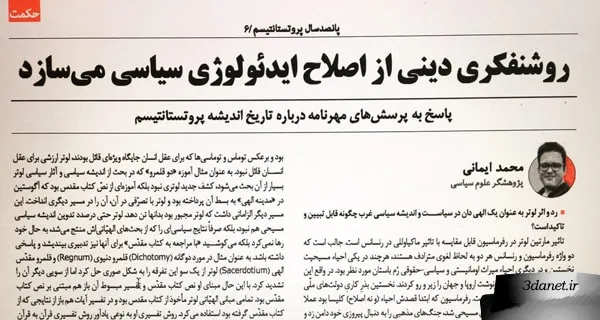
Religious intellectualism constructs a political ideology out of reform
*How can Luther's trace and impact, as a theologian, on Western politics and political thought be explained and emphasized?
Martin Luther's impact on the Reformation is comparable to Machiavelli's impact on the Renaissance. It is interesting that the two words Reformation and Renaissance are etymologically synonymous, although one referred to the revival of early Christianity and the other to the revival of the humanist and political-legal heritage of ancient Rome. In fact, these two main currents in the 1500s turned the fate of Europe and the world upside down. The Reformation planted the first effective seeds of the new nation-states in Europe. The Reformation, which initially intended the revival (and not the reform!) of the Church, practically led to the splitting of the unity of Christian Europe, fueled religious wars following its victory, and was not only the groundwork but also the theorist for the formation of absolute sovereignty, secular absolute government, and religious freedom. Two kinds of wars shaped the destiny of modern Europe, and it is interesting that these wars are not the First and Second World Wars, but rather, first, the religious civil wars, one example of which led to the Peace of Westphalia—a peace that became the basis for national sovereignty, modern territorial states, and religious freedom—and second, the French Civil War, which led to the French Revolution. There is a consensus among scholars of political thought that the French Revolution was a product of the Enlightenment in Europe, and as Reinhart Koselleck correctly explains in his book Critique and Crisis, the Enlightenment was able to take shape in Europe when secular and worldly absolute governments were able to create the vital space necessary for the development of the Enlightenment by establishing economic stability and securing freedom of thought and expression. Regardless of how far Dr. Luther, professor of theology at the University of Wittenberg, was aware of the consequences of his work, he was able to "stand somewhere" and from there utterly destroy the medieval order. This standing somewhere refers to his historic statement at the Diet of Worms, to which he had been summoned to recant the 95 Theses: "Here I stand, I can do no other, God help me, Amen!". From this perspective, as the main figure of the Reformation, he disseminated doctrines in Europe that became the cornerstone of the new world; among these doctrines one can mention "individuality," "freedom of conscience," obedience to the absolute worldly ruler, and the principle of "subjective freedom." Luther created a revolution "within" the European human being that led to great revolutions in the external world. Historians date the starting point of the Reformation to the day in 1517—exactly 500 years ago—when Luther posted his 95 Theses on the door of the Wittenberg Church, and its endpoint to the Peace of Westphalia! This dating itself shows us the importance of the Reformation and the importance of Luther.
Can one speak of Luther's political thought? In other words, does Luther primarily have specific foundations and principles in politics, or has political thought been attributed to him over the course of the historical evolution of concepts and political thought?
Without a doubt, one can speak of Luther's political thought. Works such as Address to the Christian Nobility of the German Nation (1520), On the Babylonian Captivity of the Church (1520), On the Freedom of a Christian (1520), On Secular Authority and the Limits of Obedience to It (1523), Against the Robbing and Murdering Hordes of Peasants (1525), and other treatises and writings are works in which one can study and research Luther's political thought. But this does not mean that Luther was seeking to articulate a kind of political thought or pursuing a goal to devise a new plan in political thought! Luther was a theologian; his main question was a theological one, and all his other questions were raised within the bounds of Christian theology, and it was within those same bounds that he tried to answer these questions—more precisely, if I want to put it, within the bounds of the "Holy Scripture." Luther's motto was "Hasbuna Kitab Allah" (Scripture alone is sufficient for us), and all the works he wrote were his interpretation of the Testaments, turning away from Christian tradition and returning to early Christianity. Not that he had no other source of thought; we know, for example, that Luther was strongly opposed to Aristotle, or we know that he was an Augustinian theologian, and unlike Thomas and the Thomists, who accorded a special place to human reason, Luther accorded no value to human reason.
For example, the doctrine of the “two kingdoms,” which is much discussed in treatments of Luther’s political thought and political writings, was not a new Lutheran discovery but a doctrine from the text of Holy Scripture that Augustine had elaborated in The City of God, and Luther, by adapting it, set it on a different course. This different course entailed requirements to which Luther was compelled to submit. Luther was not even seeking to formulate a Christian political thought; rather, he simply did not leave the political consequences that resulted from his theological discussions to themselves, but endeavored, “by referring to Scripture,” to devise a measure and an answer for them as well. For instance, regarding the dichotomy of the earthly realm (Regnum) and the sacred divine realm (Sacerdotium), Luther on the one hand formally resolved this division, but on the other hand intensified it; yet his basis was the text of Holy Scripture and an extensive interpretation of it, again grounded in the text of Holy Scripture. All of Luther’s theological foundations were derived from Scripture, and in interpreting the verses he again employed the conclusions he had drawn from Scripture. His interpretive method is somewhat reminiscent of Mohammad Hossein Tabatabai’s method of interpreting the Qur’an by the Qur’an. Luther himself writes in one place: Also ist die schrifft jr selbs ain aigen liecht. Das ist dann fein, wenn sich die schrifft selbs außlegt. Translation: Thus, Scripture is in itself its own light. That is then fine, when Scripture interprets itself, then it will be the measure. But all of this does not prevent the scholar of political thought from paying attention to the works of a theologian. Luther’s theological “works” left important and fateful “effects” on the political history of Europe and the history of European political thought. Of course, by these effects I do not mean merely socio-political effects. For the scholar of political thought, this sociological and simplistic formulation that the Reformation triumphed because it was bound up with the interests of princes and nobles as well as the interests of the common people, presents a caricatured picture of European history and the history of thought in Europe. Religious revival in Christianity did not begin with Luther. With the advance of research and the study of the works of Luther’s forerunners, new truths about the triumph of the Reformation have been discovered. Luther’s theological and political thought did not take shape in a vacuum but developed in connection with deep-rooted traditions in Europe, and when his thought spread, in every corner of Europe each of these intellectual traditions reacted to it. It is natural that the scholar of political thought, just as he researches within the text of Scripture in relation to his work, also examines the works of writers and theologians of all Christian denominations.
*What is the relationship between Protestantism and political modernity? Can the religious reformation in Europe serve as a model for religious intellectualism to achieve democracy and articulate human rights?
First, we must see what we mean by political modernity. Usually, five fundamental characteristics are enumerated for the 1500 rupture point: the discoveries, the advancement of the natural sciences and the transformation of human knowledge, the Renaissance as a revolution in thought and politics, the Reformation as a revolution in religious faith, and finally, the formation of the modern state. These developments over three centuries brought about the new age and the new world, until we reach the 1800 rupture point, where two great revolutions—namely the American War of Independence and the Great French Revolution—in a sense, realize political modernity. Here, following Ernst Troeltsch, a distinction must be made between two Protestantisms: one, the old Protestantism that begins with the Reformation, and the other, the new Protestantism that emerges with the end of the religious wars. In both stages, Protestantism, willingly or unwillingly, contributed to the realization of political modernity. Whether in the unintended schism it cast upon the unity of Christendom, paving the way for religious wars and ultimately the formation of the secular absolutist state and the unified nation-state in the world, or in the subsequent stage with values such as freedom of conscience, freedom of religion, industriousness, and… I prefer to use the term Reformation instead of religious reform. Firstly, because the Reformation, like the Renaissance, is a unique historical event that refers to a transformation in European history. Secondly, because in my opinion, the word reform, from the root of peace and righteousness, has no connection to the root of the word Reformation. Reformation comes from the Greek root μεταμόρφωσις, meaning a change in form, figure, or shape, and in its terminological sense here, it means the revival and rebirth of early Christianity. Of course, if we must use a Persian equivalent, just as Renaissance is rendered as rebirth, I think the term revival of religion would be correct.
اما اینکه رفرماسیون چه ربطی به روشنفکری دینی دارد برای خود من همیشه سوال بوده است. اول از هم باید دید روشنفکری دینی چیست؟ در سالهای اخیر جز یک نفر تمام کسانی که خود را روشنفکر دینی مینامیدند دیگر خود را روشنفکر دینی نمیدانند و از تعابیر جدیدی مثل روشنفکری معنوی و… استفاده میکنند. علّت آن هم این است که در یکی دو دهه اخیر بحثهای نظری ای شد که به تناقضات منطقی تعبیر روشنفکری دینی پرداخت. به نظر من آن بحثها مفید بود اما یک اشکال اساسی ای که داشت این بود که بر این پیش فرض غلط بنا شده بود که روشنفکری دینی حتما باید یک اصطلاح بامعنا و از نظر منطق درونی مستحکم باشد. به نظر من این اتفاقا اهمیتی ندارد که این جریان چه نامی بر خود مینهد، مهم شناخت واقعیت تاریخی آن است. روشنفکری دینی یک واقعیت تاریخی است. به جای اینکه بخواهیم تناقض منطقی عنوان این واقعیت را نشان دهیم، به نظر من، باید واقعیت تاریخی آن را مطالعه کنیم و نشان دهیم. یعنی به جای اینکه برویم و در کتاب لغت بگردیم که روشنفکری کجا بوجود آمد و به چه معنایی بود، و یا اینکه اسلام چه محدودیت هایی برای فکر کردن ایجاد میکند، و بعد تناقض های منطقی آن را نشان دهیم، باید برویم و ببینیم این واقعیت کجا و در چه زمانی شکل گرفت؟ چرا شکل گرفت؟ ماهیت آن چه بود؟ جریاناتِ پیشروِ آن چه جریاناتی بودند؟ چه تحولاتی را همگام با تحولات بیرونی موازی، درون خود ایجاد کرد؟ سخن گفتن از پروتستاتنیسم اسلامی که از بی معناترین سخنان سده اخیر است با آخوندزاده شروع شد که درک درستی از پروتستانتیسم نداشت. با شکل گیری بنیادگرایی دینی در خاورمیانه سیدجمال الدین اسدآبادی که میتوان او را موسس روشنفکری دینی دانست حرفهای مشابهی درباره اصلاح دینی زد اما درک او از پروتستانتیسم در اروپا درکی سطحی و اشتباه بود. بعدتر که جریان بنیادگرایی دینی در ایران پیروانی پیدا کرد و به اصطلاح در ایرانِ شیعی بومی شد، کسانی مثل علی شریعتی این بحث را دنبال کردند. از آخوندزاده تا شریعتی و سروش با گذشت بیش از ۱۵۰ سال هنوز ما حتی یک اثر از مارتین لوتر یا یک اثر کلاسیک درباره رفرماسیون یا پروتستانتیسم ترجمه نکرده ایم و بی تعارف هر چه در این ۱۵۰ سال توسط روشنفکران دینی درباره رفرماسیون و پروتستانتیسم گفته شده است چیزی جز خیال بافی و مهمل گویی نبوده است. البته برخی از نویسندگان مشابهت هایی بین رفرماسیون بویژه کالوینیسم و بنیادگرایی دینی که روشنفکری دینی یکی از میوه های وطنی آن است، قائل شده اند. برخی اسلام شناسان معتقدند اصل sola scriptura لوتر که در اسلام میتوان حسبنا کتاب الله را معادل آن دانست (رفرماسیون ۴ اصل اساسی داشت که لوتر بیان کرده بود : فقط کتاب مقدس (sola scriptura)، فقط ایمان (sola fide)، فقط بخشش (sola gratia) و فقط مسیح (solus Christus))، و یا بازگشت به صدر مسیحیت که جریانهای سَلَفیستی مثل وهابیّت، اخوان المسلمین و شاخه های تروریستی ای مثل القاعده در بازگشت به صدر اسلام نمود پیدا کرده است، مشابهت های ظاهری ای است که میتوان بین رفرماسیون در اروپای مسیحی با بنیادگرایی در خاورمیانه مشاهده کرد. روشنفکری دینی هم شاخه ای ایدئولوژیک از همین بنیادگرایی دینی است که با سیّدجمال الدّین اسدآبادی آغاز می شود و دغدغه نجات اسلام و احیاء خلافت اسلامی را دارد، اما وقتی به مطالعه تطبیقی دقیق می پردازیم متوجه میشویم این مقایسه اشکالاتی دارد. به چند مورد آن مختصر میتوان اشاره کرد. نخست تفاوت بین اسلام و مسیحیت است که توضیح مفصل و جداگانه ای می طلبد. دوم عدم توجه به دو بستر تاریخی، جغرافیایی و فکری کاملا متفاوت است و این عدم توجه ناشی از درکی خطی و ساده لوحانه از تاریخ و البته تقلید ناشیانه است. سوم اینکه بنیادگرایی دینی و روشنفکری دینی پدیده هایی مدرن هستند و انگیزه های سیاسی و جنایی شان بر انگیزه های دینی شان غلبه دارد. مارتین لوتر صرفا انگیزه دینی داشت اما بنیادگرایان و روشنفکران دینی برنامه سیاسی دارند. چهارم اینکه لوتر یک متألّه درجه یک بود اما آثار بنیادگرایان و روشنفکران دینی فاقد ارزش الهیّاتی و حتی فاقد ارزش کلامی در خور توجه است و در آن هیچ اصالت یا اجتهادی دیده نمی شود. پنجم اینکه رفرماسیون منجر به فروپاشی امّت واحده مسیح در اروپای غربی و شکل گیری ملّت های مدرن شد اما بنیادگرایی و روشنفکری دینی در خاورمیانه علیه دولت های ملّی جدیدالتّاسیس یا در مورد ایران علیه ملّتی کهن شکل گرفت و شعارش احیاء امّت اسلامی تحت لوای خلافت اسلامی است. روشنفکری دینی نیز با ملیّت و دولت ملّی مشکل دارد، اما از آنجا که ایران قرنهاست از دستگاه خلافت جدا شده، طبیعتا در ایرانِ شیعه، امکان احیاء خلافت پیشاپیش ممتنع است.
For this reason, in Shi‘i Iran we have two new heresies, one of which, a more recent one, is religious democracy or the human-rights claims of religious intellectuals. This democracy or human rights that is articulated by religious intellectuals is, in my view, an ideological ruse. When religious intellectuals are in power they are theorists of power, and as soon as they are pushed aside from power they become theorists of freedom! Religious intellectualism does not want to reform religion; rather, it wants to turn it into yet another political ideology. Once, in its pre-revolutionary version, it made a socialist guerrilla out of Abu Dharr, and another time, in its post-revolutionary version, it becomes an advocate of democracy, and by democracy it means a government in which they themselves come to power through the votes of Muslims. They have also officially declared that “the future of politics in this country lies in the hands of religious intellectualism” and that “one day of ruling over Muslims is equivalent to sixty years of worship; why would anyone turn away from such a meritorious deed?” These are the words of Abdolkarim Soroush, who imagines he is playing the role of Martin Luther in the Islamic world. The author of the pamphlet “Who Can Fight?”, which theorizes suicide, if he wishes to imitate Martin Luther, can be neither a revolutionary nor a reformist! Luther called the peasants who had rebelled against the princes murderous criminals who committed three sins, the first of which was disobedience to the princes. “Criminals who must be beaten to the point of death.” Luther calls a prince who is defeated in battle against the peasants a martyr. Religious intellectuals were the ideologues of the ’57 Revolution. Religious intellectualism turns religion into ideology. If someone intends to revive religion, they must return to traditional Islam and traditional Shi‘ism; religious intellectualism, however, like religious fundamentalism, is opposed to this traditional Islam. Above, I referred to Luther’s interpretive method regarding the Bible. Religious intellectualism wants to present an interpretation of the Qur’an that yields a result in daily political or social power or is compatible with the findings of modern science. This interpretation is an ideological interpretation. Religion needs scholars and researchers, not intellectuals; religious intellectuals ruin both religion and the world.
*What influence did the movement of Luther and the Protestants have on the nature and destiny of the history of Western political thought? Had the Reformation not occurred, what possibilities would Western thought have lost?
Figgis writes in his book Political Thought from Gerson to Grotius that had there been no Luther, there would never have been a Louis XIV. And perhaps one can add to his statement that had there been no Louis XIV, the French Revolution would not have occurred either. The Lutheran Reformation transferred faith to the heart of believers and considered it to belong to the divine realm, but in the external and corporeal world, while it regarded the worldly realm as a realm inferior to the divine realm and under God’s command, it nonetheless, with reference to the text of the Bible, considered it a realm in which the Christian believer must be obedient to kings and princes. Luther considered the translation of ἐκκλησία as “church” in the Latin translation of the Bible to be incorrect, and by referring to the original Greek of the Bible, he rendered it in German as the holy Christian community. Luther regarded the church as nothing other than the assembly of Christian believers, and by transferring the church, in the sense of the house of God, to the hearts of Christian believers, he challenged the temporal rule of the church and entrusted it to the princes. This marked the end of the Middle Ages and the temporal rule of the church. Luther unintentionally laid the groundwork, through his religious revival, that brought an end to Europe’s decline. The Reformation had fundamental effects and consequences in the history of European political thought. The political philosophies of Bodin and Hobbes are a reflection of contemplation upon the situation that had plunged Europe into a great crisis due to the religious wars. The Reformation was, of course, not a single event with a single intellectual representative. Among its intellectual representatives there were also radical and revolutionary writers such as Calvin and Müntzer. Among the important political philosophers of Europe, one can also point to Grotius, Thomasius, and Leibniz, who fit within the framework of the Reformation in the formulation of their political and legal theories. Hegel writes in his History of Philosophy that the fundamental revolution begins with the Lutheran Reformation, when the endless fragmentation of spirit attained the consciousness of reconciliation with itself. Hegel considers the Reformation to be the beginning of the modern age. But the question of what possibilities Western thought would have lost had the Reformation not occurred is a very difficult one. One must, in a sense, answer this question with counterfactual history.
To answer this question, one must consider what else might have occurred in Christianity had the Reformation not taken place. And if the situation had continued as it was in the Middle Ages, would the princes and kings have risen up against the Church's domination? Or would the Church have continued its temporal rule in competition and sometimes war with the local kings and princes of Europe? Would religious wars have occurred? And if religious wars had not occurred, would a crisis have engulfed Europe to lift it out of its millennium of decline? Would the Renaissance and the revival of republican thought and humanism have stood against the Church? All these questions can be raised, but perhaps it can be said that if the Reformation had not occurred in European history, one of the possibilities for reconciliation between religion and the world, in the manner that led to progress and the realization of modernity in Europe, might have been lost.



Discussion0 comments
No comments yet; let yours be the first voice.